Category: Books

Books

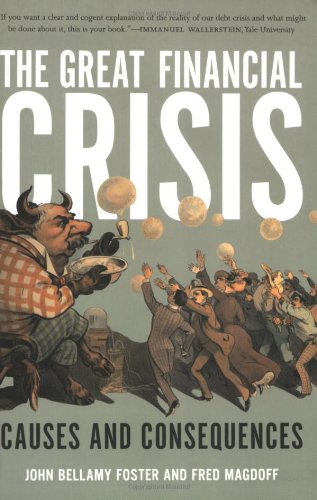
  • The Great Financial Crisis

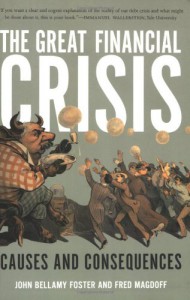
    The Great Financial Crisis

    The Great Financial CrisisThe Great Financial Crisis: Causes and Consequences,” (coauthored with Fred Magdoff, Foster listed first, New York: Monthly Review Press, 2009), 160 pp.

    Editions:

    • Indian edition (English) published by Cornerstone Books, Kharagpur, 2009.

    Translations:

    • Korean translation from Eulyoo Publishers.
    • Czech language edition published by Grimmus, Czech Republic, 2009.
    • Spanish translation, Fondo De Cultura Económico (Spain), 2009.
    • Bangla translation by Farooque Chowdhury (Dhaka: Shahitya Prakash, 2011).
    • Arabic translation by Ateyyah Kareem Al Zafiri (Afaq Educational Services Company, Kuwait City, Kuwait, 2013).
    • Selected chapters appear in Kapitalizmin Finansal Krizi (Turkish), edited by Prof. Dr. Abdullah Ersoy (Ankara, Turkey: Imaj Publishing, 2011), 330pp.

    The bursting of the housing bubble and the ensuing financial debacle have left most people, including many economists and financial experts asking: Why did this happen? If they had been reading Monthly Review, and were familiar with such articles as “The Household Debt Bubble,” “The Explosion of Debt and Speculation,” and “The Financialization of Capitalism,” they would not have needed to ask. In their new book, The Great Financial Crisis: Causes and Consequences, Monthly Review editor John Bellamy Foster and long-time Monthly Review contributor, Fred Magdoff, update this analysis, exploring the whole course of what is now known as “the worst financial crisis since the Great Depression”: from the debt explosion and housing bubble to the subprime debacle and federal bailout. They argue that this latest financial crash, although greater than any since 1929, is itself a symptom of deeper problems connected to the stagnation of the “real” or productive economy of mature capitalism. Financial bubbles have become the chief means of countering stagnation, but these inevitably burst, bringing the underlying economic problems back to the surface. The only recourse of the system: new and bigger bubbles, leading, as they too pop, to still greater financial crises and worsening conditions of production—in what has now become a vicious cycle.

    With this as their key, Foster and Magdoff are able to examine the complex interconnections associated with rising debt, weakening production and investment, stagnant wages, burgeoning unemployment, rapidly growing class inequality, spiraling global economic instability, and spreading militarism and imperialism. At the center of the story is the latest phase of capitalism, “monopoly-finance capital,” that has generated a giant casino economy and promotes enormously exorbitant, exploitative, and corrupt practices as well as violence abroad—all geared to finding and protecting profitable ways to invest the corporate capital surplus. Meanwhile, the real, pressing needs of most people in the society go unaddressed. The only genuine way out of trap, The Great Financial Crisis argues, is the promotion of those very measures—such as massively expanding socially useful public spending, improving the security of the working class, and democratizing ownership of productive property—that are invariably opposed by the current system of wealth and power. If the legendary Mother Jones was right, and we must educate ourselves for the coming struggle, then this book is today’s most essential reading.

    Reviews:

    …an insightful account of the roots of the crisis.

    —Noam Chomsky, Hopes and Prospects

    With all the charges of ‘socialist’ hurled at Barack Obama from the howling back benches, I decided it was time to find out what some real socialists are saying about the crisis of monopoly capitalism. It’s a short book long on insight.

    —Bill Moyers, on selecting the book for his booklist

    In this timely and thorough analysis of the current financial crisis, Foster and Magdoff explore its roots and the radical changes that might be undertaken in response. . . . This book makes a valuable contribution to the ongoing examination of our current debt crisis, one that deserves our full attention.

    Publishers Weekly

    Those interested in the Marxist perspective should get hold of The Great Financial Crisis. . . . It is a fascinating read.

    —Larry Elliot, economics editor, The Guardian

    Follows Marxist writers Harry Magdoff and Paul Sweezy in arguing that ‘stagnation’ is the normal state of capitalism (or what the present authors term ‘monopoly-finance capital’). To preserve ‘growth,’ finance becomes increasingly decoupled from investment in real things, but in doing so it creates bubbles, and we all know what happens when they are pricked … Foster and Magdoff did call out an imminent collapse of the US “household debt bubble” as far back as spring 2006.

    The Guardian

    I like to hope that some members of the economics profession, some journalists who routinely interpret economics for the general public, and even (could we hope?) some public officials unafraid to think what had previously been the unthinkable (namely that radical leftists have something useful to say about the U.S. economy and economic policy) will take up this book and engage with it. . . . We ignore the arguments of this book and other dissenting economists at our peril.

    —Michael Meeropol, Challenge magazine

    The challenge for the left is to articulate both the temporary nature of capitalism’s fixes and of capitalism itself in accessible terms. This book is a useful weapon for all who strive to do so.

    Morning Star

    Everyone at last knows we are in a great financial crisis. Foster and Magdoff have seen it coming for some time now. If you want a clear and cogent explanation of the reality of our debt crisis and what might be done about it, this is your book.

    —Immanuel Wallerstein, Yale University

    The Great Financial Crisis will be extremely useful for all who are trying to sort out the meaning of the most serious crisis U.S. and global capitalism has faced in eighty years. Few today are able both to make sense of the details of the modern ‘financial architecture’ that turned a predictable burst in the U.S. housing bubble into a full scale financial meltdown, and also to bring an historical perspective stemming from the work of Keynes, Hansen, Steindl, Kalecki, Minsky, Galbraith, and of course Marx, Sweezy, and Harry Magdoff. Because the authors could draw on their own excellent coverage of the lead up to the crisis in the pages of Monthly Review magazine, we have an invaluable book available to us much sooner than would otherwise be possible.

    —Robin Hahnel, Professor of Economics, American University

    Those of us who are dissatisfied with the analyses of the financial-economic meltdown of 2008 that attribute it to easily remediable ‘mistakes’ on the part of financial institutions, regulators, or policy-makers can learn a lot from John Bellamy Foster and Fred Magdoff’s The Great Financial Crisis: Causes and Consequences. Foster and Magdoff follow up the theses of Paul Sweezy, Paul Baran, and Harry Magdoff that diagnose the structural problems of U.S. capitalism in its chronic tendency toward stagnation rooted in inadequate business investment and leading to slow growth, unemployment of labor, and low utilization of capital. This book makes the case that the excesses of financialization and the widening inequality of income distribution are themselves indirect effects of stagnation in the real economy, and explains with sobering clarity why the roots of this crisis may turn out to be deep and difficult to address with conventional policy measures.

    —Duncan K Foley, Leo Model Professor of Economics

    New School for Social Research

    Much of the analysis of the latest economic meltdown has been confined to explanations about the housing bubble and bust. In The Great Financial Crisis, Foster and Magdoff take a broader approach, presenting a rigorous and sorely needed historical and forward-looking perspective of the capitalist system out of control. With intricate detail, Foster and Magdoff contextualize the housing debt and speculative bubble within its rightful place at the core of an accelerated period of the financialization of capital, eloquently arguing why a people-first, or socialistic, approach to this crisis is the most logical way to stabilize the general economy.

    —Nomi Prins, author of Other People’s Money and Jacked

    Harry Magdoff and Paul Sweezy, to whom this book is dedicated, analyzed the financial crisis as inseparable from the tendency to stagnation of monopoly capital. The present book is written in the same spirit and brings their approach fully up to date under the circumstances of ‘monopoly-finance capital.’ It underlines that, whatever might be attempted today, the necessarily recurring crisis is bound to get worse without remedying the causes of stagnation. Thus Foster and Fred Magdoff rightly stress that ‘the answer lies in a truly revolutionary reconstruction of the entire society.’ Their book is a worthy memorial to Harry Magdoff and Paul Sweezy.

    —István Mészáros, author of The Challenge and Burden of Historical Time

    and Beyond Capital

    Foster and Magdoff’s very readable account of the crisis merits close and wide attention. Their analysis of consumer debt burdens is the perfect antidote for everyone who is tired of hearing how ‘we’ went on a consumption binge, and their historically sensitive discussions of the roots of the crisis are fresh and provocative.

    —Thomas Ferguson, University of Massachusetts, Boston

    Author of The Golden Rule: The Investment Theory of Party Competition and the Logic of Money-Driven Political Systems

    John Bellamy Foster and Fred Magdoff’s book on ‘The Great Financial Crisis’ is an excellent example for the usefulness of studying Marx’s works and that of other Marxist political economists, e.g. the writings of Paul M. Sweezy and Harry Magdoff, in order to better grasp the dynamics and contradictions of the financial turmoil and its implications for social conflict. The disastrous contemporary financial crisis cannot be understood as the consequence of a ‘wrong regulation’ of the world of finance. It is an emanation of the ‘real’ accumulation process of financialized monopoly capital.

    —Elmar Altvater, Otto-Suhr-Institute of the Free University of Berlin

    Foster and Magdoff’s new book presents a sharp and stimulating analysis of the historical origins and structural roots of the current financial crisis. The authors argue that the implosion is a logical consequence of the contradictions of monopoly finance capital—contradictions that are reflected in the twin processes of financialization and stagnation that have dominated the development of the U.S. economy in the recent decades. It is an essential read if the mea culpas and post mortems of ‘the experts’ faced suddenly with ‘a fundamental flaw’ in the logic of unregulated markets have left you demanding a more penetrating account of this crisis.

    —Ramaa Vasudevan, Colorado State University

    A must read! Here is an excellent guide to understanding the role debt overload and the stagnation of real economy played in the recent crisis, in the tradition of Sweezy and Magdoff.

    —Michael Perelman, Professor of Economics, California State University at Chico

    Author of Railroading Economics, The Invention of Capitalism

    and The Confiscation of American Prosperity

    The financial crisis of 2007–08, and with more certainly in store for 2009 and beyond, is one of the great calamities of modern neoliberal capitalism. But it should come as no surprise for regular readers of John Bellamy Foster and Fred Magdoff’s writings over the past few years in Monthly Review. In a series of highly accessible and cogent articles, they have consistently explained both the build up to the crisis and its consequences. The Great Financial Crisis brings their ideas together in one place. It is compelling reading for anyone seeking to both understand and change the world we live in today.
    —Robert Pollin, Professor of Economics and Co-Director, Political Economy Research Institute (PERI), University of Massachusetts-Amherst

  • Critique of Intelligent Design

    Critique of Intelligent Design

    Buy at Monthly Review Press

    Critique of Intelligent Design: Materialism versus Creationism from Antiquity to the Present,” (co-authored with Brett Clark and Richard York, Foster listed first, New York: Monthly Review Press, 2008), 240 pp.

    Critique of Intelligent Design is a direct reply to the criticisms of intelligent design proponents and a compelling account of the long debate between materialism and religion in the West. It provides an overview of the contemporary fight concerning nature, science, history, morality, and knowledge. Separate chapters are devoted to the design debate in antiquity, the Enlightenment and natural theology, Marx, Darwin, and Freud, and to current scientific debates over evolution and design. It offers empowering tools to understand and defend critical and scientific reasoning in both the natural and social sciences and society as a whole.

    Reprints:

    • Reprint of chapter 5, “Marx’s Critique of Heaven and Critique of Earth,” Monthly Review, vol. 60, no. 5 (October 2008), pp. 22-42; Chapter 5.
    Translations:
    •  Arabic translations in Civilized Dialogue, issue 2498 (December 17, 2008), http://www.ahewar.org/ and Free Thought, March 3, 2010.
  • Marx’s Grundrisse and the Ecological Contradictions of Capitalism

    Marx’s Grundrisse and The Ecological Contradictions of Capitalism,” in Marcello Musto, ed. Karl Marx’s Grundrisse: Foundations of the Critique of Political Economy One Hundred and Fifty Years Later (New York: Palgrave Macmillan, 2008), pp. 93-106.

    In The Eighteenth Brumaire of Louis Bonaparte Marx famously wrote: ‘Men make their own history, but they do not make it just as they please; they do not make it under circumstances chosen by themselves, but under circum- stances directly encountered, given and transmitted from the past’ (Marx 1979: 103). The material circumstances or conditions that he was referring to here were the product of both natural and social history. For Marx production was a realm of expanding needs and powers. But it was subject at all times to material limits imposed by nature. It was the tragedy of capital that its narrow logic propelled it in an unrelenting assault on both these natural limits and the new social needs that it brought into being. By constantly revolutionizing production capital transformed society, but only by continually alienating natural necessity (conditions of sustainability and reproduction) and human needs.

     Translations:
    • Japanese translation by Horshi Uchida, 2012.
  • Naked Imperialism

    Naked Imperialism

    Buy at Monthly Review Press

    Naked Imperialism: The U.S. Pursuit of Global Dominance,” (New York: Monthly Review Press, 2006), 192 pp.

    (Consists of previously published articles/chapters from Monthly Review between 2000 and 2005 with a new preface by the author.)

    During the Cold War years, mainstream commentators were quick to dismiss the idea that the United States was an imperialist power. Even when U.S. interventions led to the overthrow of popular governments, as in Iran, Guatemala, or the Congo, or wholesale war, as in Vietnam, this fiction remained intact. During the 1990s and especially since September 11, 2001, however, it has crumbled. Today, the need for American empire is openly proclaimed and defended by mainstream analysts and commentators.

    Editions:

    • Indian edition (Delhi:Aakar Books, 2006).
    Translations:
    • Japanese translation by Watanabe Keiko, published by arrangement through Sakai Agency, 2009.
    • Korean translation, Renaissance Publishing Co. Korea, 2008.
    • Preface translated into Bangla in Bangla Monthly Review, no. 1 (December 2006). Translated by Indrani Nandi.
  • Pox Americana

    Pox Americana

    Buy at Monthly Review Press

    Pox Americana: Exposing the American Empire,” co-edited with Robert W. McChesney (Foster listed first) (New York: Monthly Review Press/London: Pluto Press, 2004), 192 pp.

    This volume brings together the work of leading Marxist analysts of imperialism to examine the burning question of our time—the nature and prospects of the U.S. imperial project currently being given shape by war and occupation in the Middle East.

    Notes/Reprints

    • Revised and expanded version of July-August 2003 special issue of Monthly Review with new material. (Contains an article co-authored by Foster and a preface and another article co-authored by Foster).
    • “Editors’ Preface” reprinted in Monthly Review, vol. 56, no. 4 (September 2004), pp. 1-4—under the title “The American Empire: Pax Americana or Pox Americana?”

    Translations

  • Ecological Imperialism

    “Ecological Imperialism: The Curse of Capitalism,” (coauthored with Brett Clark), In Leo Panitch and Colin Leys, ed., The Socialist Register, 2004 (London: Merlin Press, 2004), pp. 230-46.

    Translations:
    • Catalan translation in Corrent Roig, June 6, 2010, http://www.correntroig.org.
    • Spanish translation in El Nuevo Desafío Imperial: Socialist Register 2004 (Clasco, February 2005).
    • Portugese translation in O Novo Desafio Imperial: Socialist Register 2004 (Sao Paolo, Brazil: Clasco, 2006).
  • Imperialism Without Colonies

    Imperialism Without Colonies

    “Introduction” to Harry Magdoff, Imperialism Without Colonies (New York: Monthly Review Press, 2003), pp. 9-19

    In the decades after 1945, as colonial possessions became independent states, it was widely-believed that imperialism as a historical phenomenon was coming to an end. The six essays collected in this volume demonstrate that a new form of imperialism was, in fact, taking shape—an imperialism defined not by colonial rule but by the global capitalist market. From the outset, the dominant power in this imperialism without colonies was the United States.

    Magdoff’s essays explain how this imperialism works, why it generates ever greater inequality, repression, and militarism, and the essential role it plays in the development of U.S. capitalism.

    His concluding essay presciently points out the limits of any attempted reform of the global economy which does not directly challenge the framework of capitalism.

    Written in the 1960s and 70s, Magdoff’s essays constituted a major contribution to Marxist theory and provided a model of rigorous argument in which theory is constantly checked against the economic reality. They provide an indispensable guide to the basic forces at work in the global politics of the twenty-first century.

    • Published also in Monthly Review, vol. 55, no. 1 (May 2003) under the title “Imperial America and War,” pp. 1-10.
    Translations:
    • Chinese translation in Chinese Academic Social Science Press, 2012.
  • Ecology Against Capitalism

    Ecology Against Capitalism

    Buy at Monthly Review Press

    Ecology Against Capitalism,” (New York: Monthly Review Press 2002), 176 pp.

    (Consists of previously published articles/chapters on ecology and capitalism written between 1992 and 2002.)

    Within these debates on the politics of ecology, Foster’s work develops an important and distinctive perspective. Where many of these debates assume a basic divergence of “red” and “green” issues, and are concerned with the exact terms of a trade-off between them, Foster argues that Marxism — properly understood — already provides the framework within which ecological questions are best approached. This perspective is advanced here in accessible and concrete form, taking account of the major positions in contemporary ecological debate.

    Foster’s introduction sets out the unifying themes of these essays to present a consolidated approach to a rapidly-expanding field of debate which is of critical importance in our time.

    Editions:

    • Indian edition (Kharagpur, India: Cornerstone Publications, 2003).
    • Korean edition by Chaekalpi Publishers, 2007 (contains new preface to Korean edition by author).
    • Bangla edition, (Dhaka, Bangladesh: Shrabon Prokoshani, 2008).
    Translations:
    • Portuguese translation forthcoming from Expressao Popular, 2015.
    • German translation, Hamburg: Laika-Verlag, 2013.
    • Chinese translation by Geng Jianxin and Song Xingwu, (Shanghai: Shanghai Translation Publishing House, 2006).
    • Greek translation, Metaixmio Editions.
  • Hungry for Profit

    Hungry for Profit

    Buy at Monthly Review Press

    Hungry for Profit: The Agribusiness Threat to Food Farmers and the Environment,” (co-edited with Fred Magdoff and Fred Buttel (Foster listed second) (NewYork: Monthly Review Press, 2000). Revised and expanded version of July-August 1998 issue of Monthly Review. (Contains two essays co-authored by Foster.)

    The agribusiness/food sector is the second most profitable industry in the United States — following pharmaceuticals — with annual sales over $400 billion. Contributing to its profitability are the breathtaking strides in biotechnology coupled with the growing concentration of ownership and control by food’s largest corporations. Everything, from decisions on which foods are produced, to how they are processed, distributed, and marketed is, remarkably, dictated by a select few giants wielding enormous power. More and more farmers are forced to adopt new technologies and strategies with consequences potentially harmful to the environment, our health, and the quality of our lives. The role played by trade institutions like the World Trade Organization, serves only to make matters worse.

    Through it all, the paradox of capitalist agriculture persists: ever-greater numbers remain hungry and malnourished despite an increase in world food supplies and the perpetuation of food overproduction.


    Editions:

    • Japanese edition, (Tokyo, Otsuki Shoten, 2004).


  • Marx’s Ecology

    Marx’s Ecology

    Buy at Monthly Review Press

    Marx’s Ecology: Materialism and Nature,” (New York: Monthly Review Press, 2000), 310 pp.

    Marx, it is often assumed, cared only about industrial growth and the development of economic forces. John Bellamy Foster examines Marx’s neglected writings on capitalist agriculture and soil ecology, philosophical naturalism, and evolutionary theory. He shows that Marx, known as a powerful critic of capitalist society, was also deeply concerned with the changing human relationship to nature.

    Marx’s Ecology covers many other thinkers, including Epicurus, Charles Darwin, Thomas Malthus, Ludwig Feuerbach, P. J. Proudhon, and William Paley.

    By reconstructing a materialist conception of nature and society, Marx’s Ecology challenges the spiritualism prevalent in the modern Green movement, pointing toward a method that offers more lasting and sustainable solutions to the ecological crisis.

     Awards:
    • Winner of the Best book award granted the Marxist Sociological Section, American Sociological Association, 2000

    Editions:

    • Portuguese language edition, (Rio de Janeiro: Civilização Brasileira, 2005).
    • Korean language edition (Seoul: In-Gan-Sa-Rang Publishing Company, 2007).
    • Japanese language edition, (Tokyo: Kobushi Forum/Sakai Agency, 2004), translated by Keiko Watanabe.
    • Persian edition, containing a new “Preface to the Persian Language Edition,” (Tehran Digar Publishing House, 2004)—translator Akbar Masoumbeigi.
    • Turkish language edition, (Ankara: EPOS, 2001)–contains new “Preface to the Turkish Edition” by the author.
    • Indian edition, (KharagpurI, India:Cornerstone Books, 2001).
    • Chinese language edition (Beijing: High Education Press, 2006).
    • Finnish language edition, Publishing Company TA, 2001.
    • Spanish language edition, Ediciones de Intervencion Cultural/El Viejo Topo, 2004.
    • Indonesian language edition, translated by Pius Ginting (Jakarta: Wahana Lingkungan Hidup Indonesia, 2013).
    Translations:
    • Russsin-language translation by Yrii Trofimenko in process.
    • German-language translation (Hamburg: Laika Verlag, 2012), translators Alp Kayserilioglu and Max Zirngast.