Category: Books

Books

  • Introduction: “French Theory in the Intellectual Cold War,” in Aymeric Monville and Gabriel Rockhill, Requiem for French Theory: Transatlantic Funeral Dirge in a Marxist Key

    Introduction: “French Theory in the Intellectual Cold War,” in Aymeric Monville and Gabriel Rockhill, Requiem for French Theory: Transatlantic Funeral Dirge in a Marxist Key

    Introduction: “French Theory in the Intellectual Cold War,” in Aymeric Monville and Gabriel Rockhill, Requiem for French Theory: Transatlantic Funeral Dirge in a Marxist Key (New York: Monthly Review Press, 2026), 9-26.

                [Reprinted in Monthly Review, vol. 77, no. 10 (March 2026), pp. 1-14.]

    Requiem for French Theory

    French Theory is due for an insider critique, and in Requiem for French Theory, Aymeric Monville and Gabriel Rockhill do just that. Drawing upon decades of studying French philosophy in Paris, they build upon the best Marxist criticisms of postmodernism, while further developing them by situating postmodern theory within the global political economy of knowledge and U.S. driven intellectual imperialism. The result is a broad dialogue on topics ranging from international class struggle and the dissemination of ideology, to fascism, identity politics, dialectics, actually existing socialism, and among others.

    Requiem for French Theory soundly criticizes this tradition’s chameleonic ideological permutations under new names, such as postcolonial thought, decolonial theory, new materialism, and other trendsetting discourses. But it also reveals how these theoretical developments are all part of a broader anticommunist cultural front. Most importantly, Monville and Rockhill develop the positive project of anti-imperialist Marxism as the ultimate antidote to French theoretical sophistry. Far from indulging in the political defeatism characteristic of the Western Marxist critiques of postmodernism, this intellectual exchange issues a clarion call for revitalizing revolutionary theory and putting it into practice.

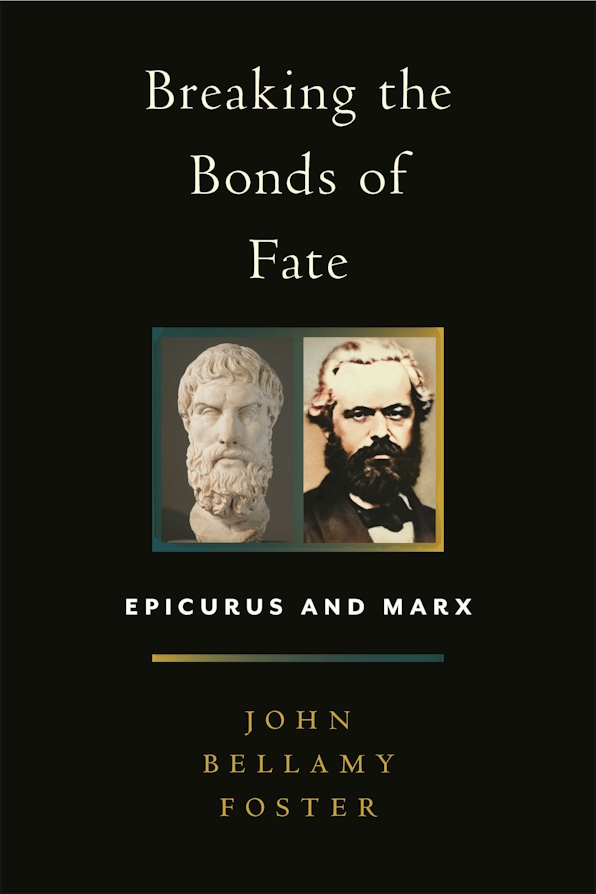
  • Breaking the Bonds of Fate: Epicurus and Marx

    Breaking the Bonds of Fate: Epicurus and Marx

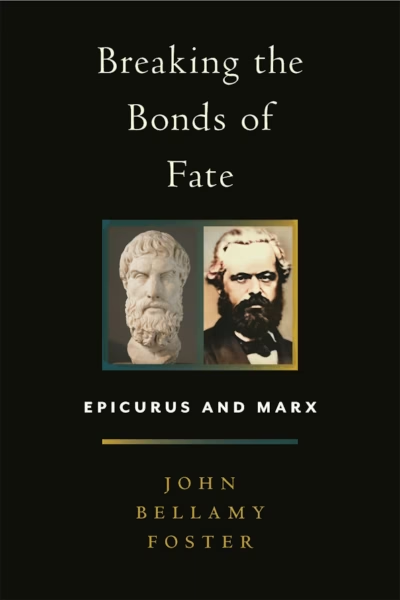
    Breaking the Bonds of Fate

    Breaking the Bonds of Fate: Epicurus and Marx (New York: Monthly Review Press, 2025), 328 pp.

    The immanent dialectic of the ancient Greek materialist philosopher, Epicurus (341-270 BCE), helped inspire the nineteenth-century ideas of Karl Marx, forming the subject of his doctoral dissertation. Marx’s detailed study of Epicurus led him to develop his own materialist dialectic in distinction to the idealist philosophy of G. W.F. Hegel. Until now, however, there has been no full scholarly treatment of the relation of Epicurus to Marx, paying equal attention to both thinkers and examining the long-term impact of Epicureanism on Marxist thought.

    Breaking the Bonds of Fate: Epicurus and Marx fills this gap. Taking into consideration today’s revolution in the understanding of Epicurus—resulting from the recovery of fragments of his major work On Nature in the carbonized papyri that survived the burying in volcanic ash of the Roman town Herculaneum when Mt. Vesuvius erupted in 79 CE—it demonstrates that this new interpretation corresponds closely to Marx’s nineteenth-century treatment of Epicurus. The result is to fundamentally transform our contemporary understanding of both Epicurus and Marx.

    The last (though logically the first) book to be written in a trilogy that also includes John Bellamy Foster’s Marx’s Ecology: Materialism and Nature (2000) and his The Return of Nature: Socialism and Ecology (2020), Breaking the Bonds of Fate: Epicurus and Marx provides a detailed historical and textual analysis grounding the argument of all three works. Not only does this clarify Marx’s relation to materialism and ecology, but also his analysis of freedom and necessity. Both Epicurus’ philosophy and that of Marx are given new meaning in our time, highlighting questions of substantive equality, dialectical naturalism, and sustainable community.

  • “Introduction” to Arghiri Emmanuel, “Unequal Echange: A Study of the Imperialism of Trade”

    “Introduction” to Arghiri Emmanuel, “Unequal Echange: A Study of the Imperialism of Trade”

    “Introduction” (coauthored with Brett Clark) to Arghiri Emmanuel, Unequal Echange: A Study of the Imperialism of Trade (New York: Monthly Review Press, 2025, updated edition), pp. XXXIII—LXII.

    Unequal Exchange

    How one nation can grow rich at the expense of another is one of the central problems of economics in the era of neo-colonialism. Traditional doctrine, resting on Ricardo’s theory of comparative costs, which has dominated investigation of this issue for a century and a half, has proven itself incapable of providing an answer. Emmanuel’s path-breaking study, now itself a classic, upends the conventional assumptions, subjecting the phenomena of international trade to critical scrutiny, both systematically and with logical rigor. It integrates the theory of international value (and unequal exchange) into the general theory of value as propounded by the classical economists and Marx.

    Enmanuel’s theory of unequal exchange generated a widespread world debate on its first appearance, part of which, emanating from French economist Charles Bettelheim, is included in this volume. It has remained the foundation of critical analysis of international exchange relations ever since, and has gained even more importance today in the age of global value chains.

  • “The Physics of Capitalism” (Book Launch)

    “The Physics of Capitalism” (Book Launch)

    The Physics of Capitalism” (Book Launch), with Erald Kolasi, John Bellamy Foster, and Blair Fix, Monthly Review, March 9, 2025, https://www.youtube.com/watch?v=47p5zcJ8yqw

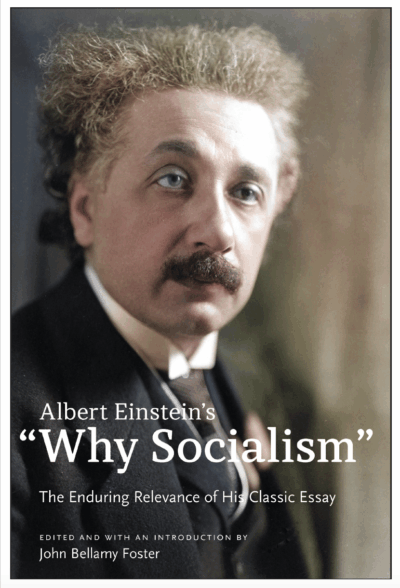
  • Albert Einstein’s “Why Socialism?”: The Enduring Legacy of His Classic Essay

    Albert Einstein’s “Why Socialism?”: The Enduring Legacy of His Classic Essay

    Albert Einstein’s “Why Socialism?”: The Enduring Legacy of His Classic Essay

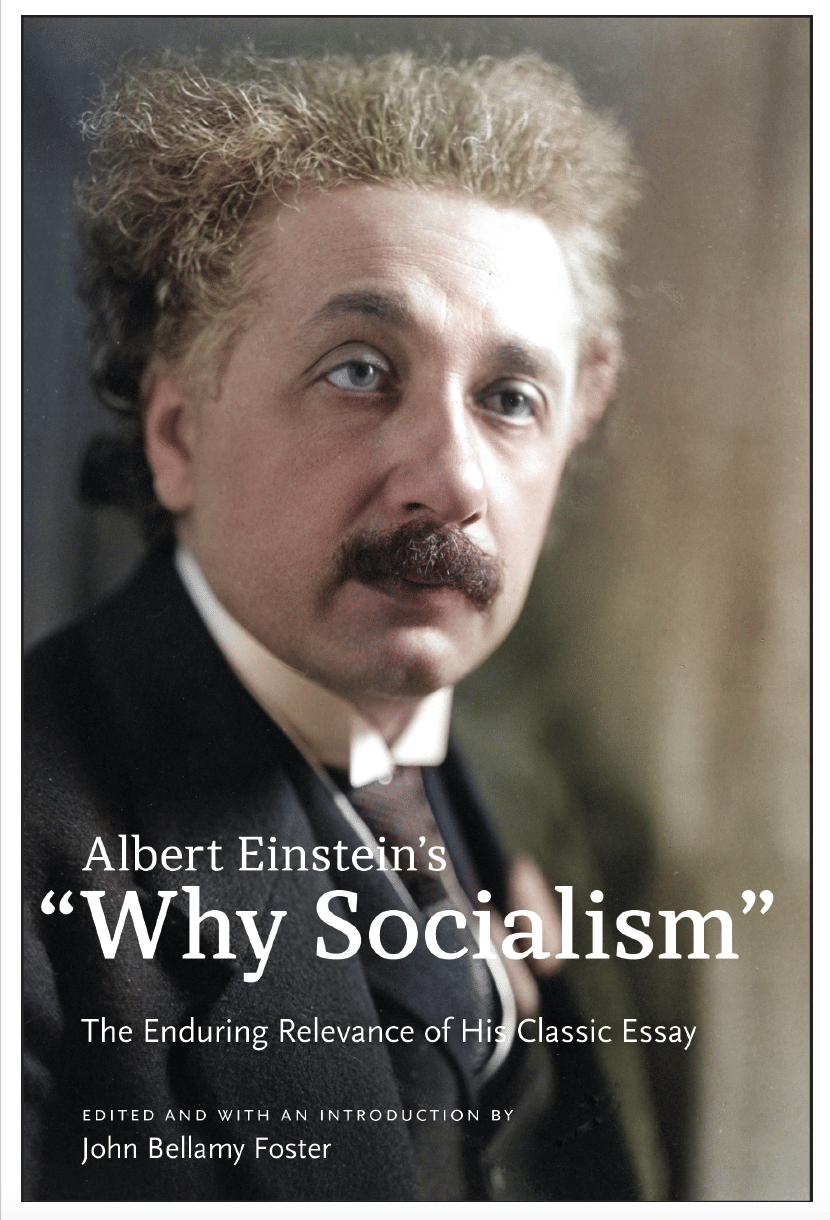
    Albert Einstein’s “Why Socialism”: The Enduring Relevance of His Classic Essay, edited and introduced by John Bellamy Foster (New York: Monthly Review Press, 2025).

    First published more than seventy-five years ago in the inaugural issue of Monthly Review: An Independent Socialism Magazine, Albert Einstein’s “Why Socialism?” is an unheralded classic. Written during the McCarthyite witch-hunt in the United States, it constituted an act of defiance, making a case for socialism unrivaled in its time or ours. Yet, its very existence has been an embarrassment to an establishment which has continually sought to downplay the significance of his iconoclastic essay, together with Einstein’s socialism itself.

    This slim, elegant volume includes Einstein’s essay along with a detailed commentary on his essay by Monthly Review editor, John Bellamy Foster. Foster’s introduction tells the story of Einstein’s life-long commitment to socialism and the events leading to the publication of “Why Socialism?” and contextualizes the importance of his essay as we enter a time of planetary crisis and new threats of world war. Over the three-quarters of century since its publication, “Why Socialism?” is one of those rare statements whose power has only grown, reaching untold numbers of readers over the years. It is of crucial importance that—for the sake of the future of humanity—Einstein’s message continues to proliferate.

    Albert Einstein was the world-famous theoretical physicist.

    John Bellamy Foster is editor of Monthly Review.

  • The Dialectics of Ecology: Socialism and the Defense of Nature

    The Dialectics of Ecology: Socialism and the Defense of Nature

    The Dialectics of Ecology: Socialism and the Defense of Nature (New York: Monthly Review Press, 2023), 360 pp.

    The Dialectics of EcologyToday the fate of the earth as a home for humanity is in question—and yet, contends John Bellamy Foster, the reunification of humanity and the earth remains possible if we are prepared to make revolutionary changes. As with his prior books, The Dialectics of Ecology is grounded in the contention that we are now faced with a concrete choice between ecological socialism and capitalist exterminism, and rooted in insights drawn from the classical historical materialist tradition. In this latest work, Foster explores the complex theoretical debates that have arisen historically with respect to the dialectics of nature and society. He then goes on to examine the current contradictions associated with the confrontation between capitalist extractivism and the financialization of nature, on the one hand, and the radical challenges to these represented by emergent visions of ecological civilization and planned degrowth, on the other.
    The product of contemporary ecosocialist debates, The Dialectics of Ecology builds on earlier works by Foster, including Marx’s Ecology (2000) and The Return of Nature (2020), aimed at the development of a dialectical naturalism and the formation of a path to sustainable human development.

  • “The Return of the Dialectics of Nature” (video lecture)

    “The Return of the Dialectics of Nature” (video lecture), Isaac and Tamara Deutscher Prize, Historical Materialism Coference, London, November 12, 2021, 70 minutes.

    This is a prerecording of the 2020 Deutscher Prize Lecture by John Bellamy Foster. The title of the lecture is: “The Return of the Dialectics of Nature: Marxian Ecology and the Struggle for Freedom as Necessity.” In addition to this lecture a remote panel discussion was held on November 12, 2021. You can watch the panel discussion here.


  • Capitalism in the Anthropocene: Ecological Ruin or Ecological Revolution

    Capitalism in the Anthropocene: Ecological Ruin or Ecological Revolution

    Capitalism in the Anthropocene: Ecological Ruin or Ecological RevolutionCapitalism in the Anthropocene: Ecological Ruin or Ecological Revolution (New York: Monthly Review Press, forthcoming 2022), 693 pp.

    Over the last 11,700 years, during which human civilization developed, the earth has existed within what geologists refer to as the Holocene Epoch. Now science is telling us that the Holocene Epoch in the geological time scale ended, replaced by the onset of a new, more dangerous Anthropocene Epoch, which began around 1950. The Anthropocene Epoch is characterized by an “anthropogenic rift” in the biological cycles of the Earth System, marking a changed reality in which human activities are now the main geological force impacting the earth as a whole, generating at the same time an existential crisis for the world’s population.

    What caused this massive shift in the history of the earth? In this comprehensive study, John Bellamy Foster tells us that a globalized system of capital accumulation has induced humanity to foul its own nest. The result is a planetary emergency that threatens all present and future generations, throwing into question the continuation of civilization and ultimately the very survival of humanity itself. Only by addressing the social aspects of the current planetary emergency, exploring the theoretical, historical, and practical dimensions of the capitalism’s alteration of the planetary environment, is it possible to develop the ecological and social resources for a new journey of hope.

    What people are saying about Capitalism in the Anthropocene

    John Bellamy Foster has returned Socialism to a serious and sincere engagement with nature. He is as adept at navigating the latest scientific literature as he is comfortable with the immense body of Marxist theory. JBF is a key reference for the elaboration of our political struggles and for the expansion of our political imagination.

    Vijay Prashad, Director, Tricontinental: Institute for Social Research

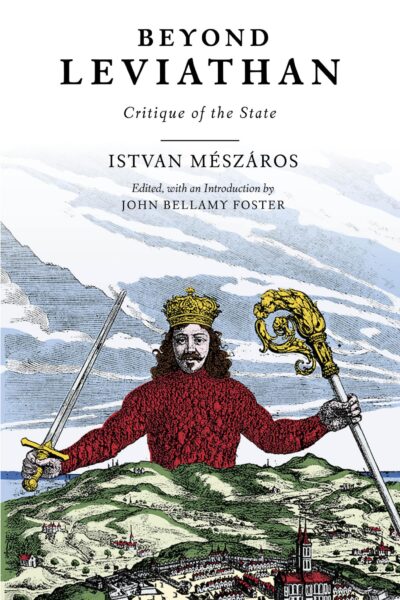
  • Beyond Leviathan: Critique of the State

    Beyond Leviathan: Critique of the State

    Beyond Leviathan: Critique of the State

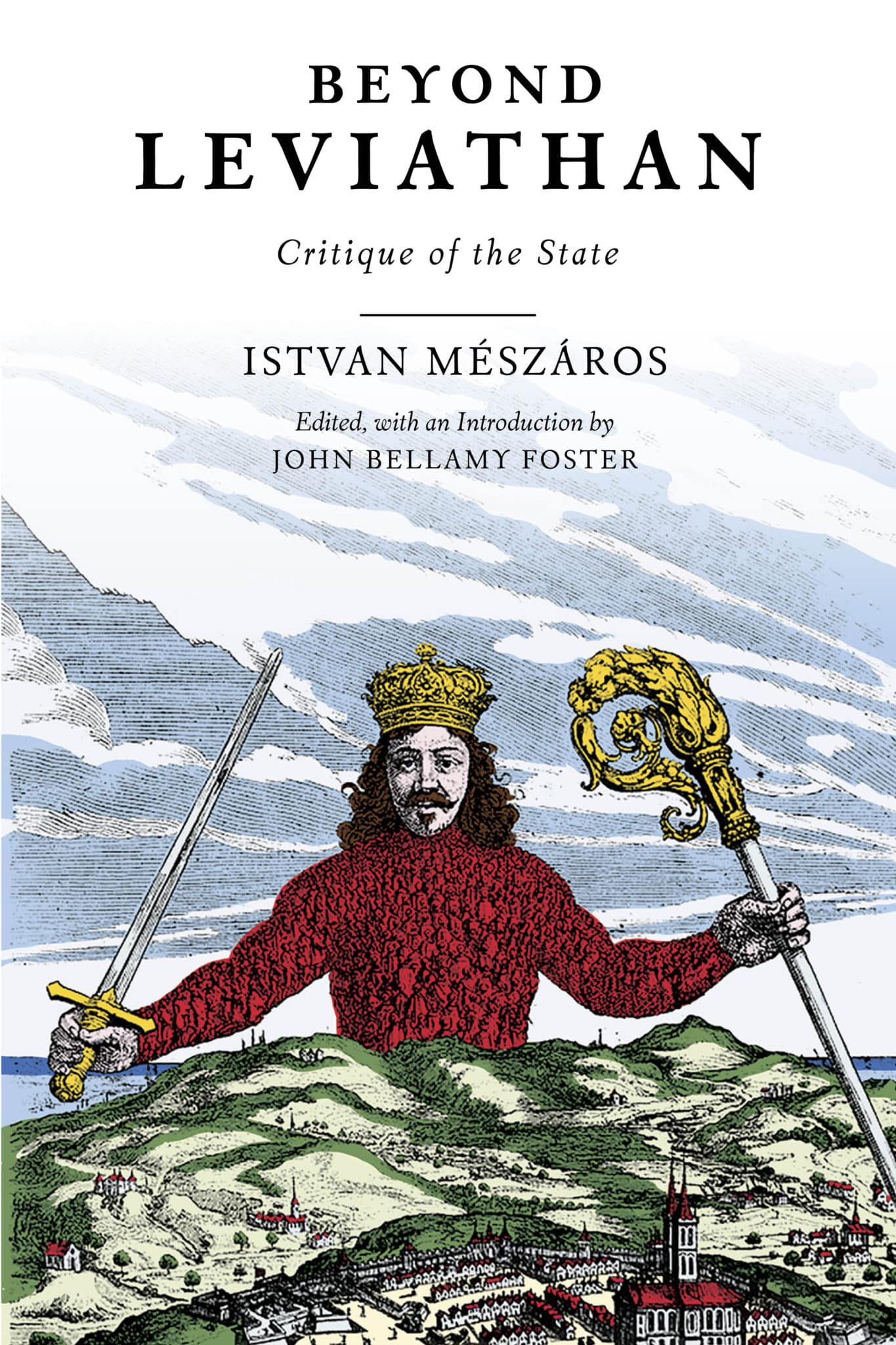
    István Mézáros Beyond Leviathan: Critique of the State, edited and introduced by John Bellamy Foster (forthcoming, New York: Monthly Review Press, 2022), 512 pp.

    István Mészáros was one of the greatest political theorists of the twentieth century. Left unfinished at the time of his death, Beyond Leviathan is written on the magisterial scale of his previous book, Beyond Capital, and meant to complement that work. It focuses on the transcendence of the state, along with the transcendence of capital and alienated labor, while traversing the history of political theory from Plato to the present. Aristotle, More, Machiavelli, and Vico are only a few of the thinkers discussed in depth.

    The larger objective of this work is no less than to develop a full-fledged critique of the state, in the Marxian tradition, and set against the critique of capital. Not only does it provide, for the first time, an-all-embracing Marxian theory of the state, it gives new political meaning to the notion of “the withering away of the state.” In his definitive, final work, Mészáros seeks to illuminate the political preconditions for a society of substantive equality and substantive democracy.

    In his scholarly and personal introduction, John Bellamy Foster traces the gestation of this masterwork and its place in the history of political theory.


    “The pathfinder of socialism.”
    Hugo Chávez, former Venezuelan President and a leader of the Bolivarian revolution


    “Posthumously edited by Professor John Bellamy Foster, “Beyond Leviathan: Critique of the State” by Istvan Meszaros is a seminal work that will be an enduringly appreciated and valued addition to college and university library Political Economy and Religious Philosophy collections in general, and Communism/Marxism political science studies lists in particular.”
    Midwest Book Review