[Reprinted in Monthly Review, vol. 77, no. 10 (March 2026), pp. 1-14.]
French Theory is due for an insider critique, and in Requiem for French Theory, Aymeric Monville and Gabriel Rockhill do just that. Drawing upon decades of studying French philosophy in Paris, they build upon the best Marxist criticisms of postmodernism, while further developing them by situating postmodern theory within the global political economy of knowledge and U.S. driven intellectual imperialism. The result is a broad dialogue on topics ranging from international class struggle and the dissemination of ideology, to fascism, identity politics, dialectics, actually existing socialism, and among others.
Requiem for French Theory soundly criticizes this tradition’s chameleonic ideological permutations under new names, such as postcolonial thought, decolonial theory, new materialism, and other trendsetting discourses. But it also reveals how these theoretical developments are all part of a broader anticommunist cultural front. Most importantly, Monville and Rockhill develop the positive project of anti-imperialist Marxism as the ultimate antidote to French theoretical sophistry. Far from indulging in the political defeatism characteristic of the Western Marxist critiques of postmodernism, this intellectual exchange issues a clarion call for revitalizing revolutionary theory and putting it into practice.
Speaking before at the Opening Ceremony of the Fourth World Conference on Marxism in Beijing, John Bellamy Foster discusses the development of eco-Marxism and its relation to Marxist theory. Here, Foster argues, “eco-Marxism as we know it today is not simply another branch of Marxism,” but is a pathway to the projects of complete socialism and ecological civilization.
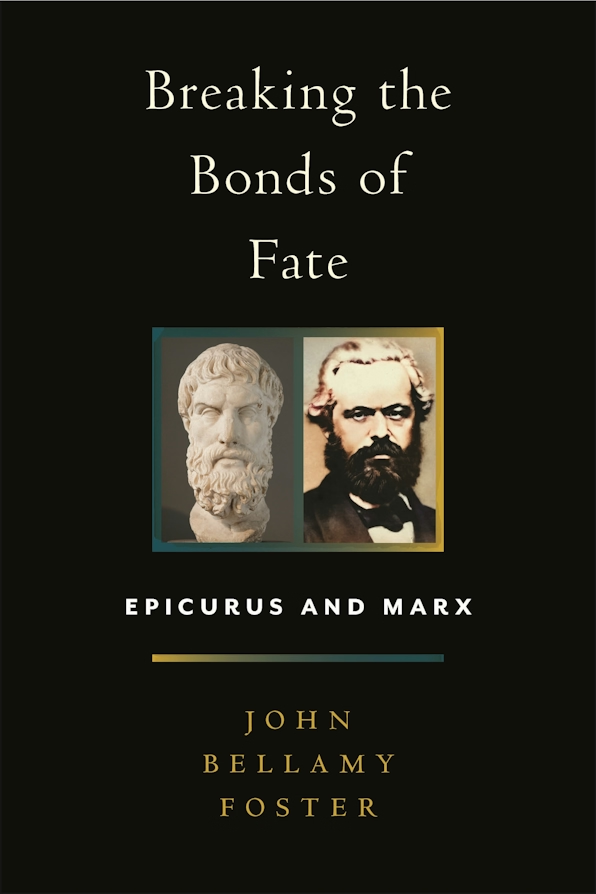
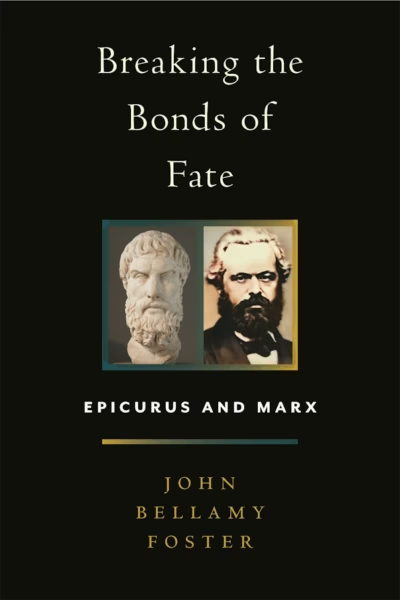
In his doctoral thesis on the ancient philosopher Epicurus, Karl Marx compared Epicurus to Prometheus, the Titan of Greek mythology, who was bound with unbreakable adamantine chains to a rock for what was intended to be eternity by Hephaestus on the orders of Zeus. Prometheus’s crime was that he had provided fire, standing for universal enlightenment (the name Prometheus means “foresight”) and creative, emancipatory powers to humanity.1 The symbolism was important. Marx quoted Epicurus (via Lucretius) several times in his dissertation on “breaking the bonds of fate,” arguing that a materialist perspective was not necessarily rigidly deterministic or fatalistic, but rather was compatible with notions of human freedom, which would always break free or swerve away from any imposed limits.2 For Marx, no adamantine fetters stood in the way of the progress of freedom. As the 20-year-old revolutionary Frederick Engels wrote in “Retrograde Signs of Our Times,” all reactionary movements “eventually disintegrate in conflict with one another and under the adamantine foot of the forward moving time,” which inevitably creates new conditions and new revolts.3 In Aeschylus’s great dramatic trilogy, Prometheus Bound was succeeded by Prometheus Unbound, and then Prometheus the Firebearer, standing for the great gift of freedom to humanity. Marx, who read Aeschylus every year in the original Greek, never lost sight of the revolutionary implications of the Greek myth.4
The post-Second World War Western Marxist philosophical tradition departed from the revolutionary spirit of classical historical materialism, in effect accepting the notion of adamantine chains imposed by capitalism on the working class, while abandoning the notion of “breaking the bonds of fate.” The ancient Greek Promethean myth, as presented by Aeschylus, was inverted, becoming a symbol not of enlightenment, hope, defiance, and revolution, but of the adamantine fetters imposed by modern capitalism, which could not be surmounted. For Herbert Marcuse in his Eros and Civilization, Prometheus stood for toil, order, and imprisonment. This was not the Prometheus of Aeschylus, representing defiance and revolt on behalf of humanity, but the Cold War version of the Prometheus myth armed against Marxism.5 Western Marxism thus surrendered to defeatism and adopted its own version of the end of history, as in the abstract negativity of Marcuse’s Great Refusal, replacing revolutionary praxis.6 None other than Perry Anderson wrote in Considerations on Western Marxism in 1976, “The hidden hallmark of Western Marxism as a whole is…that it is a product of defeat. The failure of the socialist revolution to spread outside Russia…is the common background to the entire theoretical tradition of this period…. This unbroken record of political defeat—for working-class struggle, for socialism—could not but have profound effects on the nature of Marxism formed in this era.”7 Here Anderson ignored revolutions in the periphery, such as those of China and Cuba, as of no significance in this regard, since occurring outside a developed occidental capitalism.
The Dialectic of Defeat
At the root of the retrogression of Western Marxism was a belief in the complete economic triumph of capitalism. As Marcuse wrote in One-Dimensional Man, “The enchained possibilities of advanced industrial societies are: development of the productive forces on an enlarged scale, extension of the conquest of nature, growing satisfaction of needs for a growing number of people, creation of new needs and possibilities. But these possibilities are gradually being realized through means and institutions which cancel their liberating potential, and this process affects not only the means but the ends.”8 The result of such a Western Marxist conception was the writing off altogether of proletarian-based revolutions, which were undermined by capitalism’s “enchained possibilities.”
The various material successes that Marx pointed to in his panegyric to the bourgeoisie in the first half of Part One of The Communist Manifesto were seen by Marcuse as freed of the contradictions that Marx introduced a few pages later: economic crises; the sorcerer’s apprentice, standing for the unforeseen rifts between society and nature; and the rise of capital’s gravedigger in the form of the modern proletariat. Capitalism was thus presented as victorious in a material sense. “On theoretical as well as empirical grounds, the dialectical concept,” Marcuse stated,
pronounces its own hopelessness. The human reality is its history, and, in it, contradictions do not explode by themselves. The conflict between streamlined, rewarding domination on the one hand, and its achievements that make for self-determination and pacification [of the struggle for human existence] on the other, may become blatant beyond any hope of denial, but it may well continue to be a manageable and even productive conflict, for with the growth in the technological conquest of nature grows the conquest of man by man.
Summing up, he wrote, “dialectical theory is not refuted, but it cannot offer the remedy. It cannot be positive.”9
The view that saw a Weberian “iron age” imposed by capitalism based on its economic and technological successes became the default position of the Frankfurt School and the Western Marxist philosophical tradition as a whole. Writing during the first quarter-century after the Second World War in what is today called “the golden age,” Western Marxists adopted the view that not only was the capitalist economy an overriding success, but the proletariat had been enriched and permanently “bourgeoisified,” enchained in its subservient role by the petty rewards obtained in the process of capitalism’s successful development. This was evident in the work of Theodor Adorno, who argued in 1964 that, contrary to the Marx and Engels of The Communist Manifesto, workers now had much “more to lose” than simply their chains. He referred here to their “cars and motorcycles.”10 What Adorno meant by this, from the standpoint of his negative dialectics, was that these commodities, symbolizing the embourgeoisement of the proletariat, represented new sociopsychological chains of oppression. Marx’s absolute general law of accumulation, in which he had emphasized that the relative gap between the capitalist class and the working class constantly increased, creating ever-greater class polarization, whether the workers’ wages were “high or low,” was trivialized by Adorno, in line with Cold War ideology, as a mere “theory of immiseration.”11
Following in the footsteps of Engels and V. I. Lenin in this respect, Adorno insisted that Western workers were now to a considerable degree bourgeoisified. However, Adorno did not follow Engels and Lenin in analyzing such embourgeoisement in terms of the labor aristocracy theory, whereby a privileged section of workers benefited from the surplus of monopoly capitalism/imperialism.12 Nor did he subscribe to the notion, emphasized by Engels, in relation to Britain, that the existence of a labor aristocracy and the embourgeoisement of a significant section of the proletariat was fleeting, eventually to be undermined by the waning of colonial/imperial dominance. Rather, Adorno’s Eurocentric analysis left no room for the critique of imperialism, or even a developed analysis of monopoly capitalism. As the German critic Hans Mayer, who had known Adorno since 1934, remarked: “Europe sufficed for him entirely. No India or China, no Third World, not the people’s democracies and not the workers’ movement.”13
What is at issue here can be clarified by saying that the main thrust of the philosophical tradition of Western Marxism is characterized by four retreats: (1) from class, (2) from materialism, (3) from the dialectics of nature, and (4) from the critique of imperialism. Behind this is not a denial of Marxist theory altogether, but rather its enclosure in a permanent bourgeois universe, which could be critically analyzed for its lack of true liberation but not transcended.14
The retreat from class was built into the notion that in its golden-age capitalism was lessening class distinctions and removing any radicalism on the part of an affluent bourgeoisified working class with their cars and motorcycles.15The retreat from materialism was both an abandonment of genuine economic critique and, more importantly, of the materialist conception of nature, the dialectical counterpart of the materialist conception of history. The retreat from the dialectics of nature meant that the human relation to external nature could be reduced to a technological conquest of nature (what Max Horkheimer and Adorno dubbed the “dialectic of Enlightenment”).16The retreat from critique of imperialism meant that Europe was the final destiny and the definition of modernity. As Georg Wilhelm Friedrich Hegel had written: “the History of the World travels from East to the West, for Europe is absolutely the end of History.”17
Western Marxism was a retreat from Marx, not so much to Hegel, but rather to Max Weber, who rejected the Marxian theory of class and class struggle (in favor of the mere competition for life chances on the market); replaced historical materialism with neo-Kantian idealism, dualism, and methodological individualism; and conceived of the West as the only source of cultural phenomena of “universal significance and value” based on formal or instrumental rationality. Hence, the world was an “iron cage,” from which there was no escape.18 In its long, convoluted dialectical inversion, Western Marxism went from the left-Hegelian notion that “the rational is real” not to its opposite, the right-Hegelian notion that “the real is rational,” but rather steering toward the pseudo-critical, pseudo-Freudian position that the irrational is real, ruled by the “death instinct,” with the world permanently stripped by capitalism of any genuine materialist-revolutionary content.19 It thus increasingly converged with the anti-rationalist reaction of Friedrich Nietzsche. This is what Russell Jacoby called, in the title of his book, the Dialectic of Defeat.20 The dialectic of defeat of Western Marxism was not of course the dialectic of a spiral, embodying the negation of the negation, but what Adorno termed “negative dialectics,” denying a positive moment altogether, and thus caught up in an endless circling back to bourgeois views.21
Where Western Marxism thrived was in its analysis of the subjective, particularly in the application of psychoanalytic categories drawn from Sigmund Freud, and the critique of reification. There were detailed analyses of the culture industry and media domination. Yet, this gave rise not to analysis of the vicissitudes of class consciousness but rather to the reified, enchained world of class unconsciousness, turning Georg Lukács’s Historyand Class Consciousness on its head.22 The problem, as Marcuse put it in Weberian terms, is that the “administered individuals” of modern one-dimensional society must “liberate themselves from themselves as well as from their masters.”23 The almost exclusive focus thus became the self-destruction of the human material for change. So great was the problem as conceived in critical theory that Marcuse, as we have seen, asked whether the critical theory of society must abdicate altogether, “the dialectic having pronounced its hopelessness.” He concluded his book by highlighting the bare possibility that “the historical extremes may meet again: the most advanced consciousness of humanity and its most exploited force. It is nothing but a chance.”24
The Longer and Wider View
Raymond Williams strongly warned against “long-run adjustments to short-run problems,” the tendency to see the condition of the immediate moment as determining the long-run trajectory.25 Rather, as Paul A. Baran insisted, it was necessary to take “the longer view” directly into account in all of one’s immediate actions, in order to understand the contradictions, and possibilities for revolutionary praxis. Baran was a Russian Marxist economist who was a researcher at the Institute for Social Research in Frankfurt prior to Adolf Hitler’s rise to power, and who emigrated to the United States at the commencement of the Second World War. In the 1960s, he wrote Monopoly Capital with Paul M. Sweezy, which exhibited some aspects of the Frankfurt School analysis, but which was also a historical critique of the irrational monopolistic and imperialistic capitalism of the twentieth century. Although Baran and Sweezy, like Marcuse, ended their book with the observation that the working class was not then in revolt in the United States, unlike Marcuse they did not see this as a permanent phenomenon, but rather as something that would change with changing historical conditions. Writing in the mid-1960s, they concluded that “even if the present protest movements should suffer defeat or prove abortive, that would be no reason to write off permanently the possibility of a real revolutionary movement in the United States.”26 Not only were militarism and imperialism at the center of Baran and Sweezy’s book, but Baran had published the pioneering dependency analysis, The Political Economy of Growth, less than a decade before.27 Baran and Sweezy argued, based on concrete reality, that the main revolutionary struggle between workers and capital had shifted in the twentieth century to the periphery of the system in the Global South, which was the basis of the contemporary world revolution inspired by Marxist theory.
Baran had a long friendship with Marcuse going back to the early 1930s, when they were both at the Institute for Social Research in Frankfurt. Marcuse sent him the manuscript of One-Dimensional Man in 1963, prior to publication. Seeing the flaws in the work, Baran wrote to Sweezy:
What is at the present time at issue and indeed most urgently so is the question of whether [the] Marxian dialectic has broken down, i.e. whether it is possible for Scheisse [shit] to accumulate, to coagulate, to cover all of society (and a goodly part of the related world) without producing the dialectical counter-force which would break through it and blow it into the air. Hic Rhodus, hic salta! If the answer is affirmative then Marxism in its traditional form has become superannuated. It has predicted the misery, it has explained full well the causes of [this misery] becoming as comprehensive as it is; it was in error, however, in its central thesis that the misery generates itself the forces of its abolition.
I have just finished reading Marcuse’s new book (in MS) [One-Dimensional Man], which in a laborious kind of a way advances this very position which is called the Great Refusal or the Absolute Negation. Everything is Dreck [dirt]: monopoly capitalism and the Soviet Union, capitalism and socialism as we know it; the negative part of the Marx story has come True—its positive part remained a figment of imagination. We are back at the state of the Utopians pure and simple; a better world there should be but there ain’t no social force in sight to bring it about. Not only is Socialism no answer, but there isn’t anyone to give that answer anyway. From the Great Refusal and the Absolute Negation to the Great Withdrawal and the Absolute Betrayal is a very short step….
What is required is a cool analysis of the whole situation, the restoration of a historical perspective, a reminder of the relevant time dimensions and much more.28
There is no doubt that in many cases, as Baran intimated, the Great Refusal and the Absolute Negation did turn into the Great Withdrawal and the Absolute Betrayal. The argument that the real is irrational, when divorced from a “cool [materialist] analysis of the whole situation, the restoration of a historical perspective, and a reminder of the relevant time dimensions”—not excluding the Eurocentric failure to confront imperialism—led to an absolute retreat into what Lukács called the “Grand Hotel Abyss.”29 It was only a step beyond this to retrograde forms of postmodernism and posthumanism, representing purportedly radical views that undermined what was left of the radical Enlightenment. Hegel ended his final work with the question “reform or revolution?” (clearly preferring the former).30 The post-Marxist left is no longer capable of doing even that, identifying with populism or republicanism, anything but genuine socialist praxis rooted in the international working class, as if it were a relic of a different age. But with this was lost any hope of transcending the existing society. “The history of [Western] Marxism,” Jacoby wrote, “is the loss of the dialectical critique of bourgeois society.”31
Material Crisis of Our Time and the Necessity of Freedom
In truth, there is no such thing as an objective dialectic of defeat. History is a process of continuity and change, of the negation of the negation, with no possibility of a final ending short of nuclear or environmental oblivion (real possibilities today). Western Marxism inculcated a view that history had reached a resting point, even if it continued to peer out between the bars of the iron cage—most often simply peering about within. The main focus of critical theory was understanding the persuasive power of capital and the capitulation of the working class that this brought about. Class analysis gave way in postmodernist thinkers, like Gilles Deleuze and Felix Guattari, who took this logic to its conclusion, to the treatment of capitalist induced schizophrenia.32
As Galileo is supposed have said (doubtless apocryphal) as he reached down to the earth, after being compelled by the Church to renounce the Copernican view of the universe: “And yet it moves.”33 Western Marxism’s retreats from the dialectics of nature and from imperialism, along with materialism and class, left it ill-equipped to address actual economic, social, and environmental change on a global level. By rejecting both materialism and the dialectics of nature and thereby natural science, Western Marxists were unprepared to address ecological issues when they arrived. Alfred Schmidt’s Concept of Nature in Marx, a doctoral thesis written under the supervision of Horkheimer and Adorno, published in the same year as Rachel Carson’s Silent Spring, partly recognized the significance of Marx’s notion of metabolism, but missed altogether his theory of metabolic rift, or ecological crisis. Arguing against Bertolt Brecht and Ernst Bloch, who, following Marx, had theorized the revolutionary reconciliation and harmonization of nature and humanity, Schmidt pointed to the inescapable rule of the conquest of nature or the so-called dialectic of the Enlightenment. Nature and natural science were seen as largely alien to any understanding of society as second nature.34 The retrieval of Marx’s ecology was thus delayed, even as the world became aware of the mounting planetary ecological crisis.
A similar phenomenon happened with respect to class. More and more, Western Marxists, as Ellen Meiksins Wood explained in The Retreat from Class in 1986, dissociated politics from class, moved toward a technological determinism, substituted loosely defined “democratic forces” for the working class, and adopted mass “populist” politics that ignored class relations. In this way, Western Marxists tended to merge with liberal ideology, creating what could be called an Inverted Marxism.35 Today, these arguments have morphed into the position that Marx is better seen as a republican, or as advocating a politics limited to the democratic citizen, than a militant socialist concerned with revolutionary working-class transformation aimed at substantive democracy.36 Even the famous analysis of the “culture industry” of Adorno and others lacked any concrete significance when placed against the critical-realist political economy of communication and the contemporary revolt for control of the cultural apparatus.37
The ultimate retreat of Western Inverted Marxism was its tendency to see the quintessential modern capitalism as representing “the rational capitalistic organization of (formally) free labour” in Weber’s terms, divorced from the theory of monopoly capitalism/imperialism and even from Marx’s theory of exploitation.38Socialist humanism and radical historical materialism were both roundly criticized by structuralist thinkers such as Louis Althusser, despite their role in all genuine revolutions erupting in the Global South. Peripheral capitalist societies were seen, according to the logic of modernity, as moving inexorably toward developed capitalism, and thus the West—insofar as they could be seen as modernizing at all. As Bill Warren argued, supposedly basing his analysis on the Marx of the early 1850s, imperialism was the “pioneer of capitalism.”39 So indifferent were Western Marxists to Third World struggles, as Domenico Losurdo pointed out, that they saw 1968 in Europe and its defeat as more important than the decades of revolutionary struggle around the globe—from China to Cuba, from Kwame Nkrumah’s Ghana to Salvador Allende’s Chile—associated with what L. S. Stavrianos called The Global Rift.40 Curiously, with revolutions against colonialism, imperialism, and dependency taking place throughout the three continents of the Global South, Western Eurocentric Marxists frequently spoke myopically of the failure of revolution, since this was supposed to take place only in mature capitalist societies in the West.
Unmoored from history and materialism in this way, the Inverted Marxism of the West, while full of penetrating ideas, can restore its fading place in Marxism as a whole only through a process of rescue and retrieval, putting it on its feet once again. This requires reconnecting with the classical historical-materialist tradition of Marx and Engels, and with the revolutionary struggles against imperialism and capitalism, both past and present, being fought throughout the Global South. Today this coincides with the great antisystemic battle to save the planet as a place of human habitation. These realities have required paradigm shifts in historical-materialist theory to incorporate the ubiquitous new dangers of capitalism’s limitless globalization and the rift that this has created in the biogeophysical flows of the planet—viewed as a place of earthly habitation for humanity and all living species.41 These crucial paradigm shifts require regrounding Marxism in its original materialist, dialectical, and revolutionary bases, with their more universal aims.
It should be acknowledged today that the development of Marxist theory and praxis, in the present historical context, is today occurring more rapidly in countries such as China, Venezuela, and Cuba than in the so-called “advanced countries” of the West. The former have delinked to some extent from the imperialist world system and are pursuing their own sovereign socialist projects in cooperation with other countries in the Global South. The main contradictions are now planetary: the Earth System crisis, the threat of thermonuclear war, the reality of hyperimperialism, and the necessity of an international labor alliance. All these struggles point to socialism as the only possible alternative.
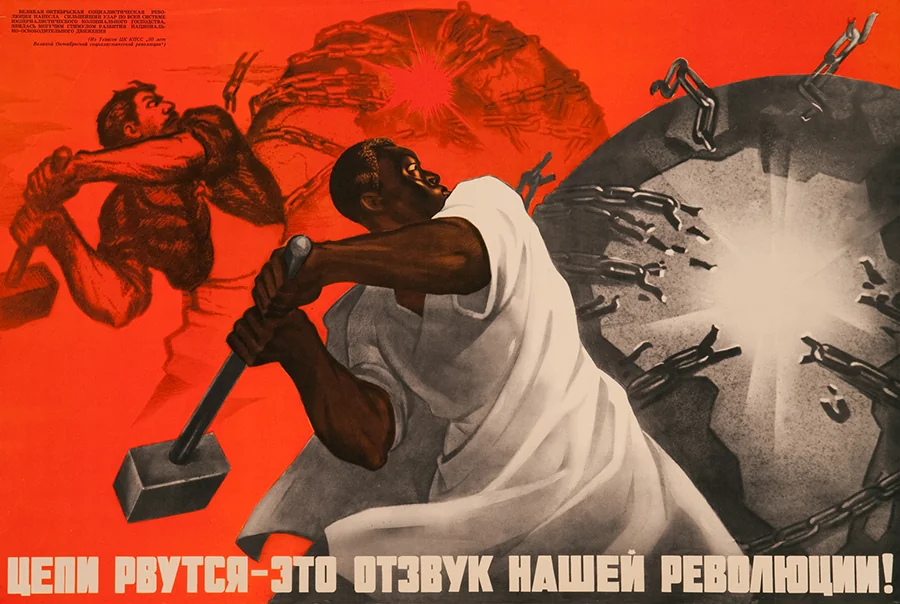
Breaking the Adamantine Chains
Prometheus did not remain in chains for eternity, despite Zeus’s original intentions, but regained his freedom after only 30,000 years. In Aeschylus’s Prometheus Unbound, of which we have only fragments, Prometheus was freed from his unbreakable adamantine chains by Heracles/Hercules, the son of Zeus and the mortal Alcmene, who broke the unbreakable shackles, achieving the impossible. Prometheus was able to use his foresight as leverage on the tyrant Zeus, who needed the farsighted Prometheus to reveal the details of his own possible future so as to prevent his being deposed.42 In the final part of Aeschylus’s trilogy, Prometheus the Firebearer, Prometheus, as George Thomson surmised from the structure of the first two plays, and what little evidence can be derived of the third, comes to be worshiped by humanity as the deliverer.43
In the late eighteenth and early nineteenth-century, Enlightenment/Romantic figures like Samuel Taylor Coleridge, Mary Wollstonecraft, and Percy Bysshe Shelley wrote of human freedom and the release from adamantine chains, breaking the bonds of fate.44 For the young Engels, an admirer of Shelley, the “adamantine foot” of time, which kicked loose all existing material conditions and created new ones, altered the realm of human possibility and social relations, providing openings for historical change. Marx referred to both “golden chains,” when workers and their potential allies were bought off, and the “chain” of “illusion” in which mysticism, religion, and commodity fetishism constantly constrained (but did not contain) the struggle for human freedom. Nevertheless, he insisted that the fetters represented by the existing relations of production could be broken.45
In the present day, the alienated material necessity of capitalism in the form of the concentration and centralization of immense wealth and power among a very few, the scaling up of wars of extermination, and the planetary ecological crisis can only be overcome by the revolutionary emergence of a society of substantive equality, ecological sustainability, and social freedom.
The agent of that change is best conceived today as the global environmental proletariat, the working class in its broadest, most universal materialist form—a new emergent reality of revolt. Just as ecological civilization, as it is conceived at present primarily in China, represents the highest form of the socialist struggle, so the environmental proletariat is the mature form of the material class struggle, directed at sustainable human development. If the capitalist class expropriated both humanity and the earth, the environmental proletariat is the necessary negation of the negation if the world is to free itself from capitalist perdition. The chains of humanity are self-imposed, meaning that the present can be unshackled—but only if the struggle for human freedom is progressively widened.
Notes
↩ See George Thomson, “Introduction,” in Aeschylus, Prometheus Bound, ed. and trans. George Thomson (Cambridge: Cambridge University Press, 1932), 1–47; George Thomson, “Special Introduction,” in Aeschylus, Oresteia Trilogy/Prometheus Bound, trans. George Thomson (New York: Dell, 1965), 24–26.
↩ Karl Marx and Frederick Engels, Collected Works (New York: International Publishers, 1975), vol. 2, 48.
↩ Paul Lafargue, “Reminiscences on Marx,” in Reminiscences of Marx and Engels, ed. Institute of Marxism and Leninism (Moscow: Foreign Languages Publishing House, n.d.), 74.
↩ Herbert Marcuse, Eros and Civilization (Boston: Beacon Press, 1964), 74–75. See John Bellamy Foster, “Eco-Marxism and Prometheus Unbound,” Monthly Review 77, no. 6 (November 2025): 2–5.
↩ Herbert Marcuse, One-Dimensional Man (Boston: Beacon Press, 1964), 63–64, 255–57.
↩ Perry Anderson, Considerations on Western Marxism (London: Verso, 1976), 42–43.
↩ Theodor W. Adorno, Philosophical Elements of a Theory of Society, eds. Tobias ten Brink and Marc Phillip Nogueira, trans. Wieland Hoban (Cambridge: Polity, 2019), 38, 49–50.
↩ Adorno, Philosophical Elements of a Theory of Society, 31, 49.
↩ What Marx called the unity of opposites (or the identity of identity and nonidentity) characterizing capital and labor was here turned into a narrow, one-sided identity of opposites.
↩ Max Horkheimer and Theodor Adorno, Dialectic of Enlightenment (New York: Continuum, 1944).
↩ G. W. F. Hegel, The Philosophy of History (New York: Dover, 1956), 103.
↩ Max Weber, The Protestant Ethic and the Spirit of Capitalism, trans. Talcott Parsons (London: George Allen and Unwin, 1930), 13–17, 181; Max Weber, From Max Weber: Essays in Sociology, eds. Hans Gerth and C. Wright Mills (New York: Oxford University Press, 1946), 181.
↩ G. W. F. Hegel, The Philosophy of Right (New York: Oxford University Press, 1952), 10; Sigmund Freud, Beyond the Pleasure Principle (New York: W. W. Norton, 1989), 53, 59.
↩ Russell Jacoby, Dialectic of Defeat: Contours of Western Marxism (Cambridge: Cambridge University Press, 1981).
↩ Theodor Adorno, Negative Dialectics (New York: Continuum, 1973), xix.
↩ Paul A. Baran and Paul M. Sweezy, The Age of Monopoly Capital, eds. Nicholas Baran and John Bellamy Foster (New York: Monthly Review Press, 2017), 430.
↩ Georg Lukács, The Theory of the Novel (London: Merlin Press, 1971), 22.
↩ Georg Wilhelm Friedrich Hegel, Political Writings (Cambridge: Cambridge University Press, 1999), 270.
↩ Bruno Leipold, Citizen Marx: Republicanism and the Formation of Marx’s Social and Political Thought (Princeton: Princeton University Press, 2024); William Clare Roberts, Marx’s Inferno: The Political Theory of Capital (Princeton: Princeton University Press, 2018).
↩ Theodor Adorno, The Culture Industry (London: Routledge, 1991). On the critique of the cultural apparatus, see John Bellamy Foster and Robert W. McChesney, “The Cultural Apparatus of Monopoly Capital,” Monthly Review 65, no. 3 (July–August 2013): 1–33. On the contemporary struggle over the political economy of the cultural apparatus, see John Bellamy Foster, “Robert W. McChesney (1952–2025): A Personal and Political-Intellectual Memoir,” Monthly Review 77, no. 7 (December 2025): 1–23.
↩ Weber, The Protestant Ethic and the Spirit of Capitalism, 21.
↩ L. Bill Warren, Imperialism, Pioneer of Capitalism (London: Verso, 1980).
↩ S. Stavrianos, Global Rift: The Third World Comes of Age (New York: William Morrow and Co., 1981).
↩ See John Bellamy Foster, Brett Clark, and Richard York, The Ecological Rift (New York: Monthly Review Press, 2010).
↩ It was foretold that if Zeus had a child with a particular woman, then Zeus’s own offspring, the fruit of this union, would depose him. Only Prometheus, with his foresight, knew who that woman (Thetis) was, and used this as a means against Zeus, and used this information as a means of obtaining his release and readmission to Olympus—but only after Zeus had ended his absolute tyranny over Gods and humans.
↩ Samuel Taylor Coleridge, Aids to Reflection (London: Edward Moxon, 1854); Mary Wollstonecraft, A Vindication of the Rights of Women (New York: A. J. Matsell, 1833) 37; Percy Bysshe Shelley, Prometheus Unbound (Boston: D. C. Heath and Co, 1892), 68.
↩ Marx and Engels, Collected Works, vol. 3, 176; Karl Marx, Wage-Labour and Capital in Karl Marx, Wage-Labour and Capital/Value, Price and Profit (New York: International Publishers, 1976), 40; Karl Marx, A Contribution to a Critique of Political Economy (Moscow: Progress Publishers, 1970), 21; Erich Fromm, Beyond the Chains of Illusion (New York: Simon and Schuster, 1962).
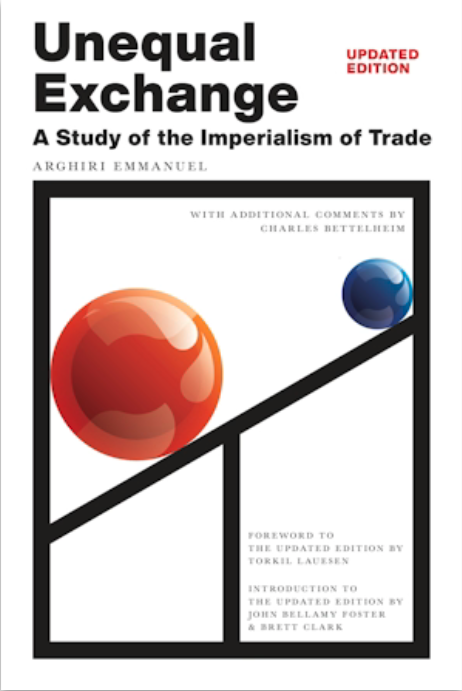
Arghiri Emmanuel’s Unequal Exchange: A Study of the Imperialism of Trade was an explosive work when it was first published in French in 1969, not simply due to the depth of its critique of neoclassical economics, but even more because of the enormous challenge that it presented for Marxist economic theory itself.1 This incendiary reception was immediately evident in that the book incorporated an extensive debate between Emmanuel, a Greek economist, who became director of economic studies at the University of Paris-VII, and the French Marxist economist Charles Bettelheim, under whom Emmanuel had written his doctoral thesis on unequal exchange, and whose views departed sharply from those of Emmanuel. Thus, Emmanuel’s Unequal Exchange erupted on the public scene in a storm of controversy, which was already embedded in the book and quickly extended to a wider debate that continued for years, raising the issue of the relation of the working class in the advanced capitalist economies to imperialism. The impact of Unequal Exchange was startling at the time, but it then declined as interest in imperialist theory ebbed in the Western left and as the reality that Emmanuel had pointed to was frequently denied. Meanwhile, the inquiry that he had initiated was taken up by others, such as the Egyptian-French economist Samir Amin, and transformed in other directions. In the twenty-first century, however, the reality of both unequal economic and unequal ecological exchange has come to be regarded as the very crux of the anti-imperialist world struggle, and interest in Emmanuel’s classic work has once again skyrocketed.
The issue of unequal international exchange goes back to Karl Marx’s critique of classical political economy and indeed was an important question within classical-liberal political economy.2 In his seminal work On the Principles of Political Economy and Taxation(1817), David Ricardo assumed that capital was immobile globally, while the Malthusian iron law of wages meant that labor costs were determined by the requirements of physical subsistence. Hence, the law of value did not apply to international transactions. Although it could be assumed that the wages of workers were equalized since determined more or less by absolute subsistence, profits, due to the immobility of capital across nations, were not. Consequently, Ricardo introduced his famous theory of comparative advantage to explain international trade, as a departure from and inversion of the law of value, relying on supply and demand as the main determinant.3
Ricardo’s analysis demonstrated that it was always beneficial for countries to engage in trade, by exporting the products for which they had the greatest comparative advantage, relative to other goods they might choose to exchange. Nevertheless, he also acknowledged that due to differing productivities (and labor intensities) some countries would receive more labor for less labor in international exchange, while other countries would receive less labor for more.4 “Even according to Ricardo’s theory,” Marx observed, “three days of labour of one country can be exchanged against one of another country.… In this case, the richer country exploits the poorer one, even where the latter gains by trade, as John Stuart Mill explains in his Some Unsettled Questions.”5 As Amin summed up the Ricardian theory of comparative advantage in international trade, “All that this theory enables us to state is that, at a given moment, the distribution of levels of productivity being what it is, it is to the interest of the two countries to effect an exchange, even if it is unequal.”6
“Two nations,” Marx explained in the Grundrisse, “may exchange according to the law of profit in such a way that both gain, but one is always defrauded…. One of the nations may constantly appropriate for itself a part of the surplus labour of the other, giving nothing back for it in exchange.”7 In the third volume of Capital, he went on to note that “the privileged country receives more labour in exchange for less,” thereby obtaining “surplus profit,” while, inversely, the poorer country “gives more objective labour than it receives.”8 Related to this was the fact that “the profit rate is generally higher [in underdeveloped countries] on account of the lower degree of development, and so too is the exploitation of labour through the use of slaves and coolies, etc.”9 It was thus possible to see “how one nation can grow rich at the expense of another.”10 Although Marx never managed to write his planned volume on the world economy and crises, it is clear that—building on the reality of unequal exchange already depicted by theorists like Ricardo and Mill—he saw the problem as ultimately lying in inequalities of labor, with poor nations giving more labor for less in the exchange process.11
Austrian Marxist Otto Bauer is credited with being the first to put unequal exchange on a firmer footing. Writing in 1924, Bauer dispensed with Ricardo’s assumption that profit rates between countries were unequal, replacing the notion of the immobility of capital with one of the mobility of capital and with a tendency for profits to equalize at the international level. Nevertheless, unequal exchange continued to exist, in Bauer’s terms, because of the differing organic compositions of capital and thus differing rates of productivity between the more advanced and less advanced economies, which meant that in the process of equalizing profit rates between countries there was a transfer of value from poorer to richer countries. In Marx’s modified value theory, incorporating prices of production, equalization of profit rates required a transfer of value from industries with a lower organic composition of capital (or invested capital/labor ratio) to those with higher organic composition. The same essential process, Bauer argued, occurred between countries. In the equalization of profit rates internationally, those countries with higher organic composition gained value at the expense of those with lower organic composition. In Bauer’s words, “The capitalists of the more highly developed areas not only exploit their own workers, but [they] also appropriate some of the surplus value produced in less highly developed areas. If we consider the prices of commodities, each area receives in exchange as much as it has given. But if we look at the values involved, we see that the things exchanged are not equivalent.”12
German Marxist economist Henryk Grossman, writing in the 1930s, carried forward Bauer’s analysis. As he put it, “International trade is not based on an exchange of equivalents because, as on the national market, there is a tendency for the rate of profit to be equalised. The commodities of the advanced capitalist country with the higher organic composition will therefore be sold at prices of production higher than their value; those of the backward country at prices of production lower than value.”13
The whole approach to unequal exchange focusing on the organic composition of capital and the related higher productivity in developed capitalist countries was designated by Emmanuel as “unequal exchange in the broad sense.”14 Here countries with higher productivity due to a higher organic composition of capital and thus higher rates of productivity drew on surplus value in poorer regions, merely as a product of the equalization of profit rates internationally. In this case, it was true that the richer countries gained at the expense of the poorer countries, but this was a mechanical function of the equalization of profit rates, and did not in itself constitute actual imperialist exploitation.15
What Emmanuel brought to the concept of unequal exchange, and what gave it lasting importance, was a theory that focused on the international mobility of capital coupled with the international immobility of labor. His analysis did not deny the significance of the “broad basis” of unequal exchange as articulated by Bauer, Grossman, and others. But for Emmanuel, there was a second, and ultimately more significant, form of unequal exchange associated with imperialist exploitation. Namely, core economies in the center of the global capitalist system with high wages in global terms extracted surplus labor from economies in the periphery with persistently low wages, enhancing accumulation at the core at the cost of the periphery.
Although Ricardo had recognized the existence of unequal exchange, for Emmanuel the causes were reversed. For Ricardo’s unequal rates of profit and standardized subsistence wages internationally, Emmanuel substituted “unequal wages between countries” with profits “tending toward equalization.”16 Emmanuel did not primarily construct his analysis in terms of imperialism theory in V. I. Lenin’s sense. Rather, he assumed in this abstract model not monopoly capital but free competition. Nor did he start his examination with class-based production and accumulation, though both were part of his analysis. Instead, he treated wages as an independent variable, based on Marx’s analysis of their historically determined character.
Surplus value arises in capitalist production because the value generated by the exercise of a worker’s labor power exceeds the value of labor power or the wages paid to the worker. In core capitalist countries—including not only the old colonial powers but also, according to Emmanuel, the “white settler states” (the United States, Canada, Australia, and New Zealand) that had effectively exterminated or removed the original Indigenous inhabitants from the land—wages were comparatively high globally. This promoted internal, autocentric economic development. A “super-wage,” as in the United States, according to Emmanuel, generated a positive “dialectical interaction between the movement of wages and economic development.”17 In contrast, all countries in the periphery had much lower wages, associated with higher rates of exploitation, generating a dialectic of underdevelopment. It was this that constituted the structural basis for unequal exchange. In trade relations between what is now called the Global North and the Global South, the former was able to obtain more labor for less, or a net transfer of value, due to the structural inequality in wages built into the international system (and enforced by immigration laws)—a fact that was concealed by the supposed equality of trade when expressed in terms of price rather than labor value.
The reason that Emmanuel’s theory of unequal exchange stirred so much controversy within Western Marxism was due less to a departure from Marx, resulting from Emmanuel’s emphasis on wages as opposed to the accumulation of capital as the determining element in capitalist development, than from the direct political implications of his analysis. Frederick Engels and Lenin, in proposing the notion of a labor aristocracy, had argued that an upper stratum of the workers had knowingly been bought off by capital from the largesse of imperialism.18 In contrast, Nikolai Bukharin had seen this less in terms of a labor aristocracy within the advanced capitalist states than an embourgeoisement of the entire working class in the developed economies. Thus, he referred to “the additional pennies” offered to workers in the rich countries from the proceeds of imperialism, leading to their cooperation with capital. Following Bukharin, much more than Engels and Lenin, Emmanuel expanded his critique beyond a mere labor aristocracy to a Western working class as a whole that was seen as gaining from imperialism.19 This pointed to what Oskar Lange had called a “people’s imperialism” dividing the workers in the Global North from the Global South. In Emmanuel’s words, “Lange’s ‘people’s imperialism’ has today become a reality in the big capitalist countries.”20 Emmanuel thus presented this startling view: “Once a country has got ahead, through some historical accident, even if this be merely that a harsher climate has given men additional needs, this country begins to make other countries pay for its high-wage level through unequal exchange. From this point onward, the impoverishment of one country becomes an increasing function of the enrichment of another, and vice versa.”21
Although not denying that the workers in the core countries were exploited, Emmanuel argued that there was a point where the sense of gains from imperialism could altogether check national struggles, creating a capitalist-worker imperialist bloc, and that this point had been reached. He asked: “Could it be that revolutionary Marxism based on…solidarity has been inhibited by the dreadful implications of such a proposition [unequal exchange leading to a people’s imperialism] in relation to the international solidarity of working people?”22 Writing during the Vietnam War, he pointed to examples of U.S. workers supporting U.S. imperialism against Vietnam (as well as their support of U.S. attacks on Cuba) rather than exhibiting international solidarity. Similar developments had arisen in France (and among the white settlers in Algeria) in the French-Algerian War.23
Emmanuel went so far as to suggest, against historical reason, that if one could imagine the United States reduced to an underdeveloped country, this would be disastrous for U.S. workers, who would be “hurled into an abyss,” but that such a development would hardly affect the long-term prospects of U.S. capitalists themselves. “Leaving out of account the material losses suffered during and as a result of the event itself, the American capitalist would not find himself any worse off” in such a situation.24 This was a view that denied the larger structure of U.S. monopoly capitalism, including the many ways, apart from unequal exchange, in which surplus was extracted from the Global South by multinational corporations. More significantly, Emmanuel’s argument suggested that it was the working class, not the capitalist class, in the Global North who benefited most from unequal exchange/imperialism.
Behind Bettelheim’s sharp criticisms of Emmanuel and the volatile debate that ensued, therefore, lay the question of a people’s imperialism, issues that challenged much of post-Second World War Marxist political economy in Europe and North America. Emmanuel’s analysis was directly confronted by Bettelheim and then modified and extended by Amin. In the half-century that has followed the publication of Emmanuel’s book, his analysis has become more, not less, relevant. With all the limitations of his analysis in Unequal Exchange, Emmanuel’s contention that Marx’s value theory was superior to all other approaches in its ability to uncover the realities of the “imperialism of trade” has been strongly confirmed in the context of the global-value chain economy of the twenty-first century.25
Bettelheim and Emmanuel
The theoretical and political complexities and divergence of views within Marxism unleashed by Emmanuel’s Unequal Exchange are best seen through the lens of the debate with Bettelheim in the five appendices to the book. Emmanuel’s book appeared in a series edited by his mentor, Bettelheim. Although Bettelheim was strongly supportive of Emmanuel’s critique of the theory of comparative advantage, and their views coincided with respect to their understanding of the “basic theory” of unequal exchange as in Bauer and Grossman, they disagreed on what was the heart of the matter for Emmanuel: unequal exchange arising from the inequality in wages between rich and poorer nations or the “imperialism of trade.” Among the criticisms that Bettelheim raised were that (1) one nation cannot exploit another (a view in which he departed from Marx and Lenin), (2) exploitation could not occur via exchange but could only arise in production, (3) no analysis of unequal exchange could disregard productivity, (4) Emmanuel’s argument reversed Marx’s causality by seeing wage levels as the independent variable determining accumulation, and (5) Emmanuel’s analysis was based on free competition rather than monopoly capitalism.26
All these criticisms were meant to reinforce Bettelheim’s rejection of Emmanuel’s fundamental argument that not only did the rich nations extract surplus via unequal exchange from poor nations, but also that the workers in the developed capitalist countries, in effect, exploited workers in the underdeveloped countries. In response to Emmanuel, Bettelheim argued that even though workers in the Global South were frequently “superexploited,” in the sense that they were paid less than the value of their labor power (or the cost of its reproduction), these “workers in the underdeveloped countries were [nevertheless] even less exploited than those of the advanced, and so dominant, countries.” Emmanuel referred to this as “Bettelheim’s Paradox.”27
Bettelheim’s reasoning, which was not accompanied by any empirical analysis, was that since the organic composition of capital in the rich nations was much higher, labor productivity, or output per labor hour, was also much higher, which translated into a higher rate of exploitation (the ratio of surplus labor to necessary labor) in economically advanced countries, as opposed to underdeveloped countries. Since the labor time necessary to produce a good was reduced, while surplus labor was increased proportionately, this represented a higher rate of surplus value. Emmanuel had made the mistake, Bettelheim argued, of failing to account properly for labor productivity.
Arguing based on the existence of monopoly capital, as opposed to Emmanuel’s reliance in his model on free competition, Bettelheim insisted that there was such a thing as “imperialist exploitation” via multinational corporation investment in the Third World. However, he insisted, this dynamic was enabled by the greater technology, higher productivity, and larger rate of exploitation in the center capitalist economies. Moreover, such monopolistic surplus extraction, he claimed, could not occur through exchange but was the result of international production relations. In contrast, he suggested that Emmanuel had fallen for the fantasy of mere “commercial exploitation” divorced from production.28 Other Marxist political economists in Europe and the United States adopted the same argument as Bettelheim with respect to the higher rate of productivity and higher rate of exploitation in developed capitalist countries, as in the case of figures like Ernest Mandel, Michael Kidron, Geoffrey Kay, and others down to the present day.29
What was critical in Bettelheim’s view was that Emmanuel’s analysis denied the exploitation and class struggle at the center of the capitalist system, “making the proletarians of the rich countries appear to be the ‘exploiters’ of the poor ones. These proletarians must therefore have ceased to be exploited themselves, which means their labor is no longer a source of surplus value.”30 From this, Bettelheim concluded:
Emmanuel’s position seems to me to be clearly incompatible with Marxism, since in denying the existence of the class struggle in the industrialized countries (except in the economic form of that struggle, which conforms to the classic trade-unionist position, that is to say, an “economist,” and so non-Marxist, position). It amounts indeed to denying the existence of the political class struggle, and of classes themselves, when one treats the bourgeoisie and the proletariat of the industrial countries as identical, by alleging that the proletariat has “become bourgeois” and so has been integrated into the bourgeoisie.31
Emmanuel’s thesis, if true, Bettelheim insisted, would point to a break in the “objective solidarity of the workers of the industrialized countries and the dominated countries, while, in truth, that objective solidarity, representing a common class struggle, was as strong as ever.”32 However, capitalists both in the imperialist bourgeoisie and in the national bourgeoisies in the Third World could, Bettelheim argued, use Emmanuel’s notion of a split among workers internationally due to unequal exchange to distract workers from the class struggles in their own countries. The big bourgeoisie in the underdeveloped countries could falsely use the struggle against imperialism to consolidate their own power.33
Emmanuel’s responses in the debate with Bettelheim further complicated without decisively ending the debate. He argued that, for Marx, wage levels determined productivity (through technological innovation in response to high wages) and that Bettelheim and his other critics had simply reversed Marx’s logic: “To set up the productivity of labor as the determining element in the value of labor power, and also of wages, is an idea that is diametrically opposed to the Marxist, or even to any objectivist, conception of value.”34 There was no contradiction involved in the capitalists of one country obtaining surplus value from the production of workers in other countries via exchange since production and exchange were interconnected. Appropriationof surplus value, if ultimately rooted in production, did not occur solely within the production process.35Ultimately, Emmanuel pointed to the need for a world value theory that transcended merely national conditions that concealed global value relations.36
Amin and Emmanuel
As Amin indicated in “End of a Debate” in his Imperialism and Unequal Development (1977), Emmanuel’s approach was vulnerable to criticism since the restrictive assumptions built into his economic model made it impossible to address the most essential questions with respect to unequal exchange relations. Among the limitations of Emmanuel’s analysis were (1) his treatment of the wage as an independent variable, rather than dialectically related to the historical development of production and accumulation; (2) his resulting inability to deal adequately with the question of productivity; (3) the wider historical limitations of his analysis, which, since rooted in the assumption of free competition, was therefore not applicable either to noncapitalist economies or, more significantly, to the conditions of monopoly capitalism; (4) the related lack of a developed historical explanation for the immobility of labor; and (5) the tendency in Emmanuel’s theory to point to the direct exploitation of workers in the periphery by the workers in the core via trade relations, as if such economic transactions were not all mediated by and dominated by capital in its own interest.37 Nevertheless, the genius of Emmanuel’s analysis, in Amin’s view, was that it raised for the very first time the issue of world value, correctly indicating that labor, since it was engaged in producing international commodities, was itself international, subject to a world system of value.38
The fundamental theoretical problem in Emmanuel’s analysis was how to deal with the differences in the development of productive forces and of productivity in different parts of the world. Here Amin introduced a historically more general and theoretically irrefutable definition of unequal exchange, no longer relying simply on wage differentials, or seeing productivity as dependent on the level of wages. As Amin put it, “The essentialtheory of unequal exchange” points to the reality that “the products exported by the periphery are important,” in purely economic as opposed to natural resource terms, “to the extent that the difference between the returns to labor is greater than the difference between the productivities.”39 This was particularly evident when the production processes and particular use values were the same. But the fact that in the international system of production a labor hour in any part of the system was comparable with a labor hour somewhere else in the system gave the analysis a universal character.40
Amin departed sharply from Emmanuel’s notion that wage levels were determinant of productive forces, labor productivity, and accumulation. In Emmanuel’s framework there was a tendency to view high wages as directly related to unequal exchange. In contrast, Amin argued that the higher wages in the developed capitalist economies had arisen historically as a counterpart of economic development. Thus, they could not be assigned in the main to unequal exchange but had multiple causes.41 While insisting that workers in the Global North benefited from the imperialist exploitation in unequal exchange, Amin indicated that this was invariably mediated by the reigning monopoly capital, which took by far the lion’s share of the appropriated surplus, worsening its own problems of surplus absorption as a result.42
Bettelheim had stressed in his criticism of Emmanuel that the comprador elements in the underdeveloped countries could take advantage of the theory of unequal exchange and the struggle against imperialism, focusing on national rather than class conflict, to consolidate their own rule. However, for Amin, this simply pointed, in line with the whole Marxist analysis of imperialism, to the dual struggle of class and nation and the need to develop a strong working-class revolutionary consciousness.43
Adopting a somewhat more philosophical stance, Eurocentric Marxists sought to combat Emmanuel and other imperialism theorists with what Amin called an “epistemological argument,” charging that focusing on the extraction of surplus value from countries in the periphery via unequal exchange relied on circulation rather than production as the basis of the analysis and thus fetishized the former. In responding to such views, Amin not only emphasized the interrelationship between production and exchange, he also went on to declare forthrightly that “‘unequal’ exchange is nothing more than the mechanism of surplus-value circulation in the imperialist stage of capitalism.” Far from ignoring the importance of circulation, Marx himself, Amin pointed out, had devoted the whole third volume of Capital to it, hardly according to it a minor “epistemological” importance.44
Where Amin broke most decisively with Emmanuel was in relation to historical analysis. Emmanuel’s model was entirely based on the artificial assumption of free trade, insofar as it assumed the absence of monopoly capital, even though many of the historical factors he considered, such as the international immobility of labor and the international mobility of capital, were less characteristic of the era of free trade (where Ricardo’s assumptions were more realistic) than they were of monopoly capitalism. Hence, Amin took monopoly capitalism/imperialism in the terms laid out by Lenin and subsequent theorists of imperialism as the basis of his approach. Unequal exchange in international trade and the rise of a system of world value had to be viewed through the lens of “generalized monopoly capitalism.”45
It was in twentieth-century monopoly capitalism that more restrictive immigration laws, designed to control labor internationally, were instituted, enforcing the global immobility of labor and the superexploitation of peripheral labor, while also allowing for the overexploitation of migrant labor within the metropolitan countries.46 Likewise, it was only with the growth of the multinational corporation that the international mobility of capital—prior to that mostly confined to portfolio investment—became an established fact. Moreover, it was monopoly capitalism, Amin argued, in fundamental agreement with Ruy Mauro Marini, that made the “superexploitation” of labor in the periphery a more systematic reality.47
In an attempt to take full advantage of the fact that the difference between wages was greater than the difference in productivities between the Global North and the Global South, multinational corporations increasingly—once improved communication and transportation technology made this feasible—introduced the same technology and production processes in the export zones of the Third World as existed in the center of the world economy.48 Thus, the transfer of value through the unequal exchange process was greatly enhanced in the age of neoliberal globalization from the 1980s on, leading to the development of global value chains as a dominant reality of global production.
The Reality of Unequal Exchange
Amin’s critical elaboration, with greater historical consideration of Emmanuel’s analysis, allowed for the empirical investigation of international trade, while considering differences in wages and productivity. Recent scholarship has clearly revealed how the difference in wages between workers in the Global North and the Global South are much greater than the differences in their productivity. Importantly, this work illuminates how imperialist exploitation plays a central role in the creation and transfer of world value, whereby the surplus is appropriated by monopoly capital in the Global North. Given the limitations of price-based categories, unequal exchange reflects the transfer of value associated with the embodied labor in production that is concealed in standard trade accounts. It thus reveals the often invisible reality of value transfers from poor to rich nations through unequal exchange, in addition to the more visible ways that surplus is transferred through direct monopolistic power relations, as captured in current accounts.
Emmanuel’s and Amin’s insights regarding unequal exchange greatly enrich global commodity chain research, which studies the economic transfer of value within the numerous extraction, production, distribution, consumption, and financial linkages dominated by multinational corporations. By the twenty-first century, multinational corporations in the center of the world economy had shifted most industrial employment of workers to the Global South, practicing “arm’s length” contracting, whereby production was outsourced to independent suppliers. Here, giant corporations were able to take advantage of the low wages paid to workers, while externalizing some of their direct production costs and reducing their culpability for running sweatshops and for pollution. These conditions kept wages very low in the Global South and helped repress wages in the North. Foreign direct investment, from core nations to periphery economies, accelerated the offshoring process and arm’s length contracting, dramatically reorganizing the latter’s economies while expanding their industrial workforce.
As a result, developing country exports as a percentage of U.S. imports quadrupled in the last half of the twentieth century. By 2008, 73 percent of all industrial employment globally was located in the Global South, while, by 2013, the majority of total foreign direct investment went to the Global South.49 The South’s global share of manufacturing trade skyrocketed, with the primary export destination as the Global North. Industrialized manufacturing, intensive production practices, and global integration did not alleviate poverty in the South or lead to its convergence with the North. Instead, the relative health and environmental conditions of workers in developing countries worsened.50 Furthermore, value added, within global commodity chains, ended up being attributed primarily to economic activities within the Global North where the goods were marketed and consumed, rather than the Global South where the bulk of labor in production occurred.51
In “Global Commodity Chains and the New Imperialism,” Intan Suwandi, R. Jamil Jonna, and John Bellamy Foster developed an empirical approach for studying the invisible transfer of value, whereby unequal exchange allows monopoly capital to capture the value produced by labor in the periphery.52 To create the basis for cross-national comparisons from 1995 to 2014, they examined unit labor costs, or the ratio of wages to labor productivity, for the eight countries with the highest participation in the global commodity chains. The Global North countries were represented in this study by the United States, United Kingdom, Germany, and Japan, and the Global South countries by China, India, Indonesia, and Mexico. The authors found that the difference in wages between the North and South were far greater than differences in productivity. Thus, the former were getting much more labor for less in the international exchange, allowing the surplus to be captured by multinational corporations. The average unit labor costs in manufacturing in China, India, Indonesia, and Mexico ranged between 37 percent to 62 percent of unit labor costs in the United States, indicating that higher profit margins could be obtained by producing in the periphery. This trend is only amplified when considering all the other productive linkages of the global commodity chain that include the rest of the Global South.53Thus, the differential rates of exploitation between nations leads to a massive transfer of surplus within the global capitalist system.
The extent of the ongoing unequal exchange was further captured in an important 2024 study published in Nature Communications by Jason Hickel, Morena Hanbury Lemos, and Felix Barbour. They explained that following the imposition of structural adjustment programs in the 1980s and ’90s on the Global South, which included devaluing currencies, cutting public funding for social welfare and environmental protection, encouraging lower wages to attract investment for manufacturing, and creating export-oriented facilities, the dynamics of unequal exchange intensified. To assess these relationships and conditions, they sought to “track flows of embodied labour between North and South, for the first time accounting directly for sectors, wages and skill levels,” which enabled them “to define the scale of labour appropriation through unequal exchange in terms of physical labour time, while also representing it in terms of wage value, in a manner that accounts for the skill level composition of labour embodied in North-South trade.” They found that 90 to 91 percent of “the labour of production in the world economy, across all skill levels and all sectors” took place within the Global South. However, the value produced was “disproportionately captured” by the North.54
In 2021 alone, the Global North had a net-appropriation of “826 billion hours of embodied labour from the Global South,” which took place across all skill categories, from low to high, via the “invisible ghost workers’” within this system of generalized commodity production. This translated into the equivalent of $18.4 trillion in wages in the Global North, more than doubling the amount appropriated in 1995. The wage gaps across skill categories significantly increased between 1995 and 2021, resulting in Global South wages being 87 to 95 percent lower than their counterparts of equal skill in the North. Wages in the North over this time period increased eleven times those of workers in the South. Nevertheless, workers’ share of GDP declined by 1.3 percent in the Global North and 1.6 percent in the South, demonstrating the weakening position of labor worldwide.55
The imbalance was even more dramatic when considering the difference in labor hours contributions to the global economy. In 2021, the Global South contributed 90 percent of the 9.6 trillion hours of labor. This pattern was evident at all skill levels, as the Global South represented 76 percent of high-skilled labor, 91 percent of medium-skilled labor, and 96 percent of low-skilled labor, as far as total labor hours in global production. As a result, from 1995 to 2021, the Global South steadily increased its contribution to total global production in all areas. Hickel, Lemos, and Barbour found that “the South now contributes more high-skilled labour to the world economy [in total labor hours]…than all the high-, medium-, and low-skilled labour contributions of the Global North combined.” Global South workers were as productive as their counterparts in the North, plus they confronted extreme controls to maximize output. Despite these conditions, the Global South received only 44 percent of global income, with workers in these countries receiving “only 21 percent of global income” in 2021.56
Between 1995 and 2021, the Global North imported over fifteen times more embodied labor than it exported to the South. As far as embodied agricultural labor is concerned, the North imported 120 times more than it exported. “There is no sector,” Hickel, Lemos, and Barbour explained, “in which the North net-exports labour to the South.” The only thing that briefly tempered the exchange ratio during this period was China, given improvements there in wages. This invisible transfer of value increased over the period and was accompanied by the transfer of “embodied land, energy, [and] materials” as part of overall production. There is no evidence of the Global South catching up with the North; in fact, the divergence within the global capitalist economy is deepening, with a larger share of surplus being captured by monopoly capital.57 This point, and the trends highlighted above, are all the more important considering recent arguments that China and other BRICS countries, such as Brazil, Russia, and India, are draining wealth from the United States, reversing the overall direction of imperialism.58
As Minqi Li demonstrated, in 2017 China experienced a net labor loss in foreign trade of 47 million worker years, while the United States had a net labor gain of 63 million worker years (measured in terms of total labor embodied in exported goods minus total labor embodied in imported goods), due to the production of commodities in China and other countries in the Global South, which were then consumed within the United States. The low unit labor costs in China and in other developing countries exacerbated this difference in net labor loss and gain. Additionally, as Marxist economists Guglielmo Carchedi and Michael Roberts have demonstrated, the BRICS countries are not draining surplus from other countries in the Global South or capital from the North. Instead, the imperialist bloc at the center of the global economy continues to extract surplus from BRICS countries.59
To gain a better understanding of the overall drain from the Global South, it is necessary to consider not simply the invisible transfers of embodied labor in unequal exchange proper, but also the visible transfers of wealth that accompany colonial and imperialist relations associated with the net flow of capital as part of international trade, recorded in national accounts. These accounts include the balance of trade regarding imports and exports, net payments to foreign investors and banks, insurance and freight payments, and payments for royalties and patents. The United Nations Conference on Trade and Development (UNCTAD), in a 2020 policy brief, indicated that from 2000 to 2017, for 134 developing countries, there was a net financial transfer “from developing to developed countries.” In 2012 alone, the net resource transfers, due to a “recovery of exports,” hit $977 billion. This has generated a “debt treadmill” in which developing countries in general find themselves “financially exhausted.”60 The system of international debt peonage resulting from the “difference between net capital inflows and net income payments to foreign capital, including net changes to international reserves,” reproduces itself, in part, because “external resources are deemed necessary to fund development, but this in turn generates return flows of interest payments and profit remittances that have to be funded by the developing country and can outweigh any earnings flows.”61
The underlying reality is one in which there is “a clear and persistent” situation, visible in the international system of accounts, where the Global South persistently experiences a net loss of capital to the Global North. According to UNCTAD, “The returns on external assets received are generally lower than the payments made on external liabilities, resulting in an ongoing net transfer of financial resources from developing to developed countries.”62 This constitutes a reverse flow of capital, from the periphery to the core, quite apart from unequal exchange as such, here arising simply from the monopolistic power relations of multinational capital located in the Global North.63
The transfer of economic value between nations is intertwined in complex ways with material-ecological flows.64 As Amin pointed out, following Emmanuel in this respect, there are many “other forms of unequal exchange,” which include an array of ecological considerations, especially when associated with the extraction and control of natural resources.65 Within the capitalist system, this gives rise to unequal ecological exchange (the exchange of more natural-physical use values for less), whereby there is a vertical flow of value embodied in energy and matter, which is beyond the value associated with the exploitation of labor from the Global South to the Global North. Additionally, unequal ecological exchange is associated with the North externalizing many of the environmental consequences, such as pollution, of this international production to the South, exacerbating inequalities and the disproportionate using up of the ecological commons, such as the atmosphere and oceans, by the North.66
Marx noted that real wealth included the contributions of both nature and labor, whereas, under capitalist accounting, value was only associated with the labor. Nature was deemed a “free gift” for capital.67 Thus, nature was part of the “hidden abode” of capital, as its contributions were outside the normal economic categories, constituting “profit upon expropriation.”68 Here, expropriation involved robbery, theft, and plunder. This appropriation without reciprocity undermined the processes that support the regeneration of ecosystems and the conditions of life itself.69 So-called primary accumulation involved the dissolution of previous property forms, the enclosure movement, the alienation of the human population from nature, colonialism, settler colonialism, imperialism, the plundering of resources abroad, enslavement, and genocide, all of which helped establish the polarized capitalist system, as wealth was concentrated in the core countries.70
This system of robbery is integral to the everyday operations of capital. The second agricultural revolution, between the mid-seventeenth century and the late nineteenth century, involved the despoliation of soil nutrients, as intensive agricultural practices were employed to produce food and fiber for distant urban populations. The nutrients were not returned to the countryside as part of a reciprocal process to restore the land. Agricultural operations became dependent on external inputs to try to maintain production. From 1840 to 1880, guano from Peru was the most prized fertilizer in the world. The Peruvian guano islands were plundered, under de facto slavery conditions, to enrich the soils of Europe and the United States.71
Colonial and imperial relations have played a central role in establishing and maintaining unequal ecological exchange. In Open Veins of Latin America, Eduardo Galeano provided an extensive account of how for centuries the Global North had robbed this region of the Global South of its natural resources, which included gold, silver, rubber, and a broad array of agricultural goods. “The plantation” system, in particular, he explained, “was structured as to make it, in effect, a sieve for the draining-off of natural wealth.”72 Within this global system, “the more a product is desired by the world market, the greater the misery it brings to the Latin American peoples whose sacrifice creates it.”73 Under the imperial conditions of unequal economic and unequal ecological exchange, Latin America was poor because it was a rich land. As Galeano described, “It continues to exist at the service of others’ needs, as a source and reserve of oil and iron, of copper and meat, of fruit and coffee, the raw materials and foods destined for rich countries which profit more from consuming them than Latin America does from producing them.”74 Amin argued that this process contributed to the “systematic destruction of soils,” “degradation of the environment,” and “impoverishment” of dependent countries.75
Through unequal ecological exchange, the Global North was overshooting its own resource base, as it utilized “ghost acreage” abroad to supply foods and other natural resources.76 Additionally, the Global North disproportionately utilized the ecological commons, greatly amplifying the ecological crisis. Emmanuel indicated that the developed countries were actively using up the ecological commons by “dispos[ing] of their waste products by dumping them in the sea or expelling them into the air.”77 As global capitalism progressively transgresses the planetary boundaries, threatening ecological destruction of life on Earth, the importance of Emmanuel’s investigation of unequal exchange increases, as does the international movement to confront the death drive of capital.
The Imperialism of Trade
Imperialism is a complex phenomenon, which has been imposed differentially, depending on how imperialism originally penetrated the domains of peripheral nations, and by numerous other factors having to do with innumerable other features, such as forms of colonization and semicolonization, the nature of anticolonial struggles, control of natural resources, strategic position as conceived by geopolitics, the exercise of monopoly power, and the role of comprador classes. In all cases, however, imperialism under capitalism has ultimately taken an economic form, in which the drain of the surplus of developing countries is achieved by multifarious means, involving more visible and less visible forms of exploitation and expropriation. Moreover, the robbing of the Global South has extended beyond mere economic transfers to ecological ones, involving the seizure of land and resources. It is a system of open veins, demanding revolutions and delinking.
Emmanuel’s unequal exchange analysis has played an indispensable role in demonstrating that a value analysis that focuses on the role of labor in production and the exchange of labor reveals the full depth of economic imperialism, inhibiting underdeveloped countries, and holding them back. It thus represents the deepest roots of economic imperialism, traceable to the fact that while labor is relatively immobile internationally (and while migration of workers from the Global South is so structured that they carry their low wages with them), capital is mobile internationally. Any attempts by peripheral countries to delink from international capital and to place limits on capital’s mobility inevitably lead to economic sanctions and military interventions emanating from the imperial core of the system.
Referring to his analysis in Unequal Exchange, Emmanuel wrote: “If I succeed, I shall have shown that not only is international trade not, as is thought, the Achilles’ heel of the labor theory of value but that it is, on the contrary, [only] on the basis of this theory’s premises that we can understand certain features of international trade that have hitherto remained unexplained.” At bottom, this required “integrating international value in the general theory of value.”78 Emmanuel succeeded to such an extent that his theory of unequal exchange, though modified by later thinkers such as Amin to accord with the reality of monopoly capitalism, has become indispensable to the analysis of the transfer of value within today’s global commodity economy. This uncovered the reality of the global labor arbitrage, revealing the world value system that constitutes its basis. Hic Rhodus, Hic Salta! (Here is Rhodes, leap here!)
↩ See Michael Perelman, The Invention of Capitalism: Classical Political Economy and the Secret History of Primitive Accumulation (Durham: Duke University Press, 2000). Analysis in this and the next few paragraphs relies considerably on John Bellamy Foster and Hannah Holleman, “The Theory of Unequal Ecological Exchange: A Marx-Odum Dialectic,” Journal of Peasant Studies 41, no. 2 (2014): 201–5.
↩ David Ricardo, On the Principles of Political Economy and Taxation (Cambridge: Cambridge University Press, 1951), 128–49; Samir Amin, Imperialism and Unequal Development (New York: Monthly Review Press, 1977), 184.
↩ Ricardo, Principles of Political Economy and Taxation, 135–36.
↩ Karl Marx, Theories of Surplus Value, Part 1 (Moscow: Progress Publishers, 1971), 105–6; John Stuart Mill, Essays on Some Unsettled Questions of Political Economy (London: John W. Parker, 1844), 2.
↩ Amin, Imperialism and Unequal Development, 134–35, italics added.
↩ Karl Marx, Grundrisse (London: Penguin, 1973), 872.
↩ Karl Marx, Capital, vol. 3 (London: Penguin, 1981), 345.
↩ Karl Marx, The Poverty of Philosophy (New York: International Publishers, 1963), 223.
↩ How much Marx’s views remained within the framework of Ricardo and Mill in this respect, and how much they moved beyond their perspectives, is difficult to tell, given the incomplete nature of his work in this area.
↩ Otto Bauer, The Question of Nationalities and Social Democracy (Minneapolis: University of Minnesota Press, 2000), 200; Emmanuel, Unequal Exchange, 175.
↩ Henryk Grossman, The Law of Accumulation (London: Pluto Press, 1993), 170.
↩ Emmanuel, Unequal Exchange, 167; Guglielmo Carchedi, Frontiers of Political Economy (London: Verso, 1991), 222–25.
↩ Exploitation in Marxist theory has to do with the appropriation of surplus (value) from the direct producer. Imperialist exploitation is a term used to refer to the net appropriation of the surplus generated in an underdeveloped country by a developed country. For a precise treatment of this, see Amiya Kumar Bagchi, The Political Economy of Underdevelopment (Cambridge: Cambridge University Press, 1982), 15–16.
↩ Frederick Engels, The Condition of the Working Class in England (Chicago: Academy Chicago, 1982), 33–34; V. I. Lenin, Imperialism, The Highest Stage of Capitalism (New York: International Publishers, 1939), 13–14. Engels did say that the entire working class in England, the focus of his article, could benefit momentarily in rare instances from imperialism, but that the benefits were mostly confined to the upper stratum. On the labor aristocracy theory, see Martin Nicolaus, “The Theory of the Labor Aristocracy,” Monthly Review 21, no. 11 (April 1970): 91–101; Eric Hobsbawm, “Lenin and the ‘Aristocracy of Labor,’” Monthly Review 21, no. 11 (April 1970): 47–56.
↩ Nikolai Bukharin, Imperialism and the World Economy (New York: International Publishers, 1929), 164–67; Emmanuel, Unequal Exchange, 17–79.
↩ Bettelheim, Appendix I, in Emmanuel, Unequal Exchange, 271–72, 276, 300–4.
↩ Ernest Mandel, Late Capitalism (London: Verso, 1975), 354; Michael Kidron, Capitalism and Theory(London: Pluto Press, 1974), 95–123; Geoffrey Kay, The Economic Theory of the Working Class (New York: St. Martin’s Press, 1979), 52; Alex Callinicos, Imperialism and Global Political Economy (London: Polity, 2009), 179–81; and Joseph Choonara, Unraveling Capitalism (London: Bookmarks, 2009), 34–35.
↩ Bettelheim, Appendix I, in Emmanuel, Unequal Exchange, 301.
↩ Charles Bettelheim, Appendix III, in Emmanuel, Unequal Exchange, 352.
↩ Bettelheim, Appendix I, in Emmanuel, Unequal Exchange, 309.
↩ Bettelheim, Appendix I, in Emmanuel, Unequal Exchange, 310.
↩ Amin, Modern Imperialism, Monopoly Finance Capital, and Marx’s Law of Value, 192; Amin, Imperialism and Unequal Development, 207.
↩ Samir Amin, “Capitalism, State Collectivism, and Socialism,” Monthly Review 29, no. 2 (June 1977): 39–41; Samir Amin, Class and Nation (New York: Monthly Review Press, 1980); Bettelheim, Appendix I, in Emmanuel, Unequal Exchange, 310.
↩ Amin, “Capitalism, State Collectivism, and Socialism,” 33.
↩ Amin, Modern Imperialism, Monopoly Finance Capital, and Marx’s Law of Value, 162.
↩ Amin, Imperialism and Unequal Development, 222; Amin, “Self-Reliance and the New International Economic Order,” 8; Ruy Mauro Marini, The Dialectics of Dependency (New York: Monthly Review Press, 2022).
↩ United Nations Conference on Trade and Development (UNCTAD), World Investment Report, 2013(Geneva: United Nations, 2013), xii; John Bellamy Foster and Robert W. McChesney, The Endless Crisis(New York: Monthly Review Press, 2012), 128.
↩ Smith, Imperialism in the Twenty-First Century, 257–58.
↩ Suwandi, Jonna, and Foster, “Global Commodity Chains,” 4–5, 11–21.
↩ Martin Hart-Landsberg, Capitalist Globalization (New York: Monthly Review Press, 2013); Intan Suwandi, Value Chains: The New Economic Imperialism (New York: Monthly Review Press, 2019); Zak Cope, Divided World Divided Class (Montreal: Kersplebedeb, 2015); Foster and McChesney, The Endless Crisis; Smith, Imperialism in the Twenty-First Century.
↩ Jason Hickel, Morena Hanbury Lemos, and Felix Barbour, “Unequal Exchange of Labour in the World Economy,” Nature Communications 15 (2024), article no. 6298: 1–2.
↩ Hickel, Lemos, and Barbour, “Unequal Exchange of Labour in the World Economy,” 2–7.
↩ Hickel, Lemos, and Barbour, “Unequal Exchange of Labour in the World Economy,” 2–3.
↩ Hickel, Lemos, and Barbour, “Unequal Exchange of Labour in the World Economy,” 3–6. See also: Jason Hickel, Christian Dorninger, Hanspeter Wieland, and Intan Suwandi, “Imperialist Appropriation in the World Economy: Drain from the Global South through Unequal Exchange, 1990–2019,” Global Environmental Change 72 (March 2022): 1–13; Phie Jacobs, “Rich Countries Drain ‘Shocking’ Amount of Labor from the Global South,” Science, August 6, 2024; Mateo Crossa, “Unequal Value Transfer from Mexico to the United States,” Monthly Review 75, no. 5 (October 2023): 42–53.
↩ David Harvey, “A Commentary on A Theory of Imperialism,” in A Theory of Imperialism, eds. Utsa Patnaik and Prabhat Patnaik (New York: Columbia University Press, 2017), 169–71.
↩ Minqi Li, “China: Imperialism or Semi-Periphery?,” Monthly Review 73, no. 3 (July–August 2021): 57; Guglielmo Carchedi and Michael Roberts, “The Economics of Modern Imperialism,” Historical Materialism 29, no. 4 (2021): 23–69; Michael Roberts, “Further Thoughts on the Economics of Imperialism,” The Next Recession, April 23, 2024, thenextrecession.wordpress.com.
↩ UNCTAD, “Topsy-Turvy World: Net Transfer of Resources from Poor to Rich Countries,” Policy Brief no. 78 (May 2020), 2.
↩ Harry Magdoff, “International Economic Distress and the Third World,” Monthly Review 33, no. 11 (April 1982): 8–13; Robert Lucas, “Why Doesn’t Capital Flow from Rich to Poor Countries?,” American Economic Review 80, no. 2 (May 1990): 92–96.
↩ Foster and Holleman, “The Theory of Unequal Ecological Exchange”; Torkil Lauesen, “Arghiri Emmanuel and Unequal Exchange,” Monthly Review 76, no. 10 (March 2025): 29–42; Alejandro Pedregal and Nemanja Lukić, “Imperialism, Ecological Imperialism, and Green Capitalism,” Journal of Labor and Society 27, no. 1 (2024): 105–38.
↩ Stephen Bunker, “Modes of Extraction, Unequal Exchange, and the Progressive Underdevelopment of an Extreme Periphery,” American Journal of Sociology 89 (1984): 1017–64; Andre Gunder Frank, Capitalism and Underdevelopment in Latin America (New York: Monthly Review Press, 1967); Andrew K. Jorgenson, “Unequal Ecological Exchange and Environmental Degradation,” Rural Sociology 71 (2006): 685–712; Andrew K. Jorgenson and Brett Clark, “The Economy, Military, and Ecologically Unequal Exchange Relations in Comparative Perspectives,” Social Problems 56 (2009): 621–46; Andrew K. Jorgenson and Brett Clark, “Footprints: The Division of Nations and Nature,” in Ecology and Power: Struggles Over Land and Material Resources in the Past, Present, and Future, Alf Hornborg, Brett Clark, and Kenneth Hermele, eds. (London: Routledge, 2012), 155–67; James Rice, “Ecological Unequal Exchange,” Social Forces 85 (2007): 1369–92; Alf Hornborg, “Towards an Ecological Theory of Unequal Exchange,” Ecological Economics 25 (1998): 127–36.
↩ Karl Marx and Frederick Engels, Collected Works (New York: International Publishers, 1975), vol. 37, 732–33.
↩ John Bellamy Foster and Brett Clark, The Robbery of Nature (New York: Monthly Review Press, 2020); Paul Burkett, Marx and Nature (Chicago: Haymarket, 2014).
↩ John Bellamy Foster, Marx’s Ecology (New York: Monthly Review Press, 2000); Brett Clark and John Bellamy Foster, “Ecological Imperialism and the Global Metabolic Rift: Unequal Exchange and the Guano/Nitrates Trade,” International Journal of Comparative Sociology 50, no. 3–4 (2009): 311–34; Dolores Loustaunau, Mauricio Betancourt, Brett Clark, and John Bellamy Foster, “Chinese Contract Labor, the Corporeal Rift, and Ecological Imperialism in Peru’s Nineteenth-Century Guano Boom,” Journal of Peasant Studies 49, no. 3 (2022): 511–35; Brett Clark, Daniel Auerbach, and Karen Xuan Zhang, “The Du Bois Nexus: Intersectionality, Political Economy, and Environmental Injustice in the Peruvian Guano Trade in the 1800s,” Environmental Sociology 4, no. 1 (2018): 54–66; Mauricio Betancourt, “Guano and the Rise of the American Empire,” Socius 10 (September 2024): 1–11.
Robert (Bob) Waterman McChesney and I met each other in September 1973, within days of his arrival at The Evergreen State College in Olympia, Washington, where I had been studying for two years. Bob was 21 and I had just turned 20. We immediately became fast friends. Bob had grown up in a conservative environment in suburban Cleveland, where his father, Samuel Parker McChesney, sold advertising for This Week magazine. His mother Edna (Meg) McChesney (née McCorkle) was a nurse but left nursing to become a homemaker before he was born. After attending high school at Pomfret, a private boarding (prep) school in Connecticut, he enrolled in college at Antioch in Ohio, transferring from there to Evergreen.
At the time we met, Bob and I were both living in the dorms and were both enrolled in an intensive group contract called Revolt In/By Economics.1 I had a wreck of a car—a 1952 Rambler that had been left out in the snow in Minnesota and had rust up both sides—that Bob named Jezebel, which was our main means of transportation in getting around town. Bob named me Duke, which is how I was commonly known for years. He never called me anything else. We would hang out for hours at a local restaurant with a jazz combo, some of them accomplished musicians from the big band era. He and I shared a rundown apartment in downtown Olympia and then moved into a house with two other friends. The two of us were inseparable in those early days. We thought of each other as brothers.
Bob and I were drawn together personally, intellectually, and politically. I had a left upbringing and had been immersed for years in Karl Marx, G. W. F. Hegel, and classical political economy. Bob was attracted to Marxist economics, as well as economics in general. He had been reading Monthly Review: An Independent Socialist Magazine since mid-1972. On his way to Evergreen, in 1973, he found a copy of The Dynamics of U.S. Capitalism by Monthly Review editors Harry Magdoff and Paul M. Sweezy, which had just been published, in an airport bookstore.2 He read it on the plane, and, by the time he arrived in Olympia, he was convinced that it was by far the best political-economic analysis of contemporary capitalism then available. Soon after we met, Bob introduced me to Monthly Review, of which I had only a very slight awareness before.3 Bob and I devoured everything written by Paul A. Baran, Sweezy, and Magdoff, and the entire MR tradition, along with related Marxist works.
Revolt In/By Economics was an economics immersion group contract, which included at the start about twenty-eight students, with Charles Nisbet as professor-facilitator. We did nothing but economics all day every day for two quarters, with heavy homework assignments at night. We studied both basic economic theory and intermediate micro- and macroeconomics, both Keynesian and monetarist, up to the graduate level, as well as economic history, and Marxist economics. Among the texts that we used in studying Marxist political economy were Baran and Sweezy’s Monopoly Capital, Howard Sherman’s Radical Political Economy, and Ernest Mandel’s Marxist Economic Theory—and, of course, we studied Marx.4 Some of the class opted for a less demanding course of study part way through, but among the small group that persisted with the original intensive mode were four students who went on to graduate studies in economics directly or explored political economy within other fields. All four became professors. This included Susan Feiner and Geoff Rothwell in economics, Bob in communication, and me in political science/political economy.5 Bob later would say he majored in economics as an undergraduate (even though Evergreen had no majors). But this actually downplayed, rather than elevated, the full extent of his education in political economy.
At this time, the Vietnam War was still taking place, along with the return of economic crisis in the United States. These things were always on our minds. But a decisive event affecting our thinking was the overthrow in 1973 of Salvador Allende’s democratically elected socialist government in Chile. Nisbet had done research in Latin America, including Chile, and when the coup—carried out with U.S. support and planning—occurred, twelve of us in Revolt In/By Economics, including Bob and me, organized a national conference called the Northwest Symposium on Chile, which brought in top speakers from the United States and Chile, constituting an extraordinary event. Two of the major speakers, James Petras and Maurice Zeitlin, had written for Monthly Review on Chile. Bob encouraged me to write a series of articles for the campus newspaper, the Cooper Point Journal, on the U.S. role in the coup, as a way of getting the community involved.6 That touched off my writing career. I eventually became business manager of the paper. Bob, however, loved broadcasting and worked at the campus/community radio station across the hall.
Bob listening at a conference circa 2003.
After Revolt In/By Economics, Bob and I were both in a group contract, led by history professor Tom Rainey, called Marx and the Third World, in which we did intensive studies of Hegel, Marx, Soviet history and thought, dependency theory, and third world Marxism. Some of the students coming out of Revolt In/By Economics, especially Bob and I, had considerable input in determining the curriculum, under the brilliant guidance of Rainey, who was impressed by our organization of the Chile symposium. The first book we read in class was Paulo Freire, The Pedagogy of the Oppressed. Bob and I went up with some others to Seattle to hear Sweezy, who was giving a lecture there in a massive auditorium on his way back from a trip to China. I remember only vaguely what he had to say about China at the time. But when the rest of the audience had departed after his lecture, the Evergreeners all sat down and talked to him at length about U.S. monopoly capitalism and about China. We also went down to Eugene, Oregon, for the Union for Radical Political Economics meetings there in 1975. Magdoff, together with Sweezy, had just published “Banks: Skating on Thin Ice” in Monthly Review and was to be the main speaker.7However, Magdoff didn’t show due to an illness. Nevertheless, the conference was electrifying. I remember Doug Dowd, another frequent MR author, saying at the time that capitalism was “like a bad compass,” it took you “systematically in the wrong direction.”
Bob served as a teaching assistant in an economics program at Evergreen. He took on that role since he was so advanced in his studies and because there was no graduate program from which to draw teaching assistants. These were heady days, as Bob and I considered ourselves part of a radical movement for change.
However, by the mid-1970s, the spirit of 1968 was already on the wane. I went off to graduate school at York University in Toronto, which was a center for radical studies. Bob moved to Seattle, where he worked as a stringer for United Press International covering sports; became the publisher of a weekly newspaper, the Seattle Sun in 1979–1980; and then became the publisher, in 1979, of The Rocket, a free music and culture magazine emphasizing rock and roll, which started out as a supplement to the Seattle Sun and then soon became an independent publication. The Rocket was honored in the Rock and Roll Hall of Fame for having engendered and promoted the Seattle rock scene. Bob sold his interest in The Rocket in 1984 to fund his graduate education.
Communication Scholar
As an undergraduate, Bob had planned to pursue graduate studies in economics, following in the footsteps of Sweezy, Baran, and Magdoff. However, he found that the complete dominance of neoclassical economics in nearly all economics departments in the United States—there were only three or four departments that had small coteries of radical economists, and they typically spent the bulk of their time teaching neoclassical theory—made the pursuit of graduate studies in the field “inhospitable.”8 Wanting to stay in Seattle, he entered the graduate program in communication at the University of Washington in 1983. He had taken a couple of communication classes in the department in 1978, and decided that he could engage in critical and interdisciplinary study of the media there. The Department of Communication at the University of Washington had virtually no relation to critical work in the field but had the advantage of being strong in traditional media history and law, as well as in international studies of communication.
At the time that Bob applied to the graduate program at the University of Washington, he hardly knew that a critical tradition in communication—particularly one adopting a political-economic perspective—existed, something he discovered soon after. Mainstream communication thought in the United States operated on the presumption that the media system as it existed under monopoly capitalism was natural and unchangeable to the point that any thought of questioning it was beyond all consideration. As Bob said, it was generally considered as worthless to question the foundations of the U.S. media system as it would be to ask whether the western United States would be different “if the Rocky Mountains did not exist.”9 Experiences in other countries that were in conflict with the U.S. model were deemed irrelevant in the dominant perspective.
However, due to the growth of radical political economy and critical theories in the 1960s and ’70s, this seemingly impregnable mainstream view came to be challenged by a relatively small number of thinkers on the left in the United States and Europe. The two most important pioneers of critical political economy of the media in the United States were Dallas Smythe and Herbert Schiller, both of whom taught at the University of Illinois in Urbana. Smythe died in 1992 and Schiller around a decade later. But four British political economy of communication theorists were also of distinct importance: Nicholas Garnham, James Curran, Peter Golding, and Graham Murdock.10 Welsh socialist Raymond Williams was a commanding New Left presence in cultural studies and communication. Outside of the communication field itself, Noam Chomsky and Edward Herman became leaders in the political economy of the media through their rigorous critique of mainstream media practices seen as constituting a de facto “propaganda model.”11 Williams, Chomsky, and Herman all wrote articles for Monthly Review. Finally, Ben Bagdikian, a well-known journalist, published his book Media Monopoly in 1993. Bob, who was naturally aligned with these radical currents within the political economy of communication, found himself in the midst of “an intellectual war zone,” in which such critical scholarship was both harshly rejected by the mainstream and was to be found in the interstices of the U.S. academy at best, while being only slightly more acceptable in Britain.12
If the political economy of the media was the original basis of the critique of the media system in the United States, the growth of Western Marxism, in the form of critical theory associated with the Frankfurt School, along with the work of Louis Althusser on ideological-state apparatuses, and the emergence later on of postmodernism—all emanating from Europe—were to increasingly dominate discussions in the critical communication community in the 1980s and 1990s. The political-economy-based critique found itself losing ground within the left, even while it offered the most direct challenge to the dominant media system and its capitalist basis.
Navigating all this while a graduate student in a communication department, where critical views of the media were rarely entertained, was difficult. At one point Bob had contemplated doing a dissertation on Monthly Review as an alternative media organ in the United States.13 He did write a major paper for a history of communications class in his first year of graduate school on “The Monthly Review: 1949–1984,” for which he carried out considerable research, including interviews of the editors.14 Bringing together his seemingly disparate interests in sports, the regime of monopoly capital, and communication history, he did his MA thesis on “Sports, Mass Media and Monopoly Capital: Toward a Reinterpretation of the 1920s and Beyond.” However, he eventually turned his attention to the question of radical reform movements directed against the system of concentrated corporate communications in the United States.
It was generally assumed at the time that the U.S. broadcast system had arisen as naturally and as irresistibly as a tidal wave, with no serious dissension taking place. Doubting this official history, Bob proceeded to search for a period of conflict over the construction of the media system. He discovered that in the 1920s and early ’30s a movement had emerged against the commercialization and corporate domination of radio broadcasting, constituting a serious debate that had been erased from historical memory. His research led him to explore the many individuals involved in this struggle, which included figures like the Veblenite socialist James Rorty, the father of philosopher Richard Rorty.15
The arguments of those opposing a commercial-corporate model for radio in the 1920s and ’30s can be seen as directly related to similar arguments today. Indeed, Bob was to draw on many of the insights of this early twentieth-century movement when he was engaged in the early twenty-first century media revolt. A crucial factor in the defeat of the early broadcast reform movement was that the U.S. newspaper industry, unlike in Britain and some other countries, treated the broadcast industry as their “corporate brethren,” and refused to disseminate information on the reform movement, thus leaving the public uninformed. In addition, the Great Depression undermined the nonprofit broadcasters who were crucial to the media reform movement, further weakening the struggle. Although the broadcast reform movement of the day was defeated, its lack of success partly had to do with a matter of historical timing. The issue was finally “resolved” in the Communications Act of 1934 during the First New Deal Era, which had a conservative, corporatist basis, and thus prior to the great revolt from below of the industrial unions and the beginning of the Second New Deal, during which the left gained considerable power. All this was discussed in Bob’s 1989 dissertation, “The Battle for America’s Ears and Minds: The Debate Over the Control and Structure of American Radio Broadcasting, 1930–1935.” His dissertation was then revised as his monumental first book, Telecommunications, Mass Media, and Democracy: The Battle for the Control of U.S. Broadcasting, 1928–1935, published by Oxford University Press in 1993.16 It is clear that this history of a critical debate on the corporate media system, directed at radio broadcasting, was to inspire his own later efforts directed at building a media reform movement for our time aimed at overcoming the extreme commercialization and monopolistic control of communications.
Bob in 1993.
Flyleaf photo for Telecommunications, Mass Media, and Democracy(Oxford University Press, 1995). Reproduced with permission of the Licensor through PLSclear.
In Telecommunications, Mass Media, and Democracy, Bob outlined the long-term factors limiting the broadcast reform movement. He conceptualized this at a more general level in a crucial 1992 article entitled “Off Limits: An Inquiry into the Lack of Debate Over the Ownership, Structure and Control of the Media in U.S. Political Life.” Here he provided three hypotheses as to why any questioning of the structure and control of the advertising supported monopoly-capitalist media system—parading as a system of free speech, free enterprise, and free competition—was seen as off limits at all levels in the society, including communication research itself, and extending to movement activity. First, “the inability to debate the capitalist basis of the media is a function of the general inability to make fundamental criticism of capitalism itself in U.S. political culture.” Second, “corporate media have cultivated, with considerable success, the ideology that the status quo is the only rational media structure for a democratic and freedom-loving society.” Third, “the lack of legitimate debate regarding the ownership, structure, and control of the media in U.S. political life owes much to the nature of the corporate media itself” and its ability to place all such discussions out of bounds.17 This placing of the question of fundamental changes in the system off limits, as Bob later remarked in Rich Media, Poor Democracy, rested on the view, cultivated by all ruling classes throughout history, that “there is no possibility of social change for the better, so it is a notion not even worth pondering, let alone pursuing.” He called this “the biggest lie of them all.”18
During all of these years, Bob and I stayed in close touch, though usually by phone or correspondence, since we lived far apart. In 1985, I moved back to Olympia to take up a visiting professor position teaching political economy at Evergreen and soon after accepted a position as an assistant professor in sociology at University of Oregon in Eugene, Oregon, where I remained for the remainder of my teaching career. Around this time, Bob met Inger Lisbeth Stole, a Norwegian student taking classes in communication as an undergraduate at the University of Washington. They fell in love and married in 1986. In 1988, the year before he completed his dissertation, Bob and Inger moved to Madison, Wisconsin, where Bob accepted a position as an assistant professor in Journalism and Mass Communication at the University of Wisconsin, and where they were to remain for ten years. They had two daughters Amy (born 1988) and Lucy (born 1995). Inger earned her PhD in the communication department at Madison in 1998, specializing in the history of advertising. Although the geographical distance separating us increased, Bob and I managed to see each other at times. In 1992, we were both in London and visited Marx’s grave together.
Bob (left) and John (Bellamy Foster, right) at Marx’s grave in London, 1992.
Photo of Bob taken by John, photo of John taken by Bob.
The Political Economy of Communication
Bob was hired at the University of Wisconsin at Madison mainly to teach advertising, due to articles he had already written on the subject, and his own extensive experience in advertising as publisher of The Rocket, although he soon branched out into communication as a whole. In the treatment of advertising, he always considered the key work, opening up a critical perspective on the subject, to be Baran and Sweezy’s 1964 “Theses on Advertising,” written for the British Labour Party’s Advertising Commission in 1962. Their report explained the growth of modern advertising in the context of the development of monopoly capital.19
In his decade at the University of Wisconsin at Madison, Bob was able to develop his foundational ideas in the political economy of communication. Many of the articles he wrote in this period, beginning in 1989, the year he completed his dissertation, were in Monthly Review, where he was able to write more freely and in his own voice—while no less rigorously—than in mainstream publications. Nevertheless, he also published numerous peer-reviewed articles in top communication journals.
Interwoven in Bob’s analysis was an increasingly sophisticated view of the role of the media in a democracy, which was fundamental to his whole critique of the corporate media system. Here two thinkers played a major role in his thought. Alexander Meiklejohn, whose work on the first amendment as a means for enabling the full participation of the people in democratic governance (not, as it was usually treated in communication studies, as simply a protection for the media), revolutionized Bob’s thinking. C. B. Macpherson, whose treatment of the limits and contradictions of capitalist democracy, particularly his The Life and Times of Liberal Democracy, had a similar effect.20 All Bob’s work on communication had the promotion of genuine democracy at its core. It responded critically to the new threats that media concentration and conglomeration in the United States and globally raised with respect to democratic rule. “Democracy,” he wrote, “requires that there be an effective means of political communication, broadly construed, that informs and engages the citizenry, drawing people meaningfully into the polity…. While democracies by definition must respect individual freedoms, these freedoms can only be expressed in a meaningful sense when the citizenry is informed, engaged, and participating.”21
In the 1970s, Global South countries, working through UNESCO, had proposed a New World Information and Communication Order to free themselves from the domination of media from the Global North. However, these efforts were successfully blocked by the North and its multinational media corporations. This was reinforced in the 1980s by neoliberalism and the globalization of commercial, advertising-supported media, operating on a U.S. monopoly capital model. In 1997, Ed Herman and Bob wrote a book on the global struggle for democratic communications: The New Global Media: The Missionaries of Corporate Capitalism.22 They argued that the struggle for media reform needed to be revived on a more radical and global basis and directed at the key problem of media commercialization and concentration, if true alternatives were to be sought. As always, the key was noncommercial and nonprofit media, and state-supported public media in those cases where it facilitated free and open communication and the promotion of democratic values.
By the 1990s, it was clear that a political economy of communication was more important than ever, not simply in the assertion of free speech and democracy in the face of concentrated corporate commercial control, but also, increasingly, for critical analyses of the functioning of the economy as a whole. With the rise of digital technology and the Internet, the communications sector, dominated by high tech, had become the center of capital accumulation, while closely tied to the financialization of capital. At the same time, the public was being force-fed the line that the Internet would lead to free communication, abolishing corporate control and power over the media. Bill Gates, the megabillionaire at the head of Microsoft, promoted the idea of an Internet-based “friction-free capitalism” that would bring into being a true free-market-based democratic order.23 Suddenly, media ownership and control, with the stakes raised, became even more important to both the capitalist class and society as a whole.
In 1997, Bob, Ellen Meiksins Wood, and I brought out a special issue of Monthly Review, turned into a book the following year, entitled Capitalism and the Information Age: The Political Economy of the Global Communication Revolution. Bob wrote the lead article on “The Political Economy of Global Communication.” His argument, while tracing out the history of the field, focused on two problems dominating the critical juncture of the late 1990s, during the famous high-tech-financial boom of those years.
First, “by the end of the 1980s,” he pronounced, “the wheels had come off U.S. journalism. In the new world of conglomerate capitalism [fed by financialization and the concentration and centralization of capital in the high-tech sector] the goal of the entire media product was to have a direct positive effect on the firm’s earnings statement,” to the point that journalism’s role in serving the public interest was now effectively negated.24 The kind of research that is necessary for real investigative journalism is expensive. The response of the media moguls was to replace journalism with public relations outputs from corporations and government, with the result that journalists were in most cases no longer necessary, and vast reductions in workforces occurred. Salaries for the remaining journalists were reduced. Media consolidation and digitalization reinforced these tendencies, raising the question (today much more a reality) of the end of journalism. In discussing the Internet, Bob warned of a speeding up, not a diminishing, of the monopolization and commercialization of the media in the Internet Age, threatening democracy. Marshall McLuhan’s famous “media is the message” was turning into the media is the monetization.
“Second, the commercial media, advertising, and telecommunication markets themselves,” he observed, “are rapidly globalizing, arguably even more so than the balance of the political economy. Indeed, global media and communication are in some respects the advancing armies of global capitalism.”25
In 1999, Bob and Inger took positions at the University of Illinois, Urbana-Champaign. Bob received an endowed chair, becoming the Gutgsell Endowed Professor in the Department of Communication. Inger had already published a number of key articles in Communication Review and was to become a leading critical analyst of the history of advertising and commercial propaganda. In 1999, Bob published his extraordinary book, Rich Media, Poor Democracy with University of Illinois Press, placing the issue of democracy at the center of the transformations then occurring in the entire media system with the rise of the Internet. The book focused on “the corporate media explosion and the corresponding implosion of public life,” posing the “rich media/poor democracy paradox.” It argued for four major structural changes minimally necessary to ensure what could reasonably be referred to as a democratic society, even though such changes would leave the private media system still in the dominant position. These were: (1) building a nonprofit, noncommercial media system; (2) establishing strong public broadcasting; (3) creating a viable structure of media regulation; and (4) enforcing antitrust in the entire communications sector.26 Pioneering public broadcasting journalist Bill Moyers wrote of Bob in relation to this book: “If Thomas Paine were around, he would have written this book. If Paul Revere were here, he would have spread the word. Thank God we have in Bob McChesney their equal in his love of liberty and his passion to reclaim it from the media giants who treat the conversation of democracy as their private property.” Ralph Nader declared: “Rich Media, Poor Democracy is more than a profound wake-up call; it shames those who do nothing and motivates those who are trying to build a more democratic media that reflects the all-important noncommercial values which forge a rich society.”27
Monthly Review: An Independent Socialist Magazine
In 1989, I had become a member of the editorial committee of Monthly Review and a director of the Monthly Review Foundation. Bob and I frequently discussed MR and its doings. In 2000, MR went into a crisis. Its longtime editors Sweezy and Magdoff were ages 90 and 87, respectively, and were finding it difficult to run the magazine. Ellen Meiksins Wood became a coeditor and added force and insight to the magazine, but she departed in 2000 as a result of an internal dispute. Some solution was needed if the magazine were not to fold. Bob and I together were that solution. Neither of us at the time wished to take on the job because we both were full-time professors with heavy loads. Moreover, we were both engaged in major projects: Bob had just published Rich Media, Poor Democracy, and I had just completed Marx’s Ecology.28 Nevertheless, we signed on in April 2000 as coeditors, next to Harry and Paul, due to our deep commitment to the magazine. In the next few years, we poured our energy into it. We revived MR’s political-economic analysis and its critique of imperialism. The first article that we wrote together as coeditors (along with Magdoff) in May 2000, “Working-Class Households and the Burden of Debt,” examined the statistics on the debt of households in the lower income levels—seven years before the onset of the Great Recession—arguing that the U.S. economy was faced with financial instability rooted in increasing working-class household debt, principally mortgages.29These were years of great productivity. Bob authored and coauthored sixteen articles in MR between 2000 and 2024.
Bob published his major work, The Problem of the Media: U.S. Communication Politics in the 21st Centurywith Monthly Review Press in 2004.30 A major part of this book was a penetrating analysis of the rise and fall of professional journalism. He argued that for most of the nineteenth century, there was a proliferation of thousands of newspapers in the United States. However, from the Gilded Age in the late nineteenth century to the Progressive Age of the early twentieth century, there was an enormous consolidation of capital in the United States with the rise of giant monopolistic firms. This was the case in the newspaper industry as well. With the growth of advertising and the rise of advertising-supported newspapers—a phenomenon attributable to monopoly capitalism itself—commercialism came to dominate the industry, and innumerable populist and socialist publications were wiped out. Even major cities ended up with just one or two newspapers.
In this situation, coupled with the “yellow journalism” of the time, which had undermined the reputation of newspapers, professional journalism came in as the savior. Professional schools would train journalists, and a separation of “church and state” would exist in which owners would not interfere with journalistic content. From the standpoint of democratic theory, journalists safeguarded democracy by fulfilling three functions: (1) as a watchdog of power, (2) ferreting out truth from lies, and (3) providing a wide range of informed input on issues.
In theory, professional journalism would ensure political neutrality and the representation of the views of all segments of society. In reality, the major media organs from newspapers to broadcasting to telecommunications were capitalist institutions. Increasing concentration and centralization of communications and the turning of the media into vehicles of accumulation had the negative effects that (1) the existing system was treated as natural, (2) there was ever greater reliance on official sources as unquestioned information, (3) advertising was ubiquitous and penetrated into content, and (4) media were ever more dependent on the corporate “public relations” industry to manage content. All of this served to undermine professional journalism, marking its rise and fall. The book ended with the “Uprising of 2003,” examining the growth of perhaps the most serious media reform movement in U.S. history.31
Bob’s historical work on The Problem of the Media was complemented by the analysis of other media historians such as Inger Stole and Ben Scott showing how major revolts of the populace over communications, such as the consumer movement emerging in the 1930s that challenged the advertising system, had at times contributed to significant media reform but had generally failed to confront the increasing dominance of corporate control and the capitalist structure and content of the U.S. media system. Inger’s book, Advertising on Trial: Consumer Activism and Corporate Public Relations in the 1930s, was published by University of Illinois in 2006. This was a startling and pioneering look at how the great consumer movement of the time had fought against the growing dominance of advertising and of the related PR industry. She later followed this up with Advertising at War (2012) on the struggle in the 1940s.32
The years in which Bob was coeditor of MR coincided with the U.S. invasions of Afghanistan and Iraq. In 2004, Bob and I coedited the book Pox Americana: Exposing the American Empire.33 The following year saw the publication of John Nichols and Bob’s New Press book, Tragedy and Farce: How American Media Sell Wars, Spin Elections, and Destroy Democracy.34
Not long after the death of Sweezy in February 2004, and due to the heavy demands imposed on Bob by the new media reform movement in which he was playing a major role through the founding of Free Press, he reluctantly resigned as a coeditor of Monthly Review. In his letter to MR readers published in the Notes from the Editors in June 2004, he wrote:
In 2000, I agreed to become coeditor of Monthly Review along with my dear friend John Bellamy Foster. I had been reading MR since mid-1972 when I was a teenager and had been educated, enlightened, and inspired by it, and the work of editors Paul Sweezy and Harry Magdoff. I had introduced John to it soon after I discovered it. By the 1990s I had become a regular contributor to MR. When John and Harry asked me to join them as a coeditor I initially balked. I already had a very full schedule and there was no sign that it would abate. Plus, I was a media historian and critic; not an economist. But John, in particular, insisted that my involvement was necessary to bring MRthrough a difficult transition editorially and financially. He promised me that he would do most of the work. I agreed with an understanding that I would have to revisit the situation in due time.
That time has come. MR’s subscriptions are now at the highest level that they have been in more than two decades, and we are in sight of the peak reached in the early 1970s. John Bellamy Foster has kept his promise to me and then some. He, along with Harry and an exceptional editorial committee, have done virtually all of the heavy lifting with respect to editorial labor on the magazine. My own career has veered off into media activism in a manner I did not anticipate in 2000 or 2001. Last year I took what was in effect a leave of absence as editor of the magazine in response to the meteoric rise of the media reform movement and the enormous demands it placed upon me as a political organizer and writer. These demands have only grown over the past year, however, and by 2004 my editorial contribution to MR has become almost nonexistent. As a result, I have ceased to function as an MR editor in anything but name and my initial leave of absence has stretched into a situation that can only be regarded as permanent.
Accordingly, I will no longer be listed as an editor in the MR staffbox. Yet, my actual labor for the magazine—which throughout has been less that of editing than writing periodically and serving as a member of the MR [Foundation] Board—will remain pretty much the same. Only my title (which will now be designated as a director of the MR Foundation) will change to better reflect what I actually do. In all of this I want to stress that MR is a family and that it remains my family. We are in this together and for the long haul, though my title is changing to reflect my actual contribution. I hope and trust you will continue to join me in supporting MR.35
Although no longer a coeditor of the magazine, Bob continued to write for MR and Monthly Review Press in the years that followed and remained a director of the Foundation for the rest of his life. In 2006, right-wing influencer David Horowitz published The Professors: The 101 Most Dangerous Academics in America, and listed both Bob and me as two of the “most dangerous professors” in the country. In Bob’s case, the reasons given were his time as editor of Monthly Review, his founding of Free Press, and his role in the media reform movement.36 Bob won many awards over the course of his career, but he was proudest of this designation from the right.
Communication Revolution
It is impossible to capture the full extent of Bob’s efforts during the first two decades of this century. From 2000–2012 he was the host of Media Matters, a long interview program on Sundays from 1:00–2:00 P.M., on WILL-AM radio in Urbana, Illinois, a National Public Radio affiliate. His interviewees encompassed a broad sweep of the left, including such figures as Tariq Ali, Gar Alperovitz, Bill Ayres, Dean Baker, David Barsamian, Max Blumenthal, Mary Jo Buhle, Paul Buhle, John Cassidy, Alexander Cockburn, Noam Chomsky, Michael Copps, Roger Ebert, Barbara Ehrenreich, Tom Engelhardt, Laura Flanders, Thomas Frank, Al Franken, Amy Goodman, Glenn Greenwald, Tom Hayden, Chris Hedges, Seymour Hersch, Jim Hightower, Molly Ivins, Janine Jackson, Sut Jhally, Chalmers Johnson, Naomi Klein, Paul Krugman, Saul Landau, Ralph Nader, John Nichols, Greg Palast, Michael Perelman, Frances Fox Piven, Robert Pollin, Robert Reich, Matt Rothschild, Bernie Sanders, Juliet Schor, Norman Solomon, Joseph Stiglitz, Inger Stole, Katrina vanden Heuvel, Gore Vidal, Mark Weisbrot, Howard Zinn, and many others (including myself). Over the course of his career, Bob made over 1,000 conference presentations and guest lectures, as well as 1,100 radio and television guest appearances, weighted heavily toward the first two decades of this century. He was the subject of some two hundred profiles and guest interviews.
Bob saw the 1996 Telecommunications Act, which replaced the 1934 Communications Act, as a low point for genuine media reform. In the face of the technological changes that were shaping the industry, the new Telecommunications Act was aimed at deregulating the entire communications industry. This was presented as leading to the breakup of monopolies and the development of a freely competitive information highway. Yet, Bob correctly recognized that it would lead to waves of mergers and acquisitions and the rapid acceleration of monopolization in the communications sector. Most discouraging at the time was the fact that, as he emphasized, there was virtually no public debate worthy of being considered as such when the Telecommunications Act was coming into being. The exchanges that took place existed only within the accepted range of legitimate debate, extending all the way from Al Gore, the corporate centrist advocate of the new information highway on the left, to Newt Gingrich, the extreme Reaganite technophile on the right. The news media refrained from presenting the Telecommunications Act as a public policy issue at all, giving it very limited coverage, which was consigned almost entirely to the business pages of newspapers. One could have reasonably concluded from this that a media reform movement in the United States neither existed nor could exist.37
However, at the beginning of this century one of the great revolts from below that punctuate U.S. history occurred in the realm of democratic media reform, which gained enormous ground by 2003, in the context of public opposition to the Iraq War. Bob was at the movement’s forefront. Around the time that the Telecommunications Act was passed, Nichols moved to Madison to take up a position as the editorial page editor of the afternoon daily, the Capital Times. They immediately hit it off. “Nichols,” Bob wrote in Communication Revolution, had “a love of journalism” and “a command of politics, past, present, and future, that was encyclopedic, and, as far as I could tell, unrivaled.” They soon began working together, writing around two dozen articles for The Nation and a string of books. In 2002–2003, the two of them teamed up with Josh Silver to found the Free Press advocacy group in Washington, DC dedicated to media reform. The key organizational strategy for Free Press was developed by Nichols, who suggested modeling their efforts after the environmental movement, which purposely did not take an explicit political party form, but aimed at drawing mass support across the social spectrum, viewing the issue as essentially nonpartisan, or above politics as usual. In the case of media reform, it was approached as a democratic struggle, not a left struggle, though this opened up certain contradictions by placing self-imposed limits on the movement’s critique. Bob and Nichols were invited by Moyers to appear on his PBS program NOW with Bill Moyers in February 2003 for the longest segment in the show’s history up to that time. The result was electrifying. Their book, Our Media, Not Theirs, published by Seven Stories Press in 2002, climbed from five thousand on the Amazon bestseller list to end up in the top ten.38
What led to the mushrooming of a mass movement against media consolidation, emerging almost overnight in 2003, was a Republican Congressional plan to relax or eliminate ownership rules for media and communications in general. Some three million people across the nation sent emails and letters, made phone calls, and signed petitions. Free Press played a strategic role in this movement, but the muscle came from large established democratic pressure groups, such as the Consumer Union, the Center for Digital Democracy, the Media Access Project, and the Consumer Federation of America. Even bigger guns became involved, such as MoveOn.org and Common Cause. The National Rifle Association joined in the fight against the new media ownership rules. Media reform became one of the leading issues in Washington, second perhaps only to the Iraq War. Under enormous political pressure, the Republican-controlled Congress was forced to abandon some of the new media rules, and the federal courts threw out the FCC’s corporate-friendly ownership rules altogether. All this showed what a mass, organized, democratic movement could accomplish. At a time when capital accumulation was increasingly focused on the communications sector, this revolt from below undoubtedly struck fear in the hearts of the media/communications giants and the new tech billionaires.
Bob, Russell Newman, and Ben Scott edited The Future of the Media, published by Seven Stories Press in 2005, with a foreword by Moyers, and including a chapter by Federal Communications Commissioner Copps. This was intended as a how-to-do-it book for the media reform movement. It included as an appendix the “Free Press Media Reform Action Guide.”39
The next big battle was launched by Free Press itself: the battle for net neutrality. In 2006, Free Press rallied the media reform movement around the question of net neutrality, calling it the “First Amendment of the Internet.” Net neutrality would mean that Internet Service Providers would have to treat all net content equally, without creating fast lanes for some content and slow lanes for others based on financial or political criteria. Within months of the launching of Free Press’s campaign, the SavetheInternet.com coalition included hundreds of organizations across the nation, and almost a million individual members. A million people wrote or called their members of Congress to kill the COPE Act of 2006, which would have overhauled the Telecommunications Act of 1996 without net neutrality (common carriage) provisions. The 2015 Open Internet Order of the FCC in the Barack Obama administration was a victory for the net neutrality movement. These victories were overcome, however, when Donald Trump first attained the presidency in 2017, and the Open Internet rules were thrown out. There is no doubt that the mass movement for net neutrality scared the billionaires of Silicon Valley, who shifted sharply to the right, funding the creation of a neofascist alliance between monopolistic tech, finance, and energy capital and the lower-middle class, thus constituting the basis of the Trump regime.40
In the midst of this struggle Bob wrote Digital Disconnect: How Capitalism Is Turning the Internet Against Democracy, published by the New Press in 2013, undoubtedly the most penetrating treatment of the Internet and the struggle for democracy that exists today. The core of the book (“The Internet and Capitalism,” published in two parts, chapters 4 and 5), as Bob explained in its preface, was based on an article that the two of us wrote in Monthly Review in March 2011, titled “The Internet’s Unholy Marriage to Capitalism.” But what Bob brought out more fully in his book was how increasing monopoly power was producing a classic cartel in the communications sector centered on economic and political dominance of the Internet by a handful of giant tech players, who increasingly loomed over society.41 In 2013, the same year as Digital Disconnect, Nichols and Bob published Dollarocracy with Nation Books, inducing Naomi Klein to write: “No two people are more dedicated to the transformative, democratizing power of journalism.”42 Having stepped down from Media Matters in 2012, and taking a less active role in Free Press, Bob’s productivity as a writer only seemed to increase.
The most ambitious and the most politically vital attempt of Bob and Nichols to confront the challenges facing the United States was People Get Ready: The Fight Against a Jobless Economy and a Citizenless Democracy, published in 2016 by Nation Books. The work was replete with charts and data and contained a statistical appendix by R. Jamil Jonna, associate editor of communications and production for Monthly Review. Bernie Sanders wrote of this book that “John Nichols and Robert W. McChesney…call us, as Tom Paine did more than two centuries ago, to turn knowledge into power.”43 No other political work so captured the state of the nation in the period just prior to the first Trump presidential term, backing this with powerful empirical support. Importantly, People Get Ready carried a warning in the form of a detailed treatment of fascism and of its growing threat to the U.S. polity. It made it clear that, as in the past, “a powerful democratic media” is “mandatory” in the United States “to prevent the weakening of democracy and the rise of fascism.”44 In 2017, Bob wrote a foreword to my Monthly Review Press book, Trump in the White House: Tragedy and Farce, in which he extended his initial analysis of the growing neofascist trend in the United States.45
Blowing the Roof Off the Twenty-First Century
Bob was what is commonly referred to in the academy as that rare case of a “public intellectual.” In his view, the role of intellectuals within the social science and humanities, as well as, in a somewhat different way, within the natural sciences, was to serve the public. Yet, this has never been the dominant reality in the academy. Indeed, the term public intellectual is applied to only a relatively tiny part of the higher education faculty—and not the part most esteemed within the university system—designating those organic intellectuals, primarily on the left, who defy the deep-seated tendency of academics to remove themselves from the real world. In effect, this dominant ivory tower stance treats the fundamental characteristics of the given society as natural and inviolable.46 Attention then is directed at more discrete and highly abstract issues, or at minor policy adjustments to the existing order. Most scholars thus refrain from publicly challenging the system. For the most part, academics simply write for other academics within a careerist track, engaged in an insular discourse.
In contrast, Bob was inspired early on by Baran’s article, “The Commitment of the Intellectual,” which insisted that the responsibility of the intellectual was “the confrontation of reality with reason.”47 Even though he wrote many peer-reviewed academic articles and presented at numerous academic conferences, his work was always aimed at the broader public and the concrete issues of historical change. He took seriously the young Marx’s notion of “the ruthless criticism of all that exists,” even using this as the basis of the title of an edited volume on U.S. communication history that he did with William S. Solomon in 1993 for the University of Minnesota Press.48 This whole attitude of the radical public intellectual, engaged not simply with theory but also practice, made his existence in the academic world a difficult one.
Nevertheless, Bob understood that the question of the public intellectual posed a contradiction that had two sides, not simply one of the academic disdain for praxis. The pragmatic goal of making change at an immediate tactical level within real politics ran up against its own internal limitations, since it often missed the larger strategic context, or what Baran had called “the longer view.”49 Too often those seeing themselves as devoted simply to practice failed to perceive the wider historical context. It was this historical and political-economic perspective that Bob brought to all of his efforts to construct a new media politics. Ironically, this led to the frequent assessment of him within the media movement—by those who paid little attention to the actual bases of his thought—as remarkably farsighted, even clairvoyant, a modern day Nostradamus. In reality, he brought to bear a theoretical perspective derived from Marx, and modern Marxist political economists, such as Baran and Sweezy, as well as the best of democratic theory.
The clearest manifestation of the historical-materialist method in Bob’s work was his book Communication Revolution: Critical Junctures and the Future of the Media, published by the New Press in 2008, which was seen as a complementary volume to his The Political Economy of Media, published by Monthly Review Press the following year.50 The two of us had contracted out some time before to do a book on communication theory for The New Press. However, I was unable to fulfill my end of the commitment due to unforeseen events in my life at the time. This turned out to be fortunate in a way, since Bob went on to write in Communication Revolution an extraordinary book that brought together both the various theoretical and historical strands of his analysis and how they were woven into the movement for radical media transformation. Here we have his most straightforward discussions of the impact on his thought of Marx and Baran and Sweezy as well as that of numerous other critical thinkers.51 What he was trying to accomplish in this book was to establish the common theoretical ground that would merge the best critical work of the academy with the best instincts of the movement, bringing the strategic and tactical dimensions of the struggle over communications together for the first time.
It was no mere coincidence that Bob (with the editorial help of Brett Clark, then director of Monthly Review Press) simultaneously put together his book The Political Economy of the Media. It included twenty-three chapters, a considerable number of which were drawn from articles that Bob had written for Monthly Review. If Communication Revolution was a theoretical memoir and methodology on how to work as a public intellectual in the communication field, The Political Economy of Media presented Bob’s concrete intellectual engagements in this respect as they had developed over time in the form of a running critique. It was this work, as right-wing figures like Horowitz, Charlie Kirk’s mentor, realized, that made Bob one of the most “dangerous professors” in the United States. (It should be noted that the role of a public intellectual on the political right, normally designated by the media as that of an official “expert”—defined by Henry Kissinger as someone who expresses the consensus of those in power—has never been considered a liability for the conservative scholars concerned. Such establishment thinkers are not dangerous to the powers that be, but only to the great majority of people that those powers rule.)52
The 2007–2009 Great Financial Crisis/Great Recession was a historical turning point. Suddenly the financial instability hypothesis of left economist Hyman Minsky and the stagnation and financialization thesis of Magdoff and Sweezy, arising from the theory of monopoly capital, began to attract increased mainstream economic attention.53 In 2009, I published The Great Financial Crisis with Fred Magdoff.54 As the Great Recession ended—albeit in the context of a very slow recovery pointing to secular stagnation—Bob and I decided to do a major economic analysis of the whole situation, based on the framework that Baran and Sweezy had introduced in Monopoly Capital, updated for our more global times. This resulted in The Endless Crisis: How Monopoly-Finance Capital Produces Stagnation and Upheaval from the USA to China, published by Monthly Review Press in 2014.55 Most of the book appeared as articles previously published in Monthly Review, although designed expressly for the book. The statistical analysis was done by Jonna in cooperation with me and Bob. Our intention was to show that the conditions of stagnation and financialization were products of the underlying logic of monopoly-finance capital now operating within a global orbit. The key chapter, “Monopoly and Competition in Twenty-First Century Capitalism,” first appeared in the April 2011 issue of Monthly Review (coauthored with Jonna, who worked on the charts in the article, using the data sets). It definitively disproved the ingrained assumption within orthodox economics that monopoly power was not growing in the U.S. economy. This article had an enormous impact on the international political-economic debate at the time, and was referred to favorably in such places as the New York Times and Industry Week. The Economist replicated some of the analysis. Jonna worked with Bob in subsequent work such as People Get Ready, helping with the overall economic and statistical analysis, particularly as related to unemployment.56
Over the years, Bob and I returned again and again to Baran and Sweezy’s Monopoly Capital, which was at the center of our understanding of the historically specific contradictions of capital in the current era. Monopoly Capital was from its inception an incomplete work. Baran had died in 1964 when the book was still being written. Sweezy decided not to include in the book two chapters that Baran had drafted but had not yet been fully worked out by both authors together. In 2010, I discovered these draft chapters in Baran’s papers. It was decided to publish these chapters in two separate special issues of Monthly Review. The first missing chapter, titled “Some Theoretical Implications,” dealing with the deeper significance of their analysis for economics at the level of value analysis, was published in the July–August 2012 issue of Monthly Review.57 The second missing chapter, drafted by Baran, was on “The Quality of Monopoly Capitalist Society: Culture and Communications” and raised the question of “the cultural apparatus.” Bob and I wrote a long introduction to the July–August 2013 issue of MR, centered on this second missing chapter, which we titled “The Cultural Apparatus of Monopoly Capital.” Here we examined the development of the concept of the cultural apparatus within the Marxian tradition, as seen in the work of Bertolt Brecht, Erich Fromm, Max Horkheimer, Herbert Marcuse, Ralph Milliband, Raymond Williams, C. Wright Mills, and Baran and Sweezy. We saw this as a powerful political-economic critique of the cultural realm that had been lost in subsequent Western Marxism.58
In the following year, a special July–August issue of Monthly Review was published on Surveillance Capitalism, a term coined by Bob and me in our introduction to the issue, titled “Surveillance Capitalism: Monopoly-Finance Capital, the Military-Industrial Complex, and the Digital Age.”59 The argument was structured around the organic development of surveillance capitalism within the three areas that had been most historically important in the absorption of economic surplus, as understood in Monopoly Capital: the sales effort, military-imperial production, and finance. We put all of this in the context of the increasing digitalization of the economy. The object was to provide a much wider political-economic and historical understanding of the structural changes that had led to the regime of surveillance capitalism in the age of monopoly-finance capital.
Bob and I (with the help at times of Jonna, and of Hannah Holleman, then my MR research assistant, who soon completed her PhD in sociology at the University of Oregon and was hired as an assistant professor of sociology at Amherst College) had been working on and off for a few years on a book that was to address all the major aspects of monopoly capitalism, including such topics as: stagnation/financialization, the sales effort, the imperial-military-industrial complex, the ruling-class state, the penal system, class inequality, race and gender oppression, health, the cultural apparatus, media reform, and the future of democratic communication. Baran and Sweezy’s analysis had never been simply about the economy and the state as such, but had encompassed society as a whole. Our goal was to replicate this in our analysis of the current contradictions of the capital system. We wrote quite a number of pieces spaced out over years, but we kept on pivoting toward other matters (in my case, ongoing ecological debates), and the book did not jell. Bob eventually decided to incorporate four of these cowritten MR articles, and an additional article of his written for MR, together with other work that he had done elsewhere, thereby producing his important book, Blowing the Roof Off the Twenty-First Century: Media, Politics, and the Struggle for Post-Capitalist Democracy, published by Monthly Review Press in 2014.60
(Left to right) Inger, Bob, and John (Bellamy Foster) circa 2015.
(Photo taken by Carrie Ann Naumoff.)
In this book, he argued that the political experience and changing conditions in the last two decades showed that the entire social movement struggle in the United States, including the media reform movement, needed a “sharp turn to the left” in the direction of a “post-capitalist democracy,” if it were to succeed at all.61 Trying to work within the accepted boundaries of an increasingly conservative, corporate-dominated monopolistic system, which was fielding ever more extreme right-wing movements, would no longer work in the current juncture, where the most urgent threat was resurgent right-wing reaction. Some of these themes were later taken up by Bob and Nichols in People Get Ready.
Around 2016, Bob suffered from a heart-related illness that forced him to slow down, and hence his intellectual productivity declined at that point. He retired from the University of Illinois in 2020. A silver lining was that he had more time to talk. In the last few years of his life, we met on Zoom for a couple of hours every week or two, exchanging ideas and conversing about world developments. It was during these discussions that I learned about Bob’s Local Journalism Initiative. This was his creative response to the almost complete collapse of journalism, best described by Bob and Nichols in The Death and Life of American Journalism, published by Nation Books in 2010 (with charts and a statistical appendix by Jonna), and by numerous authors in the 2011 New Press book Will the Last Reporter Please Turn Out the Lights, edited by Bob and Victor Pickard.62 Bob’s solution, the Local Journalism Initiative (dealt with in detail in Pickard’s article in this issue), was to have people vote at the local level on a plan that would allocate a small amount of funding to each individual via tax deductions to support the local nonprofit media of their choice. The idea was concretized by Bob and Nichols in their article, “The Local Journalism Initiative: A Proposal to Protect and Extend Democracy,” published in the Columbia Journalism Review in November 2021.63
During our talks, we naturally considered ways the two of us might go forward in response to the growing crises of our time. Our article on “Surveillance Capitalism” and the question of extending the analysis came up several times. But Bob felt strongly that carrying on the work that we had begun with our article on “The Cultural Apparatus of Monopoly Capital” was the key since it provided a more powerful materialist, political-economic, and cultural analysis seen as a totality. In fact, he intimated that it was particularly important, in his mind, because he had underestimated the scope of the structural problems faced by the media reform movement. Our conversation did not get further than that, however. The next time we talked, the subject was the onset of Bob’s fatal illness. When my wife Carrie Ann Naumoff and I visited Bob and Inger in Madison a few weeks before he died, I asked him about his comments on the cultural apparatus, thinking that he might somehow offer a clue to his thinking. But it was too late.
Bob was very excited about my book on the ancient philosopher Epicurus (the subject of Marx’s dissertation) and Marx, which I completed in summer 2024, and we talked a lot about it while it was being written.64 What sparked his interest the most was the fact that at the center of Epicurus’s philosophy was friendship as the supreme principle. When Inger asked him in his last days how he wanted to be remembered, he said: “as a good friend.” I can attest that Bob was the best friend that one could ever imagine.
Yet, there was something more, beyond mere personal relations for him. Like Epicurus, for whom “the world is my friend,” Bob believed one had to struggle relentlessly on behalf of humanity and the earth, and he strove to move mountains to that end.65 In that sense, he was a genuine hero of our time.
Notes
↩ A group contract at The Evergreen State College is a full-time intensive study program, typically with one faculty member and around twenty-five students, meeting on a seminar basis, aimed at the systematic study—at an intermediate or advanced level—of a distinct theme or field.
↩ My father revered Sweezy because of his principled resistance in the McCarthy Era. Monthly Reviewand the Guardian (New York) were publications that some of us drew on, indirectly, for evidence in high school debate, when arguing over “Should Congress Prohibit Unilateral United States Intervention in Foreign Countries?” a topic that was mainly directed at the Vietnam War. But MR was at best in my peripheral vision, and I had no real knowledge of the magazine and what it stood for until Bob introduced me to it in 1973.
↩ Paul A. Baran and Paul M. Sweezy, Monopoly Capital (New York: Monthly Review Press, 1966); Ernest Mandel, Marxist Economic Theory, vols. 1 and 2 (New York: Monthly Review Press, 1968); Harry Braverman, Labor and Monopoly Capital (New York: Monthly Review Press, 1974).
↩ See the tribute by Geoffrey Rothwell in this issue.
↩ John Foster, “History of the Symposium,” Cooper Point Journal (January 21, 1974): 14.
↩ Harry Magdoff and Paul M. Sweezy, “Banks: Skating on Thin Ice,” Monthly Review 26, no. 9 (February 1975): 1–21.
↩ Robert W. McChesney, Communication Revolution: Critical Junctures and the Future of Media(New York: New Press, 2007), 38.
↩ See especially Nicholas Garnham, Capitalism and Communication: Global Culture and the Economics of Information (London: Sage, 1990).
↩ Edward S. Herman, “The Propaganda Model Revisited,” in Capitalism and the Information Age, eds. Robert W. McChesney, Ellen Meiksins Wood, and John Bellamy Foster (New York: Monthly Review Press, 1998), 191–206; Edward S. Herman and Noam Chomsky, Manufacturing Consent: The Political Economy of the Mass Media (New York: Pantheon, 1988).
↩ Ben Bagdikian, Media Monopoly (Boston: Beacon Press, 1983); McChesney, Communication Revolution, 40.
↩ Robert W. McChesney, “The Monthly Review Story: 1949–1984,” Department of Communication, University of Washington (1984, published on MR Online, 2007), mronline.org.
↩ Thorstein Veblen is viewed in the Monthly Review tradition, particularly in the work of Sweezy, as a foremost early theorist of monopoly capitalism in the United States. James Rorty had done research on advertising with Veblen, and emerged as a leading critic of the role of advertising, its relation to big capital, and its impact on both the media system and democratic culture. This was integrated with his commitment to socialist environmentalism. Bob and I once examined the Rorty papers in the University of Oregon archives together, and we were fascinated by all the connections in this respect.
↩ Robert W. McChesney, Telecommunications, Media, and Democracy: The Battle for the Control of U.S. Broadcasting, 1928–1935 (New York: Oxford University Press, 1993).
↩ Robert W. McChesney, Rich Media, Poor Democracy: Communication Politics in Dubious Times(Urbana, Illinois: University of Illinois, 1999), 3.
↩ Paul A. Baran, The Longer View (New York: Monthly Review Press, 1969), 223–35; McChesney, Communication Revolution, 69–70; Hannah Holleman, Inger L. Stole, John Bellamy Foster, and Robert W. McChesney, “The Sales Effort and Monopoly Capital,” Monthly Review 60, no. 11 (April 2009): 1–23.
↩ McChesney, Communication Revolution, 67–68, 73–77; C. B. Macpherson, The Life and Times of Liberal Democracy (Oxford: Oxford University Press, 1977); Alexandre Meiklejohn, Political Freedom(New York: Harper, 1960).
↩ Robert W. McChesney, Corporate Media and the Threat to Democracy (New York: Seven Stories Press, 1997), 5–6.
↩ Edward S. Herman and Robert W. McChesney, The New Global Media: The Missionaries of Corporate Capitalism (London: Cassell, 1997).
↩ See Michael Dawson and John Bellamy Foster, “Virtual Capitalism,” in eds. McChesney, Wood, and Foster, Capitalism and the Information Age, 59–63.
↩ Robert W. McChesney, “The Political Economy of Global Communications,” in eds. McChesney, Wood, and Foster, Capitalism and the Information Age, 1–26.
↩ Marshall McLuhan, Understanding Media (New York: McGraw Hill, 1964), 23.
↩ Inger L. Stole, Advertising on Trial: Consumer Activism and Corporate Public Relations in the 1930s(Urbana: University of Illinois Press, 2006); Inger L. Stole, Advertising at War: Business, Consumers, and Government in the 1940s (Urbana: University of Illinois Press, 2012); Ben Scott, “Labor’s New Deal for Journalism,” PhD diss., University of Illinois, 2007).
↩ John Nichols and Robert W. McChesney, Tragedy and Farce: How American Media Sell Wars, Spin Elections, and Destroy Democracy (New York: The New Press, 2005).
↩ Robert W. McChesney in “Notes from the Editors,” Monthly Review 56, no. 2 (June 2004), inside front cover.
↩ David Horowitz, The Professors: The 101 Most Dangerous Professors in America (Washington, DC: Regnery Press, 2006), 180, 260–62.
↩ McChesney, Corporate Media and the Threat to Democracy, 41–44; McChesney, The Problem of the Media, 51–54; McChesney, Rich Media, Poor Democracy, 206–9.
↩ Robert W. McChesney and John Nichols, Our Media, Not Theirs: The Democratic Struggle Against Corporate Media (New York: Seven Stories Press, 2002); McChesney, Communication Revolution, 155.
↩ Robert W. McChesney, Russell Newman, and Ben Scott, The Future of Media: Resistance and Reform in the 21st Century (New York: Seven Stories Press, 2005).
↩ Robert W. McChesney, Digital Disconnect: How Capitalism Is Turning the Internet Against Democracy (New York: The New Press, 2013), xii–xiii, 109–20; John Bellamy Foster and Robert W. McChesney, “The Internet’s Unholy Marriage to Capitalism,” Monthly Review 62, no. 10 (March 2011): 1–30.
↩ John Nichols and Robert W. McChesney, Dollarocracy: How the Money and Media Election Complex Is Destroying America (New York: Nation Books, 2013). Klein statement on back cover.
↩ Bernie Sanders, endorsement on the back cover of Robert W. McChesney and John Nichols, People Get Ready: The Fight Against a Jobless Economy and Citizenless Democracy (New York: Nation Books, 2016).
↩ McChesney and Nichols, People Get Ready, 39–42, 180.
↩ Robert W. McChesney, foreword in Foster, Trump in the White House, 7–13.
↩ One of the best books on this subject, which adopted a materialist perspective, influencing Bob and me, and that was notable for its discussion of Monthly Review was Russell Jacoby, The Last Intellectuals: American Culture in the Age of Acadame (New York: Basic Books, 1987), 134, 176–79.
↩ Paul A. Baran, The Longer View (New York: Monthly Review Press, 1969), 3–15, 35.
↩ Karl Marx and Frederick Engels, Collected Works (New York: International Publishers, 1975), vol. 3, 142; William S. Solomon and Robert W. McChesney, eds., Ruthless Criticism: New Perspectives in U.S. Communication History (Minneapolis: University of Minnesota Press, 1993).
↩ McChesney, Communication Revolution, 38, 46–58, 67–71, 80–81. Bob’s treatment of Marx in his book drew on John Bellamy Foster and Robert W. McChesney, “Marxism and Communication: Some Preliminary Observations,” presented at the Annual Conference of the Union for Democratic Communications, Eugene, Oregon, October 17, 1999. We had meant to develop this analysis further but did not do so, and it was never published.
↩ Henry Kissinger, American Foreign Policy (New York: Norton, 1969), 28.
↩ See John Cassidy, How Markets Fail (New York: Farrar, Straus, and Giroux, 2009), 205–27, 216–17, 332–33.
↩ John Bellamy Foster, Robert W. McChesney, and R. Jamil Jonna, “Monopoly and Competition in Twenty-First Century Capitalism,” Monthly Review 62, no. 11 (April 2011): 1–39; Nancy Folbre, “Who Rules the Economy?,” New York Times, November 7, 2011; Michael Collins, “Is Manufacturing Industry Consolidation Stifling Competition and Innovation?,” Industry Week, June 3, 2015; Paul Krugman, “Barons of Broadband,” New York Times, February 16, 2014; “Too Much of a Good Thing,” Economist, March 26, 2016; Paul Krugman, “Robber Baron Recessions,” New York Times, April 18, 2016. Jonna was hired as to do much of this research out of Bob’s funds associated with his endowed chair, and had a close relationship with Bob through MR, where Jonna was associate editor for communications and production. He brought to the work a strong background in the critical analysis of unemployment. See R. Jamil Jonna, “Toward a Political-Economic Sociology of Unemployment: Renewing the Classical Reserve Army Perspective,” PhD dissertation, Department of Sociology, University of Oregon, June 2013.
↩ Paul A. Baran and Paul M. Sweezy, “Some Theoretical Implications,” Monthly Review 64, no. 3 (July–August 2012): 24–59.
↩ McChesney, Blowing the Roof Off the Twenty-First Century, 22, 219.
↩ Robert W. McChesney and John Nichols, The Death and Life of American Journalism: The Media Revolution that Will Begin the World Again (New York: Bold Type Books, 2011).
The immanent dialectic of the ancient Greek materialist philosopher, Epicurus (341-270 BCE), helped inspire the nineteenth-century ideas of Karl Marx, forming the subject of his doctoral dissertation. Marx’s detailed study of Epicurus led him to develop his own materialist dialectic in distinction to the idealist philosophy of G. W.F. Hegel. Until now, however, there has been no full scholarly treatment of the relation of Epicurus to Marx, paying equal attention to both thinkers and examining the long-term impact of Epicureanism on Marxist thought.
Breaking the Bonds of Fate: Epicurus and Marx fills this gap. Taking into consideration today’s revolution in the understanding of Epicurus—resulting from the recovery of fragments of his major work On Nature in the carbonized papyri that survived the burying in volcanic ash of the Roman town Herculaneum when Mt. Vesuvius erupted in 79 CE—it demonstrates that this new interpretation corresponds closely to Marx’s nineteenth-century treatment of Epicurus. The result is to fundamentally transform our contemporary understanding of both Epicurus and Marx.
The last (though logically the first) book to be written in a trilogy that also includes John Bellamy Foster’s Marx’s Ecology: Materialism and Nature (2000) and his The Return of Nature: Socialism and Ecology (2020), Breaking the Bonds of Fate: Epicurus and Marx provides a detailed historical and textual analysis grounding the argument of all three works. Not only does this clarify Marx’s relation to materialism and ecology, but also his analysis of freedom and necessity. Both Epicurus’ philosophy and that of Marx are given new meaning in our time, highlighting questions of substantive equality, dialectical naturalism, and sustainable community.