Category: Books

Books

  • Capitalism in the Information Age

    Capitalism in the Information Age

    Buy at Monthly Review Press

    Capitalism in the Information Age,” (co-edited with Robert McChesney and Ellen Meiksins Wood (Foster listed third) (New York: Monthly Review Press, 1998), 254 pp.
     Expanded version of July-August 1996 issue of Monthly Review. (Contains one essay co-authored by Foster.)

    Not a day goes by that we don’t see a news clip, hear a radio report, or read an article heralding the miraculous new technologies of the information age. The communication revolution associated with these technologies is often heralded as the key to a new age of “globalization.” How is all of this reshaping the labor force, transforming communications, changing the potential for democracy, and altering the course of history itself? Capitalism and the Information Age presents a rigorous examination of some of the most crucial problems and possibilities of these novel technologies. Taken together, the essays reveal how the new information technologies have been grafted onto a global capitalist system characterized by vast and growing inequality, economic stagnation, market saturation, financial instability, urban crisis, social polarization, graded access to information, and economic degradation.

    Editions:

    • Indian edition, (Kharagpur, India: Cornerstone Publications, 1998).
    Translations:
    • Turkish translation, (Ankara: EPOS, 2003).
    • Vietnamese translation, Hanoi, May 2001.
  • The Communist Manifesto and the Environment

    The Communist Manifesto and the Environment,” in Leo Panitch and Colin Leys, ed., The Socialist Register, 1998 (London: Merlin Press), pp. 169-89.

    Most of the debate about Marx’s relation to environmental thought has focused on the early philosophical critique of capitalism in his Economic and Philosophic Manuscripts of 1844 and on his later economic critique embodied in Capital in the 1860s – since in both of these works he had a great deal to say about human interactions with nature. Nevertheless, the Communist Manifesto has often been invoked as presenting a view that was anti-ecological – some would say the very definition of anti-ecological modernism.

    Reprints:
    • Reprinted in Dave Holmes, Terry Townsend, and John Bellamy Foster, Change the System, Not the Planet (pamphlet), Chippendale, Australia: Resistance Books, 2007, 27-43.
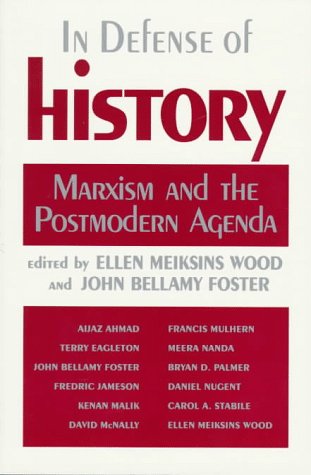
  • In Defense of History

    In Defense of History

    Buy at Monthly Review Press

    In Defense of History: Marxism and the Postmodern Agenda,” co-edited with Ellen Meiksins Wood (Foster listed second) (New York: Monthly Review Press, 1997), 204 pp. Expanded version of July-August 1995 special issue of Monthly Review. (Contains two essays, including an afterword, authored by Foster.)

    Are we now in an age of “postmodernity”? Even as some on the right have proclaimed the “end of history” or the final triumph of capitalism, we are told by some left intellectuals that the “modern” epoch has ended, that the “Enlightenment project” is dead, that all the old verities and ideologies have lost their relevance, that the old principles of rationality no longer apply, and so on. Yet what is striking about the current diagnosis of postmodernity is that it has so much in common with older pronouncements of death, both radical and reactionary versions. What has ended, apparently, is not so much another, different epoch but the same one all over again.

    In response, the best of today’s new intellectuals on the left are returning to historical materialism, to class analysis. This collection reflects that move, pinning postmodernism in its place and time. It exposes the erroneous bases of “pomo” premises, by identifying the real problems to which the current intellectual fashions offer false or no solutions. In doing so, the contributors challenge the limits imposed on action and resistance by those who see liberating “new times” in the contradictions of contemporary capitalism. What is being celebrated in the postmodern agenda, argues Ellen Meiksins Wood, is the prosperity of the consumerist 1960s reflected in a distorting mirror. The instability and economic polarization of the 1990s demand a solid critique of the conditions of capitalism, not endless reexaminations of their “meanings” this is the standard and goal of In Defense of History.

    Editions:

    • Indian edition, (Delhi: Aakar Books, 2006).
    Translations:
    • Chinese translation by Hao Mingwei. (Beijing: Social Science Academic Press, 2009).
    • Portuguese translation published in Rio de Janeiro in 1999.
    • The afterword to this book by Foster, entitled “In Defense of History,” was translated into Farsi and published in the Iranian journal Negah, September 2000.


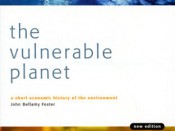
  • The Vulnerable Planet

    The Vulnerable Planet

    Buy at Monthly Review Press

    The Vulnerable Planet: A Short Economic History of the Environment,” (New York: Monthly Review Press, 1994), 160 pp.
    (A volume in the Cornerstone Books series; second edition, 1999.)

    In this clearly written and accessible book, John Bellamy Foster grounds his discussion of the global environmental crisis in the inherently destructive nature of our world economic system. Rejecting both individualistic solutions and policies that tinker at the margins, Foster calls for a fundamental reorganization of production on a social basis so as to make possible a sustainable and ecological economy.

    The Vulnerable Planet has won respect as the best single-volume introduction to the global environmental crisis. This edition includes a new afterword by the author.

    Editions:

    • Bangla language edition (Dhaka: Shahitya Prakash, 2010), with a new preface by the author.
    • Turkish language edition, (Maltepe-Ankara: EPOS Yayinlari, 2002).
    • Japanese edition, (Tokyo: Kobushi Forum/Sakai Agency, 2001), translated by Keiko Watanabe.
    • Telugu language edition (Andhra Padesh, India: Prajasakti), 2001.
    • Korean language edition, (Seoul: Dongzoknara, 1996)–contains new “Preface to the Korean Edition” by author.
    • Low cost edition, (Kharaaqpur, India: Cornerstone Publications, 1995)–for Indian market.
    Translations:
    • Chinese translation by Guo Jianren (Beijing: Commercial Press, 2013).
    • Chinese translation, Beijing University Press.
    • German translation (Hamburg: Laika-Verlag). Chapter 6, entitled “The Vulnerable Planet,” reprinted in Leslie King and Deborah McCarthy, Environmental Sociology: From Analysis to Action. (Lanham, MD: Rowman and Littlefield, 2005), pp. 3-15.
  • Liberal Practicality and the U.S. Left

    Liberal Practicality and the U.S. Left,” in Ralph Miliband, Leo Panitch and John Saville, ed., Socialist Register, 1990: The Retreat of the Intellectuals. (London: Merlin Press, 1990), pp. 265-89.

  • What is Stagnation?

    What is Stagnation?” in Robert Cherry, et. al., eds. The Imperiled Economy: Macroeconomics from a Left Perspective (New York: Union for Radical Political Economics, 1987), pp. 59-70. [PDF]

    INTRODUCTION:

    For a majority of mainstream and radical economists, the answer to the question “What is Stagnation”? is fairly simple and straightforward and devoid of any real theoretical significance in and of itself. Either it is seen as a period of longer and deeper than average recessions, or it stands for a long-cycle downturn, which will be followedmore or less automatically, after some 25 years duration, by a long-cycle upturn. However, in the case of most of those thinkers on the left who continue to emphasize theprimacy of demand- side constraints on the accumulation process in “the present as history,” the search for an answer to the above question is nothing less than an attempt toaddress the central contradiction of the mature monopoly capitalist system.

    The purpose of this article is to uncover the complex historical logic through which the phenomenon of stagnation is manifested in modern capitalism , as explained in the work of such radical demand-side theorists as Michal Kalecki, Josef Steindl, Paul Baran, Paul Sweezy and Harry Magdoff. Beginning with the reasons why a condition of stagnation (the main traits of which are widening underemployment, stop-and-start investment and slow growth) has come to represent the normal trend-line of the modem economy around which the recurrent fluctuations of the business cycle occur, the analysis will then shift to a consideration of the various self-limiting forces that sparked the expansionary wave of the 1960s; and how a waning of these forces, or of their positive effects, has led in the 1970s and 1980s to a resurfacing of stagnation and a doubling-over of economiccontradictions. The seriousness of the multi-layered crisis that emerges from such a conception of political economic evolution, will then be contrasted, in the conclusion, to the relative complacency engendered by the dominant supply-side strategy for the renewal of American capitalism.

  • The Faltering Economy

    The Faltering Economy

    Buy at Monthly Review Press

    The Economy: The Problem of Accumulation Under Monopoly Capitalism,” (co-edited with Henryk Szlajfer (Foster listed first) (New York: Monthly Review Press, 1984), 357 pp. (Contains three essays authored and one co-authored by Foster.)

    The essays in this volume, by veteran economists as well as younger scholars, are part of a radical attempt to grapple with the problems of advanced capitalist development without discarding the real theoretical breakthroughs made by Keynes. The contributors argue that Keynes was correct in pointing to the economic contradictions stemming from unemployment, incoming inequality, and speculative finance, but failed to consider the class composition of social output, the macroeconomic effects of the modern firm, and the atrophy of investment under conditions of capitalist maturity. They thus seek to uncover the sources of stagnation under monopoly capitalism by building on the work of three of the great economists of modern times: Marx, Keynes, and Kalecki.