Category: Contributions

Forewords, Introductions and Afterwords to Books by Others

  • “Foreword” to István Mészáros

    “Foreword” to István Mészáros, O Desafio E O Fardo Do Temp Histórico: O Socialismo No Século XX! [The Challenge and Burden of Historical Time] (Portuguese edition, Boitempo Editorial, Sao Paulo, Brazil, 2007), pp. 13-18.

    Translation(s):
    • English version of foreword in English edition of book, (New York: Monthly Review Press, 2008).
    • Portuguese language version also printed in Le Monde Diplomatique—Brazilian edition, November 2007.
    • Included in Spanish edition: El Desafio y la Carga del Tiempo Histórico.
  • Florence Kelley and the Struggle Against the Degradation of Life: An Introduction to a Selection from Modern Industry

    Florence Kelley and the Struggle Against the Degradation of Life: An Introduction to a Selection from Modern Industry” [PDF] (coauthored with Brett Clark, Clark listed first), Organization and Environment, vol. 19, no 2 (June 2006), 1-13. DOI: 10.1177/1086026606288224

    Florence Kelley illuminated how degraded environments stemmed from the social relations and operations of industrial capitalism. As a social reformer, she worked to document the various dangers that workers confronted. She presented how laborers were exposed to noxious gases, toxic substances, and poisonous chemicals and dyes. Dangerous materials, such as arsenic, were introduced into the production process without a concern for their health implications. Kelley’s critique of industrial capitalism and its exploitation of workers, especially in the form of child labor, revealed how a productive process driven by the accumu- lation of capital threatened the health of all people and hindered social development. She fought to make the public aware of the dangerous materials and hazardous conditions that were involved in the production of items for market. Kelley worked to unite consumers and laborers in a campaign to improve industrial relations, recognizing that a radical transformation of social relations was necessary in order to stop the degradation of life.

  • Political Economy and the Environmental Crisis: Introduction to Special Issue

    Political Economy and the Environmental Crisis: Introduction to Special Issue” [PDF] (co-authored with Richard York, Foster listed first—special issue on the treadmill of production, part I), vol. 17, no. 3 (September 2004), pp. 293-95. DOI: 10.1177/1086026604268016

    According to Frederick Buell (2003) in his book ‘From Apocalypse to Way of Life, perceptions of environmental crisis in the 1960s and 1970s were both narrower in scope and more apocalyptic (usually Malthusian) in tone than those of today. Rather than diminishing, the problem of the environment has only expanded in the years since Rachel Carson’s ‘Silent Spring‘, was published. Severe environmental crisis is no longer foreign to us—not some future to be feared and avoided so much as a present in which we are living. It has become a structural reality of modern life and accepted as such, even normalized. If anything, a certain fatalism has emerged. It is now increasingly understood by environmental sociologists and many others that global ecological degradation is at the core of the development of modern (particularly capitalist) forms of production and is inescapable as long as those relations of production remain unaltered. Proba- bly the earliest analyst to articulate such a structural view through a fully developed political-economic theory of environmental degradation under corporate capitalism was Allan Schnaiberg (1980) in his magnum opus, ‘The Environment: From Surplus to Scarcity‘. It was here that Schnaiberg introduced the important concept of the treadmill of production—the topic taken up in this special issue. Schnaiberg rejected all apocalyptic notions, believing that something could be done if social relations could be radically transformed, yet his indictment of our present system of production for its degradation of the environment was all the more damning as a result.

  • China and Socialism

    China and Socialism: Editors’ Foreword” [PDF], Monthly Review, vol. 56, no. 3 (July 2004), pp. 2-6.

    “Foreword” to Martin Hart-Landsberg and Paul Burkett, China and Socialism: Market Reforms and Class Struggle (New York: Monthly Review Press, 2005)

    We depart this year from our usual practice for MR’s July–August double issue. Instead of a collection of articles on a common theme, we are devoting the issue to a single manuscript—a study of China and economic development theory by Martin Hart-Landsberg and Paul Burkett that was published in book form by Monthly Review Press. Although there are numerous books on China, this one is especially worthy. It is a careful, clear, well-grounded Marxist study of how a major post-revolutionary society turned away from socialism. In addition, the current transformation in China throws light on why capitalism, by its very nature, creates poverty, inequality, and ecological destruction in the process of economic growth.

  • Land, the Color Line and the Quest of the Silver Fleece: An Introduction to W.E.B. Du Bois, The Souls of Black Folk and The Quest of the Silver Fleece

    “Land, the Color Line and the Quest of the Silver Fleece: An Introduction to W.E.B. Du Bois, The Souls of Black Folk and The Quest of the Silver Fleece (selections),” [PDF] (coauthored with Brett Clark, Clark listed first) Organization and Environment, vol. 16, no. 4 (December 2003), 459-69.

    Manning Marable (1999) writes that William Edward Burghardt Du Bois (1868-1963) “was without question the most influential black intellectual in American history” (p. v). Even more, he was a citizen of the world, gaining an international stature rarely achieved (Gates, 1989, p. xii). This year is the centennial of The Souls of Black Folk (Du Bois, 1903/1989), in which Du Bois famously declared, “the problem of the Twentieth Century is the problem of the color line” (p. xxxi). The color line divides people within the countryside, cities, and the globe. People of color are denied the same opportunities, privileges, and rights as Whites. During a life spanning 95 years, Du Bois’s scholarly work and commitment to activism were unsurpassed. He engaged in critical examinations of social and racial relations within the United States, as well as on the global level, always incorporating a rich historical context for situating his studies. Unfortunately, the relationship between human beings and nature, which was such a crucial part of his overall analysis, has received little attention.

  • Imperialism Without Colonies

    Imperialism Without Colonies

    “Introduction” to Harry Magdoff, Imperialism Without Colonies (New York: Monthly Review Press, 2003), pp. 9-19

    In the decades after 1945, as colonial possessions became independent states, it was widely-believed that imperialism as a historical phenomenon was coming to an end. The six essays collected in this volume demonstrate that a new form of imperialism was, in fact, taking shape—an imperialism defined not by colonial rule but by the global capitalist market. From the outset, the dominant power in this imperialism without colonies was the United States.

    Magdoff’s essays explain how this imperialism works, why it generates ever greater inequality, repression, and militarism, and the essential role it plays in the development of U.S. capitalism.

    His concluding essay presciently points out the limits of any attempted reform of the global economy which does not directly challenge the framework of capitalism.

    Written in the 1960s and 70s, Magdoff’s essays constituted a major contribution to Marxist theory and provided a model of rigorous argument in which theory is constantly checked against the economic reality. They provide an indispensable guide to the basic forces at work in the global politics of the twenty-first century.

    • Published also in Monthly Review, vol. 55, no. 1 (May 2003) under the title “Imperial America and War,” pp. 1-10.
    Translations:
    • Chinese translation in Chinese Academic Social Science Press, 2012.
  • The Rediscovery of Imperialism

    The Rediscovery of Imperialism

    “The Rediscovery of Imperialism: Introduction” to Harry Madoff, Essays on Imperialism and Globalization,” Monthly Review vol. 54, no. 6 (November 2002), pp. 1-16. DOI: 10.14452/MR-054-06-2002-10_1

    The concept of “imperialism” was considered outside the acceptable range of political discourse within the ruling circles of the capitalist world for most of the twentieth century. Reference to “imperialism” during the Vietnam War, no matter how realistic, was almost always a sign that the writer was on the left side of the political spectrum. In a 1971 foreword to the U.S. edition of Pierre Jalée’s Imperialism in the Seventies Harry Magdoff noted, “As a rule, polite academic scholars prefer not to use the term ‘imperialism.’ They find it distasteful and unscientific.”

    Translations:
    • Turkish translation in Cosmo Politik, no. 6 (Winter 2002), pp. 16-25.
    • Spanish translation at Correntroig, July 6, 2008. Translation by Fernando Lizárraga.


  • Helen Keller and the Touch of Nature: An Introduction to Keller’s The World I live In

    Helen Keller and the Touch of Nature: An Introduction to Keller’s The World I live In (Selections),” [PDF], (coauthored with Brett Clark, Clark listed first), Organization and Environment, vol. 15, no. 3 (September 2002), pp. 278-84.

    I found that of the senses, the eye is the most superficial, the ear the most arrogant, smell the most voluptuous, taste the most superstitious and fickle, touch the most pro-found and the most philosophical.

    —Diderot (as cited in Herrmann, 1998, p. vii)

    Mark Twain asserted that Helen Keller (1880-1968) was immortal—fellow to Caesar, Homer, and Shakespeare—and would “be as famous a thousand years from now as she is to-day” (Twain, 1924, Vol. 2, p. 297). Elementary school teachers have told the story of Keller’s childhood for more than a hundred years, whereas her activist and intellectual developments as an adult remain in the shadows. The environmental movement has yet to discover the importance of Keller’s contribution to an ecological understanding of the world. Nonetheless, her work provides a foundation for constructing a dynamic view of the relationship between nature and ourselves. By exploring the world, through Keller’s words, insights can be gained in regard to how humans experience nature. Perhaps, through this engagement, a more complete picture of Keller’s life and position in history can be formed.
  • George Perkins Marsh and the Transformation of the Earth: An Introduction to Marsh’s Man and Nature

    George Perkins Marsh and the Transformation of the Earth: An Introduction to Marsh’s Man and Nature“, [PDF], (coauthored with Brett Clark, Clark listed first), Organization and Environment, vol. 15, no. 2 (June 2002), pp. 164-69.

    George Perkins Marsh (1801-1882) stated that his book, Man and Nature, was “a little volume showing the whereas [Carl] Ritter and [Arnold] Guyot think that the earth made man, man in fact made earth” (as cited in Lowenthal, 2000, p. 267). With this position, Marsh inverted a dominant theoretical transformation— both destruction and revitalization— of nature. Despite Marsh’s Calvinist background, he sought to remove teleological tendencies from scientific studies of the material world. In Man and Nature, Marsh (1864) provided a detailed discussion of the historical degradation of nature. His work is seen as a warning to a society that insists on an irrational interaction with nature. Marsh demanded that people must work to restore, to whatever extent is possible, damages to nature, as well as engage in practices that prevent further degradation of nature. Marsh’s work, Lewis Mumford (1931-1971) declared, was “the fountain-head of the conservation movement” (p. 35).

  • In Defense of History

    In Defense of History

    Buy at Monthly Review Press

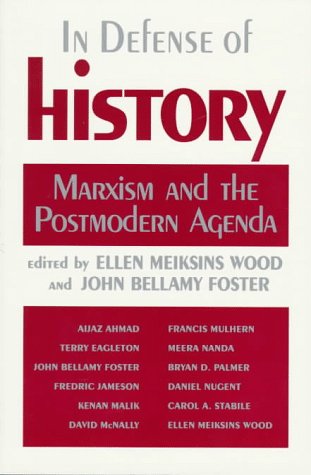
    In Defense of History: Marxism and the Postmodern Agenda,” co-edited with Ellen Meiksins Wood (Foster listed second) (New York: Monthly Review Press, 1997), 204 pp. Expanded version of July-August 1995 special issue of Monthly Review. (Contains two essays, including an afterword, authored by Foster.)

    Are we now in an age of “postmodernity”? Even as some on the right have proclaimed the “end of history” or the final triumph of capitalism, we are told by some left intellectuals that the “modern” epoch has ended, that the “Enlightenment project” is dead, that all the old verities and ideologies have lost their relevance, that the old principles of rationality no longer apply, and so on. Yet what is striking about the current diagnosis of postmodernity is that it has so much in common with older pronouncements of death, both radical and reactionary versions. What has ended, apparently, is not so much another, different epoch but the same one all over again.

    In response, the best of today’s new intellectuals on the left are returning to historical materialism, to class analysis. This collection reflects that move, pinning postmodernism in its place and time. It exposes the erroneous bases of “pomo” premises, by identifying the real problems to which the current intellectual fashions offer false or no solutions. In doing so, the contributors challenge the limits imposed on action and resistance by those who see liberating “new times” in the contradictions of contemporary capitalism. What is being celebrated in the postmodern agenda, argues Ellen Meiksins Wood, is the prosperity of the consumerist 1960s reflected in a distorting mirror. The instability and economic polarization of the 1990s demand a solid critique of the conditions of capitalism, not endless reexaminations of their “meanings” this is the standard and goal of In Defense of History.

    Editions:

    • Indian edition, (Delhi: Aakar Books, 2006).
    Translations:
    • Chinese translation by Hao Mingwei. (Beijing: Social Science Academic Press, 2009).
    • Portuguese translation published in Rio de Janeiro in 1999.
    • The afterword to this book by Foster, entitled “In Defense of History,” was translated into Farsi and published in the Iranian journal Negah, September 2000.