Category: Conference Papers/Participation

  • Western Marxism and the Myth of Capitalism’s Adamantine Chains

    Western Marxism and the Myth of Capitalism’s Adamantine Chains

    Western Marxism and the Myth of Capitalism’s Adamantine Chains,” keynote address delivered to the inagural conference of the Society for Peace, Internationalism and Ecology,” October 18, 2025, Villanova University, Pennsylvania.
    Western Marxism and the Myth of Capitalism's Adamantine Chains

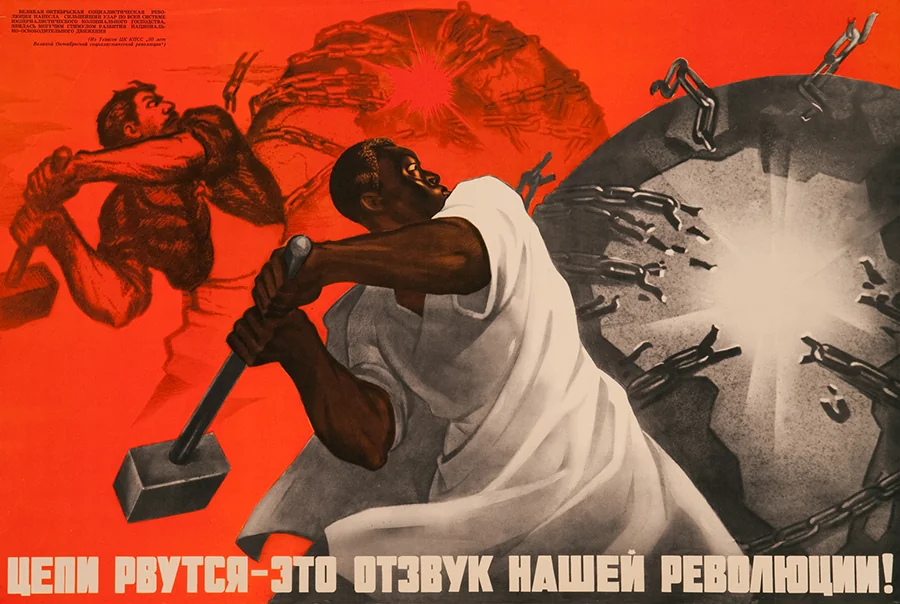
    In his doctoral thesis on the ancient philosopher Epicurus, Karl Marx compared Epicurus to Prometheus, the Titan of Greek mythology, who was bound with unbreakable adamantine chains to a rock for what was intended to be eternity by Hephaestus on the orders of Zeus. Prometheus’s crime was that he had provided fire, standing for universal enlightenment (the name Prometheus means “foresight”) and creative, emancipatory powers to humanity.1 The symbolism was important. Marx quoted Epicurus (via Lucretius) several times in his dissertation on “breaking the bonds of fate,” arguing that a materialist perspective was not necessarily rigidly deterministic or fatalistic, but rather was compatible with notions of human freedom, which would always break free or swerve away from any imposed limits.2 For Marx, no adamantine fetters stood in the way of the progress of freedom. As the 20-year-old revolutionary Frederick Engels wrote in “Retrograde Signs of Our Times,” all reactionary movements “eventually disintegrate in conflict with one another and under the adamantine foot of the forward moving time,” which inevitably creates new conditions and new revolts.3 In Aeschylus’s great dramatic trilogy, Prometheus Bound was succeeded by Prometheus Unbound, and then Prometheus the Firebearer, standing for the great gift of freedom to humanity. Marx, who read Aeschylus every year in the original Greek, never lost sight of the revolutionary implications of the Greek myth.4

    The post-Second World War Western Marxist philosophical tradition departed from the revolutionary spirit of classical historical materialism, in effect accepting the notion of adamantine chains imposed by capitalism on the working class, while abandoning the notion of “breaking the bonds of fate.” The ancient Greek Promethean myth, as presented by Aeschylus, was inverted, becoming a symbol not of enlightenment, hope, defiance, and revolution, but of the adamantine fetters imposed by modern capitalism, which could not be surmounted. For Herbert Marcuse in his Eros and Civilization, Prometheus stood for toil, order, and imprisonment. This was not the Prometheus of Aeschylus, representing defiance and revolt on behalf of humanity, but the Cold War version of the Prometheus myth armed against Marxism.5 Western Marxism thus surrendered to defeatism and adopted its own version of the end of history, as in the abstract negativity of Marcuse’s Great Refusal, replacing revolutionary praxis.6 None other than Perry Anderson wrote in Considerations on Western Marxism in 1976, “The hidden hallmark of Western Marxism as a whole is…that it is a product of defeat. The failure of the socialist revolution to spread outside Russia…is the common background to the entire theoretical tradition of this period…. This unbroken record of political defeat—for working-class struggle, for socialism—could not but have profound effects on the nature of Marxism formed in this era.”7 Here Anderson ignored revolutions in the periphery, such as those of China and Cuba, as of no significance in this regard, since occurring outside a developed occidental capitalism.

    The Dialectic of Defeat

    At the root of the retrogression of Western Marxism was a belief in the complete economic triumph of capitalism. As Marcuse wrote in One-Dimensional Man, “The enchained possibilities of advanced industrial societies are: development of the productive forces on an enlarged scale, extension of the conquest of nature, growing satisfaction of needs for a growing number of people, creation of new needs and possibilities. But these possibilities are gradually being realized through means and institutions which cancel their liberating potential, and this process affects not only the means but the ends.”8 The result of such a Western Marxist conception was the writing off altogether of proletarian-based revolutions, which were undermined by capitalism’s “enchained possibilities.”

    The various material successes that Marx pointed to in his panegyric to the bourgeoisie in the first half of Part One of The Communist Manifesto were seen by Marcuse as freed of the contradictions that Marx introduced a few pages later: economic crises; the sorcerer’s apprentice, standing for the unforeseen rifts between society and nature; and the rise of capital’s gravedigger in the form of the modern proletariat. Capitalism was thus presented as victorious in a material sense. “On theoretical as well as empirical grounds, the dialectical concept,” Marcuse stated,

    pronounces its own hopelessness. The human reality is its history, and, in it, contradictions do not explode by themselves. The conflict between streamlined, rewarding domination on the one hand, and its achievements that make for self-determination and pacification [of the struggle for human existence] on the other, may become blatant beyond any hope of denial, but it may well continue to be a manageable and even productive conflict, for with the growth in the technological conquest of nature grows the conquest of man by man.

    Summing up, he wrote, “dialectical theory is not refuted, but it cannot offer the remedy. It cannot be positive.”9

    The view that saw a Weberian “iron age” imposed by capitalism based on its economic and technological successes became the default position of the Frankfurt School and the Western Marxist philosophical tradition as a whole. Writing during the first quarter-century after the Second World War in what is today called “the golden age,” Western Marxists adopted the view that not only was the capitalist economy an overriding success, but the proletariat had been enriched and permanently “bourgeoisified,” enchained in its subservient role by the petty rewards obtained in the process of capitalism’s successful development. This was evident in the work of Theodor Adorno, who argued in 1964 that, contrary to the Marx and Engels of The Communist Manifesto, workers now had much “more to lose” than simply their chains. He referred here to their “cars and motorcycles.”10 What Adorno meant by this, from the standpoint of his negative dialectics, was that these commodities, symbolizing the embourgeoisement of the proletariat, represented new sociopsychological chains of oppression. Marx’s absolute general law of accumulation, in which he had emphasized that the relative gap between the capitalist class and the working class constantly increased, creating ever-greater class polarization, whether the workers’ wages were “high or low,” was trivialized by Adorno, in line with Cold War ideology, as a mere “theory of immiseration.”11

    Following in the footsteps of Engels and V. I. Lenin in this respect, Adorno insisted that Western workers were now to a considerable degree bourgeoisified. However, Adorno did not follow Engels and Lenin in analyzing such embourgeoisement in terms of the labor aristocracy theory, whereby a privileged section of workers benefited from the surplus of monopoly capitalism/imperialism.12 Nor did he subscribe to the notion, emphasized by Engels, in relation to Britain, that the existence of a labor aristocracy and the embourgeoisement of a significant section of the proletariat was fleeting, eventually to be undermined by the waning of colonial/imperial dominance. Rather, Adorno’s Eurocentric analysis left no room for the critique of imperialism, or even a developed analysis of monopoly capitalism. As the German critic Hans Mayer, who had known Adorno since 1934, remarked: “Europe sufficed for him entirely. No India or China, no Third World, not the people’s democracies and not the workers’ movement.”13

    What is at issue here can be clarified by saying that the main thrust of the philosophical tradition of Western Marxism is characterized by four retreats: (1) from class, (2) from materialism, (3) from the dialectics of nature, and (4) from the critique of imperialism. Behind this is not a denial of Marxist theory altogether, but rather its enclosure in a permanent bourgeois universe, which could be critically analyzed for its lack of true liberation but not transcended.14

    The retreat from class was built into the notion that in its golden-age capitalism was lessening class distinctions and removing any radicalism on the part of an affluent bourgeoisified working class with their cars and motorcycles.15 The retreat from materialism was both an abandonment of genuine economic critique and, more importantly, of the materialist conception of nature, the dialectical counterpart of the materialist conception of history. The retreat from the dialectics of nature meant that the human relation to external nature could be reduced to a technological conquest of nature (what Max Horkheimer and Adorno dubbed the “dialectic of Enlightenment”).16 The retreat from critique of imperialism meant that Europe was the final destiny and the definition of modernity. As Georg Wilhelm Friedrich Hegel had written: “the History of the World travels from East to the West, for Europe is absolutely the end of History.”17

    Western Marxism was a retreat from Marx, not so much to Hegel, but rather to Max Weber, who rejected the Marxian theory of class and class struggle (in favor of the mere competition for life chances on the market); replaced historical materialism with neo-Kantian idealism, dualism, and methodological individualism; and conceived of the West as the only source of cultural phenomena of “universal significance and value” based on formal or instrumental rationality. Hence, the world was an “iron cage,” from which there was no escape.18 In its long, convoluted dialectical inversion, Western Marxism went from the left-Hegelian notion that “the rational is real” not to its opposite, the right-Hegelian notion that “the real is rational,” but rather steering toward the pseudo-critical, pseudo-Freudian position that the irrational is real, ruled by the “death instinct,” with the world permanently stripped by capitalism of any genuine materialist-revolutionary content.19 It thus increasingly converged with the anti-rationalist reaction of Friedrich Nietzsche. This is what Russell Jacoby called, in the title of his book, the Dialectic of Defeat.20 The dialectic of defeat of Western Marxism was not of course the dialectic of a spiral, embodying the negation of the negation, but what Adorno termed “negative dialectics,” denying a positive moment altogether, and thus caught up in an endless circling back to bourgeois views.21

    Where Western Marxism thrived was in its analysis of the subjective, particularly in the application of psychoanalytic categories drawn from Sigmund Freud, and the critique of reification. There were detailed analyses of the culture industry and media domination. Yet, this gave rise not to analysis of the vicissitudes of class consciousness but rather to the reified, enchained world of class unconsciousness, turning Georg Lukács’s History and Class Consciousness on its head.22 The problem, as Marcuse put it in Weberian terms, is that the “administered individuals” of modern one-dimensional society must “liberate themselves from themselves as well as from their masters.”23 The almost exclusive focus thus became the self-destruction of the human material for change. So great was the problem as conceived in critical theory that Marcuse, as we have seen, asked whether the critical theory of society must abdicate altogether, “the dialectic having pronounced its hopelessness.” He concluded his book by highlighting the bare possibility that “the historical extremes may meet again: the most advanced consciousness of humanity and its most exploited force. It is nothing but a chance.”24

    The Longer and Wider View

    Raymond Williams strongly warned against “long-run adjustments to short-run problems,” the tendency to see the condition of the immediate moment as determining the long-run trajectory.25 Rather, as Paul A. Baran insisted, it was necessary to take “the longer view” directly into account in all of one’s immediate actions, in order to understand the contradictions, and possibilities for revolutionary praxis. Baran was a Russian Marxist economist who was a researcher at the Institute for Social Research in Frankfurt prior to Adolf Hitler’s rise to power, and who emigrated to the United States at the commencement of the Second World War. In the 1960s, he wrote Monopoly Capital with Paul M. Sweezy, which exhibited some aspects of the Frankfurt School analysis, but which was also a historical critique of the irrational monopolistic and imperialistic capitalism of the twentieth century. Although Baran and Sweezy, like Marcuse, ended their book with the observation that the working class was not then in revolt in the United States, unlike Marcuse they did not see this as a permanent phenomenon, but rather as something that would change with changing historical conditions. Writing in the mid-1960s, they concluded that “even if the present protest movements should suffer defeat or prove abortive, that would be no reason to write off permanently the possibility of a real revolutionary movement in the United States.”26 Not only were militarism and imperialism at the center of Baran and Sweezy’s book, but Baran had published the pioneering dependency analysis, The Political Economy of Growth, less than a decade before.27 Baran and Sweezy argued, based on concrete reality, that the main revolutionary struggle between workers and capital had shifted in the twentieth century to the periphery of the system in the Global South, which was the basis of the contemporary world revolution inspired by Marxist theory.

    Baran had a long friendship with Marcuse going back to the early 1930s, when they were both at the Institute for Social Research in Frankfurt. Marcuse sent him the manuscript of One-Dimensional Man in 1963, prior to publication. Seeing the flaws in the work, Baran wrote to Sweezy:

    What is at the present time at issue and indeed most urgently so is the question of whether [the] Marxian dialectic has broken down, i.e. whether it is possible for Scheisse [shit] to accumulate, to coagulate, to cover all of society (and a goodly part of the related world) without producing the dialectical counter-force which would break through it and blow it into the air. Hic Rhodus, hic salta! If the answer is affirmative then Marxism in its traditional form has become superannuated. It has predicted the misery, it has explained full well the causes of [this misery] becoming as comprehensive as it is; it was in error, however, in its central thesis that the misery generates itself the forces of its abolition.

    I have just finished reading Marcuse’s new book (in MS) [One-Dimensional Man], which in a laborious kind of a way advances this very position which is called the Great Refusal or the Absolute Negation. Everything is Dreck [dirt]: monopoly capitalism and the Soviet Union, capitalism and socialism as we know it; the negative part of the Marx story has come True—its positive part remained a figment of imagination. We are back at the state of the Utopians pure and simple; a better world there should be but there ain’t no social force in sight to bring it about. Not only is Socialism no answer, but there isn’t anyone to give that answer anyway. From the Great Refusal and the Absolute Negation to the Great Withdrawal and the Absolute Betrayal is a very short step….

    What is required is a cool analysis of the whole situation, the restoration of a historical perspective, a reminder of the relevant time dimensions and much more.28

    There is no doubt that in many cases, as Baran intimated, the Great Refusal and the Absolute Negation did turn into the Great Withdrawal and the Absolute Betrayal. The argument that the real is irrational, when divorced from a “cool [materialist] analysis of the whole situation, the restoration of a historical perspective, and a reminder of the relevant time dimensions”—not excluding the Eurocentric failure to confront imperialism—led to an absolute retreat into what Lukács called the “Grand Hotel Abyss.”29 It was only a step beyond this to retrograde forms of postmodernism and posthumanism, representing purportedly radical views that undermined what was left of the radical Enlightenment. Hegel ended his final work with the question “reform or revolution?” (clearly preferring the former).30 The post-Marxist left is no longer capable of doing even that, identifying with populism or republicanism, anything but genuine socialist praxis rooted in the international working class, as if it were a relic of a different age. But with this was lost any hope of transcending the existing society. “The history of [Western] Marxism,” Jacoby wrote, “is the loss of the dialectical critique of bourgeois society.”31

    Material Crisis of Our Time and the Necessity of Freedom

    In truth, there is no such thing as an objective dialectic of defeat. History is a process of continuity and change, of the negation of the negation, with no possibility of a final ending short of nuclear or environmental oblivion (real possibilities today). Western Marxism inculcated a view that history had reached a resting point, even if it continued to peer out between the bars of the iron cage—most often simply peering about within. The main focus of critical theory was understanding the persuasive power of capital and the capitulation of the working class that this brought about. Class analysis gave way in postmodernist thinkers, like Gilles Deleuze and Felix Guattari, who took this logic to its conclusion, to the treatment of capitalist induced schizophrenia.32

    As Galileo is supposed have said (doubtless apocryphal) as he reached down to the earth, after being compelled by the Church to renounce the Copernican view of the universe: “And yet it moves.”33 Western Marxism’s retreats from the dialectics of nature and from imperialism, along with materialism and class, left it ill-equipped to address actual economic, social, and environmental change on a global level. By rejecting both materialism and the dialectics of nature and thereby natural science, Western Marxists were unprepared to address ecological issues when they arrived. Alfred Schmidt’s Concept of Nature in Marx, a doctoral thesis written under the supervision of Horkheimer and Adorno, published in the same year as Rachel Carson’s Silent Spring, partly recognized the significance of Marx’s notion of metabolism, but missed altogether his theory of metabolic rift, or ecological crisis. Arguing against Bertolt Brecht and Ernst Bloch, who, following Marx, had theorized the revolutionary reconciliation and harmonization of nature and humanity, Schmidt pointed to the inescapable rule of the conquest of nature or the so-called dialectic of the Enlightenment. Nature and natural science were seen as largely alien to any understanding of society as second nature.34 The retrieval of Marx’s ecology was thus delayed, even as the world became aware of the mounting planetary ecological crisis.

    A similar phenomenon happened with respect to class. More and more, Western Marxists, as Ellen Meiksins Wood explained in The Retreat from Class in 1986, dissociated politics from class, moved toward a technological determinism, substituted loosely defined “democratic forces” for the working class, and adopted mass “populist” politics that ignored class relations. In this way, Western Marxists tended to merge with liberal ideology, creating what could be called an Inverted Marxism.35 Today, these arguments have morphed into the position that Marx is better seen as a republican, or as advocating a politics limited to the democratic citizen, than a militant socialist concerned with revolutionary working-class transformation aimed at substantive democracy.36 Even the famous analysis of the “culture industry” of Adorno and others lacked any concrete significance when placed against the critical-realist political economy of communication and the contemporary revolt for control of the cultural apparatus.37

    The ultimate retreat of Western Inverted Marxism was its tendency to see the quintessential modern capitalism as representing “the rational capitalistic organization of (formally) free labour” in Weber’s terms, divorced from the theory of monopoly capitalism/imperialism and even from Marx’s theory of exploitation.38Socialist humanism and radical historical materialism were both roundly criticized by structuralist thinkers such as Louis Althusser, despite their role in all genuine revolutions erupting in the Global South. Peripheral capitalist societies were seen, according to the logic of modernity, as moving inexorably toward developed capitalism, and thus the West—insofar as they could be seen as modernizing at all. As Bill Warren argued, supposedly basing his analysis on the Marx of the early 1850s, imperialism was the “pioneer of capitalism.”39 So indifferent were Western Marxists to Third World struggles, as Domenico Losurdo pointed out, that they saw 1968 in Europe and its defeat as more important than the decades of revolutionary struggle around the globe—from China to Cuba, from Kwame Nkrumah’s Ghana to Salvador Allende’s Chile—associated with what L. S. Stavrianos called The Global Rift.40 Curiously, with revolutions against colonialism, imperialism, and dependency taking place throughout the three continents of the Global South, Western Eurocentric Marxists frequently spoke myopically of the failure of revolution, since this was supposed to take place only in mature capitalist societies in the West.

    Unmoored from history and materialism in this way, the Inverted Marxism of the West, while full of penetrating ideas, can restore its fading place in Marxism as a whole only through a process of rescue and retrieval, putting it on its feet once again. This requires reconnecting with the classical historical-materialist tradition of Marx and Engels, and with the revolutionary struggles against imperialism and capitalism, both past and present, being fought throughout the Global South. Today this coincides with the great antisystemic battle to save the planet as a place of human habitation. These realities have required paradigm shifts in historical-materialist theory to incorporate the ubiquitous new dangers of capitalism’s limitless globalization and the rift that this has created in the biogeophysical flows of the planet—viewed as a place of earthly habitation for humanity and all living species.41 These crucial paradigm shifts require regrounding Marxism in its original materialist, dialectical, and revolutionary bases, with their more universal aims.

    It should be acknowledged today that the development of Marxist theory and praxis, in the present historical context, is today occurring more rapidly in countries such as China, Venezuela, and Cuba than in the so-called “advanced countries” of the West. The former have delinked to some extent from the imperialist world system and are pursuing their own sovereign socialist projects in cooperation with other countries in the Global South. The main contradictions are now planetary: the Earth System crisis, the threat of thermonuclear war, the reality of hyperimperialism, and the necessity of an international labor alliance. All these struggles point to socialism as the only possible alternative.

    Breaking the Adamantine Chains

    Prometheus did not remain in chains for eternity, despite Zeus’s original intentions, but regained his freedom after only 30,000 years. In Aeschylus’s Prometheus Unbound, of which we have only fragments, Prometheus was freed from his unbreakable adamantine chains by Heracles/Hercules, the son of Zeus and the mortal Alcmene, who broke the unbreakable shackles, achieving the impossible. Prometheus was able to use his foresight as leverage on the tyrant Zeus, who needed the farsighted Prometheus to reveal the details of his own possible future so as to prevent his being deposed.42 In the final part of Aeschylus’s trilogy, Prometheus the Firebearer, Prometheus, as George Thomson surmised from the structure of the first two plays, and what little evidence can be derived of the third, comes to be worshiped by humanity as the deliverer.43

    In the late eighteenth and early nineteenth-century, Enlightenment/Romantic figures like Samuel Taylor Coleridge, Mary Wollstonecraft, and Percy Bysshe Shelley wrote of human freedom and the release from adamantine chains, breaking the bonds of fate.44 For the young Engels, an admirer of Shelley, the “adamantine foot” of time, which kicked loose all existing material conditions and created new ones, altered the realm of human possibility and social relations, providing openings for historical change. Marx referred to both “golden chains,” when workers and their potential allies were bought off, and the “chain” of “illusion” in which mysticism, religion, and commodity fetishism constantly constrained (but did not contain) the struggle for human freedom. Nevertheless, he insisted that the fetters represented by the existing relations of production could be broken.45

    In the present day, the alienated material necessity of capitalism in the form of the concentration and centralization of immense wealth and power among a very few, the scaling up of wars of extermination, and the planetary ecological crisis can only be overcome by the revolutionary emergence of a society of substantive equality, ecological sustainability, and social freedom.

    The agent of that change is best conceived today as the global environmental proletariat, the working class in its broadest, most universal materialist form—a new emergent reality of revolt. Just as ecological civilization, as it is conceived at present primarily in China, represents the highest form of the socialist struggle, so the environmental proletariat is the mature form of the material class struggle, directed at sustainable human development. If the capitalist class expropriated both humanity and the earth, the environmental proletariat is the necessary negation of the negation if the world is to free itself from capitalist perdition. The chains of humanity are self-imposed, meaning that the present can be unshackled—but only if the struggle for human freedom is progressively widened.

    Notes

    1. See George Thomson, “Introduction,” in Aeschylus, Prometheus Bound, ed. and trans. George Thomson (Cambridge: Cambridge University Press, 1932), 1–47; George Thomson, “Special Introduction,” in Aeschylus, Oresteia Trilogy/Prometheus Bound, trans. George Thomson (New York: Dell, 1965), 24–26.
    2. See John Bellamy Foster, Breaking the Bonds of Fate: Epicurus and Marx (New York: Monthly Review Press, 2025).
    3. Karl Marx and Frederick Engels, Collected Works (New York: International Publishers, 1975), vol. 2, 48.
    4. Paul Lafargue, “Reminiscences on Marx,” in Reminiscences of Marx and Engels, ed. Institute of Marxism and Leninism (Moscow: Foreign Languages Publishing House, n.d.), 74.
    5. Herbert Marcuse, Eros and Civilization (Boston: Beacon Press, 1964), 74–75. See John Bellamy Foster, “Eco-Marxism and Prometheus Unbound,” Monthly Review 77, no. 6 (November 2025): 2–5.
    6. Herbert Marcuse, One-Dimensional Man (Boston: Beacon Press, 1964), 63–64, 255–57.
    7. Perry Anderson, Considerations on Western Marxism (London: Verso, 1976), 42–43.
    8. Marcuse, One-Dimensional Man, 255.
    9. Marcuse, One-Dimensional Man, 253.
    10. Theodor W. Adorno, Philosophical Elements of a Theory of Society, eds. Tobias ten Brink and Marc Phillip Nogueira, trans. Wieland Hoban (Cambridge: Polity, 2019), 38, 49–50.
    11. Adorno, Philosophical Elements of a Theory of Society, 31, 49.
    12. See Martin Nicolaus, “The Theory of the Labor Aristocracy,” Monthly Review 21, no. 11 (April 1970): 91–101.
    13. Martin Jay, The Dialectical Imagination (Boston: Little, Brown, and Co., 1973), 187.
    14. This framework was first introduced in John Bellamy Foster and Gabriel Rockhill, “Western Marxism and Imperialism: A Dialogue,” Monthly Review 76, no. 10 (March 2025): 9.
    15. What Marx called the unity of opposites (or the identity of identity and nonidentity) characterizing capital and labor was here turned into a narrow, one-sided identity of opposites.
    16. Max Horkheimer and Theodor Adorno, Dialectic of Enlightenment (New York: Continuum, 1944).
    17. G. W. F. Hegel, The Philosophy of History (New York: Dover, 1956), 103.
    18. Max Weber, The Protestant Ethic and the Spirit of Capitalism, trans. Talcott Parsons (London: George Allen and Unwin, 1930), 13–17, 181; Max Weber, From Max Weber: Essays in Sociology, eds. Hans Gerth and C. Wright Mills (New York: Oxford University Press, 1946), 181.
    19. G. W. F. Hegel, The Philosophy of Right (New York: Oxford University Press, 1952), 10; Sigmund Freud, Beyond the Pleasure Principle (New York: W. W. Norton, 1989), 53, 59.
    20. Russell Jacoby, Dialectic of Defeat: Contours of Western Marxism (Cambridge: Cambridge University Press, 1981).
    21. Theodor Adorno, Negative Dialectics (New York: Continuum, 1973), xix.
    22. Jacoby, Dialectic of Defeat, 120–21.
    23. Marcuse, One-Dimensional Man, 250.
    24. Marcuse, One-Dimensional Man, 25.
    25. Terry Eagleton, “Resources for a Journey of Hope: The Significance of Raymond Williams,” New Left Review I/168 (March–April 1988).
    26. Paul A. Baran and Paul M. Sweezy, Monopoly Capital (New York: Monthly Review Press, 1966), 366–67.
    27. Paul A. Baran, The Political Economy of Growth (New York: Monthly Review Press, 1957, 1962).
    28. Paul A. Baran and Paul M. Sweezy, The Age of Monopoly Capital, eds. Nicholas Baran and John Bellamy Foster (New York: Monthly Review Press, 2017), 430.
    29. Georg Lukács, The Theory of the Novel (London: Merlin Press, 1971), 22.
    30. Georg Wilhelm Friedrich Hegel, Political Writings (Cambridge: Cambridge University Press, 1999), 270.
    31. Jacoby, Dialectic of Defeat, 27.
    32. Gilles Delueze and Felix Guattari, Anti-Oedipus: Capitalism and Schizophrenia (Minneapolis: University of Minnesota Press, 1983).
    33. Mario Livio, “Did Galileo Truly Say ‘And Yet It Moves?,’” Scientific American (blog), May 6, 2020.
    34. Alfred Schmidt, The Concept of Nature in Marx (London: New Left Books, 1971), 11, 43, 78–79, 88, 154–62, 186–87.
    35. Ellen Meiksins Wood, The Retreat from Class (London: Verso, 1986). On “Inverted Marxism,” see John Bellamy Foster, Comments, “Gabriel Rockhill, Who Paid the Pipers of Western Marxism Book Launch with Ali Kadri and John Bellamy Foster,” posted by Critical Theory Workshop, 1:40:27, December 11, 2025, youtube.com/watch?v=0SOFasECUbg.
    36. Bruno Leipold, Citizen Marx: Republicanism and the Formation of Marx’s Social and Political Thought (Princeton: Princeton University Press, 2024); William Clare Roberts, Marx’s Inferno: The Political Theory of Capital (Princeton: Princeton University Press, 2018).
    37. Theodor Adorno, The Culture Industry (London: Routledge, 1991). On the critique of the cultural apparatus, see John Bellamy Foster and Robert W. McChesney, “The Cultural Apparatus of Monopoly Capital,” Monthly Review 65, no. 3 (July–August 2013): 1–33. On the contemporary struggle over the political economy of the cultural apparatus, see John Bellamy Foster, “Robert W. McChesney (1952–2025): A Personal and Political-Intellectual Memoir,” Monthly Review 77, no. 7 (December 2025): 1–23.
    38. Weber, The Protestant Ethic and the Spirit of Capitalism, 21.
    39. L. Bill Warren, Imperialism, Pioneer of Capitalism (London: Verso, 1980).
    40. S. Stavrianos, Global Rift: The Third World Comes of Age (New York: William Morrow and Co., 1981).
    41. See John Bellamy Foster, Brett Clark, and Richard York, The Ecological Rift (New York: Monthly Review Press, 2010).
    42. It was foretold that if Zeus had a child with a particular woman, then Zeus’s own offspring, the fruit of this union, would depose him. Only Prometheus, with his foresight, knew who that woman (Thetis) was, and used this as a means against Zeus, and used this information as a means of obtaining his release and readmission to Olympus—but only after Zeus had ended his absolute tyranny over Gods and humans.
    43. Thomson, “Introduction,” Aeschylus, Prometheus Bound; Thomson, “Special Introduction,” Aeschylus, Oresteia Trilogy/Prometheus Bound; Carey Jobe, “Aeschylus’ Prometheus Unbound: Rebuilding a Lost Masterpiece,” Antigone (2024), antigonejournal.com.
    44. Samuel Taylor Coleridge, Aids to Reflection (London: Edward Moxon, 1854); Mary Wollstonecraft, A Vindication of the Rights of Women (New York: A. J. Matsell, 1833) 37; Percy Bysshe Shelley, Prometheus Unbound (Boston: D. C. Heath and Co, 1892), 68.
    45. Marx and Engels, Collected Works, vol. 3, 176; Karl Marx, Wage-Labour and Capital in Karl Marx, Wage-Labour and Capital/Value, Price and Profit (New York: International Publishers, 1976), 40; Karl Marx, A Contribution to a Critique of Political Economy (Moscow: Progress Publishers, 1970), 21; Erich Fromm, Beyond the Chains of Illusion (New York: Simon and Schuster, 1962).
  • Eco-Marxism and Prometheus Unbound: Capitalist versus Socialist Ecomodernism

    Eco-Marxism and Prometheus Unbound: Capitalist versus Socialist Ecomodernism

    “Eco-Marxism and Prometheus Unbound: Capitalist versus Socialist Ecomodernism,” keynote presentation to Fourth World Congress of Marxism, Peking University, Beijing, October 12, 2025.

    Eco-Marxism and Prometheus Unbound

    In the West, ecological modernization as a model for addressing environmental problems has long been the subject of critique by ecosocialists and by radical ecologists in general. In contrast, in China, ecological modernism as a way of redressing environmental problems has the strong backing of ecological Marxists. The primary reason for these differing approaches should be obvious. In the West, the notion of ecological modernization, while unobjectionable in itself as part of a comprehensive process of environmental change, has come to stand ideologically for the restrictive model of capitalist ecological modernization. Here it is suggested that environmental problems can be addressed by technological means alone within the established social relations of capitalism in a purely reformist context. Distinct from this, socialist ecological modernization, as envisioned in China and in a few other postrevolutionary states, is substantively different. It requires a break with the social relations of capital accumulation, facilitating changes in the human relation to nature that are of a revolutionary character, aimed at the creation of an ecological civilization geared to sustainable human development.

    A parallel problem arises with respect to the notion of “Prometheanism,” an ambiguous term ostensibly based on the ancient Greek myth in which Prometheus, a Titan, gave fire to humanity. In the contemporary capitalist view, the Promethean myth has been transformed in such a way that it is seen as standing for technology and power, even for industrial revolutions.1 Yet, in the original Greek myth as presented by Aeschylus in Prometheus Boundand later adopted by Enlightenment thinkers, including Percy Bysshe Shelley and Karl Marx, Prometheus, chained to a rock by Hephaestus on the command of Zeus, stood for the revolutionary defiance of the gods, and was the source of human enlightenment and self-consciousness.2 Capitalist Prometheanism therefore is not the same as revolutionary humanist Prometheanism. The former is about technology and power and has little relation to the Greek myth itself; the latter is about revolutionary enlightenment, the development of social individuals, and the human accord with nature.

    In the ruling capitalist ideology of the West/Global North, the issue of the impact of the capital accumulation process on the environment, including the Earth System crisis itself, is either avoided altogether or is seen as subject to pure technological solutions, with no need to alter class, property, capital, and consumption relations. Ecological modernization as a theory and a practice has thus come to stand principally for an anti-ecological stance in that it puts capitalist social relations before issues of humanity and nature, insisting that nothing needs to change but the machines, while the accumulation of capital remains the supreme object of the system. It is ecological modernization in this narrow ecotechnic sense that is meant when mention is made of the “greening of capitalism.” In its absolute rejection of ecological limits to unrestrained accumulation, capitalist ecological modernization is a manifestation of a fatal incapacity to address the needs of humanity and nature.

    Within Chinese ecological Marxism, in contrast, ecological modernization is not about preserving capitalism and opposing environmentalism. Instead, it is conceived as socialist ecological modernization, part of the process of creating a new ecological civilization. This does not mean that the ecological contradictions of development and modernity magically disappear. But the task here is viewed differently, aimed at explicitly building a more environmental consciousness and reality. As Xi Jinping says, “clear waters and green mountains” are worth as much or more than “mountains of gold,” and ultimately this means that choices have to be made to sustain the former, even at the expense of the latter.3

    Ecosocialism and the Promethean Myth

    What makes it so difficult to disentangle the ecological debate in the West is that the alienated, dualistic consciousness that has historically characterized the hegemonic ideology has penetrated the ecosocialist movement itself. This has generated all sorts of contradictions, arising not simply out of capitalism but also emanating from the legacy of the Cold War and its antisocialist ideology. Western Marxism often played an ambiguous role in the Cold War, critical of both capitalism and state socialism, while falling prey to the four retreats (from materialism, the dialectics of nature, class, and imperialism).4 Hence, it is not surprising that the rise of ecosocialism as a defining concept in the 1980s was closely tied to Cold War ideology. Leading ecosocialists of the period, such as Ted Benton in England and John P. Clark in the United States, took the position that Marx’s work and that of Marxism generally was “Promethean” in the hyperindustrialist sense and thus opposed to ecology. For Benton, writing in New Left Review, Marx stood accused of having a mechanistic “Promethean, ‘productivist’ view of history” that militated against an environmental perspective.5

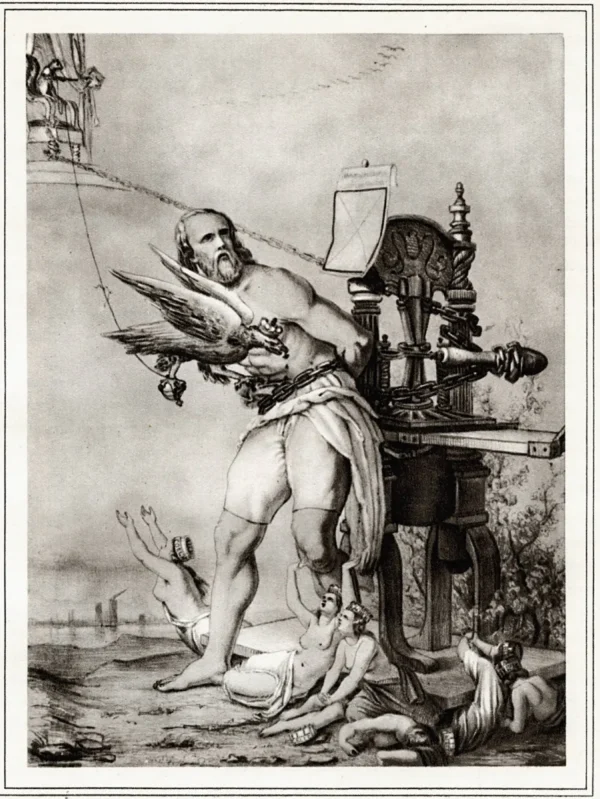
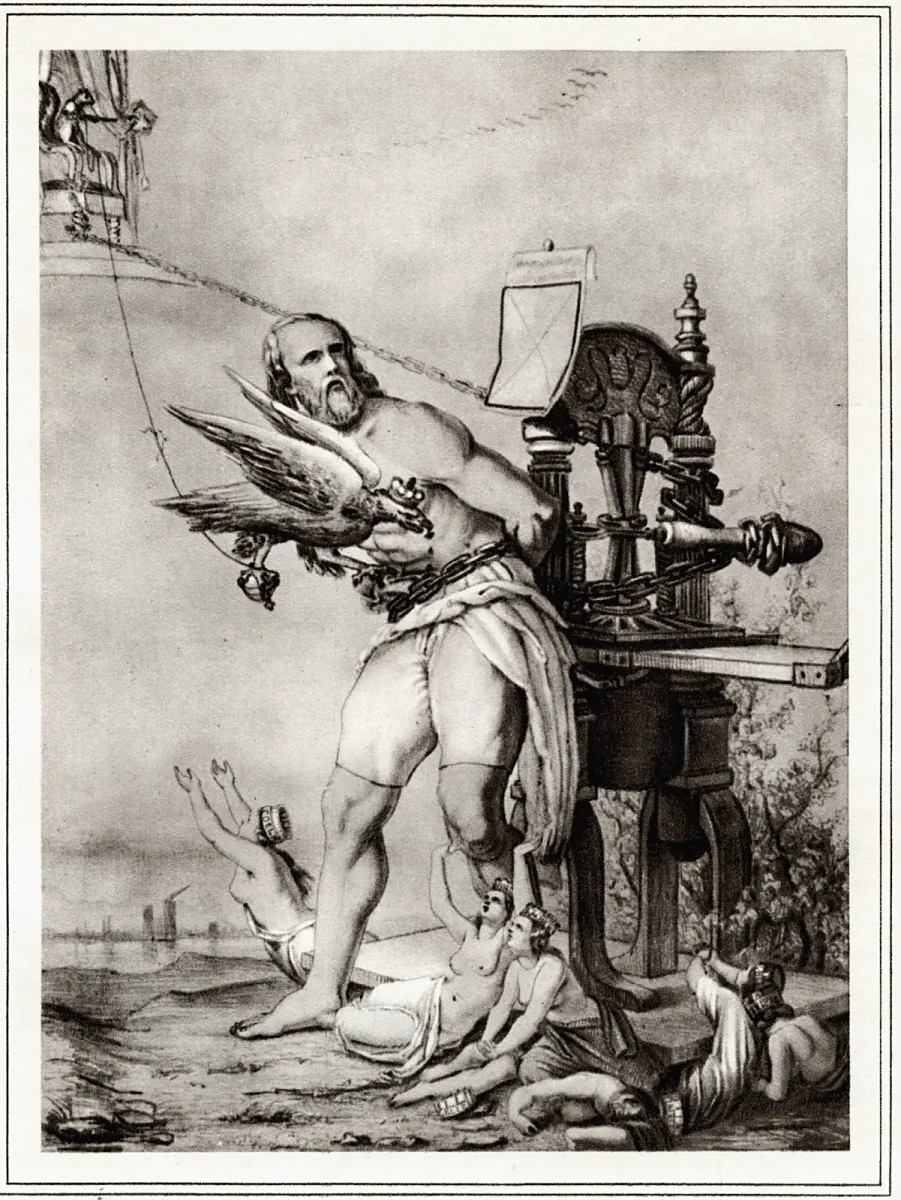
    For Marx, Epicurus was “the true radical Enlightener of antiquity.”6 In his praise of Epicurus in his dissertation, Marx compared him to Prometheus (as depicted by Aeschylus)—the revolutionary Titan who had defied the gods of Olympus by bringing fire—standing for light and knowledge­—to humanity, and who was punished by being chained to a rock for eternity on the orders of Zeus.7 Here Marx replicated Lucretius’s famous eulogy to Epicurus in De rerum natura, which had formed the basis for Voltaire’s use of the term “Enlightenment” in eighteenth-century France.8 This, and a contemporary lithograph on the censorship of the Rheinische Zeitung, of which Marx was editor, depicting Prometheus chained to a printing press, engendered the common identification of Marx with Prometheus.9

    Breaking with the dominant millennia-long conception of Prometheus as a bringer of light/Enlightenment—though Joseph Pierre-Proudhon in the nineteenth century had promoted a mechanical Prometheanism and Mary Shelley had referred to “The Modern Prometheus” in the subtitle to her Frankenstein—Cold War warriors in the West, many of them disaffected leftists writing for CIA-funded publications like Encounter, began presenting Marx as an advocate of extreme Prometheanism.10 This was a code name for the advocacy of unlimited instrumentalism, as the chief aim of society, used to identify Marx with Russia under Joseph Stalin, with its rapid industrialization and seeming emphasis on gigantism. Biography after biography of Marx touted his reference to Prometheus in his dissertation, with no attempt to explain the context—that is, his praise of Epicurus as a Prometheus-like figure in the sense of Aeschylus’s Prometheus Bound. Epicurus was known for being the leading materialist philosopher of the ancient Greek world and for his humanistic commitment to a self-conscious sustainable community, all of which led Marx to compare him to the Prometheus of myth, none of which had anything to do with instrumentalism, hyperindustrialism, or gigantism.11

    Notably, in his famous 1918 biography of Marx, Franz Mehring had characterized Marx as a “second Prometheus both in struggle and in suffering.”12 This was adopted and distorted early on by critics of Marx. In To the Finland Station (1940), Edmund Wilson presented Marx as a mechanistic Prometheus with production as his only object, behind whom stood the ominous shadow of Lucifer.13 One of the earliest and most influential Cold War works to portray Marx as a Promethean instrumentalist was Robert C. Tucker’s Philosophy and Myth in Karl Marx (1961), which saw both G. W. F. Hegel and Marx as promoting philosophies “whose very own confession was that of Prometheus.”14 This general view was taken over by Cold Warriors like Lewis Feuer in Marx and the Intellectuals (1969) and Daniel Bell in his The Cultural Contradictions of Capitalism (1976), with the former accusing Marx of a Promethean “mythopoeic compulsion” devoted to technological absolutism.15

    Cold War propagandists who attacked Marx and Marxism for its so-called mechanistic Prometheanism were mainly concerned with presenting Marxism as antihumanist, instrumentalist, and hyperindustrialist, in line with their conception of Soviet Communism. Yet, true to their capitalist vision, such critics of Marxism were neither enemies of productivism nor on the side of the environment. Thus, Bell, in The Coming of Post-Industrial Society, was one of the chief critics of the Club of Rome’s Limits to Growth study (1972). He argued that ecological limits to growth simply did not exist and that resource scarcity was impossible in the new postindustrial world.16

    Although Cold War criticism of classical Marxism for its supposed mechanistic Prometheanism was thus originally aimed at claiming that Marxism was inherently antihumanistic, this was to metamorphose into the charge that historical materialism was anti-environmentalist through the work of figures like British sociologist Anthony Giddens, who contended in 1981 in A Contemporary Critique of Historical Materialismthat Marx had a “Promethean attitude” in which nature was reduced to instrumental terms.17 This was seconded by a number of prominent ecosocialists, who claimed that Marx was a “Promethean” productivist, and thus an anti-environmentalist, thinker.18 What is now commonly referred to as first-stage ecosocialism, in the 1980s and ’90s, thus came to stand mainly for a view that represented a break with classical Marxism on environmental grounds, often comparing Marx unfavorably to Thomas Malthus and modern neo-Malthusianism in this respect.19

    In the late 1990s, however, a second-stage ecological Marxism emerged, beginning with the work of the present author and Paul Burkett. Here the object was to uncover Marx’s own ecological critique, while countering charges that Marx had advocated a so-called hyperindustrialist “Prometheanism.”20 Emphasis was placed on Marx’s ecological critique of capitalism in his theory of metabolic rift and his conception of sustainable human development.21 This led to the rapid development of Marxian ecology or of second-stage ecosocialism, fully integrated with the critique of capitalism as a whole and with Marxian dialectics. A very substantial body of work, consisting of hundreds and hundreds of books and articles, has been published, utilizing the general metabolic rift analysis arising from Marx’s ecological critique of capitalism to address nearly every aspect of the modern planetary ecological crisis, historically and in the present.22

    Marx and ecological Marxism can be accurately viewed as Promethean only in the sense of the ancient Greek myth of Prometheus itself, as described, in particular, in Aeschylus’s Prometheus Bound, as this had been understood for millennia. Marx depicted Epicurus via Prometheus as a protorevolutionary figure who brought Enlightenment to antiquity while defying the whole “pack of gods.”23 It was in this very same spirit that Rachel Carson, in the modern environmental movement, was to defy what she called “the gods of profit and production.”24

    Capitalist Ecological Modernization as Ideology

    If numerous first-stage ecosocialists in the 1980s accused Marx and Frederick Engels of mechanistic Prometheanism or hyperindustrialism, and thus branded historical materialism as productivist and anti-ecological, the reality was that many of the most radical struggles over the environment from the 1950s on were led or inspired by socialist ecologists, including figures like Scott Nearing, Barry Commoner, Virginia Brodine, Shigeto Tsuru, K. William Kapp, Raymond Williams, Charles H. Anderson, Murray Bookchin, Allan Schnaiberg, Richard Levins, Richard Lewontin, Nancy Krieger, and Rudolf Bahro. In the 1970s, socialist ecology was already a potent force at the movement level, particularly in the United States. Socialist environmentalists were particularly noteworthy for their rejection of neo-Malthusianism, or the notion that ecological problems could be traced principally to population rather than the system of production.

    The broad socialist ecological critique was heavily influenced by Marx’s historical materialism and Engels’s Dialectics of Nature. It arose first in the natural sciences, beginning in the 1950s, in response to nuclear weapons testing, in the work of critical scientists like Commoner, and gained further impetus in the United States in the late 1960s and early ’70s, in response to a host of problems, manifested in Science for the People(both the publication and the organization).25

    Within the social sciences, radical and Marxist ecological analysis predominated in the Environmental Sociology section of the America Sociological Association (ASA), which first emerged in the early 1970s.26Among the leading figures in environmental sociology were radicals William Catton, author of Overshoot: The Ecological Basis of Revolutionary Change (1982), and Riley Dunlap, who, in the context of the limits to growth debate being waged then mainly by economists, introduced (together with Catton) the distinction between the human exemptionalist paradigm and the new ecological paradigm. The human exemptionalist paradigm, as critically defined by Catton and Dunlap, stood for the hegemonic perspective of capitalist modernity. It was the view that humanity was largely exempt from natural constraints, and that there were ultimately no natural or ecological limits to human advance, which was seen as reliant simply on human ingenuity and technology.27

    The foremost representatives of human exemptionalism in the debates over the limits to growth in the 1970s and ’80s were resource economist Julian Simon, author of The Ultimate Resource, and economic growth theorist Robert Solow, winner of the (so-called) Nobel Memorial Prize in Economic Sciences. Simon, denying all ecological constraints on capital accumulation, pronounced that “there is no meaningful physical limit [or limits]…to our capacity to keep growing [the economy] forever” within the earth environment.28 Solow wrote: “If it is very easy to substitute other factors for natural resources, then there is in principle no ‘problem.’ The world can, in effect, get along without natural resources, so exhaustion is just an event, not a catastrophe.”29 It was this dominant exemptionalist paradigm that had been challenged by Limits to Growth, which pointed to growing environmental (mainly resource) constraints as the world economy expanded and passed critical thresholds—a perspective that was later extended to address both the problem of increased natural resource constraints or the “tap” and the problem of overflowing ecological wastes or the “sink.”30

    The new ecological paradigm was closely linked to the limits to growth perspective, and thus represented a frontal attack on the human exemptionalist paradigm. It formed the initial common ground of the Section on Environmental Sociology of the ASA. Originally articulated by Catton and Dunlap, it was later codified in terms of five tenets: (1) limits to growth, (2) non-anthropocentrism, (3) fragility of nature’s “balance,” (4) untenability of human exemptionalism, and (5) ecological crisis.31 While the new ecological paradigm was in many ways the starting point, this came to be integrated by the late 1970s and early ’80s in the Environmental Sociology Section of the ASA, with Marxist critiques of monopoly capitalism, the treadmill of production/accumulation, and ecological waste, which joined in the critique of the human exemptionalist paradigm. Theoretically, environmental sociology in the United States prior to the second decade of the present century was dominated by the Marxian critique of capitalism and its ecological degradation. This included not only those, like Schnaiberg, who subscribed to the treadmill of production framework, but also those associated with second-stage ecosocialism, many of whom were identified with the Environmental Sociology Section of the ASA.32

    However, the strong critique of capitalism that formed the basis of the Environmental Sociology Section of the ASA began to break down in 2003. In October–November 2003, a conference was organized at the University of Wisconsin in honor of Schnaiberg and the treadmill of production perspective, constituting a neo-Marxist tradition central to U.S. environmental sociology that depicted the conflict between capitalism’s accumulation tendencies and the environment. Yet, the conference as it turned out had a dual agenda, since Dutch ecomodernists Arthur P. J. Mol and Gert Spaargaren were also invited.33 These thinkers set about criticizing neo-Marxist approaches to the environment and defending capitalism’s ability to solve environmental problems simply by technological means—in effect offering a new, more nuanced human exemptionalism, which had emerged out of the environmental reform movement in Europe. The debate persisted for years. Ecological modernization—though widely recognized as theoretically and empirically weak compared to radical ecological and ecosocialist analyses—eventually gained considerable prominence due to its greater conformity to the system, with the official prestige and support that this provided. For Mol and Spaargaren, it was necessary to move away from “the ecologically inspired strand of environmental sociology.” The new ecological paradigm was accused of “coquetting with ecology,” representing an unacceptable “hybrid of sociology and ecology.” Mol and Spaargaren contended that there was no “key obstruction” to environmental reform under capitalist relations of production.34

    At their best, capitalist ecological modernists advanced the notion that technology and markets could meet environmental challenges within the capitalist system through mild, light-green reforms without changes in social relations; at their worst, they denied all need for radical ecological strategies and movements. In 2010, Mol, the leading representative of ecological modernization theory, was given the Distinguished Contribution (or lifetime) Award from the Environmental Sociology Section of the ASA, indicating that ecological modernization theory, despite its opposition to the radical ecological critique, and its general anti-environmentalist stance, was now considered within the proper purview of the discipline. This reflected a general growth of anti-environmentalism, with the percentage of Americans who considered themselves environmentalists dropping from 76 percent in 1989 to 41 percent in 2021.35

    Academic ecological modernization theory had its roots in Cold War modernization theory. In attacking the red-green theories of thinkers like Bahro and Commoner, Spaargaren argued that they were wrongly opposed to the “industrial society theory” developed by “Daniel Bell and others,” celebrating capitalist modernization and industrialization. Modernization, in this sense, was associated with conservative sociologist Talcott Parsons’s structural functionalism, and even more with a conception that identified modernity with the West, which was characterized as constituting the “universal” culture in the Weberian sense.36 As leading Cold War sociologist and anti-Marxist Edward Shils argued, modernization meant the West. In his own words, “‘Modern’ means being western without the onus of following the West. The model of modernity is a picture of the West detached in some way from its geographical origins and locus.”37 Naturally, “the West” in this sense also stood for capitalism, which was seen as uniquely Western.

    Western ecological modernization theory is thus procapitalist and Eurocentric. Nevertheless, a key proposition of both Spaargaren and Mol was that ecological modernization is entirely independent of social and economic relations. As Mol put it, “the ideology of ecological modernisation” consisted of the view that “an environmentally sound society” could be created without reference to “a variety of other social criteria and goals such as the scale of production, the capitalistic mode of production, workers’ influence, equal allocation of economic goods, gender criteria, and so on. Including the latter set of criteria might result in a more radical programme (in the sense of moving further away from the present social order), but not necessarily a more ecological radical programme.”38 The implication was that the advent of socialism would not materially improve matters ecologically. Or, as he wrote elsewhere, “ecological modernisation theorists believe…that the environment can be protected within the logic and rationality of capitalism….’Green’ capitalism is seen as possible, and in some respects even desirable.” This means “redirecting and transforming ‘free market Capitalism’ in such a way that it less and less obstructs, and increasingly contributes, to the preservation of society’s sustenance base.” More broadly, he stated, ecological modernization means “the incorporation of nature as a third force of production [after labor and capital] in the capitalist economic process.”39 For the ecological modernist Maarten Hajer, it was possible to see “ecological modernisation as the perception of nature as a new and essential subsystem” of industrial capitalism.40 How the entire Earth System could become a “subsystem” of industrial society in spatial and temporal terms was not explained.

    Capitalist Ecological Modernization and the Western Left

    In 2007, ecomodernists Michael Shellenberger and Ted Nordhaus, who in 2004 published the essay “The Death of Environmentalism,” brought out their book Breakthrough: From the Death of Environmentalism to the Politics of Possibility, launching at the same time the Breakthrough Institute, a procorporate, procapitalist, ecomodernist, and anti-environmentalist think tank.41 Constituting an attempt to bring ecomodernism into the limelight, the Breakthrough Institute stands for a program of supposedly solving ecological problems via market-based technology, subsidized by the capitalist state, while keeping existing social relations intact. This approach is anti-environmentalist in the sense of rejecting the environmental movement and promoting the myth of the greening of capitalism. In 2015, the Breakthrough Institute initiated An Ecomodernist Manifesto: From the Death of Environmentalism to the Birth of Ecomodernism, which argued that the only solution to environmental challenges was “accelerated decoupling” of the economy from the environment by more intensive forms of production requiring “accelerated technological progress.” Although arguing that their approach could not be reduced to the system of capital accumulation or free market conservatism, it went against any changes in existing social relations. The best answer to climate change, the Ecomodernist Manifesto affirmed, was nuclear power, billed as “the only present-day zero-carbon technology with the demonstrated ability to meet most, if not all, of the energy demands of a modern economy.”42

    In its many accounts of ecomodernism, the Breakthrough Institute presents capitalism as the only pathway to a green solution. In his book Green Delusions (1992), attacking radical environmentalism and ecosocialism, Breakthrough senior fellow Martin Lewis advocated a mechanistic “Promethean environmentalism,” which he identified with the human-exemptionalist, “technocratic” approach of Simon in The Ultimate Resource.43Breakthrough senior fellow Patrick Brown has argued against all logic and evidence that “climate adaptation has been a resounding success in the modern era of rapid capitalistic economic growth.” According to Brown there is “no coherent trend in global floods” or global droughts or global wildfires. The “carbon budget” has not been “breached.” He flatly denies the criticism that capitalism is changing the climate “much faster than we are adapting to it.”44 Breakthrough Institute senior fellows Nordhaus and Alex Smith, writing for the “democratic socialist” journal Jacobin, argue that corporate-style agribusiness is the most efficient way in which to address agriculture ecologically, and is the model for a decoupling ecomodernism.45

    Ecomodernist strategy is often presented as “progressive” and has increasingly been openly celebrated by liberal and social democratic thinkers as “Promethean” in the hyperindustrialist sense.46 Here “Prometheanism” as a propagandistic Cold War term introduced to characterize Marxism as a form of instrumentalism and extreme productivism, and, thus, antihumanist—and then later adopted by first-stage ecosocialists to criticize Marx as anti-environmentalist—has been turned into a badge of honor in social democratic circles. Thus, so-called “democratic socialist” ecomodernists Matt Huber and Leigh Phillips, writing for Jacobin, proudly present themselves as belonging to a long tradition of mechanistic “‘Promethean’ Marxists.” Consistent with the hegemonic notion that the ecological problem is manageable without fundamental changes in social relations, they reject Marx’s metabolic rift theory. Following Simon’s human exemptionalism, Huber and Phillips insist that the only truly “insuperable limits” to economic expansion are “the laws of logic and physics.”47 In Phillip’s words, mimicking Simon’s anti-environmental human exemptionalism, which he praises, “you can have infinite [economic] growth in a finite planet.” He goes on: “The Socialist…must defend economic growth, productivism, [hyperindustrial] Prometheanism.”48 The planet we are told has a carrying capacity that can support “282 billion” people—or more. “Energy is freedom. Growth is freedom.” The goal of society is “more stuff.”49

    Economic expansion, in this view, comes first, humanity and the planet last. The ecological program of such thinkers, ostensibly on the left, does not differ materially from that of the neoliberals of the Breakthrough Institute, with whom they are closely aligned.50

    Huber and Phillips do not entirely ignore social relations. Yet, they refrain from challenging unlimited capital accumulation or infinite exponential economic growth. All that is needed to address climate change, we are told, is “socialist” (that is, social democratic) planning based on organized labor, particularly electrical workers.51 Huber strongly opposes what he calls the “anti-system environmental radical” and offers as his solution an “anti-carbon democracy.” In line with erstwhile leftist Christian Parenti, he argues that an ecosocialist “revolutionary overthrow of capitalism” is not a viable option on a reasonable timescale. Hence, the strategy adopted must conform to the internal logic of the capitalist system itself. If capitalism were “decarbonized” and the fossil fuel industry were “euthanized” as part of a capitalist Green New Deal, Huber contends, anthropogenic climate change would simply cease to exist and there would be no need for “aggregatereductions in energy consumption” or reductions in capital accumulation, even in the developed capitalist countries.52 Accumulation of capital could presumably go on as before, reaching ever greater heights, but on a decarbonized basis.

    The argument that conceives endless economic growth/accumulation as the driving force in a Green capitalist solution to climate change is tied to the reduction of the Earth System emergency to climate change alone. This is backed up by Huber and Phillips’s remarkable assertion, in defiance of all contemporary Earth System science, that the other eight planetary boundaries represent no obstacle to human advancement.53 Such planetary boundaries as the loss of biological integrity (including mass species extinction), the rift in the biogeochemical flows (disruption of the nitrogen and phosphorus cycles), land-system change (including deforestation), freshwater loss, novel entities (chemical, radionuclide, and plastic pollution), and ocean acidification—all of which natural scientists say have now been crossed—are simply wished out of existence.54Democratic socialist (or social democratic) ecomodernism, conceived in this way, “attains adequate expression when, and only when, it becomes a mere figure of speech,” belying any rational relation to ecology.55

    What is clear in all of this is that a socialist approach to the planetary ecological emergency is either revolutionary in scope, or it is a contradiction in terms: at best a strategy of making the current accumulative society work better, while denying the dialectical totality of the Earth System crisis.

    It is worth emphasizing that there are virtually no ecological thinkers on the left who actually oppose a process of ecological modernization altogether when conceived as part of a comprehensive strategy of promoting ecological sustainability, including changes in both social relations and productive forces. Ecosocialist opposition rather is directed at capitalist ecological modernization as a theory and practice that includes such regressive views as: (1) the refusal to recognize that the fundamental ecological problem is related to capitalism and requires revolutionary changes in social relations; (2) the irrational human-exemptionalist postulate that technology—in accord with the so-called “free market” and the “environmental state”—constitutes the total solution to environmental contradictions, irrespective of prevailing social relations; (3) the belief that exclusive reliance on machine technology makes a purely reformist approach to ecological crises possible; and (4) the denial of critical planetary boundaries and critical ecological limits, the crossing of which creates rifts in the biogeochemical cycles of the planet, endangering humanity and innumerable other species.

    China and Socialist Ecological Modernization

    The concept of modernity in bourgeois ideology in the West has always stood for the broad economic, political, and cultural developments of capitalism and the West, often equated with one another. The roots of modernity, for Max Weber, lay in the formal rationality that established “Western civilization and…Western civilization only” as the “universal” culture, represented by its science, technology, religion, historical method, music, art, architecture, law, politics, and above all capitalism.56 In David Landes’s The Unbound Prometheus: Technological Change and Industrial Development in Western Europe from 1750 to the Present (1969), Western capitalism and the Industrial Revolution were simply seen as products of a larger process of modernization in which the West had excelled.57 Modernization, in the Eurocentric conception, ultimately has no meaning other than the domination of nature and of the global periphery via institutions, particularly of a technological and economic nature, supposedly originating (and culminating) in the West.58 As Latin American thinker Enrique Dussel wrote, “‘Modernity’ [or at least the European conception of modernity] appears when Europe affirms itself as the ‘center’ of a World History that it inaugurates; ‘the periphery’ that surrounds this center is consequently part of its self-definition.”59 Ecological modernization is viewed in the Western imperial core of the world system, as simply a further addition to this conception, a technocapitalist, modernist, reformist solution to environmental problems, seen as reflecting another stage of the Western imperial core’s rich maturity. It denies what Marx saw as the metabolic rift inherent in the capitalist accumulation process.60

    But if in Western ideology it is held that there is only one modernity, based in European culture and capitalism, the actual historical origins of modernity, as a break with more traditional views of the human relation to the world, it can be argued, went much further back, arising in the recognition that humanity was homo faber. The view that human beings were capable of changing the world and thus makers of their own history, independently of the “pack of gods,” was never—as Marxist critics of Eurocentrism such as Joseph Needham and Samir Amin declared—a unique innovation of the Western Enlightenment. Rather it was a product of worldwide cultural development arising during the long Axial Age, in which a similar centering of human self-development could be seen as emerging in many different civilizations.61 This was evident in Epicurus’s materialist philosophy in the Hellenistic world, and in the emergence of Daoism (and Confucianism) in the Warring States period in China. Modernity, viewed in this deeper historical sense, becomes a product of universal civilization tendencies operating globally with the emergence of human self-consciousness in the Hegelian sense. Socialist, as opposed to capitalist, conceptions of modernity are a product of this more worldwide conception, extending back over millennia, where the object, as in Marx’s analysis, is sustainable human development and the full realization of elemental human needs.

    It is here that socialist modernization, and specifically socialist ecological modernism, has to be considered, particularly in relation to its development in China. China is a 5,000-year-old civilization, with a strong traditional ecological heritage stemming from Daoism and Confucianism, but that now, under “socialism with Chinese characteristics,” is introducing a revolutionary ecological modernism tied to its concept of ecological civilization that transcends anything envisioned in the West. Socialist ecological modernization, despite the familiarity of some of its basic forms—for example, the attempt to develop green technology and its concern with economic welfare—is best conceived as the inverse of capitalist ecological modernization in its underlying logic. As Chen Yiwen wrote in “The Dialectics of Ecology and Ecological Civilization“:

    Modernization in harmony with nature is part of the overall conception of Chinese modernization, which means that it requires: (1) prioritizing the coordination of the population with the resources and carrying capacity of the environment; (2) ensuring public ownership of natural resources and social sharing of ecological welfare in the process of advancing common prosperity; (3) producing ecological products and cultivating ecological culture in the context of pursuing coordination between material and cultural-ethical advancement; (4) opposing any form of ecological imperialism and extractivism; and (5) promoting the creation of a clean and beautiful world while adhering to the path of peaceful development.62

    Nothing could be more opposed to the conception of capitalist ecological modernization in the West, which has its roots in the expropriation of nature. Ecological modernization is generally seen in Europe and the United States as an extension of the technological domination of nature aimed at ensuring human exemptionalism. It envisions a world of unlimited capitalist accumulation that by virtue of technology is free from environmental constraints, with the economy simply decoupled from the biogeochemical processes and elemental conditions of the Earth System. In contrast, as Xi explains regarding China’s ecological civilization, “Nature provides the basic conditions for human survival and development. Respecting, adapting to, and protecting nature is essential for building China into a modern socialist country in all respects,” one synonymous with ecological civilization. He writes: “To fundamentally improve our ecosystems, we must abandon the model based on an increase in material resource consumption, extensive development, high energy consumption, and high emissions.”63

    Socialist ecological modernization, which avoids the delusions of “green capitalism,” makes the building of an ecological civilization a direct object. This is counterposed to capitalist ecomodernism, which is intended to maintain the dominant social relations and the anti-ecological logic of the unrestrained capital-accumulation system, while simply attempting to ameliorate some of its worst effects—in the midst of a planetary ecological emergency!—via second-order regulations and new technology. In U.S. monopoly capitalism, for example, the development of solar technology has always been hindered by the threat it poses to the dominant fossil fuel system, and therefore is intended, at best, to supplement the latter. Here ecological modernization means the continued subordination of environmental to economic goals.64

    Under its socialist ecological modernization China has surpassed the West in nearly every category of renewable energy development. In 2023, China accounted for 83 percent of world solar panel production, while the United States accounted for only 2 percent. China’s high-speed rail system is larger, faster, and more efficient than that of Europe, and China also accounts for 90 percent of the world bus market. Electric vehicles sales in China now exceed those of internal combustion engines. Within the next three years, according to the Financial Times, China will be obtaining more than half its energy from low-carbon sources, and “is on its way to becoming the world’s first ‘electrostate,’” with a growing portion of its economy supported by electricity and clean energy. As a result, China’s carbon emissions have begun to fall, even with strong economic growth and its continuing heavy, if diminishing, reliance on coal-fired plants. China is the leader in increase in forests globally, with forest coverage nearly doubling since the 1980s.65

    Yet, it would be a mistake, based on such achievements, to see Chinese ecological modernization as simply entailing a kind of green productivism, which is the meaning of capitalist ecological modernization in the West. Rather, socialist ecological modernization aimed at building an ecological civilization is, in Xi’s words, “the modernization of harmony between humanity and nature.”66

    Crucial to the Sinicization of Marxism is the goal of the formation of a “community of life” in all of its dimensions, from ecosystems to human-nature relations to the human metabolism with the Earth System itself. “It is essential to differentiate,” Chen has written, socialist ecological modernization in China “from the notion of ‘ecological modernization’ that emerged in Europe in the mid- to late 1980s…prevalent in developed capitalist nations, [which] seeks to enhance gradually environmental quality through economic and technological improvements and public administration adjustments (including the increasing application of market instruments) often without challenging the fundamental tenets of capitalism.”67 Instead, the emphasis of socialist ecological modernization is on “the socialist reconstruction of social relations alongside a fundamental ecological transformation of humanity’s existing methods of production.” In this, “the ultimate goal is the realization of communism, which entails the liberation of both humanity and nature.”68

    Unbound Nature and Humanity

    We only have fragments from Aeschylus’s lost play Prometheus Unbound on Prometheus’s liberation from his chains.69 Percy Bysshe Shelley, in his own work, Prometheus Unbound, written in the early nineteenth century, ends his epic poem with the reunification of Prometheus with nature. Mary Shelley observed in her notes on his poem: “When the benefactor of man is liberated, Nature resumes the beauty of her prime.” As ecosocialist Walt Sheasby wrote, “There could scarcely be a more dynamic image of the romantic [revolutionary] celebration of nature and freedom as intertwined.”70

    The Cold War manipulation of the ancient Greek Promethean myth, appropriating out of context Marx’s quotation from Aeschylus in the foreword of his dissertation, was a device used to disparage Marxism, characterizing it as a philosophy of instrumentalism, extreme productivism, and anti-humanism. What has been called “first-stage ecosocialism” turned the Cold War myth of an instrumentalist, mechanistic Prometheanism supposedly embedded in classical historical materialism, into a charge of anti-environmentalism, while ignoring or downplaying Marx’s own ecological critique. Second-stage ecosocialism demonstrated that this characterization of classical Marxism as a instrumentalist, mechanistic Prometheanism was false in every respect—both with regard to the ancient Greek Promethean myth, and the classical historical-materialist relation to the environment. Meanwhile, capitalist ecological modernization theory, in its polemic against radical environmentalism and ecological Marxism, was itself openly to embrace an instrumentalist/mechanistic Prometheanism as a symbol of its own outlook. The full irony was evident in the reemergence in social-democratic circles of a supposedly left ecomodernism under the false flag of Promethean Marxism, wrongly claiming that for classical Marxism, the object was simply economic growth, rather than sustainable human development.71

    The inverted, alienated world of capitalist ecomodernism with its mechanistic “Prometheanism” is a flight from the possibility of socialist ecomodernism and a revolutionary humanist-ecological Prometheanism. Capitalist ecological modernism, with its distorted, mechanistic version of the Prometheus myth, vainly seeks to change the productive forces while keeping existing social relations of accumulation and expropriation of nature intact. In contrast, socialist ecomodernism, or humanist-ecological Prometheanism, as developed in Chinese ecological Marxism today, in line with China’s own humanist-environmental traditions, represents a revolutionary stance. Here the object is to change social, productive, and environmental relations in such a way that acquisitive society is abandoned and both nature and humanity are unbound and in mutual accord—as envisioned, in different ways, by such humanistic thinkers as Laozi, Aeschylus, Epicurus, Shelley, and Marx. As Marx states in his Economic and Philosophical Manuscripts of 1844, communism is at one and the same time “the perfected unity in essence of man with nature, the true resurrection of nature, the realized naturalism of man and the realized humanism of nature.”72

    Notes

    1. When “Prometheanism” is criticized by ecosocialists in the West, what is invariably meant is mechanistic Prometheanism, a product of Cold War modernist and ecomodernist ideology, having no direct relationship to the ancient Prometheus myth, which was not about industrialization.
    2. Aesch, PV, 965–75; Karl Marx and Frederick Engels, Collected Works (New York: International Publishers, 1975), vol. 1, 29–31; John Bellamy Foster, “Marx and the Environment,” Monthly Review 47, no. 3 (July–August 1995), 108–23; Walt Sheasby, “Anti-Prometheus, Post-Marx: The Real and the Myth in Green Theory,” Organization and Environment 12, no. 1 (March 1999): 5–44.
    3. Xi Jinping, quoted in “Green Waters and Green Mountains,” China Media Project, April 16, 2021, chinamediaproject.org; Xi Jinping, The Governance of China, vol. 3 (Beijing: Foreign Languages Press, 2014), 419–20; Chen Yiwen, “The Dialectics of Ecology and Ecological Civilization,” Monthly Review 76, no. 11 (April 2025): 35–36; Xi Jinping, Selected Readings From the Works of Xi Jinping, vol. 1 (Beijing: Foreign Languages Press, 2024), 51.
    4. It should be noted that some Marxists have employed the notion of Prometheanism in relation to Marx in the original sense of humanism, enlightenment, and creativity, rather than standing for instrumentalism and hyperindustrialism as in Cold War ideology. See, for example, Hal Draper, “The Principle of Self-Emancipation in Marx and Engels,” The Socialist Register (London: Merlin, 1971), 81–109.
    5. Ted Benton, “Marxism and Natural Limits,” New Left Review 178 (November–December 1989), 82; John P. Clark, “Marx’s Inorganic Body,” Environmental Ethics 11, no. 3 (Fall 1989): 258.
    6. Marx and Engels, Collected Works, vol. 5, 141.
    7. Marx read Aeschylus every year in the original in Greek and listed him as his favorite ancient poet. This had to do not only with Prometheus Bound but also with the young Marx’s fascination with Epicurus, whom he compared to Prometheus. Karl Marx, “Confessions,” in Late Marx and the Russian Road, ed. Teodor Shanin (New York: Monthly Review Press, 1983), 140; Paul Lafargue, “Reminiscences of Marx,” in Reminiscences of Marx and Engels, ed. Institute of Marxism-Leninism (Moscow: Foreign Languages Press, no date), 74.
    8. Peter Gay, The Enlightenment (New York: Alfred A. Knopf, 1966), vol. 1, 102–3.
    9. Marx and Engels, Collected Works, vol. 1, 30–31, 374–75. Although the editors of the Collected Works correctly say that the image is meant to be Prometheus tied to the printing press, there has been a tendency for some interpreters to see it as an image of a bearded Marx as Prometheus, since he at the time was editor of the Rheinische Zeitung.
    10. Marx was a strong critic of Proudhon’s introduction of a mechanistic Prometheanism. See John Bellamy Foster, Marx’s Ecology (New York: Monthly Review Press, 2000), 126–33. On the CIA-funded left publications, see Frances Stoner Saunders, The Cultural Cold War: The CIA and the Congress for Cultural Freedom in the Early Cold War (New York: Routledge, 2016).
    11. John Bellamy Foster, Breaking the Bonds of Fate: Epicurus and Marx (New York: Monthly Review Press, 2025), 52–63.
    12. Franz Mehring, Karl Marx (Ann Arbor: University of Michigan Press, 1979), 31.
    13. Edmund Wilson, To the Finland Station (Garden City, New York: Doubleday, 1940), 111–19.
    14. Robert C. Tucker, Philosophy and Myth in Karl Marx (Cambridge: Cambridge University Press, 1961), 77–78, 81.
    15. Lewis Feuer, Marx and the Intellectuals (Garden City, New York: Doubleday, 1969), 9–10, 29; Daniel Bell, The Cultural Contradictions of Capitalism (New York: Basic Books, 1976, 1996), 160.
    16. Daniel Bell, The Coming of Post-Industrial Society (New York: Basic Books, 1973), 463–66.
    17. Anthony Giddens, A Contemporary Critique of Historical Materialism, vol. 1 (Berkeley: University of California Press, 1981), 59–60.
    18. Even many of those who remained sympathetic to historical materialism in this period saw Marx as lapsing into a crude instrumentalization of nature. See Stanley Aronowitz, The Crisis in Historical Materialism (London: Palgrave MacMillan, 1990).
    19. John Bellamy Foster, foreword to Paul Burkett, Marx and Nature (Chicago: Haymarket, 1999), viii–x.
    20. Foster, “Marx and the Environment”; Burkett, Marx and Nature.
    21. Foster, Marx’s Ecology, 141–77; Paul Burkett, “Marx’s Vision of Sustainable Human Development,” Monthly Review 57, no. 5 (October 2005): 34–62.
    22. See John Bellamy Foster and Paul Burkett, Marx and the Earth (Boston: Brill, 2016), 3–4, 10–11; “The Metabolic Rift: A Selected Bibliography,” MR Online, October 16, 2013.
    23. Aesch, PV, 975; Marx and Engels, Collected Works, vol. 1, 30.
    24. Rachel Carson, Lost Woods (Boston: Beacon Press, 1998), 210.
    25. See John Bellamy Foster, The Return of Nature (New York: Monthly Review Press, 2020), 502–26.
    26. Riley E. Dunlap, “A Brief History of the Environment and Technology Section,” Environment, Technology, and Society, ASA Section Newsletter, no. 100 (Winter 2001): 1, 4–5, envirosoc.org/Newsletters/Winter2001.pdf.
    27. William R. Catton, Overshoot: The Ecological Basis of Revolutionary Change (Urbana: University of Illinois Press, 1982); William R. Catton and Riley E. Dunlap, “Environmental Sociology: A New Paradigm,” American Sociologist 13, no. 1 (1978), 41–49; Riley E. Dunlap and William R. Catton, “Struggling with Human Exemptionalism: The Rise, Decline, and Revitalization of Environmental Sociology,” American Sociologist 25 (1994): 5–30.
    28. Julian Simon, The Ultimate Resource (Princeton: Princeton University Press, 1981), 346.
    29. Robert Solow, “The Economics of Resources or the Resources of Economics,” American Economic Review 64, no. 2 (1974): 11. Solow went on to consider the opposite case where substitutability was bounded. But the thrust of his argument was to emphasize very high levels of substitutability. Thus, he referred to “[William] Nordhaus’s notion of the inevitability of a ‘backstop technology,’” in which, “at some fine cost, production can be freed from exhaustible resources altogether”—a view that Solow treated not as absurd, but as somehow much closer to the truth than its opposite.
    30. Donella H. Meadows, Dennis L. Meadows, Jørgen Randers, and William Behrens III, The Limits to Growth (New York: Universe Books, 1972); Donella H. Meadows, Dennis L. Meadows, and Jørgen Randers, Beyond the Limits (White River Junction, Vermont: Chelsea Green Publishing, 1995).
    31. On the prominence of radical ecology and neo-Marxian ecology, see Part I of the “Special Issue on the Environment and the Treadmill of Production in Environmental Sociology,” Organization and Environment 17, no. 3 (September 2004), and Part II, Organization and Environment 18, no. 1 (March 2005).
    32. Those associated with second-stage ecosocialism include figures such as the present author, Richard York, Brett Clark, and, later, Hannah Holleman.
    33. Arthur P. J. Mol and Gert Spaargaren, “From Additions and Withdrawals to Environmental Flows: Reframing Debates in the Environmental Social Sciences,” Organization and Environment 18, no. 1 (March 2005): 91–107.
    34. Gert Spaargaren and Arthur P. J. Mol, “Sociology, Environment, and Modernity,” Society and Natural Resources 5 (1992): 325–26; Gert Spaargaren, The Ecological Modernization of Production and Consumption, doctoral dissertation, University of Wageeningen, Netherlands, 1997, 65–66, edepot.wur.nl/138382; Arthur P. J. Mol and Gert Spaargaren, “Ecological Modernisation Theory in Debate: A Review,” Environmental Politics 9 (2000): 22–23.
    35. Gallup, “Environment,” news.gallup.com/poll/1615/environment.aspx.
    36. Spaargaren, The Ecological Modernization of Production and Consumption, 9–11.
    37. Edward Shils, Political Development in the New States (London: Mouton & Co., 1965), 7–10.
    38. Arthur P. J. Mol, “Ecological Modernisation and Institutional Reflexivity: Environmental Reform in the Late Modern Age,” Environmental Politics 5 (1996): 302–23; Spaargaren, The Ecological Modernisation of Production and Consumption, 20–22; see also John Bellamy Foster, “The Planetary Rift and the New Human Exemptionalism: A Political-Economic Critique of Ecological Modernization Theory,” Organization and Environment 25, no. 3 (2012): 219–20.
    39. Arthur P. J. Mol, The Refinement of Production: Ecological Modernisation Theory and the Chemical Industry (Utrecht, Netherlands: International Books, 1995), 41–42; Arthur P. J. Mol and Martin Jänicke, “The Origins and Theoretical Foundations of Ecological Modernisation Theory,” in The Ecological Modernization Reader, eds. Arthur P. J. Mol, David Sonnenfeld, and Gert Spaargaren (London: Routledge, 2009), 24.
    40. Maarten Hajer, “Ecological Modernisation as Cultural Politics,” in Risk, Environment, and Modernity: Towards a New Ecology, eds. Scott Lash, Bronislaw Szerszynski, and Brian Wynne (London: Sage, 1996), 252.
    41. Michael Shellenberger and Ted Nordhaus, “The Death of Environmentalism” (2004); Ted Nordhaus and Michael Shellenberger, Break Through: From the Death of Environmentalism to the Politics of Possibility (Boston: Houghton Mifflin Harcourt, 2007).
    42. John Asafu-Adjaye et al., An Ecomodernist Manifesto, April 2015, ecomodernism.org.
    43. Martin Lewis, Green Delusions: An Environmentalist Critique of Radical Environmentalism(Durham, North Carolina: Duke University Press, 1992), 7, 15.
    44. Patrick Brown, “Defending Economic Productivity and Capitalism for Climate Adaptation and Mitigation,” Breakthrough Institute, September 16, 2024, thebreakthrough.org; Patrick Brown, “Forget Adapting to Climate Change: We Must First Adapt to the Climate We Have,” Breakthrough Institute, July 17, 2024.
    45. Ted Nordhaus and Alex Smith, “The Problem with Alice Waters and the ‘Slow Food’ Movement,” Jacobin, December 3, 2021.
    46. See, for example, William B. Meyer, The Progressive Environmental Prometheans: Left-Wing Heralds of a “Good Anthropocene” (London: Palgrave Macmillan, 2016).
    47. Matt Huber and Leigh Phillips, “Kohei Saito’s ‘Start from Scratch’ Degrowth Communism,” Jacobin, March 9, 2024; Leigh Phillips, Austerity Ecology and the Collapse-Porn Addicts: A Defense of Growth, Progress, Industry and Stuff (Winchester, UK: Zero Books, 2015), 217–34. Readers can find their profiles on the Breakthrough Institute website; see Huber: thebreakthrough.org/people/matt-huber; Phillips: thebreakthrough.org/people/leigh-phillips. Phillips frequently contributes articles to the Breakthrough Institute and to the MAGA-hegemonic publication Compact Magazine, as well as Jacobin.
    48. Phillips, Austerity Ecology and the Collapse-Porn Addicts, 59, 255, 259.
    49. Phillips, Austerity Ecology and the Collapse-Porn Addicts, 63, 89, 263.
    50. See the profiles of Huber and Phillips on the Breakthrough Institute website.
    51. Huber and Phillips, “Kohei Saito’s ‘Start from Scratch’ Degrowth Communism”; Leigh Phillips, “Hurrah for 8 Billion Humans,” Compact Magazine, December 2, 2022; Leigh Phillips and Michal Rozworski, The People’s Republic of Walmart: How the World’s Biggest Corporations are Laying the Foundation for Socialism (London: Verso, 2019).
    52. Matthew T. Huber, Climate Change as Class War (London: Verso, 2022), 159, 201–4.
    53. Huber and Phillips, “Kohei Saito’s ‘Start from Scratch’ Degrowth Communism”; Phillips, “Hurrah for 8 Billion Humans.”
    54. Cristen Hemingway Jaynes, “‘Ticking Time Bomb’ of Ocean Acidification Has Already Crossed Planetary Boundary, Threatening Marine Ecosystems Study,” EcoWatch, June 9, 2025.
    55. Karl Marx and Frederick Engels, The Communist Manifesto (New York: Monthly Review Press, 1964), 54.
    56. Max Weber, The Protestant Ethic and the Spirit of Capitalism (London: Unwin Hyman, 1930), 13–17.
    57. David S. Landes, The Unbound Prometheus: Technological Change and Industrial Development in Western Europe from 1750 to the Present (Cambridge: Cambridge University Press, 1969).
    58. On the concept of the domination of nature and its complexities, see William Leiss, The Domination of Nature (Boston: Beacon Press, 1972).
    59. Enrique Dussel, “Eurocentrism and Modernity (Introduction to the Frankfurt Lectures),” boundary 220, no. 3 (Autumn 1993): 65.
    60. On Marx’s theory of metabolic rift, see John Bellamy Foster, Capitalism in the Anthropocene (New York: Monthly Review Press, 2022), 41–61; John Bellamy Foster and Brett Clark, The Robbery of Nature: Capitalism and the Ecological Rift (New York: Monthly Review Press, 2020), 12–34.
    61. See Joseph Needham, Within the Four Seas: The Dialogue of East and West (Toronto: University of Toronto Press, 1969), 69, 91–93, 106; Samir Amin, Eurocentrism (New York: Monthly Review Press, 2009), 13, 109, 115, 121, 143–46, 212–13; Foster, Breaking the Bonds of Fate, 25–26.
    62. Chen, “The Dialectics of Ecology and Ecological Civilization,” 36.
    63. Xi Jinping, Selected Readings, vol. 1, 51, 638.
    64. Daniel M. Berman and John T. O’Connor, Who Owns the Sun?: People, Politics, and the Struggle for a Solar Economy (White River Junction, Vermont: Chelsea Green Publishing, 1996).
    65. Debby Cao, “Why Is China, and Not the US, the Leader in Solar Power?,” SolarCtrl, April 24, 2024; Danny Kennedy, “U.S. Petrostate Versus China’s Electrostate,” Climate and Capital Media, January 23, 2025; Nassos Stylianou et al., “How Xi Sparked China’s Electricity Revolution,” Financial Times, May 12, 2025; Laurie Myllyvirta, “Clean Energy Just Put China’s CO2 Emissions into Reverse for the First Time,” Carbon Brief, May 15, 2025; Yaotong Cai et al., “Unveiling Spatiotemporal Tree Cover Patterns in China: The First 30m Annual Tree Cover Mapping from 1985 to 2023,” ISPRS Journal of Photogrammetry and Remote Sensing 216 (October 2024): 240–58.
    66. Xi, Selected Readings, vol. 1, 23.
    67. Chen Yiwen, “Marxist Ecology in China: From Marx’s Ecology to Socialist Eco-Civilization Theory,” Monthly Review 76, no. 5 (October 2024): 41–42.
    68. Chen, “Marxist Ecology in China,” 40.
    69. Carey Jobe, “Aeschylus’ Prometheus Unbound: Rebuilding a Lost Masterpiece,” Antigone, February 10, 2024, antigonejournal.com.
    70. Mary Shelley, “Notes on ‘Prometheus Unbound,’” in Percy Bysshe Shelley, The Complete Poetical Works (Oxford: Oxford University Press, 1914), 268; Sheasby, “Anti-Prometheus, Post-Marx,” 18.
    71. Huber and Phillips, “Kohei Saito’s ‘Start from Scratch’ Degrowth Communism.”
    72. Karl Marx, Early Writings (London: Penguin, 1974), 349–50.
  • Eco-Marxism and the Reconstruction of Materialist Dialectics

    Eco-Marxism and the Reconstruction of Materialist Dialectics

    Eco-Marxism and the Reconstruction of Materialist Dialectics,” keynote address to the Opening Ceremony of the Fourth World Congress of Marxism, Peking University, Beijing, October 11, 2025.

    Eco-Marxism and the Reconstruction of Materialist Dialectics

    Speaking before at the Opening Ceremony of the Fourth World Conference on Marxism in Beijing, John Bellamy Foster discusses the development of eco-Marxism and its relation to Marxist theory. Here, Foster argues, “eco-Marxism as we know it today is not simply another branch of Marxism,” but is a pathway to the projects of complete socialism and ecological civilization.

    This article will be released in full online on February 20, 2026. Current subscribers: please log in to view this article.

  • Epicurus, Marx, and the Origins of the Ecological Worldview

    Epicurus, Marx, and the Origins of the Ecological Worldview

    “Epicurus, Marx, and the Origins of the Ecological Worldview,” Radical Philosophy Association Conference, University of Utah, October 12, 2024.

    Ecological Marxism in the Anthropocene

    Xu Tao and Lv Jiayi: You have a broad influence in the field of ecological Marxism. Your texts are references for Marxist researchers worldwide. However, as far as we know, your early research focused on Marxist political economy and the theory of capitalist development, particularly the monopoly capital theory of Paul M. Sweezy and Paul A. Baran. What led you to shift your research focus to ecological Marxism? Do you still have further concerns and research in Marxist political economy today?

    John Bellamy Foster: You are right that my work has increasingly focused on ecology, though this shift was more a question of adding another layer to my previous research in political economy than an actual reorientation. I was drawn to the ecological issue by the recognition that capitalism was generating a planetary ecological crisis rooted in the class-based system of accumulation that was increasingly endangering all humanity. But, at the same time, I have continued to publish major works in political economy. Political economy and ecology are not really distinct questions. Marx’s critique of the political economy of capital is fundamental to all Marxist ecological analysis, and his ecological critique—now known as the theory of metabolic rift—is crucial to our understanding of today’s economic malaise. In my view, they cannot be separated, although we often have to do so for the sake of analysis. Rather they constitute different sides of the material crisis of our times.

    In many ways, much of the economic analysis that has been associated with Monthly Review, addressing the relation of Stagnation and the Financial Explosion—the title of a 1986 book by Harry Magdoff and Sweezy—has now been widely accepted, since the Great Financial Crisis of 2007–2010. But since these problems are clearly endemic to accumulation under monopoly-finance capital, the system itself has no answers, and it constantly seeks to divert attention from the core contradiction: capital itself. At present, issues of militarism, imperialism, and the planetary environment, which together present an existential crisis for humanity, often take precedence over the direct analysis of economic crisis, though they are all intrinsically related.

    XT and LJ: In the study of ecological Marxism, many scholars, including yourself, believe that humanity is now living in the Anthropocene Epoch. Could you please elaborate on the origin and development of the concept of the Anthropocene? How does this concept help us understand the capitalist ecological crisis? Furthermore, many scholars (such as Andreas Malm) argue that the concept of the Anthropocene implies a narrative logic dominated entirely by natural science, attributing ecological issues to humanity as a whole, thus obscuring political and ideological positions. Therefore, they prefer the term “Capitalocene” (that is, the idea that capital is destroying the ecological environment). How do you view this perspective?

    JBF: The term Anthropocene actually has a long history. The word first appeared in English as far back as 1973 in the English-language translation of the article “The Anthropogenic System (Period)” by E. V. Shanster in The Great Soviet Encyclopedia. Here, “Anthropocene” was used as an alternate term for “Anthropogene,” the name that the Soviets had given to the geological period now called the Quaternary (encompassing the Pleistocene and Holocene Epochs). This usage was introduced by the Soviet geologist Aleksei Petrovitch Pavlov in 1922 and influenced Vladimir I. Vernadsky, author of The Biosphere (1926). Vernadsky’s understanding of the biosphere provided a proto-Earth System analysis. The introduction of the concept of “Anthropogene” or “Anthropocene” at this stage was meant to suggest that somehow humanity was now affecting the geology and environmental system of the entire planet. Both Pavlov and Vernadsky strongly emphasized the dominant role of anthropogenic factors in the biosphere.

    To be sure, Pavlov and Vernadsky introduced this shift in the way we looked at the human relation to the biogeochemical cycles of the earth in the context of a geological period, instead of the shorter geological epoch, thus relating their concept to the entire period in which human beings and their hominin ancestors have existed. Moreover, their framework was connected to the concept of the biosphere. In contrast, the recognition of anthropogenic factors as the main force in changes in the entire Earth System (beyond the biosphere and including the climate), outweighing nonanthropogenic factors in this respect, dates back only to the beginning of this century. The Anthropocene itself, in its most developed scientific conception today, is seen as having replaced the earlier Holocene Epoch in the 1950s at the time of what is called the Great Acceleration in global material and resource use, affecting the entire Earth System metabolism.

    Still, while our geological/environmental understanding has broadened, it would be a mistake on mere technical grounds to downplay the forerunners of this holistic-dialectical kind of thinking prior to emergence of the contemporary concepts of the Earth System and the Anthropocene. In 1911, E. Ray Lankester, the foremost British zoologist of the late nineteenth-century, the protégé of Charles Darwin and Thomas Huxley, and a close friend of Karl Marx, published his Kingdom of Man. In this work, an argument was put forward, similar to that of Frederick Engels in The Dialectics of Nature, that human beings had gained a power in relation to the earth that could lead to their own civilizational destruction, metaphorically referred to as the “revenge” of nature, if the conditions of the environment were not sustained. (The conflict between human domination of nature and “nature’s revenge” was symbolically depicted on the cover of The Kingdom of Man. Under the title was an image of the first species of the trypanosome blood parasite [genus Trypanosoma] to be discovered, in 1843, and rediscovered by Lankester, in 1871. A species of the trypanosome parasite carried by the tsetse fly was responsible for killing untold numbers of people in Africa in the sleeping sickness, due to the environmental effects of capitalism and colonialism—symbolizing for Lankester “nature’s revenge.”) The main enemy of nature for Lankester was capital. In effect, he was arguing, like Marx and Engels before him, that only a change in social and scientific relations could prevent global environmental degradation and epidemics, threatening life, including human life itself.

    It was Nikolai Bukharin, one of the leading figures of the October Revolution, who declared at the Second International Conference on the History of Science and Technology in London, in 1931, that, “Living and working in the biosphere, social man has radically remoulded the surface of the planet.” Bukharin, following Marx, saw this in terms of a portentous alteration in the “metabolism” of humanity and nature. The unifying concept of the biosphere, however, was for many years largely excluded from Western thought, though included somewhat surreptitiously in scientific circles, until it appeared on the cover of Scientific American in April 1970, at the time of the first Earth Day. It is no coincidence that the author of the cover story in that issue was the prominent Yale ecologist G. Evelyn Hutchinson, a former student of leading British Marxist biologists Joseph Needham (also the lead author of Science and Civilization in China) and J. B. S. Haldane. Moreover, Hutchinson’s shift to ecology was induced by another leading British Marxist biologist, Lancelot Hogben. Both Needham and Hogben had been present during Bukharin’s 1931 talk in London. The whole discussion around the biosphere was thus largely associated for years with Soviet and Marxist thought.

    What changed this in the late 1950s and ’60s was not only the growth of the environmental movement, but also the rapid growth of climate science, first in the Soviet Union and then the United States. This led to the discovery of accelerated global warming, first raised by Mikhail Budyko in the USSR. In the 1970s and ’80s, the growth of climatology, together with the notion of the biosphere, led to the emergence of Earth System analysis. Out of this arose the current notion of the Anthropocene, as articulated by Paul Crutzen and Eugene Stoermer—later taken up by the Anthropocene Working Group—indicating a whole new geological epoch, breaking with the Holocene of the last 11,700 years, such that anthropogenic forces were now the major determinants of Earth System change.

    The previous history of the Anthropogene/Anthropocene concept in Soviet science is downplayed in the dominant Western view. The notion that the term was first coined in the 1980s by Stoermer (in a way largely devoid of systematic scientific meaning) and later by Crutzen is presented as the official history—if only because the concept could then be presented as an American one.

    The origins of the concept of the Anthropocene aside, the widespread adoption of the term, which was directly associated with the planetary ecological crisis, is of enormous significance from a scientific standpoint, because it underscores that human society, due to its economic and technological advances, now has the responsibility for sustaining the planet as a place of human habitation (and with respect to innumerable other species as well), and that failure to do so would invite (metaphorically) Nature’s Revenge.

    The term Capitalocene was coined by Malm from a social-scientific standpoint. He argued that simply to attribute the new geological epoch to human beings (through the use of anthro) served to deemphasize the principal cause of planetary environmental change, namely capitalism as a specific historical mode of production. However, there were a number of problems here. The natural-science concept of the Anthropocene in no way prevents a social-scientific analysis of this in terms of the role of capitalism. Moreover, attempting, with no real understanding of the construction of the Geological Time Scale, to foist the concept of the Capitolocene onto natural scientists, whose domain is not social science, was a somewhat imperious attempt to disregard the complexity of the problem from the standpoint of natural science.

    Those natural scientists advocating the notion of the Anthropocene Epoch were already making a revolutionary breakthrough motivated by a need to deal with the planetary ecological crisis. To question this realization on the basis of imposing a narrow social-science perspective, as if this was all that was at issue, only served to make their task more difficult. In fact, the conservative view prevailed in the end and in 2024 the International Commission on Stratigraphy and the International Union of Geological Sciences rejected the proposed designation of the Anthropocene as a new geological epoch within the Geological Time Scale, a decision that was clearly in part politically motivated. Needless to say, this does not end the question, but it places a further obstacle before attempts to educate the world’s population on the nature of the transformation in the human relation to the Earth System that has taken place.

    In Marxist ecological theory, it is necessary to see nature and society as dialectically related, with human society as an emergent form within the universal metabolism of nature. This means that it is a mistake simply to subsume the more naturalistic description within a social-scientific one focusing on capitalism, lest the nature of the dialectical interaction be lost. (By the same logic, a narrow natural-scientific perspective eliminates the essential social aspect of the problem, and the nature of the interaction.) Although capitalism is the main culprit in the degradation of the Earth System, the Anthropocene Epoch will persist within any conceivable socialist system as well, even in the context of a more sustainable relation to the planet. That is, once humanity becomes the main force in Earth System change, this is irreversible as long as industrial society continues. We will remain on the knife’s edge, with a sustainable relation to the planet constituting a core responsibility and constant concern from that point forward. The only issue in this respect is how we govern our relation to the planet now and into the future.

    XT and LJ: In the study of ecological Marxism, the concept of degrowth has been widely discussed. Japanese scholar Kohei Saito even proposes that Marx ultimately points to a “degrowth communism.” How do you evaluate “degrowth” and “degrowth communism”? Does this concept represent progress in the study of ecological Marxism?

    JBF: I have some reservations about the concept of “degrowth communism,” and especially in relation to Saito’s development of it. There are two issues here. One is the question of Saito’s particular claims with respect to Marx, and the other is the general notion of degrowth, along with the more specific concept of “degrowth communism.”

    In his first book, Karl Marx’s Ecosocialism (2016), Saito sought to extend the metabolic rift tradition, developed by numerous earlier thinkers, including myself. This analysis had rejected the charge of some first-stage ecosocialists that Marx himself could be understood as a “Promethean” thinker, or extreme productivist. (Such a definition of Prometheanism as instrumentalism or hyper-industrialism, it should be noted, had little relation to the original Promethean myth, as depicted particularly in Aeschylus play Prometheus Bound.) In this respect, Saito made significant contributions. However, in his two most recent books, Marx in the Anthropocene and Capital in the Anthropocene (the latter retitled Slow Down in its English translation), Saito has reversed his argument, now claiming that Marx was a Promethean/hyper-industrialist thinker up to the late 1850s. Even when he wrote Capital, we are told, Marx was a transitional “ecosocialist”—representing a perspective that Saito views negatively—who still believed in the necessity of economic growth (at least under socialism) and thus retained in large part a productivist perspective. In Saito’s framework, Marx finally abandoned productivism in the last decade and a half of his life and emerged as a “degrowth communist” who unequivocally rejected the expansion of productive forces and economic growth.

    Thus, in his two most recent works, Saito, contradicting his own previous analysis, reinterprets the black-bearded Marx of the 1850s as a strong “Promethean” who supported the expansion of production as an end in itself. In contrast, the gray-bearded Marx of Capital in 1867 is criticized as a transitional ecosocialist, who has taken on some ecological values recognizing the metabolic rift, but still retains Promethean elements in his thought, and thus is still a productivist in overall orientation. Only in his final years do we find the white-bearded Marx who, according to Saito, has metamorphosed into a “degrowth communist.” Here Marx is seen as taking on a fully ecological stance by rejecting aggregate economic growth, both under capitalism and socialism.

    The trouble is that both parts of Saito’s argument—his reintroduction of a Marx depicted as a Promethean hyper-industrialist for the better part of his life, and his description of Marx’s metamorphosis into a “degrowth communist” in his final years—are wrong. There is no evidence (Saito’s references to G. A. Cohen notwithstanding) that Marx was ever an extreme productivist, which would mean seeing the expansion of production in and of itself as the beginning-and-end-all of human development. The notion that Marx became a “degrowth communist” in his last years, is so lacking in any substance that Saito is unable to find a single sentence in Marx’s work that in any way presents such a view. In fact, the whole argument in this respect is textually insupportable.

    Those statements that Saito takes as suggesting that Marx had adopted a degrowth perspective are all connected to Marx’s much broader, lifelong commitment to sustainable human development, as emphasized for decades in Marxist ecological theory. Marx’s approach was certainly ecological in this sense. But the notion of growth vs. degrowth was unthinkable in his time, and thus its application to Marx in Saito’s argument is historically anachronistic. Marx did not live in a full-world economy, but in the early stages of the Industrial Revolution, where industrialization still had not developed in most of the world. Even in England, local transport was still in the horse-and-buggy stage.

    Although figures like Engels and Lankester warned of global environmental depredations in the late nineteenth and early twentieth centuries, this did not translate in their minds into a notion that economic growth in the abstract was the problem, and degrowth as a solution would certainly never have crossed their minds. Rather, they saw the ecological contradiction as lying in the nature of capitalism as a society geared simply to short-run profit, and thus necessarily failing to protect the environment. The issue was sustainable human development.

    Still, setting aside Saito’s whole claim that Marx was a degrowth communist, there remains the question of the concepts of “degrowth” and “degrowth communism” themselves, as viewed in our own time. I think that a concept of planned degrowth is a necessary strategic perspective in the critique of the wasteful, destructive, unequal, and irrational world of monopoly capitalism in the Global North. Per capita energy use in the United States is sixty times that of Nepal. If all the world had the per capita ecological footprint of the United States, we would, at the present time, need three or four planet Earths. The United States and Europe account for the bulk of the historical carbon dioxide emissions, while their per capita emissions still exceed those of China, even though their role in world production is diminishing. The United States is the most automobile-dependent country in the world. In the Global North, we see a system geared to maximizing capital accumulation for a very few by means of the exploitation and expropriation exercised by multinational corporations, while generating a habitability crisis for the earth itself. Obviously, these conditions demand an ecological revolution in the twenty-first century.

    All of this means that, in ecological terms, the rich countries need to reduce their per capita energy use, while the poorest countries need to increase theirs, so that we reach a sustainable global equilibrium. The wealthy countries of the capitalist core are also the historic imperialist countries, expropriating surplus from the Global South to benefit the apex of the world system in the Global North. A July 2024 study by Jason Hickel and his coauthors in Nature Communications shows that labor in the South provides 90 percent of the world’s labor contribution to production, while receiving only 21 percent of the income in return. This inequality lies at the center of the entire imperialist world system.

    What is essential in the Global North then is not simply “degrowth” in the negative, purely quantitative sense, but also in a positive sense: the creation of a society of substantive equality and ecological sustainability. This requires a focus on qualitative development; income, wealth, and resource redistribution; meeting basic human needs for the entire population; production for use, not exchange; rational distribution of resources; cultivation of social use and communal values; and so on. To say that limits to growth and even degrowth are necessary in the wealthiest, most globally exploitative, and wasteful parts of global monopoly-finance capital, is not to make degrowth into an absolute principle, any more than it is to make economic growth itself one. The governing principle of Marxist ecology is always sustainable human development. Moreover, it would be wrong to claim that the poorest countries do not need growth in the means of production. To be a socialist today means to stand for the building of a society of substantive equality and ecological sustainability, measured in global terms.

    A definitive, detailed critique of Saito’s work in all of these respects can be found in Brian Napoletano’s article, “Was Karl Marx a Degrowth Communist?,” in the June 2024 issue of Monthly Review.

    XT and LJ: For young students and scholars who focus on and study ecological Marxism, what are some cutting-edge issues and research directions worth delving into? In what aspects does Marx’s ecological thought still need further exploration?

    JBF: Your question breaks down into a distinction between research, on the one hand, into Marx’s ecological thought and classical Marxist ecology more broadly, and, on the other hand, the further development of this analysis to address the present-day ecological crisis. In terms of Marx’s analysis, we have only just scratched the surface because the answers lie in the nature of his materialism, which was ecological at the roots, that is, connected to a materialist conception of nature, out of which Marx’s materialist conception of history arose. The failure to recognize the depth of his materialism, which, in Western Marxism, was reduced simply to a set of narrowly economic propositions oddly excluding nature itself, left Marxism impoverished. Closely related to this was the rejection in what is known as the Western Marxist philosophical tradition of the dialectics of nature of classical Marxism. I have just completed a book titled Breaking the Bonds of Fate: Epicurus and Marx(2025). A central goal of this analysis, already dealt with in part in my book Marx’s Ecology (2000), was to explore the roots of Marx’s materialism, understanding it in a more holistic way. To look at Marx’s development in this way, then, creates a massive project, requiring the deepening of Marxist theory and its organic bases.

    Other projects I have in mind, some of which I have pursued, but only partially, involve an exploration of Marx’s aesthetics and ecology, the ecological bases of Marx’s anti-Eurocentrism, further research into the metabolic rift analysis in areas like epidemiology, investigations into the theory of ecological imperialism, and exploration of the relation of ecology to communal production. More attention needs to be given to Marx’s lifelong critique of the expropriation of nature (tied to his analysis of the expropriation of the commons), and the conception of the dialectics of nature as a dialectical naturalism or dialectical ecology. The Marxist notion of the labor theory of culture, that is, the whole anthropological origins of humanity, is closely related to an ecological conception of the origins of human beings, which needs to be revived and pursued. Engels’s “The Part Played by Labor in the Transition from Ape to Man” is crucial here. There is also the question of classical Marxism’s relation to evolutionary theory. Most important in the development of Marxian dialectics is the theory of emergence or integrative levels, which is vital in any ecological perspective.

    In exploring our contemporary ecological situation with the tools and methods of Marxian ecology, we have to be clear about our own methods, allowing us also to draw on the best that science and culture have to offer in the search for sustainable solutions. Marx’s critique of the political economy of capital remains crucial, but it has to be integrated with his ecological critique (as in his theory of metabolic rift) if we are to penetrate to the core of the contemporary ecological problem. We also need to turn our attention to a long history of ecological Marxism after Marx, which I explored in my book The Return of Nature (2020)—though much more is needed on this score. The recognition, first made, by Brett Clark and Richard York in 2005, that the whole problem of the carbon metabolism and thus climate change could be understood at its core in terms of Marx’s theory of metabolic rift, opened up an area of critique of contemporary capitalism that continues to expand in manifold areas.

    The dialectics of nature, which insists on the organic interrelationship of all things, is crucial in the Marxian perspective and requires continual application. For example, it is a mistake to fall into the reductionistic trap of seeing the current planetary ecological crisis in terms of climate change alone, however all-encompassing that may appear to be, since it is crucial to recognize that we have crossed or are in the process of crossing most of the other planetary boundaries as well. All ecological problems today need to be addressed, including conditions of human survival (and the survival of living species in general), along with the conditions of living well on the earth. The most important area of research, I believe, is ecological civilization, or the conditions of sustainable human development beyond capitalism. We are struggling to generate a whole new era of human development. Ecological Marxism is central here.

    Ecology and the Multiple Crises of Capitalism

    XT and LJ: The infinite expansion of capitalist production has destroyed the carrying capacity of the natural environment, causing a global ecological crisis. You have restored the original character of Marxist ecological thought with a large amount of factual evidence, especially your “metabolic rift” theory, which has gained wide recognition in the academic community. How does the metabolic rift theory reveal the relationship between the capitalist system and environmental crisis? Have you had any new thoughts on the “metabolic rift” theory in recent years?

    JBF: I do not regard the theory of metabolic rift as my theory. My 1999 article in which I introduced the subject was titled “Marx’s Theory of Metabolic Rift.” I have always regarded it at root as Marx’s theory, the ecological side of his theory of alienation. In numerous works, I have tried to provide what Marx in his own work termed a “genetic exposition,” which then has been elaborated in various ways and applied to concrete problems. The concept of the metabolic rift itself has limitations. Marxian ecology has a broader base in a materialist and dialectical understanding of the human relation to both nature and society that cannot easily be encompassed in its entirety in the theory of metabolic rift as such, which mainly relates to the question of ecological crisis. Thus, Marxian ecology as a whole needs to be seen in terms of the broader issues of the metabolism of humanity and nature and Marx’s organic materialism, which permeates all of his thought.

    The dialectical construction of Marx’s metabolic rift theory was not brought out fully in Marx’s Ecology, though it was implicit there. It is elaborated in some of my later work, for example, The Return of Nature(2020), The Robbery of Nature (with Brett Clark, 2020) Capitalism in the Anthropocene (2022), and The Dialectics of Ecology (2024). Here it is important to recognize that Marx had three concepts: “the universal metabolism of nature” (also sometimes referred to as the “natural metabolism”), the “social metabolism,” and the metabolic rift (or “the irreparable rift in the interdependent process of social metabolism, a metabolism prescribed by the natural laws of life itself”). The social metabolism, which Marx equated with the labor and production process, was the ecological side of production, the specifically human relation to the universal metabolism of nature. The metabolic rift arises when an alienated social metabolism ruptures the human connection to the universal metabolism of nature in such a way as to create an ecological crisis for social reproduction. The metabolic rift concept continues to be developed as we delve into various aspects of Marx’s analysis. For example, we now know that Marx’s theory here was impacted by the work of his friend Roland Daniels in the latter’s Mikrokosmos, a study that remained unpublished until the late 1980s. In recent years, the connection that Marx himself, inspired by Engels, drew between the metabolic rift and periodic epidemics in capitalism has been explored. Thinkers such as Rob Wallace in his Dead Epidemiologists (2020) and Sean Creaven in his Contagion Capitalism (2024) have applied the metabolic rift analysis to COVID-19.

    It is true, as you note, that the contemporary ecological crisis can be seen in terms of the issue of carrying capacity, but to express it simply in this way is to reduce the whole problem to the question of scale. However, it is not only scale that is involved but also system, which more directly relates to the question of the metabolic rift. Crossing planetary boundaries is therefore not simply a matter of the scale of production, but also the way in which production is organized, the particular technologies used, the ends of production, and so on. Metabolic rift theory is thus concerned with system as well as scale, which raises all sorts of qualitative issues. For example, the production of toxics is not simply a matter of scale, it is a question of the production of toxics at all.

    There are all sorts of ways in which the essential irrationality of the capitalist mode of production, particularly in its monopoly stage, generates ruptures in the biogeochemical cycles of the planet that are not simply a question of carrying capacity, but relate to the structure of production itself. In its attempt to expand itself in more and more irrational forms under global monopoly capitalism, capital intensifies the ecological problem. Metabolic rift analysis thus allows us to address the full complexity of the ecological problem in this respect, not reducing everything to a notion of carrying capacity—as if what we produce, how we produce, and for whom we produce were not also essential elements of the problem.

    XT and LJ: Besides the ecological crisis, do you think capitalism is facing other crises? (For example, economic and financial crises, imperialist war crises, cultural and ideological crises, and so on.)

    JBF: Production and financial crisis are endemic to capitalism as a class-based system of exploitation. Imperialism too is endemic to capitalism, and in its mature, monopolistic stage becomes all-encompassing, which means not only globally unequal economic (and ecological) exchange, but also constant tendencies to global war, which are heightened today, in the period of decline of the United States as the hegemonic global power of the capitalist system. Ideology is primarily about how a ruling class justifies its rule and how other classes resist—in the realm of ideas. Culture arises from forms of human kinship and community, and from the way in which use values are generated and absorbed in society, which affects “structures of feeling” (Raymond Williams’s term), characterizing different historical epochs. Ideological and cultural conflict is inherent in a global capitalist system defined by class and imperialism and rooted in inequalities and the attendant global appropriation of value.

    All of these contradictions of capitalism dialectically feed into the ecological crisis, which has elevated the entire field of the crisis of capital to a planetary scale. The British Marxist historian E. P. Thompson saw preparation for nuclear war and environmental destruction as together posing a new historical reality of “Exterminism, the Last Stage of Civilization.” If we alter Thompson’s phrase here to refer to “Exterminism, the Last Stage of Capitalist Civilization,” we get at the reality of today’s planetary crisis engendered by the social relation of capital. This represents the fundamental irrationality of our age. Everything in the globalized monopoly-capitalist system of today points toward exterminism—evident in the genocide that Israel (and the United States) are now imposing on the Palestinian population in Gaza. This is because the barrier to addressing the ecological crisis, along with all the other crises of capitalism/imperialism, is the barrier of capital itself. The accumulation of capital without constraint, according to its own inner logic, has turned into the accumulation of catastrophe on a planetary scale. All solutions, therefore, point to the need to go against the logic of capital.

    A dialectical approach means seeking constantly to fight against reductionism even while addressing the question of totality. If capitalism threatens to draw the whole world into its negative ecology of exterminism, this is a product ultimately of the class-centered system of social exploitation and expropriation that constitutes the mode of capital accumulation itself. Fighting these oppressions at every level and the crises they engender is at one with the struggle against capitalist exterminism. It is no accident that fascism has returned in most capitalist societies. Monthly Review thus deals continually with economic crisis, the crisis of the state, imperialism, war, and oppressions based on racial and gender (and transgender) identities. This means combatting cultural/ideological impositions from above, reactionary movements, and, above all, capital itself.

    XT and LJ: Digital capitalism, formed by the combination of capital and digital technology, has become a new form of contemporary capitalist exploitation. Academic research on digital capitalism is also on the rise. Do you think digital capitalism will cause ecological problems? Will digital capitalism face ecological crises?

    JBF: The notion of “digital capitalism” now covers a wide ground. Digital technology is, of course, here to stay. It is not in itself of course a bad thing, but represents the expansion of human capacities. In the 1950s, Sweezy, a Marxist economist and one of the founding editors of Monthly Review, wrote a report in which he said there would come a day when it would be commonplace for people to walk around with computers in their pockets. The problem is not the technology itself but the way in which it is shaped by the social relations. The social relations of capitalism are class-based relations aimed at the accumulation of capital and the enrichment of the capitalist class as practically the sole end of society. In such circumstances, the development and use of technology, and even the limitations on technology imposed by society, are largely determined by class relations of accumulation.

    Digital capitalism—which includes of course surveillance capitalism (a term first introduced in Monthly Review), AI capitalism, drone capitalism, and so on—poses serious problems, largely due to the way that the technology is utilized in the class war of capital against workers. Indeed, the operative word in all of this is capitalism. I do not think we can properly define any phase or stage of capitalism in terms of technology, though that necessarily plays a part. Rather, it has to be defined in terms of the latest, dominant phase of accumulation, focusing on social-class relations. Otherwise, it is too easy to fall into the trap of a kind of technological determinism.

    It is crucial to scrutinize the social relations of technology, not technology in isolation. With regard to technology and the environmental crisis, one has to avoid all kinds of fetishisms. It is true that the digital revolution offers new ecological problems—just look at the astronomical amounts of energy needed for the new massive computer complexes. Yet, the real contradiction is not the technological mode, which of course is affected by the system, but rather the nature of the social relations of capitalism itself. Digital technology could be a much greater boon to society. But in the context of existing social relations of production, it is caught up in the contradictions of the system and its exploitative, crisis-prone, and exterminist tendencies that now embrace the entire planet. Digital technology is thus primarily being used by the accumulation system to further divide and control people, rather than to meet individual, social, and environmental needs. As a result, it is heightening all the contradictions of capitalism, including ecological ones. A very prophetic article on this titled “Imperialism in the Silicon Age” was written more than four decades ago by A. Sivanandan in the July–August 1980 issue of Monthly Review.

    XT and LJ: Many scholars, including yourself, believe that capitalist countries exploit and control global ecological resources through political, economic, and military means, leading to ecological degradation and inequality, thereby forming ecological imperialism. How is ecological imperialism, as a new form of imperialism, related to and different from classical imperialism? Additionally, does ecological imperialism have its limits and might it encounter crises?

    JBF: Ecological imperialism is not a new form of imperialism, but the foundation of all imperialism, making economic imperialism possible and always accompanying it. From the beginning, capitalism developed in large part from the colonial looting of the periphery of its resources and its labor, a process carried out by force with no pretense of equal exchange. Such expropriation was the direct expropriation of resources, including the expropriation of land and bodies. In Marx’s view, it was not exchange, but robbery. He argued that the Industrial Revolution was preceded by a process of “original expropriation” (a term that he said he preferred to “original [or primitive] accumulation,” since it better captured the actual nature of the process at work), in which the commons were forcibly expropriated from the population, creating the mass of the industrial proletariat. This same process of original expropriation also took place in the colonies, but there, as Marx explained, it was even more openly violent and brutal, involving extirpation (genocide) of Indigenous populations and slavery. If economic imperialism, as Marx wrote, involves a process of expropriation in which more labor is received for less, ecological imperialism involves a process where more nature is received for less. Colonialism was all about the robbing of nature/resources/bodies to benefit the “mother country.” The economic exchange aspect of this was often only the surface level.

    A lot of study has been devoted in the metabolic rift tradition to the nineteenth-century guano trade in Peru (particularly on the Chincha Islands). The early to mid-nineteenth-century soil crisis, which was the focus of Marx’s theory of metabolic rift, arose out of industrialized capitalist agriculture, in which key soil chemicals, including nitrogen, potassium, and phosphorus, were removed from the soil in food and fiber sent hundreds and even thousands of miles to the new urban manufacturing centers (also concentrated centers of population), where they ended up polluting the cities, rather than being returned to the soil. The result was the loss of soil fertility. To repair this capital turned at first to natural fertilizers, the most productive of which was guano from the Chincha Islands off of Peru. This led to a huge guano trade. Many of the guano diggers were Chinese indentured workers, referred to by the British as “coolies,” and in fact were subjected to a form of slavery. The workers who dug the guano on the Chincha Islands, under conditions of extreme exploitation and de factoslavery, invariably died on the job. In this, we find a classic case of ecological imperialism. The Opium Wars on China, which had their basis in the British creation of poppy plantations in India for the export of opium by force to China, were, arguably, a case of ecological imperialism of another type and can be studied in that context. These historical examples help us to understand the nature of ecological imperialism today.

    Just as there have been frequent attempts to provide an accounting of unequal economic exchange, in a literature that grew out of the work of Marxist theorist of imperialism, Arghiri Emmanuel—whose book on Unequal Exchange has now been republished by Monthly Review Press in a new edition—so there have been growing attempts in recent years to account for unequal ecological exchange. Measuring imperialism of trade with respect to ecological resources, however, is much more difficult, since it cannot be done in terms of money, and thus raises issues of incommensurability. Nevertheless, significant progress has been made in delineating ecological imperialism. The most important work in this respect, in my opinion, is the model constructed by the great ecological systems theorist, Howard T. Odum, who synthesized his approach with that of Marx. Hannah Holleman and I wrote an article on Odum’s critique of ecological imperialism for the Journal of Peasant Studies in 2014.

    The Ecological Future of Socialism

    XT and LJ: In your book, Capitalism in the Anthropocene: Ecological Ruin or Ecological Revolution, you wrote: “We need to create a more sustainable future: a healing of the metabolic rift and the construction of a new realm of social freedom.” How can we bridge the metabolic rift? Is it through the struggle of the “environmental proletariat”? Does establishing new realms of freedom point to ecological socialism?

    JBF: In his discussion of the metabolic rift in the first volume of Capital, Marx insisted on the need for the “restoration” of social metabolism in line with the universal metabolism of nature—something that was possible in its entirety only in the higher society of socialism. Obviously, the socialist movement would need to strive for that in the present as part of the movement toward the future. Marx clearly thought this would be a primary task in the construction of a socialist society. He insisted on the need to create sustainable conditions for “the chain of human generations.” For Marxism, the dialectic of necessity and freedom has always involved recognizing those material conditions that are objectively necessary at any given time, including both those imposed by nature and society. In order to promote social freedom in a socialist society a level of material development allowing for enough for all, and conditions of substantive equality and ecological sustainability, are required. It is only in this context that the development of a society characterized by what Marx called “freedom in general” is possible.

    Today, the objective force for change is what can be called an “environmental proletariat,” that is, a working-class milieu that reflects a revolutionary materialism in the deepest and widest sense and is not restricted to the narrow economic sphere related to factory labor in which this is often conceived. We can see this as emerging globally in the context of today’s material crisis, which is also a struggle for survival. Movements of the dispossessed (including struggles of exploited workers, the Indigenous, the racially oppressed, the gender-oppressed, peasants, landless workers, and the like) are cohering. It matters little in the end whether we call these “environmental movements” or “workers’ movements,” they are necessarily both and represent an objective tendency in response to capitalist exterminism. Marx and Engels in The Holy Family, it will be remembered, stated that the proletariat is that class in modern society that is “compelled by absolute and compulsory need (the practical expression of necessity) to revolt against [the] inhumanity” of a system of production that seeks to alienate humanity from itself, from society, from nature, and from the possibility of human freedom.

    XT and LJ: As you mentioned, the struggle of the environmental proletariat is an important aspect. However, many people today believe that the proletariat has lost its revolutionary nature and is gradually disappearing. How should we understand the environmental proletariat as a tangible existence in capitalist countries? Will the environmental proletariat lose its revolutionary nature as some people claim?

    JBF: The concept of the environmental proletariat is meant to return to the conception of the proletariat in classical historical materialism, which has been largely lost, and, at the same time, to utilize these insights to examine the objective conditions and tendencies of our time. The notion of the proletariat got more and more reduced in Western Marxism to just the industrial proletariat and even to a factory proletariat, often to the narrow realm of organized labor (and sometimes merely to white organized labor). In the United States, it was often seen as simply consisting of “blue collar” workers. Hence, the proletariat was reduced merely to economic relations, which were themselves interpreted in narrower and narrower terms. In many respects the concept of the proletariat (and the working class) came to be interpreted in conformity not with socialist theory, but with a dominant capitalist economic ideology that relegated it to a minor mechanical role, a view that was unfortunately mirrored in much of Marxist theory.

    Marx and Engels themselves, however, approached the issue differently. The original work on the proletariat in classical historical materialism was Engels’s Condition of the Working Class in England. What is immediately apparent when one reads Engels’s work is that his orientation to the working class is more environmental and more holistic in its conception than today’s view in which the working class is simply an economic category. Writing shortly after the so-called Plug Plot Riots and during the Chartist movement, Engels was concerned first and foremost about the living conditions of the proletariat in the new industrial city, although he had separate chapters on the agricultural proletariat and the mining proletariat. He focused on the urban environment, including housing, pollution of all kinds, availability of clean water, the quality of food (and its adulteration), disease, mortality and life expectancy by class and age, disability, child labor, chemicals, urban segregation, and the ethnic division between the English and the Irish.

    Of course, Engels was also concerned with the conditions of factory labor, exploitation, the reserve army of labor, and the conditions of industrial labor. But industrial work took second place in his analysis to the entire environment of the proletariat. His analysis revolved around the notion of “social murder,” the fact that the working class has a much lower life expectancy due to its overall living conditions. Not only Engels, but Marx as well, saw the proletariat primarily in this way. This was reflected throughout Capital, notwithstanding the fact that the more abstract economic analysis centered on exploitation and the production of surplus value.

    To abstract a purely economic conception of the working class tends to weaken rather than strengthen the philosophy of praxis. Among other things, it downplays the whole area of social reproduction, including the domestic sphere, the reproduction of the working class, and gender relations, all of which played critical roles in classical historical materialism. But it also leaves out the wider environmental perspective with respect to the conditions of the working class. It substitutes for a materialist conception of history—Marx and Engels’s own perspective—a much narrower economic interpretation of history.

    There is no doubt that isolation of the economic factor alone made a certain sense originally in the development of the socialist movement, concerned as it was primarily with capitalism as a system of exploitation and the need for the working class to organize economically and politically in response. Nevertheless, it is clear that in the most radical revolutionary periods, the working-class struggle is geared to material conditions in a much broader sense, beyond the merely economic, but also addressing those material conditions that we would classify as “environmental.”

    The whole idea of the emergence of an environmental proletariat today has to do with the dissolving in the age of planetary crisis of any clear distinction between material conditions that are economic and those that are environmental, and a merging of the two so that the movement itself is objectively thrust in a more revolutionary direction. We can already see this happening throughout the Global South, and it is also happening in the Global North as well, especially in what we call frontline communities. Environmental justice movements that are class- and race-based, and that tie together the ecological and the economic, are most prominent in the United States in Black, Latinx, and Indigenous communities. Today it is an objective reality that the struggles to come will be more materialist, in the broad sense, reflecting a struggle not just for social justice, but also for survival.

    XT and LJ: Marx pointed out: “No social order ever perishes before all the productive forces for which there is room in it have developed; and new, higher relations of production never appear before the material conditions of their existence have matured in the womb of the old society itself.” Marx’s premise for discussing future rational social systems is based on the development of productive forces and relations of production. However, ecological socialism does not seem to have centered on the conditions for the emergence of new relations of production. How should we understand the relationship between ecological socialism and Marx’s assertion? Does achieving ecological socialism require a high level of productive forces?

    JBF: Marx, in his famous discussion of the forces and relations of production—part of his base-superstructure metaphor in 1859—was providing not a deterministic perspective, but what he called the “guiding thread” of his studies. Today things present themselves to us differently. The fetters imposed by social relations are still there, but the principal problem under monopoly-finance capital is not the development of productive forces as such, but rather, from an economic standpoint, the inability to absorb within the capital accumulation process the enormous productivity or surplus-generating capabilities of the system within the narrow class parameters of the existing order. The resulting overaccumulation tendencies in the capitalist core have made economic waste and destruction of all kinds formally “rational” for the system, even though it is substantively irrational. The problem of the forces of production then becomes one of the utilizations of productive forces and, in some cases, their redundancy.

    In today’s monopoly-finance capitalist order, the enemy is any kind of conservation. In fact, in the United States, where the conservation movement was a major force in the nineteenth and early twentieth centuries, the very word, given the fetish of conspicuous consumption, has almost disappeared. Every kind of wasteful irrationality that will generate profits is promoted in order to enhance wealth at the top of society. The result is a system of economic stagnation, financialization, and the proliferation of wasteful and irrational commodities, while basic human needs, even the protection of the earth as a place of human habitation, are systematically neglected. A key element is the inability of capitalism to engage in planning (except in times of war), and hence an absolute discrepancy between the pattern of development and the needs of the population. Such irrationality and lack of socioeconomic planning is crucial to the preservation of monopoly capital itself. The system constantly generates bigger and bigger contradictions, which are now enveloping the entire earth. In terms of the ecological problem, we know exactly what to do to solve the problem. But the fetters of capitalist social relations block the necessary changes at every point, and even create opposing or counterrevolutionary forces that are not only irrational, but now exterminist in nature. It is not simply a question of the quantitative expansion of the productive forces, but rather their qualitative development and rational use that are fettered by present-day capitalist social relations.

    XT and LJ: As a major country, China has made great efforts in protecting the ecological environment. How do you evaluate China’s efforts and contributions in environmental protection? For developing countries like China, could you provide some suggestions for environmental protection?

    JBF: China is not only a major country, but even more significantly in the present world context, a country committed to “socialism with Chinese characteristics.” Like all countries, China has huge environmental problems. But Xi Jinping Thought has linked the goal of developing a great modern socialist society between 2035 and 2050 to the building of an ecological civilization and an aesthetically beautiful China. He insists that mountains of green are more important and more valuable than mountains of gold. These are not just words, but represent principles that have been put into practice, constituting a coordinated effort that has already made China the leader worldwide in alternative energy technologies addressing climate change, in reforestation and afforestation, in the speed of pollution reduction, and in other areas. China is at present the leading emitter of carbon dioxide globally, but on a per capita basis is well behind countries such as the United States, the United Kingdom, Germany, and Japan. The main issue here is China’s dependence on coal-fired plants, which, however, is now considerably below its peak. Beijing is making strenuous efforts to reduce its overall emissions and its dependence on coal and is introducing hard emissions targets, no longer simply carbon intensity targets, beginning in 2026. Moreover, there are signs that China’s carbon emissions have now peaked and are decreasing ahead of schedule. With all the difficulties and contradictions, there is no doubt that China’s very serious efforts in this respect offer hope to humanity as a whole in this critical area. These efforts, moreover, are not simply top-down, as is often supposed. Not only are these struggles motivated by the Communist Party of China, but they are also in part responses to Chinese on-the-ground mass environmental movements.

    The notion of an “ecological civilization” first arose as a systematic historical concept in the early 1980s in the Soviet Union. However, it was soon adopted, developed, and put into practice in China. Needless to say, the very idea of building an ecological civilization goes against the principal logic of capitalism. Although the contradictions are huge, China presently is charting a distinctive path toward sustainable human development, remarkable in a developing country. It has resurrected the mass line and is rebuilding the worker-peasant alliance with its rural revitalization and dual circulation models. I do not think China’s path is the only path, even in the Global South. We see other socialist-oriented countries making enormous strides based on their own conditions. Here I would point especially to Cuba and Venezuela. All paths toward sustainable human development by definition go against the logic of capitalism. Still, it is to be hoped that the connection between ecological Marxism and ecological civilization in China will inspire similar struggles worldwide.

  • The Ecology of Socialism

    “The Ecology of Socialism,” Rosa Luxemburg Conference, Berlin, January 9, 2021, provided a video keynote, January 9, 2021.

  • “The Return of the Dialectics of Nature” (video lecture)

    “The Return of the Dialectics of Nature” (video lecture), Isaac and Tamara Deutscher Prize, Historical Materialism Coference, London, November 12, 2021, 70 minutes.

    This is a prerecording of the 2020 Deutscher Prize Lecture by John Bellamy Foster. The title of the lecture is: “The Return of the Dialectics of Nature: Marxian Ecology and the Struggle for Freedom as Necessity.” In addition to this lecture a remote panel discussion was held on November 12, 2021. You can watch the panel discussion here.


  • “The Return of Nature: Socialism and Ecology,” online Deutscher Prize Panel

    Summary of Deutscher Lecture and Panel Presentation, online Deutscher Prize Panel on The Return of Nature: Socialism and Ecology, London, November 21, 2021.