Tag: Brett Clark

  • Henri Lefebvre’s Marxian Ecological Critique

    Henri Lefebvre’s Marxian Ecological Critique: Recovering a Foundational Contribution to Environmental Sociology” (coauthored with Brian M. Napoletano, Brett Clark & Pedro S. Urquijo), Environmental Sociology 6, no. 1 (2020): 31-41. DOI: 10.1080/23251042.2019.1670892. [PDF]

    French Marxist sociologist, Henri Lefebvre, was one of the foremost social theorists of the twentieth century, celebrated for his critiques of everyday life, urban revolution, and the production of space. We argue here that his mature work also encompassed a theory of ecological crisis, drawing directly on Marx’s theory of metabolic rift. In this conception, the dialectics of nature and society were subject to alienated capitalist accumulation, giving rise to metabolic rifts, epochal crises, and new historical moments of revolutionary praxis aimed at the metamorphosis of everyday life. Lefebvre thus ranks as one of the foundational contributors to environmental sociology, whose rich theoretical analysis offers the possibility of a wider social and ecological synthesis.

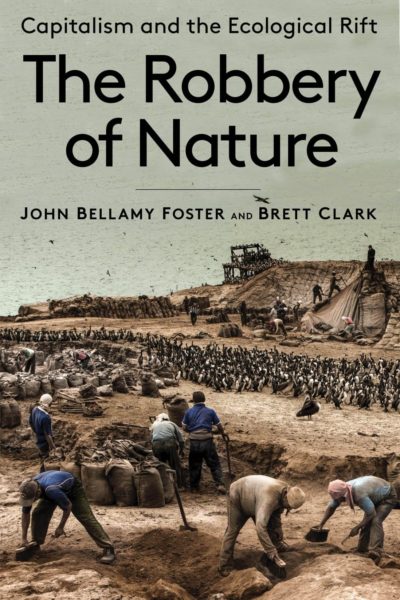
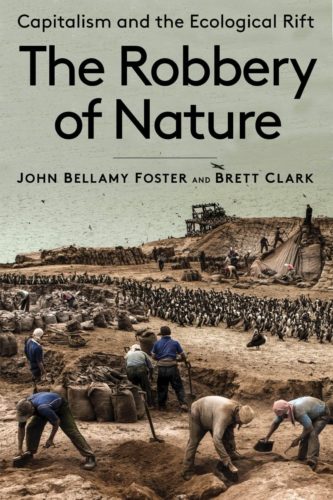
  • The Robbery of Nature: Capitalism and the Ecological Rift

    The Robbery of Nature: Capitalism and the Ecological Rift

    The Robbery of Nature

    The Robbery of Nature: Capitalism and the Ecological Rift (coauthored with Brett Clark) (New York: Monthly Review Press), January 2020.

    Consists of eleven chapters mostly based on articles previously published in Monthly Review 2016-2018, all developed around a central theme and developed into an argument in book form. Nine of the articles/chapters have been previously published, two will first appear in this book. Seven of the chapters in the book were written (or are being written) by the two authors together, three were originally written by Foster as sole author.

    In the nineteenth century, Karl Marx, inspired by the German chemist Justus von Liebig, argued that capitalism’s relation to its natural environment was that of a robbery system, leading to an irreparable rift in the metabolism between humanity and nature. In the twenty-first century, these classical insights into capitalism’s degradation of the earth have become the basis of extraordinary advances in critical theory and practice associated with contemporary ecosocialism. In The Robbery of Nature, John Bellamy Foster and Brett Clark, working within this historical tradition, examine capitalism’s plundering of nature via commodity production, and how it has led to the current anthropogenic rift in the Earth System.

    Departing from much previous scholarship, Foster and Clark adopt a materialist and dialectical approach, bridging the gap between social and environmental critiques of capitalism. The ecological crisis, they explain, extends beyond questions of traditional class struggle to a corporeal rift in the physical organization of living beings themselves, raising critical issues of social reproduction, racial capitalism, alienated speciesism, and ecological imperialism. No one, they conclude, following Marx, owns the earth. Instead we must maintain it for future generations and the innumerable, diverse inhabitants of the planet as part of a process of sustainable human development.

    This extraordinary work demonstrates, in clear and lucid prose, that capitalism is setting out doom for all of us, flora and fauna alike, and that a cooperative society is our only salvation. A book for popular readers and scholars alike, it will be widely recognized as an instant classic.

    —Paul Buhle, retired Senior Lecturer, Brown University

    Emerging from one of the most generative collaborations in the ecosocialist tradition, this collection of essays by John Bellamy Foster and Brett Clark represents a critical step forward in theoretical development and recovery, with immediate relevance to contemporary political movements and debates. Foster and Clark beautifully reveal the power of historical materialism to lay bare the connection between ecological degradation, speciesism, and social domination, and therefore the necessity of a struggle that does not artificially isolate in theory and practice what is joined in reality. This is a book for serious activists seeking to understand the world in order to change all of it that needs changing, so that every living being on earth may not only survive, but finally, be free.

    —Hannah Holleman, author of Dust Bowls of Empire: Imperialism, Environmental Politics, and the Injustice of “Green” Capitalism

    Long recognized as leading theorists of ecomarxism, Bellamy Foster and Clark here extend their “metabolic rift” paradigm to an impressive range of issues, including gender, food, British eco-imperialism in Ireland, “alienated speciesism,” the theory of value, and the meaning of work. The result is a powerful case that capitalism is inextricably bound up with the robbery of nature and constitutes the paramount obstacle to life on Earth as we know it.

    —Nancy Fraser, New School for Social Research; author, Fortunes of Feminism: From State-Managed Capitalism to Neoliberal Crisis
  • Imperialism in the Anthropocene

    Imperialism in the Anthropocene” (coauthored with Hannah Holleman and Brett Clark, Foster listed first), Monthly Review vol. 71, no. 3 (July-August 2019), pp. 70-88. DOI: 10.14452/MR-071-03-2019-07_5 [HTML]

    Today there can be no doubt about the main force behind our ongoing planetary emergency: the exponential growth of the capitalist world economy, particularly in the decades since the mid–twentieth century. The mere critique of capitalism as an abstract economic system, however, is insufficient in addressing today’s environmental problems. Rather, it is necessary also to examine the structure of accumulation on a world scale, coupled with the division of the world into competing nation-states. Our planetary problems cannot realistically be addressed without tackling the imperialist world system, or globalized capitalism, organized on the basis of classes and nation-states, and divided into center and periphery. Today, this necessarily raises the question of imperialism in the Anthropocene.

  • Metabolic Rifts and the Ecological Crisis

    Metabolic Rifts and the Ecological Crisis” (coauthored with Brett Clark and Stefano B. Longo, Clark listed first), The Oxford Handbook of Karl Marx (Oxford: Oxford University Press, 2019), 651-58, DOI: 10.1093/oxfordhb/9780190695545.001.0001. [PDF]

    The Oxford Handbook of Karl Marx provides an entry point for those new to Marxism. At the same time, its chapters, written by leading Marxist scholars, advance Marxist theory and research. Its coverage is more comprehensive than previous volumes on Marx in terms of both foundational concepts and empirical research on contemporary social problems. It also provides equal space to sociologists, economists, and political scientists, with substantial contributions from philosophers, historians and geographers.

    The Oxford Handbook of Karl Marx consists of seven sections. The first section, Foundations, includes chapters that demonstrate that the core elements of Marx’s political economy of capitalism continue to be defended, elaborated and applied to empirical social science including historical materialism, class, capital, labor, value, crisis, ideology, and alienation. Additional sections include Labor, Class, and Social Divisions; Capitalist States and Spaces; Accumulation, Crisis and Class struggle in the Core Countries; Accumulation, Crisis and Class Struggle in the Peripheral and Semi-Peripheral Countries; and Alternatives to Capitalism.

  • Making Space in Critical Environmental Geography for the Metabolic Rift

    Making Space in Critical Environmental Geography for the Metabolic Rift” (coauthored with Brian M. Napoletano, Brett Clark, Pedro S. Urquijo, Michael K. McCall & Jaime Paneque-Gálvez, Napoletano listed first), Annals of the American Association of Geographers, vol. 109, no. 6: 1811-1828, DOI: 10.1080/24694452.2019.1598841. [PDF]

    Marx’s concept of metabolic rift has emerged as a prominent theoretical framework with which to explain the socioecological crises of capitalism. Yet, despite its relevance to key concerns in critical environmental geography, it has remained marginal within the field. Here we address this by distinguishing between metabolic rift theory and two predominant Marxist approaches in environmental geography: the production-of-nature thesis and posthumanist world ecology. We follow this comparative assessment with a detailed analysis of metabolic rift theory and a brief overview of how the concept relates to key concerns in critical environmental geography. We conclude by discussing how a stronger engagement with the metabolic rift approach could benefit the field.

  • Marx and Alienated Speciesism

    Marx and Alienated Speciesism” (coauthered with Brett Clark, Foster listed first), Monthly Review vol. 70, no. 7 (December 2018), pp. 1-20. DOI: 10.14452/MR-070-07-2018-11_1. [HTML]

    In many animal-rights circles, Karl Marx and a long tradition of Marxian theorists are to be faulted for their speciesist treatment of nonhuman animals and the human-nonhuman animal relationship. These criticisms typically neglect the larger historical conditions, intellectual influences, and debates out of which Marx’s treatment of the human-animal dialectic arose—even though this is crucial to any meaningful understanding of his thought in this area. In response, this article assesses the historical-intellectual background behind Marx’s arguments on humans and animals, placing it in the context of the influence exercised on his thought by Epicurus, Hermann Samuel Reimarus, Ludwig Feuerbach, Charles Darwin, and others. In the process, they explain how Marx’s view of animals in the world came to be integrated with his theory of metabolic rift and his critique of capitalism.

  • The Robbery of Nature

    The Robbery of Nature: Capitalism and the Metabolic Rift” (co-authored with Brett Clark, Foster listed first), Monthly Review vol. 70, no. 3 (July-August 2018), pp. 1-20. DOI: 10.14452/MR-070-03-2018-07_1 [HTML]

    Marx’s notion of “the robbery of the soil” is intrinsically connected to the rift in the metabolism between human beings and the earth. To get at the complexities of his metabolic rift theory, it is useful to look separately at the issues of the robbery and the rift, seen as separate moments in a single development.

  • The Expropriation of Nature

    The Expropriation of Nature” (coauthored with Brett Clark, Foster listed first), Monthly Review vol. 69, no. 10 (March 2018), pp. 1-17. DOI: 10.14452/MR-069-10-2018-03_1 [HTML]

    To understand the present ecological crisis, it is necessary to dig much deeper into capitalism’s logic of expropriation, as first delineated by Marx during the Industrial Revolution. At the root of the problem is a spoliation of the natural environment—the expropriation of the earth itself.

  • Women, Nature, and Capital in the Industrial Revolution

    Women, Nature, and Capital in the Industrial Revolution” (coauthroed with Brett Clark, Foster listed first), Monthly Review vol. 69, no. 8 (January 2018), pp. 1-24. DOI: 10.14452/MR-069-08-2018-01 [HTML]

    Examining the historical specificity of women’s lives and labor in England during the Industrial Revolution allows us to better analyze the assumptions regarding gender, family, and work that informed the writings of Marx and Engels—and ultimately to understand how capital as a system threatens the social and ecological bases of human life.

  • Marxism and the Dialectics of Ecology

    Marxism and the Dialectics of Ecology

    Marxism and the Dialectics of Ecology,” (John Bellamy Foster, Brett Clark, Foster listed first), Monthly Review, vol. 68, no. 5 (October 2016), pp. 1-17.

    The recovery of the ecological-materialist foundations of Karl Marx’s thought, as embodied in his theory of metabolic rift, is redefining both Marxism and ecology in our time, reintegrating the critique of capital with critical natural science. This may seem astonishing to those who were reared on the view that Marx’s ideas were simply a synthesis of German idealism, French utopian socialism, and British political economy. However, such perspectives on classical historical materialism, which prevailed during the previous century, are now giving way to a broader recognition that Marx’s materialist conception of history is inextricably connected to the materialist conception of nature, encompassing not only the critique of political economy, but also the critical appropriation of the natural-scientific revolutions occurring in his day.

    What Georg Lukács called Marx’s “ontology of social being” was rooted in a conception of labor as the metabolism of society and nature. In this view, human-material existence is simultaneously social-historical and natural-ecological. Moreover, any realistic historical understanding required a focus on the complex interconnections and interdependencies associated with human-natural conditions. It was this overall integrated approach that led Marx to define socialism in terms of a process of sustainable human development—understood as the necessity of maintaining the earth for future generations, coupled with the greatest development of human freedom and potential. Socialism thus required that the associated producers rationally regulate the metabolism of nature and society. It is in this context that Marx’s central concepts of the “universal metabolism of nature,” “social metabolism,” and the metabolic “rift” have come to define his critical-ecological worldview.

    Translation:

    Spanish translation in Derrota y Navegación, November 13, 2016