“Foreword” to Samir Amin, Capitalism in the Age of Globalization (forthcoming: Zed Press, second edition, 2014).
Author: John Bellamy Foster
-

Surveillance Capitalism
“Surveillance Capitalism: Monopoly-Finance Capital, the Military-Industrial Complex, and the Digital Age” [PDF] (coauthored with Robert W. McChesney, Foster listed first), Monthly Review vol. 66, no. 11 (July-August 2014), pp. 1-32. DOI: 10.14452/MR-066-03-2014-07_1
The United States came out of the Second World War as the hegemonic power in the world economy. The war had lifted the U.S. economy out of the Great Depression by providing the needed effective demand in the form of endless orders for armaments and troops. Real output rose by 65 percent between 1940 and 1944, and industrial production jumped by 90 percent.
1, At the immediate end of the war, due to the destruction of the European and Japanese economies, the United States accounted for over 60 percent of world manufacturing output.
2, The very palpable fear at the top of society as the war came to a close was that of a reversion to the pre-war situation in which domestic demand would be insufficient to absorb the enormous and growing potential economic surplus generated by the production system, thereby leading to a renewed condition of economic stagnation and depression.Translations
- Chinese-language translation in Social Science Abroad, 2015.
- Spanish language translation by Miguel de Punoenrosto in Sin Permiso (July 2014) http://www.sinpermiso.info/textos/index.php?id=7154.
- French Translation by Miguel de Puñoenrostro in Marx Nangara (February 2015).
-
Stagnation and Financialization
“Stagnation and Financialization: The Nature of the Contradiction” [PDF] (coauthored with Fred Magdoff, Magdoff listed first) Monthly Review vol. 66, no. 1 (May 2014), pp. 1-24. DOI: 10.14452/MR-066-01-2014-05_1
More than six years after the beginning of the Great Recession in the United States, and nearly five years since it was officially declared over in this country, the core economies of the capitalist world system remain crisis-ridden. The jobs lost in the downturn in the United States have not yet been fully recovered and the economy remains sluggish. In Europe the crisis has hardly abated at all and a number of the peripheral European Union countries are in what can only be called a depression—especially Greece, Spain, and Portugal. The last member of the triad of advanced capitalist centers, Japan, has gone through what have been called two “lost decades” of slow growth and deflation and is attempting once again to jump-start the economy through a combination of devaluation of the yen and deficit spending.
Translations:
- Chinese translation by Zhou Ying in Young China 6790 (June 2014).
-

The Theory of Monopoly Capitalism: An Elaboration of Marxian Political Economy (New Edition)
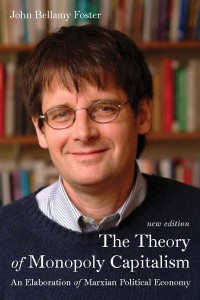 “The Theory of Monopoly Capitalism: An Elaboration of Marxian Political Economy,” (New York: Monthly Review Press, 2014), 320 pp.
In 1966, Paul Baran and Paul Sweezy published Monopoly Capital, a monumental work of economic theory and social criticism that sought to reveal the basic nature of the capitalism of their time. Their theory, and its continuing elaboration by Sweezy, Harry Magdoff, and others in Monthly Review magazine, influenced generations of radical and heterodox economists. They recognized that Marx’s work was unfinished and itself historically conditioned, and that any attempt to understand capitalism as an evolving phenomenon needed to take changing conditions into account. Having observed the rise of giant monopolistic (or oligopolistic) firms in the twentieth century, they put monopoly capital at the center of their analysis, arguing that the rising surplus such firms accumulated—as a result of their pricing power, massive sales efforts, and other factors—could not be profitably invested back into the economy. Absent any “epoch making innovations” like the automobile or vast new increases in military spending, the result was a general trend toward economic stagnation—a condition that persists, and is increasingly apparent, to this day. Their analysis was also extended to issues of imperialism, or “accumulation on a world scale,” overlapping with the path-breaking work of Samir Amin in particular.
John Bellamy Foster is a leading exponent of this theoretical perspective today, continuing in the tradition of Baran and Sweezy’s Monopoly Capital. This new edition of his essential work, The Theory of Monopoly Capitalism, is a clear and accessible explication of this outlook, brought up to the present, and incorporating an analysis of recently discovered “lost” chapters from Monopoly Capital and correspondence between Baran and Sweezy. It also discusses Magdoff and Sweezy’s analysis of the financialization of the economy in the 1970s, ‘80s, and ‘90s, leading up to the Great Financial Crisis of the opening decade of this century. Foster presents and develops the main arguments of monopoly capital theory, examining its key exponents, and addressing its critics in a way that is thoughtful but rigorous, suspicious of dogma but adamant that the deep-seated problems of today’s monopoly-finance capitalism can only truly be solved in the process of overcoming the system itself.
Foster’s book is brilliantly successful elaborating Marxian political economy and the tendency of monopoly-finance-imperialist capitalism toward stagnation. The book deserves a wide (re-)readership and a new generation of theorists to appreciate the explanatory power of Marxian political economy.
A clear and powerful explanation of the Marxian political economy, this book is a welcome addition for those who are interested in, or have serious concerns about, monopoly capital as well as economic stagnation, financial instability, and the futures of both capitalism and socialism.
Essential reading for those attracted by the monopoly capital school.
A clear and forceful elaboration of basic Marxist concepts such as economic surplus, capital accumulation, imperialism, and value.
A literate defense of the … Marxian analytical framework of Baran, Sweezy, Kalecki, and Steindl …. Foster develops an improved version of Baran and Sweezy’s … model of of accumulation by adding theoretical refinements.
Editions:
- Second edition (2013), includes new introduction to second edition by author, pp. 22
- “Introduction to Second Edition” published in Monthly Review 65, no. 3 (July-August 2013), pp. 107-34.
- Japanese language edition, (Tokyo: Uni Agency, 1988).
Translations:
- Chinese Translation of “Introduction to Second Edition” forthcoming in Foreign Theoretical Trends.
-
The Plight of the U.S. Working Class
“The Plight of the U.S. Working Class” [PDF], (coauthored with Fred Magdoff, Magdoff listed first), Monthly Review vol.65, no. 8 (January 2014), pp. 1-22. DOI: 10.14452/MR-065-08-2014-01_1
Modern capitalism, sociologist Max Weber famously observed early in the twentieth century, is based on “the rational capitalistic organization of (formally) free labor.” But the “rationality” of the system in this sphere, as Weber was to acknowledge elsewhere, was so restrictive as to be in reality “irrational.” Despite its formal freedom, labor under capitalism was substantively unfree.… This was in accordance with the argument advanced in Karl Marx’s Capital. Since the vast majority of individuals in the capitalist system are divorced from the means of production they have no other way to survive but to sell their labor power to those who own these means, that is, the capitalist class.… The result is a strong tendency to the polarization of income and wealth in society. The more the social productivity of labor grows the more it serves to promote the wealth and power of private capital, while at the same time increasing the relative poverty and economic dependency of the workers.
-
Metabolism, Energy and Entropy in Marx’s Critique of Political Economy
“Stoffwechseel, Energie und Entropie In Marx’ Kritic der Politischen Ökonomie” (“Metabolism, Energy, and Entropy in Marx’s Critique of Political Economy: Beyond the Podolinsky Myth”—edited and translated version of work based on previous articles, Burkett listed first) in Kijan Espahangizi und Barbara Orland, ed., Stoffe in Bewegun (Burlin: Diaphanes, 2014), 95-120.
Until recently, most commentators, including ecological Marxists, have assumed that Marx’s historical materialism was only marginally ecologically sensitive at best, or even that it was explicitly anti-ecological. However, research over the last decade has demonstrated not only that Marx deemed ecological materialism essential to the critique of political economy and to investigations into socialism, but also that his treatment of the coevolution of nature and society was in many ways the most so- phisticated to be put forth by any social theorist prior to the late twentieth century. Still, criticisms continue to be leveled at Marx and Engels for their understanding of thermodynamics and the extent to which their work is said to conflict with the core tenets of ecological economics. In this respect, the rejection by Marx and Engels of the pio- neering contributions of the Ukrainian socialist Sergei Podolinsky, one of the founders of energetics, has been frequently offered as the chief ecological case against them. Building on an earlier analysis of Marx’s and Engels’s response to Podolinsky, this article shows that they relied on an open-system, metabolic-energetic model that adhered to all of the main strictures of ecological economics – but one that also (unlike ecological economics) rooted the violation of solar and other environmental-sustainability conditions in the class relations of capitalist society. The result is to generate a deeper understanding of classical historical materialism’s ecological approach to economy and society – providing an ecological-materialist critique that can help uncover the systemic roots of today’s “treadmill of production” and global environmental crisis.
-
Marx and the Rift in the Universal Metabolism of Nature
“Marx and the Rift in the Universal Metabolism of Nature,” [PDF], Monthly Review, vol. 65, no. 7 (December 2013), pp. 1-19. DOI: 10.14452/MR-065-07-2013-11_1
The rediscovery over the last decade and a half of Marx’s theory of metabolic rift has come to be seen by many on the left as offering a powerful critique of the relation between nature and contemporary capitalist society. The result has been the development of a more unified ecological world view transcending the divisions between natural and social science, and allowing us to perceive the concrete ways in which the contradictions of capital accumulation are generating ecological crises and catastrophes.… Yet, this recovery of Marx’s ecological argument has given rise to further questions and criticisms.
Translations:
- Spanish-language translation in Revista Herramienta, Herramienta debate y crítica marxista, web 15 (January 2015), http://www.herramienta.com.ar/autores/bellamy-foster-john.
- Turkish translation in Monthly Review, Turkish edition (May 2014), pp. 69-92.
-
The Epochal Crisis
“The Epochal Crisis,” [PDF], Monthly Review, vol.65, no. 5 (October 2013), pp. 1-12. DOI: 10.14452/MR-065-05-2013-09_1
It is an indication of the sheer enormity of the historical challenge confronting humanity in our time that the worst economic crisis since the Great Depression, sometimes now called the Second Great Depression, is overshadowed by the larger threat of planetary catastrophe, raising the question of the long-term survival of innumerable species—including our own. An urgent necessity for the world today is therefore to develop an understanding of the interconnections between the deepening impasse of the capitalist economy and the rapidly accelerating ecological threat—itself a by-product of capitalist development.
Translations:
- German-language translation Das Argument 305 (2013): 871-80.
- Spanish language translation by Carlos Valmaseda in Mientras Tanto (May 2014)