Author: John Bellamy Foster

  • Nature

    Nature,” in Kelly Fritsch, Clare O’Connor, and A.K. Thompson, ed., Keywords for Radicals, (Oakland: AK Press, 2016), pp. 279-86.

    “Nature,” wrote Raymond Williams in Keywords, “is perhaps the most complex word in the language.” It is derived from the Latin natura, as exemplified by Lucretius’s great didactic poem De rerum natura (On the Nature of Things) from the first century BCE. The word “nature” has three primary, interrelated meanings: (1) the intrinsic properties or essence of things or processes; (2) an inherent force that directs or determines the world; and (3) the material world or universe, the object of our sense perceptions—both in its entirety and variously understood as including or excluding God, spirit, mind, human beings, society, history, culture, etc.

    Additional Publication(s)

  • Marx’s Theory of Working-Class Precariousness

    Marx’s Theory of Working-Class Precariousness: Its Relevance Today,” (coauthored with R. Jamil Jonna, Jonna listed first) Monthly Review vol. 67, no. 11 (April 2016). DOI: 10.14452/MR-067-11-2016-04_1

    First published as “Marx’s Theory of Working-Class Precariousness—And Its Relevance Today,” Alternate Routes: A Journal of Critical Social Research 27 (2016), pp. 21-45. [PDF]

    As a concept, worker precariousness is far from new. It has a long history in socialist thought, where it was associated from the start with the concept of the reserve army of labor. Frederick Engels introduced the idea of precariousness in his treatment of the industrial reserve army in The Condition of the Working Class in England. Marx and Engels employed it in this same context in The Communist Manifesto, and it later became a key element in Marx’s analysis of the industrial reserve army in volume I of Capital.… In recent years, however, the notion of precariousness as a general condition of working-class life has been rediscovered. Yet the idea is commonly treated in the eclectic, reductionist, ahistorical fashion characteristic of today’s social sciences and humanities, disconnected from the larger theory of accumulation derived from Marx and the socialist tradition. The result is a set of scattered observations about what are seen as largely haphazard developments.… In the face of such a confusion of views—most of them merely ad hoc responses to what is presumed to be an isolated social problem—it is necessary to turn back to the classical Marxian tradition, where the issue of precariousness was first raised.


  • Is Democratic Socialism the American Dream?

    Is Democratic Socialism the American Dream?” (John Bellamy Foster), The Washington Post (2016)

    National income can be likened to a pie. If between one year and the next the pie gets bigger, everyone can have a bigger slice. But if, instead, the size of the pie stays the same, a bigger slice for some can only mean a smaller slice for others.

    This helps us understand the present dismal state of the U.S. economy and the impetus behind Bernie Sanders’s electoral campaign, which is aimed at the needs of workers and working families. For decades, U.S. economic growth has stagnated, with each succeeding decade experiencing a lower rate of growth. Under these circumstances, the rapidly increasing income of those at the top — or what Sanders likes to call the “billionaire class” — is at the expense of the income shares (slices of the pie) of those at the bottom.

  • The Opt Out Revolt

    The Opt Out Revolt

    In the United States today, the age of monopoly-finance capital and neoliberal politics, all aspects of social life are being financialized at breakneck speed, while the economy as a whole and employment remain lackluster. Financial flows of whatever kind are converted into “securitized” assets to be leveraged by Wall Street speculators. The data of private communications are mined. Health care is converted into a realm of super profits. Public water and electric facilities are sold to the highest bidder. The political system is turned into an open-air auction. Even pollution is treated as a market.… At the center of this juggernaut is elementary and secondary education, which receives over $550 billion in annual public spending, equal to the GDP of Belgium, ranked twenty-fifth worldwide in national income. The new copyrighted Common Core State Standards, and the accompanying standardized tests run by two multi-state consortia in conjunction with testing companies, are “high stakes” not merely for schools, teachers, and students, but also for the vested interests of capital.
  • Ecology

    “Ecology,” in Marcello Musto, ed., The Marx Revival (Cambridge: Cambridge University Press, 2016), pp. 20.

  • Marx and the Earth: An Anti-Critique

    Marx and the Earth: An Anti-Critique

    Marx and the Earth

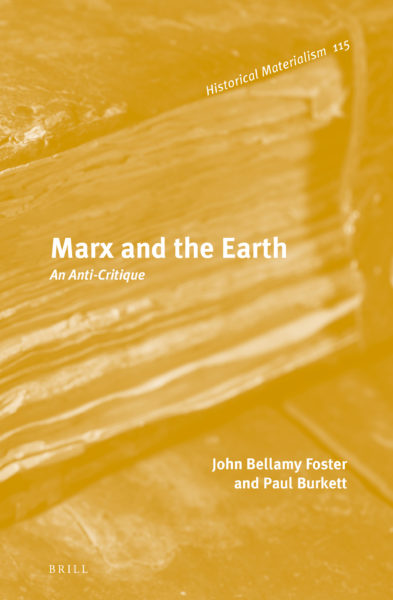
    Marx and the Earth: An Anti-Critique [co-authored with Paul Burkett] (Boston: Brill, 2016, hardcover; Chicago: Haymarket Press, March 2017, paperback), 308 pp.

    A decade and a half ago John Bellamy Foster and Paul Burkett introduced a new, revolutionary understanding of the ecological foundations of Marx’s thought, demonstrating that Marx’s concepts of the universal metabolism of nature, social metabolism, and metabolic rift prefigured much of modern systems ecology. Ecological relations were shown to be central to Marx’s critique of capitalism, including his value analysis. Now in Marx and the Earth Foster and Burkett expand on this analysis in the process of responding to recent ecosocialist criticisms of Marx. The result is a full-fledged anti-critique—pointing to the crucial roles that dialectics, open-system thermodynamics, intrinsic value, and aesthetic understandings played in the original Marxian critique, holding out the possibility of a new red-green synthesis.

  • Marxism and Ecology

    Marxism and Ecology: Common Fonts on a Great Transition,” Monthly Review, vol. 67, no. 7 (Deember 2015), pp. 1-13. DOI: 10.14452/MR-067-07-2015-11_1
    This article was originally published (along with comments on it by nine other authors, including MR contributors David Barkin, Hannah Holleman, and Fred Magdoff) on the Great Transition Initiative website in October 2015: http://greattransition.org/publication/marxism-and-ecology.
    To link Marxism and ecological transition may seem at first like trying to bridge two entirely different movements and discourses, each with its own history and logic: one having mainly to do with class relations, the other with the relation between humans and the environment. However, historically socialism has influenced the development of ecological thought and practice, while ecology has informed socialist thought and practice. Since the nineteenth century, the relationship between the two has been complex, interdependent, and dialectical.
    Versions and Publishers:
    • Earlier version published online by the Great Transition Initiative, October 19, 2015, 5800 words, greattransition.org. Published along with comments of 750-1000 words by majors scholars, part of the Great Transition Network, and with a response to the comments by the author.
    Translations:
    • Portuguese-language translation forthcoming in O Comuneiro (2016). Portugues-language version also forthcoming in Lutas Sociais (Sao Paulo, 2016).
    • German translation forthcoming in Analyse & Kritik (2016).


  • The Great Capitalist Climacteric

    The Great Capitalist Climacteric: Marxism and “System Change Not Climate Change,” Monthly Review, vol. 67, no. 6 (November 2015), pp. 1-18.
    DOI:10.14452

    This article is from a keynote address presented at Manifesta in Ostend, Belgium on September 19, 2015. This year’s Manifesta was organized around the theme of climate change in preparation for the COP21 climate negotiations (and protests) in Paris in December 2015.

    Humanity today is confronted with what might be called the Great Capitalist Climacteric. In the standard definition, a climacteric (from the Greek klimaktēr or rung on the ladder) is a period of critical transition or a turning point in the life of an individual or a whole society. From a social standpoint, it raises issues of historical transformation in the face of changing conditions.

  • Afterword: The Making of Scandinavian Ecosocialism

    “Afterword: The Making of Scandinavian Ecosocialism,”[PDF] in The Politics of Ecosocialism, ed. Kajsa Borgnäs, Teppo Eskelinen, Johanna Perkiö, and Rikard Warlenius (London: Routledge, 2015), 195-203.

  • The New Imperialism of Globalized Monopoly-Finance Capital

    The New Imperialism of Globalized Monopoly-Finace Capital,” Monthly Review vol. 67, no. 3 (July-August 2015), pp. 1-22.
    DOI: 10.14452/MR-067-03-2015-07_1

    It is now a universal belief on the left that the world has entered a new imperialist phase.… The challenge for Marxian theories of the imperialist world system in our times is to capture the full depth and breadth of the classical accounts, while also addressing the historical specificity of the current global economy. It will be argued in this introduction (in line with the present issue as a whole) that what is widely referred to as neoliberal globalization in the twenty-first century is in fact a historical product of the shift to global monopoly-finance capital or what Samir Amin calls the imperialism of “generalized-monopoly capitalism.”