Author: John Bellamy Foster

  • The Rise of the Right

    The Rise of the Right: John Bellamy Foster Interviewed by Farooque Chowdhury,” Monthly Review vol. 71, no. 5 (October 2019), pp. 1-11. DOI: 10.14452/MR-071-05-2019-09_1 [HTML]

    In an interview with Farooque Chowdhury, Monthly Review editor John Bellamy Foster speaks about the historical conditions associated with the rise of new far-right movements of a broadly neofascist character. What we are witnessing, especially in the advanced capitalist world, is the development of a neoliberal-neofascist alliance, reflecting the decline of the liberal-democratic state. Neofascism is the most dangerous and volatile phenomenon in this emerging right-wing historical bloc. All of this has to be seen in relation to the structural crisis of capitalism and growing ruling-class attempts to restructure the state-capital relationship so as to create regimes more exclusively for capital.

  • The Robbery of Nature: Capitalism and the Ecological Rift

    The Robbery of Nature: Capitalism and the Ecological Rift

    The Robbery of Nature

    The Robbery of Nature: Capitalism and the Ecological Rift (coauthored with Brett Clark) (New York: Monthly Review Press), January 2020.

    Consists of eleven chapters mostly based on articles previously published in Monthly Review 2016-2018, all developed around a central theme and developed into an argument in book form. Nine of the articles/chapters have been previously published, two will first appear in this book. Seven of the chapters in the book were written (or are being written) by the two authors together, three were originally written by Foster as sole author.

    In the nineteenth century, Karl Marx, inspired by the German chemist Justus von Liebig, argued that capitalism’s relation to its natural environment was that of a robbery system, leading to an irreparable rift in the metabolism between humanity and nature. In the twenty-first century, these classical insights into capitalism’s degradation of the earth have become the basis of extraordinary advances in critical theory and practice associated with contemporary ecosocialism. In The Robbery of Nature, John Bellamy Foster and Brett Clark, working within this historical tradition, examine capitalism’s plundering of nature via commodity production, and how it has led to the current anthropogenic rift in the Earth System.

    Departing from much previous scholarship, Foster and Clark adopt a materialist and dialectical approach, bridging the gap between social and environmental critiques of capitalism. The ecological crisis, they explain, extends beyond questions of traditional class struggle to a corporeal rift in the physical organization of living beings themselves, raising critical issues of social reproduction, racial capitalism, alienated speciesism, and ecological imperialism. No one, they conclude, following Marx, owns the earth. Instead we must maintain it for future generations and the innumerable, diverse inhabitants of the planet as part of a process of sustainable human development.

    This extraordinary work demonstrates, in clear and lucid prose, that capitalism is setting out doom for all of us, flora and fauna alike, and that a cooperative society is our only salvation. A book for popular readers and scholars alike, it will be widely recognized as an instant classic.

    —Paul Buhle, retired Senior Lecturer, Brown University

    Emerging from one of the most generative collaborations in the ecosocialist tradition, this collection of essays by John Bellamy Foster and Brett Clark represents a critical step forward in theoretical development and recovery, with immediate relevance to contemporary political movements and debates. Foster and Clark beautifully reveal the power of historical materialism to lay bare the connection between ecological degradation, speciesism, and social domination, and therefore the necessity of a struggle that does not artificially isolate in theory and practice what is joined in reality. This is a book for serious activists seeking to understand the world in order to change all of it that needs changing, so that every living being on earth may not only survive, but finally, be free.

    —Hannah Holleman, author of Dust Bowls of Empire: Imperialism, Environmental Politics, and the Injustice of “Green” Capitalism

    Long recognized as leading theorists of ecomarxism, Bellamy Foster and Clark here extend their “metabolic rift” paradigm to an impressive range of issues, including gender, food, British eco-imperialism in Ireland, “alienated speciesism,” the theory of value, and the meaning of work. The result is a powerful case that capitalism is inextricably bound up with the robbery of nature and constitutes the paramount obstacle to life on Earth as we know it.

    —Nancy Fraser, New School for Social Research; author, Fortunes of Feminism: From State-Managed Capitalism to Neoliberal Crisis
  • Imperialism in the Anthropocene

    Imperialism in the Anthropocene” (coauthored with Hannah Holleman and Brett Clark, Foster listed first), Monthly Review vol. 71, no. 3 (July-August 2019), pp. 70-88. DOI: 10.14452/MR-071-03-2019-07_5 [HTML]

    Today there can be no doubt about the main force behind our ongoing planetary emergency: the exponential growth of the capitalist world economy, particularly in the decades since the mid–twentieth century. The mere critique of capitalism as an abstract economic system, however, is insufficient in addressing today’s environmental problems. Rather, it is necessary also to examine the structure of accumulation on a world scale, coupled with the division of the world into competing nation-states. Our planetary problems cannot realistically be addressed without tackling the imperialist world system, or globalized capitalism, organized on the basis of classes and nation-states, and divided into center and periphery. Today, this necessarily raises the question of imperialism in the Anthropocene.

  • Late Imperialism

    Late Imperialism,” Monthly Review vol. 71, no. 3 (July-August 2019), pp. 1-19. DOI: 10.14452/MR-071-03-2019-07_1 [HTML]

    The globalization of production (and finance)—which emerged along with neoliberalism out of the economic stagnation of the mid–1970s and then accelerated with the demise of Soviet-type societies and China’s reintegration into the capitalist world system—has generated a more generalized monopoly capitalism, ushering in what can be called late imperialism. Late imperialism refers to the present period of monopoly-finance capital and stagnation, declining U.S. hegemony and rising world conflict, accompanied by growing threats to the ecological bases of civilization and life itself. It stands at its core for the extreme, hierarchical relations governing the capitalist world economy in the twenty-first century, which is increasingly dominated by mega-multinational corporations and a handful of states at the center of the world system. Just as it is now common to refer to late capitalism in recognition of the end times brought on by simultaneous economic and ecological dislocations, so it is necessary today to speak of late imperialism, reflecting the global dimensions and contradictions of that system, cutting across all other divisions, and posing a “global rift” in human historical development: an epochal crisis posing the question of “ruin or revolution.”

  • Metabolic Rifts and the Ecological Crisis

    Metabolic Rifts and the Ecological Crisis” (coauthored with Brett Clark and Stefano B. Longo, Clark listed first), The Oxford Handbook of Karl Marx (Oxford: Oxford University Press, 2019), 651-58, DOI: 10.1093/oxfordhb/9780190695545.001.0001. [PDF]

    The Oxford Handbook of Karl Marx provides an entry point for those new to Marxism. At the same time, its chapters, written by leading Marxist scholars, advance Marxist theory and research. Its coverage is more comprehensive than previous volumes on Marx in terms of both foundational concepts and empirical research on contemporary social problems. It also provides equal space to sociologists, economists, and political scientists, with substantial contributions from philosophers, historians and geographers.

    The Oxford Handbook of Karl Marx consists of seven sections. The first section, Foundations, includes chapters that demonstrate that the core elements of Marx’s political economy of capitalism continue to be defended, elaborated and applied to empirical social science including historical materialism, class, capital, labor, value, crisis, ideology, and alienation. Additional sections include Labor, Class, and Social Divisions; Capitalist States and Spaces; Accumulation, Crisis and Class struggle in the Core Countries; Accumulation, Crisis and Class Struggle in the Peripheral and Semi-Peripheral Countries; and Alternatives to Capitalism.

  • Absolute Capitalism

    Absolute Capitalism,” Monthly Review vol. 71, no. 1 (May 2019), pp. 1-13. DOI: 10.14452/MR-071-01-2019-05_1 [HTML]

    Although neoliberalism is widely recognized as the central political-ideological project of twenty-first-century capitalism, it is a term that is seldom uttered by those in power. Behind this particular ruse lies a deeply disturbing, even hellish, reality. Neoliberalism can be defined as an integrated ruling-class political-ideological project, associated with the rise of monopoly-finance capital, the principal strategic aim of which is to embed the state in capitalist market relations. Hence, the state’s traditional role in safeguarding social reproduction—if largely on capitalist-class terms—is now reduced solely to one of promoting capitalist reproduction. The goal is nothing less than the creation of an absolute capitalism. All of this serves to heighten the extreme human and ecological destructiveness that characterizes our time.

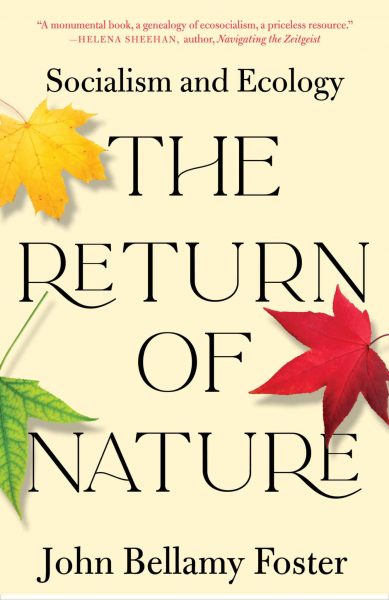
  • The Return of Nature: Socialism and Ecology

    The Return of Nature: Socialism and Ecology

    The Return of NatureThe Return of Nature: Socialism and Ecology, New York: Monthly Review Press.

    Twenty years ago, John Bellamy Foster’s Marx’s Ecology: Materialism and Natureintroduced a new understanding of Karl Marx’s revolutionary ecological materialism. More than simply a study of Marx, it commenced an intellectual and social history, encompassing thinkers from Epicurus to Darwin, who developed materialist and ecological ideas. Now, with The Return of Nature: Socialism and Ecology, Foster continues this narrative. In so doing, he uncovers a long history of efforts to unite issues of social justice and environmental sustainability that will help us comprehend and counter today’s unprecedented planetary emergencies.

    The Return of Nature begins with the deaths of Darwin (1882) and Marx (1883) and moves on until the rise of the ecological age in the 1960s and 1970s. Foster explores how socialist analysts and materialist scientists of various stamps, first in Britain, then the United States, from William Morris and Frederick Engels to Joseph Needham, Rachel Carson, and Stephen Jay Gould, sought to develop a dialectical naturalism, rooted in a critique of capitalism. In the process, he delivers a far-reaching and fascinating reinterpretation of the radical and socialist origins of ecology. Ultimately, what this book asks for is nothing short of revolution: a long, ecological revolution, aimed at making peace with the planet while meeting collective human needs.

    In the century following Marx’s death, left-wing scientists and writers made major contributions to the development of modern ecological thought. Foster’s brilliant new book recovers that history, making the work and ideas of those neglected ecosocialist pioneers accessible to the activists who are building today’s movements against global environmental destruction.

    —Ian Angus, author, Facing the Anthropocene; editor, Climate & Capitalism

    What does ecology have to do with a critique of capitalism and a movement for socialism? What are the roots of ecosocialism? For more than twenty years, John Bellamy Foster has engaged in serious thought and massive research, delving into the relation of ecology and socialism, while charting the odyssey of the network of left activist-intellectuals who forged a philosophical-scientific-political vision of our ecosystem and the forces threatening its survival. The result is a monumental book, a genealogy of ecosocialism, a priceless resource for those pursuing this path today.

    —Helena Sheehan, author, Marxism and the Philosophy of Science and Navigating the Zeitgeist

    Leftists have too readily seen capitalist science and technology’s goal—the domination of nature—as inherently progressive. In The Return of Nature, John Bellamy Foster tells a different story. The recognition that we humans, rather than dominating, are part of nature, both transformed by and transforming it, was central to Marx and Engels’ dialectical thinking. Foster’s richly detailed and ground-breaking history tells the story of the British and American scientists and activists who in the century following Marx’s death, adopted and built on this dialectical tradition, from Engels’ Dialectics of Nature to the fast developing science of ecology and the birth of the radical science movements of the 1970s. A tour de force.

    —Steven Rose, emeritus professor of neuroscience, Open University

    By now, many people will have heard about the ecological ideas of Karl Marx. And everyone knows that the modern environmental movement is filled with anti-capitalist energies. But was there anything in between? In this landmark work, John Bellamy Foster fills in the gap and reconstructs an unbroken genealogy of dialectical thinking about the environment, from the last days of Marx to the first stirrings of Western environmentalism. From the neglected writings of numerous thinkers and scientists—evolutionary biologists, not the least—he reconstructs a treasure trove of ecological insights that will keep scholars and activists preoccupied for years to come. The common knowledge of Marx’s environmentalist leanings derives from Foster’s Marx’s Ecology from 2000. With The Return of Nature, he has given ecological Marxism an epic chronicle that speaks straight to the crises of our times: a sequel and prequel of extraordinary power.

    —Andreas Malm, author, Fossil Capital: On the Rise of Steam Power and the Roots of Global Warming

    John Bellamy Foster’s magnificent The Return of Nature tells the story of the late nineteenth and early twentieth scientists and other intellectuals who followed paths laid out by Marx and Engels with respect to the profit-driven degradation of the environment and biosphere. Foster convincingly depicts the genesis, in the writings of figures such as William Morris, Joseph Needham, and Rachel Carson, of an ecosocialist vision whose further development represents the best hope of the present period. He helps us answer the question posed by one of the book’s heroes, the novelist and essayist Christopher Caudwell (1907-1937), “How can we think of the future without holding it to our own barrenness?”

    —Stuart A. Newman, Professor of Cell Biology and Anatomy, New York Medical College; coauthor, Biotech Juggernaut: Hope, Hype, and Hidden Agendas of Entrepreneurial Bioscience

  • Global Commodity Chains and the New Imperialism

    Global Commodity Chains and the New Imperialism” (coauthored with Intan Suwandi and R. Jamil Jonna, Foster listed last), Monthly Review vol. 70, no. 10 (March 2019): 1-24. DOI: 10.14452/MR-070-10-2019-03_1 [HTML]

    To comprehend twenty-first-century imperialism we must go beyond analysis of the nation-state to a systematic investigation of the increasing global reach of multinational corporations or the role of the global labor arbitrage. At issue is the way in which today’s global monopolies in the center of the world economy have captured value generated by labor in the periphery within a process of unequal exchange, thus getting “more labour in exchange for less.” The result has been to change the global structure of industrial production while maintaining and often intensifying the global structure of exploitation and value transfer.

    •   Chinese translation was published in Foreign Theoretical Trends, October 2019.
  • Making Space in Critical Environmental Geography for the Metabolic Rift

    Making Space in Critical Environmental Geography for the Metabolic Rift” (coauthored with Brian M. Napoletano, Brett Clark, Pedro S. Urquijo, Michael K. McCall & Jaime Paneque-Gálvez, Napoletano listed first), Annals of the American Association of Geographers, vol. 109, no. 6: 1811-1828, DOI: 10.1080/24694452.2019.1598841. [PDF]

    Marx’s concept of metabolic rift has emerged as a prominent theoretical framework with which to explain the socioecological crises of capitalism. Yet, despite its relevance to key concerns in critical environmental geography, it has remained marginal within the field. Here we address this by distinguishing between metabolic rift theory and two predominant Marxist approaches in environmental geography: the production-of-nature thesis and posthumanist world ecology. We follow this comparative assessment with a detailed analysis of metabolic rift theory and a brief overview of how the concept relates to key concerns in critical environmental geography. We conclude by discussing how a stronger engagement with the metabolic rift approach could benefit the field.

  • Capitalism Has Failed–What Next?

    Capitalism Has Failed—What Next?Monthly Review vol. 70, no. 9 (February 2019), pp. 1-24. DOI: 10.14452/MR-070-09-2019-02_1 [HTML]

    Less than two decades into the twenty-first century, it is evident that capitalism has failed as a social system. The world is mired in economic stagnation, financialization, and the most extreme inequality in human history, accompanied by mass unemployment and underemployment, precariousness, poverty, hunger, wasted output and lives, and what at this point can only be called a planetary ecological “death spiral.” Many of the symptoms of the failure of capitalism are well-known. Nevertheless, they are often attributed not to capitalism as a system, but simply to neoliberalism, viewed as a particular paradigm of capitalist development that can be replaced by another, better one. A critical-historical analysis of neoliberalism is therefore crucial both to grounding our understanding of capitalism today and uncovering the reason why all alternatives to neoliberalism and its capitalist absolutism are closed within the system itself.