Author: John Bellamy Foster

  • The Global Reserve Army of Labor and the New Imperialism

    The Global Reserve Army of Labor and the New Imperialism”, (coauthored with Robert W. McChesney and R. Jamil Jonna, Foster listed first), Monthly Review, vol. 63, no. 6 (November 2011), pp. 1-31. DOI: 10.14452/MR-063-06-2011-10_1

    In the last few decades there has been an enormous shift in the capitalist economy in the direction of the globalization of production. Much of the increase in manufacturing and even services production that would have formerly taken place in the global North—as well as a portion of the North’s preexisting production—is now being offshored to the global South, where it is feeding the rapid industrialization of a handful of emerging economies. It is customary to see this shift as arising from the economic crisis of 1974–75 and the rise of neoliberalism—or as erupting in the 1980s and after, with the huge increase in the global capitalist labor force resulting from the integration of Eastern Europe and China into the world economy. Yet, the foundations of production on a global scale, we will argue, were laid in the 1950s and 1960s, and were already depicted in the work of Stephen Hymer, the foremost theorist of the multinational corporation, who died in 1974.

    Translations:
    • Turkish translation in Monthly Review, Turkish edition, no. 30 (Istanbul: Kalkedon, 2012), pp. 75-110.


  • Samir Amin at 80

    Samir Amin at 80

    Samir Amin at 80: An Introduction and Tribute,” Monthly Review, vol. 63, no. 5 (October 2011), 1-7. DOI: 10.14452/MR-063-05-2011-09_1

    Samir Amin was born in Cairo in 1931, and studied within the French educational system in Egypt.… He is currently president of the World Forum for Alternatives.… Amin’s wide-ranging work can be most succinctly described in terms of the dual designation of The Law of Value and Historical Materialism—the title of one of his books, now in a new edition as The Law of Worldwide Value. Marx’s intellectual corpus, he notes, appears to be divided into writings on economics and writings on politics.… For Amin, this basic division of Marxist theory is not to be denied. Nevertheless, he insists that the economic laws of capitalism, summed up by the law of value, “are subordinate to the laws of historical materialism.” Economic science, while indispensable, cannot explain at the highest level of abstraction, as in mathematical equations, the full reality of capitalism and imperialism—since it cannot account either for the historical origins of the system itself, or for the nature of the class struggle.


  • The Ecology of Marxian Political Economy

    The Ecology of Marxian Political Economy

    The Ecology of Marxian Political Economy“, Monthly Review, vol. 63, no. 4 (September 2011), pp. 1-16. DOI: 10.14452/MR-063-04-2011-08_1

    Discussant Project XXI Conference, Venezuelan Cultural Ministry, Caracas, March 28-31, 2011.

    It is no secret today that we are facing a planetary environmental emergency, endangering most species on the planet, including our own, and that this impending catastrophe has its roots in the capitalist economic system. Nevertheless, the extreme dangers that capitalism inherently poses to the environment are often inadequately understood, giving rise to the belief that it is possible to create a new “natural capitalism” or “climate capitalism” in which the system is turned from being the enemy of the environment into its savior. The chief problem with all such views is that they underestimate the cumulative threat to humanity and the earth arising from the existing relations of production. Indeed, the full enormity of the planetary ecological crisis, I shall contend, can only be understood from a standpoint informed by the Marxian critique of capitalism.

    Translations:
    • Portuguese language translation in Lutas Sociais, www.pucsp.b/neils, 2012;
    • Turkish translation in Monthly Review, Turkish edition, no. 29 (Istanbul: Kalkedon, 2012), pp. 49-87


  • Education and the Structural Crisis of Capital

    Education and the Structural Crisis of Capital

    Education and the Structural Crisis of Capital: The U.S. Case“, Monthly Review vol. 63, no. 3 (July 2011), pp.6-37. DOI: 10.14452/MR-063-03-2011-07_3

    Today’s conservative movement for the reform of public education in the United States, and in much of the world, is based on the prevailing view that public education is in a state of emergency and in need of restructuring due to its own internal failures. In contrast, I shall argue that the decay of public education is mainly a product of externally imposed contradictions that are inherent to schooling in capitalist society, heightened in our time by conditions of economic stagnation in the mature capitalist economies, and by the effects of the conservative reform movement itself. The corporate-driven onslaught on students, teachers, and public schools—symbolized in the United States by George W. Bush’s No Child Left Behind (NCLB) legislation—is to be explained not so much by the failure of the schools themselves, but by the growing failures of the capitalist system, which now sees the privatization of public education as central to addressing its larger malaise.

    Translations:
    • Turkish translation in Monthly Review, Turkish edition, no. 29 (Istanbul: Kalkedon, 2012), pp. 49-87.


  • Education and Capitalism

    Education and Capitalism,” [PDF] (John Bellamy Foster) Monthly Review, vol. 63, no. 3 (July 2011), pp. 5-5.

    Schooling in the twenty-first century United States is not the product mainly of educational philosophies and resources—together with whatever imagination and initiative that teachers, students, parents, and communities can bring to bear. Instead, it is dominated by the changing demands of capitalist society for an increasingly stratified and regimented workforce. In the first article in this section, John Bellamy Foster analyzes the political economy of education in capitalist society; the relation of this to the evolution of U.S. schools from the early twentieth century on; and the current corporate reform movement aimed at the restructuring and privatization of education—symbolized by the Bush No Child Left Behind and the Obama Race to the Top programs.

  • Fight-Back

    Fight-Back: Education’s Radical Future,” [PDF] (John Bellamy Foster) Monthly Review, vol. 63, no. 3 (July 2011), pp. 103-103.

    The Declaration of Independence says that we are all created equal and endowed with unalienable rights to life, liberty, and the pursuit of happiness. However, these lofty ideals can be realized only through struggle. They are incompatible with the logic of capitalism, but this logic can be and has been attacked by working men and women, and victories have been won.

  • 2. Lessons from the New Corporate Schooling

    2. Lessons from the New Corporate Schooling

    2. Lessons from the New Corporate Schooling“, Monthly Review, vol. 63, no. 3 (July 2011), pp. 64-66. DOI: 10.14452/MR-063-03-2011-07_6

    -As the articles in this section indicate, the new corporate schooling in the United States combines many of the worst aspects of capitalist schooling in a period of economic stagnation, financialization, and militarization/securitization together with a strategy of privatization of the schools. Public education is being degraded, regimented, and increasingly racially segregated—while the resulting worsening conditions in the schools are used to justify the restructuring of the entire education system.


  • The Internationalization of Monopoly Capital

    The Internationalization of Monopoly Capital

    The Internationalization of Monopoly Capital“, (coauthored with Robert W. McChesney and R. Jamil Jonna, Foster listed first), Monthly Review, vol. 63, no. 2 (June 2011), pp 1-23. DOI: 10.14452/MR-063-02-2011-06_1

    In a 1997 article entitled “More (or Less) on Globalization,” Paul Sweezy referred to “the three most important underlying trends in the recent history of capitalism, the period beginning with the recession of 1974-75: (1) the slowing down of the overall rate of growth; (2) the worldwide proliferation of monopolistic (or oligopolistic) multinational corporations; and (3) what may be called the financialization of the capital accumulation process.”… The first and third of these three trends—economic stagnation in the rich economies and the financialization of accumulation—have been the subjects of widespread discussion since the onset of severe financial crisis in 2007-09. Yet the second underlying trend, which might be called the “internationalization of monopoly capital,” has received much less attention.… the dominant, neoliberal discourse—one that has also penetrated the left—assumes that the tendency toward monopoly has been vanquished… [In contrast,] we suggest that renewed international competition evident since the 1970s was much more limited in range than often supposed… In short, we are confronted by a system of international oligopoly.

    Translations:
    • Turkish translation in Monthly Review, Turkish edition, no. 28 (Istanbul: Kalkedon, 2011), pp. 91-118.


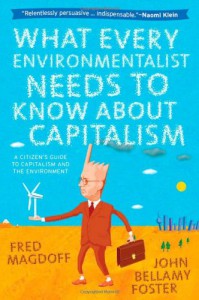
  • What Every Environmentalist Needs to Know About Capitalism

    What Every Environmentalist Needs to Know About Capitalism

    What Every Environmentalist Needs to Know About Capitalism: A Citizen’s Guide to Capitalism and the EnvironmentWhat Every Environmentalist Needs to Know About Capitalism: A Citizen’s Guide to Capitalism and the Environment,” (co-authored with Fred Magdoff, Magdoff listed first, New York: Monthly Review Press, 2011), 187 pp.

    There is a growing consensus that the planet is heading toward environmental catastrophe: climate change, ocean acidification, ozone depletion, global freshwater use, loss of biodiversity, and chemical pollution all threaten our future unless we act. What is less clear is how humanity should respond. The contemporary environmental movement is the site of many competing plans and prescriptions, and composed of a diverse set of actors, from militant activists to corporate chief executives.

    This short, readable book is a sharply argued manifesto for those environmentalists who reject schemes of “green capitalism” or piecemeal reform. Environmental and economic scholars Magdoff and Foster contend that the struggle to reverse ecological degradation requires a firm grasp of economic reality. Going further, they argue that efforts to reform capitalism along environmental lines or rely solely on new technology to avert catastrophe misses the point. The main cause of the looming environmental disaster is the driving logic of the system itself, and those in power—no matter how “green”—are incapable of making the changes that are necessary.

    What Every Environmentalist Needs To Know about Capitalism tackles the two largest issues of our time, the ecological crisis and the faltering capitalist economy, in a way that is thorough, accessible, and sure to provoke debate in the environmental movement.

    Reviews:

    I’m not sure who needs to read this relentlessly persuasive book more: environmentalists who imagine we can solve the ecological crisis without confronting capitalism, or leftists who have yet to recognize the ecological crisis as the highest expression of the capitalist threat. How about both, and then some. Indispensable.

    —Naomi Klein, author, The Shock Doctrine

    As we journey through the early stages of the end of the industrial mind an ecological world view awaits us on the horizon. We have no map, but rather a wildly oscillating compass needle. These two bold grown-ups, old hands at hard thinking, are steadying the needle. This book properly pondered will reveal that capitalism is the product of abstract thought whose particularity is to propel us to the edge of humanity’s version of a Petri dish.

    —Wes Jackson, President, The Land Institute

    With the debate about environmental collapse so dominated by technological, population, and market-based solutions, this book is a powerful antidote. Only by addressing global capitalism can we hope to avert catastrophe. Magdoff and Foster have written an up-to-date, accessible, and comprehensive account of a grim situation, yet manage to inspire the reader with their call for an ‘ecological revolution,’ already in process in parts of the world. An essential book for classroom use, to give to friends who need to learn more about what’s happening to the planet, or for the nightstand as a continual reminder of what’s really important.

    —Juliet Schor, author, True Wealth: How and Why Millions of Americans are Creating a Time-Rich, Ecologically-Light, Small-Scale, High-Satisfaction Economy

    A superb introduction to an essential conversation about capitalism’s ability to coexist with environmental progress. Magdoff and Foster do an excellent job of addressing the important issues at stake in this debate.

    —Michael T. Klare, author, Rising Powers, Shrinking Planet: The New Geopolitics of Energy

    Environmental destruction isn’t caused by ignorance or mistaken policies: it is the inevitable result of a social and economic system that puts profit before people and must constantly expand to survive. In this short and clearly written book, Magdoff and Foster explain why that is, why there can be no permanent solution to the environmental crisis so long as capitalism continues, and why greens and socialists must join forces to make an ecological revolution. Every socialist should buy two copies: one to read and learn from, and another to give to a friend who wants to go beyond environmental concern to effective action.

    —Ian Angus, editor, Climate and Capitalism

    Translations:
    • Turkish translation by Original Aksakal, Trails Publishing (2014).
    • German translation, Hamburg: Laika-Verlag, 2012.
  • On the Laws of Capitalism

    On the Laws of Capitalism: Insights from the Sweezy-Schumpeter Debate“, Monthly Review vol. 63, no. 1 (May 2011), pp. 1-11. DOI: 10.14452/MR-063-01-2011-05_1

    In February 2011, while I was drafting what was to become “Monopoly and Competition in Twenty-First Century Capitalism,” written with Robert W. McChesney and R. Jamil Jonna (Monthly Review, April 2011), I decided to take a look at Paul Sweezy’s copy of the original 1942 edition of Joseph Schumpeter’s Capitalism, Socialism, and Democracy, which I had in my possession. In doing so, I came across a folded, two-page document, “The Laws of Capitalism,” tucked into the pages. It was written in ink in Sweezy’s very compact handwriting. In the upper-right-hand corner, Sweezy had jotted (clearly much later) in pencil: “(A debate with J.A.S. before the Harvard Graduate Students’ Economics Club, Littauer Center, probably 1946 or 1947.)” The document consisted of a detailed outline, in full sentences, of a contribution to a debate. I immediately realized that this was Sweezy’s opening talk in the now legendary Sweezy-Schumpeter debate. Until that moment, I, along with everybody else, assumed that no detailed records of the actual talks had survived.