Tag: Fascism

  • The Trump Doctrine and the New MAGA Imperialism

    The Trump Doctrine and the New MAGA Imperialism

    The Trump Doctrine and the New MAGA Imperialism,” Monthly Review, vol. 77, no. 2 (June 2025), pp. 1-25.
    The Trump Doctrine and the New MAGA Imperialism

    The dramatic shift in U.S. imperialism under the Donald Trump presidency, both in his initial term of office and even more in the current one, has created enormous confusion and consternation within establishment centers of power. This sudden alteration in U.S. foreign policy is manifested in the abandonment of both the liberal international order constructed under U.S. hegemony after the Second World War and the long-term strategy of NATO enlargement and proxy war with Russia in Ukraine. Imposition of high tariffs and shifting military priorities have put the United States in conflict with even its long-term allies, while the New Cold War on China and the Global South is accelerating.

    So extreme is the shift in U.S. power projection, and so great the confusion that this has generated, that even some figures long associated with the left have fallen into the trap of seeing Trump as isolationist, anti-militarist, and anti-imperialist. Thus, disaffected leftist Christian Parenti has argued that Trump “isn’t an anti-imperialist in the left-wing sense. Rather, he is an instinctual America-First isolationist,” whose goal, “more than any recent president,” is “to dismantle America’s informal global empire,” and to promote a new “anti-militarist” foreign policy “opposing empire.”1

    Yet, far from being anti-imperialist, the global shift in the external relations of the United States under Trump is due to a hypernationalist approach to world power, based in key sections of the ruling class, particularly high-tech monopolists, as well as Trump’s largely lower-middle class followers. According to this neofascist and revanchist perspective, the United States is in decline as a hegemonic power and threatened by powerful enemies: Cultural Marxism and immigrant “invaders” from within, China and the Global South from without, while hindered by weak and dependent allies.

    Beginning with the first Trump administration following the 2016 election, the regime has stood for a hard shift to the right internationally, as well as domestically. Globally, all available resources are to be focused on a zero-sum increase in U.S. power and on the defeat of China as the newly arising rival. Thus, it was in the first Trump administration that the New Cold War on China was launched in earnest, with the concomitant shift toward détente with Russia.2 Although the Joe Biden administration subsequently went forward with Washington’s prior planned proxy war on Russia (which had commenced with the 2014 U.S.-backed right-wing Maidan coup in Ukraine), it nevertheless followed the Trump Republicans in continuing the New Cold War on China, thus confronting the two great Eurasian powers at the same time. Once back in power, Trump has sought to end the NATO proxy war in Ukraine, while turning more decisively to the struggle in Asia. Even the Middle East, where the Trump regime is currently supporting outright exterminism—or the complete elimination and removal of the Palestinians in Gaza in the name of “peace”—while bombing Yemen and increasing pressures on Iran, is viewed as secondary to the New Cold War on China.3

    The radically new imperialist strategy represented by the Trump administration, particularly in its second coming, is based on the notion of “America First.” This constitutes a rejection of the traditional U.S. role as a hegemonic world power in favor of a hypernationalist America First imperium. A manifestation of this is the U.S. attack on international organizations over which it does not have complete dominance or where it supposedly carries disproportionate burdens, such as the United Nations or even the NATO alliance. Moreover, trade relations are treated not so much as mutually beneficial exchange processes (which in reality are primarily to the benefit of the wealthier nations), but rather as transactional relations to be determined solely on the basis of national power.

    In this context, the Trump regime’s imposition of tariffs on all other countries, including high tariffs on some sixty countries (in his April 2 “Liberation Day” listing), is not a simple matter of trying to obtain economic advantage but is to be seen as a power play through which geoeconomic and geopolitical dominance can be secured. Under Trump’s America First strategy, Washington seeks to obtain tribute from its allies, who will henceforth need to pay in one way or another for U.S. military support, resulting in new forms of interimperialist (or intraimperialist) conflict.

    Targeting China, Trump’s official military spending budget proposal for the coming fiscal year envisions a nearly 12 percent increase to $1 trillion (actual military spending typically runs at twice the official level).4

    The most likely result of such developments—if they are not stopped—is a New Age of Catastrophe, on a scale not unlike the 1930s, characterized by economic, ecological, and war-induced destruction.5 This will lead not to increased U.S. dominance but to its accelerated decline, as its dollar hegemony and the international institutions on which U.S. power has historically rested are further undermined. Within the Trump regime itself, Washington’s attempts to project its power globally will only intensify the internal conflicts between monopoly-finance capital with its global economic interests and Trump’s more narrowly nationalistic Make America Great Again (MAGA) movement on the ground. All attempts to keep such a reactionary regime together will require increased repression, while the future will depend on the scale of revolt that this repression engenders, both nationally and globally.

    The Trump Doctrine

    Ironically, the strongest, and most controversial, claims with respect to the peaceful and anti-imperialist nature of the Trump regime have been introduced by erstwhile left figures like Parenti. Writing for the MAGA-hegemonic publication Compact in 2023, in an article titled “Trump’s Real Crime Is Opposing Empire,” Parenti claimed that Trump stood for an anti-Pentagon and “anti-imperial foreign policy,” exhibiting utter “disdain for ‘the National Security Complex.’”6

    However, in characterizing Trump as anti-imperialist, Parenti seems to have forgotten about the whole structure of imperialism, which has to do with global exploitation/expropriation and strategies for world domination. Trump not only introduced historic increases in military spending in his first administration and employed lethal force internationally on numerous occasions (including relaxing restrictions on the bombing of civilians), but also, and more importantly, initiated the New Cold War on China.7 The second Trump administration is again massively increasing Pentagon spending and promoting conflict with China on a still larger scale. What is seen by Parenti and others as a form of anti-imperialism is in fact a new global imperial strategy at both the national and international levels, aimed at reversing the U.S. hegemonic decline and defeating China. This strategic reorientation has strong support both within Trump’s MAGA movement and those elements of the monopoly-capitalist billionaire class, particularly the high-tech, private equity, and energy sectors, that are aligned with his demagogic regime. As celebrated Indian Marxist economist Prabhat Patnaik has remarked, Trump’s foreign policy is neither anti-empire nor mindless but is best characterized as “imperialism’s revival strategy.”8

    The national populist MAGA movement draws on a racially charged view of the world in which the United States is seen as a white Christian nation with a manifest destiny. In this perspective, having achieved over the course of its history the status of the number “one nation under God” by the twentieth century, the United States was subsequently undermined from without and within, requiring a resurrection of lost status.

    It is no accident that Trump in March 2025 hung a portrait of James K. Polk, eleventh president of the United States, in the Oval Office. Polk presided over the largest territorial expropriation of land in U.S. history through the Mexican-American War, in which Washington seized more than five hundred thousand square miles of territory, including California and much of the Southwest, while annexing Texas and gaining sovereignty over disputed areas in the Pacific Northwest through the Oregon Treaty.9 Trump’s bombastic ambitions to annex Greenland, to retake the Panama Canal, and even (if more far-fetched) to incorporate Canada as the fifty-first state—not to mention renaming the Gulf of Mexico the Gulf of America—are all aimed at recreating the spirit of “the rising American empire.”10

    In order to understand the MAGA regime’s imperialist strategy, it is necessary to examine “the Trump Doctrine.” Presidential doctrines on foreign policy are typically singled out and elaborated by the media based on White House declarations on critical foreign policy issues. However, in the case of the Trump Doctrine, it was fully articulated from the inside by leading MAGA ideologue Michael Anton, who from February 2017 to April 2018 was a member of the U.S. National Security Council and deputy assistant to the president for strategic communications. He is presently director of policy planning in the Department of State, a position equivalent to assistant secretary of state. During the first Trump administration, Anton was clearly given the assignment—once no longer directly employed by the White House—of providing coherence to Trump’s numerous, seemingly contradictory statements on foreign policy.

    In 2019, while employed as a lecturer and research fellow at the MAGA-dominated Hillsdale College in Michigan, Anton published an article in Foreign Policy based on a lecture at Princeton University titled “The Trump Doctrine” that was to become the semi-official statement of the MAGA regime’s overall strategic posture.11 Anton’s task was to define Trump’s America First strategy as one that was in line with national populism and anti-internationalism and yet sufficiently bellicose to represent a new aggressive global strategy. It thus constituted what was referred to as a “principled realism,” rooted in national self-interest, in line with conservative renditions of the ideas of thinkers like Niccolo Machiavelli and Thomas Hobbes. Trump’s foreign and military policy was described by Anton in “The Trump Doctrine” as anti-imperial for two reasons. First, empires by nature were “multiethnic” in character, and Trump’s policy was completely opposed to a multiethnic view of the American project. Second, imperial policy as pursued by neoconservatives was allied with globalism, while the Trump Doctrine was the negation of liberal globalization. Globalization is viewed in the MAGA ideology as benefiting rising powers, like China, at the expense of established powers, such as the United States. The Trump Doctrine, Anton explained, was thus consistently nationalist all across the board: To the victor nations go the spoils.12

    Such a consistent nationalism was portrayed as fully in accord with “human nature.” If Aristotle had said—in Anton’s words—that the three political units were “the tribe [ethnicity], the polis (or ‘city-state’), and the empire,” the Trump position was to emphasize the American ethnicity and the American state in an expansive mode on the world stage, and to downplay multiethnic empire, thus Making America Great Again. In this respect, the Trump Doctrine had four pillars: (1) national populism, (2) rejection of liberal internationalism, (3) consistent nationalism for all countries, and (4) the return of the nation to the homogeneous “normalcy” of the classical “ethne and polis”—as opposed to a heterogeneous character of the contemporary multiethnic empire (and the world as a whole). The fourth pillar thus constituted a racial-ethnic definition of national identity, underlying a racial nationalism. As in the case of Thrasymachus in Plato’s Republic, the moral basis of the Trump Doctrine was abundantly clear: justice is “the interest of the stronger.”13

    Economic Imperialism and the Trump Doctrine

    On April 2, 2025, Trump, in what he called “a declaration of economic independence,” using national emergency powers, slapped 10 percent tariffs on every country in the world, with higher tariffs on some 60 other countries or trading blocs. This included new tariff duties of 34 percent on China (on top of the previous 20 percent making it a 54 percent tariff), 46 percent on Vietnam, and 20 percent on the European Union. After China announced a counter tariff, Trump raised the cumulative tariff increase on China to 104 percent, and then, in a further escalation, to 145 percent. In a warlike statement, U.S. Treasury Secretary Scott Bessent said that any country that chooses to “retaliate” against the new U.S. tariffs will be seen as responsible for “escalation,” leading to the United States responding by going up the escalation ladder. The Trump administration’s actions are generating a world trade and currency war—a world recession. The new MAGA tariff strategy created panic on Wall Street, which had been until then highly supportive of his presidency, seemingly splitting the financial ruling class as securities tumbled. This forced Trump to pause some tariffs, while at the same time jacking them up on China. The Trump tariffs were calculated on the basis of what was required to generate a bilateral balance of trade with each country, a proposition devoid of any direct economic rationale but providing a blunt weapon with which the regime plans to achieve its wider ends.14

    Economically, the Trump Doctrine is tied to what is known as “conservative nationalism,” represented by various MAGA-oriented think tanks directed at geoeconomic and geopolitical strategy, such as American Compass and the Manhattan Institute for Policy Research, along with the Trump-aligned hedge fund Hudson Bay Capital Management. The founder and chief economist of American Compass, Oren Cass, is a long-time economic adviser to and associate of Trump’s present Secretary of State Marco Rubio. American Compass is heavily financed by the Thomas D. Klingenstein Fund, a multibillion-dollar foundation managed by Thomas D. Klingenstein. A Wall Street investment banker, Klingenstein is a partner in the multibillion-dollar hedge fund Cohen Klingenstein. He is also chairman of the board (and a major funder) of the leading MAGA think tank, the Claremont Institute, a Zionist, and a sharp critic of what he calls “Woke Communism.” Other funders of American Compass include the Walton Family Foundation and the William and Flora Hewlett Foundation.15

    A flagship of conservative nationalism in economics, American Compass offers a fairly realistic view of the long-term stagnation and deindustrialization of the U.S. economy, while coupling this with strong opposition to free trade and avid support for tariffs.16 Ideologically tied to Trump’s MAGA movement, it has taken a leading role in developing an economic strategy for the New Cold War on “Communist China.” Its 2023 report, A Hard Break from China, argued that “America must sever its economic relationship with China to protect its market from subversion by the Chinese Communist Party.” This includes cutting off economic relations with China in relation to investment, supply chains, and international economic agreements. All “capital flows, technology transfers, and economic partnerships between the United States and China” must end. Domestically, American Compass has declared war on “woke capital,” that is, on any attempts to incorporate diversity, equity, and inclusion into corporate practices, a position that is clearly aimed at maintaining white racial dominance.17

    Within the Trump administration itself, the high tariff strategy is overseen by Peter Navarro, senior counsel to the president on trade and manufacturing. In the previous Trump administration, Navarro was director of the Office of Trade and Manufacturing Policy. He is a virulent proponent of economic (and military) warfare against China, author of the 2008 book The Coming China Wars, and sees tariffs as playing the key role in that respect. Tariffs are touted by Navarro as providing trillions of dollars in government revenue, allowing Trump to reduce taxes on the wealthy. Navarro was imprisoned for contempt of Congress for his role in the MAGA attack on the capitol on January 6, 2021.18

    However, the principal figure governing international economic strategy in the second Trump administration is Stephen Miran, chair of the Council of Economic Advisors. Miran was a former senior advisor to the Treasury Department in the first Trump administration and was subsequently senior strategist for the investment firm Hudson Bay Capital Management that was a large institutional investor in the Trump Media & Technology Group, which runs the Truth Social media platform. Miran is also an economics fellow at the Manhattan Institute. He is the author of A User’s Guide to Restructuring the Global Trading System, published by Hudson Bay Capital Management at the time of Trump’s 2024 election victory, which introduced the plan to use high tariffs and the leverage offered by the U.S. security umbrella to force countries to agree to a major devaluation of the U.S. currency under the rubric of the Mar-a-Lago Accord. The goal is to improve the global trading position of the United States at the expense of its major trading partners. This constitutes a global beggar-thy-neighbor policy to be imposed by the United States on both its allies and its designated enemies.19

    The model for this geoeconomic strategy is the 1985 Plaza Accord worked out between the United States, Japan, Germany, the United Kingdom, and other countries, which allowed for an intentional multilateral devaluation of the dollar. The main historic result of this agreement was the bursting of the Japanese financial bubble and the introduction of a seemingly permanent deep economic stagnation in the Japanese economy, which at the time had been one of the most dynamic in the world. Soon after the Plaza Accord, Trump bought the Plaza Hotel, no doubt enamored with the deal made there. (He later placed it into bankruptcy.) In 2025, however, the United States is considerably weaker globally than in 1985, and the countries holding the most dollar-dominated foreign exchange reserves, on which the envisioned Mar-a-Lago Accord would chiefly depend, are not under the U.S. military security umbrella, and hence not so easily pressured.20

    Japan, the United Kingdom, Canada, and Mexico, Miran observed, could no doubt easily be pressured to comply with U.S. interests in this respect, having no other choice. In contrast, neither the European Union, nor China (which holds some $3 trillion in U.S. currency and is well aware of what happened to Japan as a result of the Plaza Accord) would willingly agree to such an agreement. With respect to the European Union, the Trump plan includes forcing these countries to take on more of the costs of the U.S. security umbrella, and, using this as a bargaining chip, along with the imposition of high tariffs, to compel an agreement on a currency devaluation. Imposition of U.S. tariffs, Trump’s conservative nationalist economic advisors contended, would lead initially to the dollar’s appreciation, as in the first Trump administration, thus negating some of the unfavorable macroeconomic effects of the tariffs (though the actual result at first, this time around, has been the opposite, with the dollar depreciating).21 Nevertheless, in general, such tariffs are inflationary, with the intensification of stagflation as a likely result. Moreover, controlled devaluation of the dollar (not its appreciation) is the principal object of U.S. tariff policy in line with the hoped-for Mar-a-Lago Accord, which would have the effect of increasing the prices consumers pay for U.S. imports.22

    The Trump tariffs, seen in the context of the desired Mar-a-Lago Accord, are thus a form of blackmail, with the stipulation that they will be lowered if countries comply by selling dollars in exchange for U.S. “century bonds,” that is, bonds which mature in a hundred years, typically with low interest rates. This would thus contribute to the dollar’s devaluation. Some combination of tariffs and intentional devaluation of the dollar, emphasizing the latter, is thus envisioned. This is seen as promoting exports and reindustrialization. In addition to Miran, this policy is strongly supported by Treasury Secretary Bessent. The Mar-a-Lago Accord, Miran indicates, would create “a much stronger demarcation between friend, foe, and neutral trading partner” with respect to the United States. “Friends” would provide tribute to Washington in return for being under the U.S. security and economic umbrella, while “foes” would be subject to high tariffs and economic sanctions and threatened with military aggression.23

    The entire Trump nationalistic imperial policy, initiating a global trade and currency war, is an enormous gamble, as it will likely destabilize the U.S. and world economies and global finance, accelerating attempts by countries, particularly the BRICS+ countries (comprising Brazil, Russia, India, China, South Africa, and others), to find alternatives to the dollar.

    The Trump administration seems unable entirely to grasp the reality of the Triffin Dilemma (named after Belgian economist Robert Triffin) that an international reserve currency (such as the dollar) requires a continuing deficit in the current account if the reserve currency country is to supply the world with needed liquidity, while this tends in the long-term to create conditions that erode faith in the reserve currency.24 The Trump strategy, caught on the horns of this dilemma, will thus likely fail, expediting the demise of the dollar as the world’s hegemonic reserve currency and further undermining U.S. global economic dominance. As economist Michael Hudson writes:

    Trump bases his attempt to tear up the existing linkages and reciprocity of international trade and finance on the assumption that, in a chaotic grab-bag, America will come out on top. That confidence underlies his willingness to pull out today’s geopolitical interconnections. He thinks that the U.S. economy is like a cosmic black hole, that is, a center of gravity able to pull all the world’s money and economic surplus to itself. That is the explicit aim of America First. That is what makes Trump’s program a declaration of war on the rest of the world.25

    Meanwhile, the rearmament of U.S. allies, along with a massive increase in Pentagon spending and bellicose threats directed at designated enemies, could lead to the further proliferation of conflicts, heightening the chance of a Third World War. Washington’s strong-arm approach to its allies will engender tensions within the historical imperial core of global capitalism, generating growing interimperialist rivalry between the European Union and the United States. U.S. financial capital has hitherto strongly supported Trump, but has global economic interests. Thus, U.S. financial capital is approaching the Trump administration tariff power play and the prospect of a Mar-a-Lago Accord with trepidation, born of uncertainty.

    Trump’s national-imperialist strategy is fully in accord with the reactionary views of his MAGA followers, who are not opposed to imperialism and militarism but are strongly against what they see as liberal globalization at U.S. expense, coupled with indecisive wars against minor powers where there are no visible spoils. Trump in his first administration berated the members of his Joint Chiefs of Staff with respect to the wars in the Middle East and Central Asia on the lack of spoils gained by the United States, asking: “Where is the f—ing oil?”26

    Neofascism and Empire

    The huge shifts in U.S. foreign and military policy being implemented under the Trump Doctrine are rooted in new class alignments associated with the neofascism of the MAGA movement and its close—if contradictory—connections to the ruling billionaire class, particularly in the high-tech, private equity, and oil sectors. The class basis of fascism in Marxist theory always lies in an alliance between monopoly capital and a lower-middle class/stratum. The latter consists of the small business owners, small landlords, and low-level corporate managers, along with fundamentalist religious elements and rural small landowners. It also incorporates some of the more privileged sectors of the working class. The lower-middle class is disproportionately white and racist.

    Trump in the 2024 presidential election attracted most of those voters with less than a four-year college degree, a category that encompasses a majority of both lower-middle class and working-class voters. The same exit polls show that he won both the lower-middle class and working-class voters, according to income, but lost among the poorest voters. Millions of those who had voted for the Democrats in 2020, mainly from the working class, chose the Party of Nonvoters in 2024.27 Trump’s loyal base remains the lower-middle class, extended to more privileged workers.

    Historically, the lower-middle class or petty bourgeoisie represents a sector of the population that is not only prone to white supremacism but that is also patriarchal and ultra-conservative with respect to sex and gender relations. It forms a rearguard of the capitalist system and is mobilized in fascist-style regimes on the basis of its own innate ideology, associated with a revanchist nationalist perspective aimed at making a given nation-state great again. Ernst Bloch, writing with respect to Nazi Germany in the 1930s, saw such populations as characterized by a regressive “non-contemporaneity,” aimed at recovery of an idealized Aryan past.28

    As Phil A. Neel has written, with respect to the class basis of MAGA national populism in the United States in his Hinterland: America’s New Landscape of Class and Conflict,

    The Republican Party operates on a roughly symmetrical base built up among rural white sub-elites and a whole array of urban or peri-urban petty capitalist interests…. In material terms, the far right tends to cluster among the interests of petty proprietors or self-employed but still moderately wealthy workers of the hinterland…. The material core of the far right is…the whitening exurb [outside the main cities and the suburbs]…which acts as an interface between the metropolitan and non-metropolitan, allowing the wealthier landholders, business owners, cops, soldiers, or self-employed contractors to recruit from adjacent zones of abject white poverty…. Violence plays a central role here…. The world can be restored…through salvific acts of violence, capable of forcing the collapse and hastening the approach of the True Community.29

    The mass MAGA movement rooted in the lower-middle class/petty proprietors is primarily motivated ideologically by what it refers to as the “Cold Civil War” against the liberal elites of the upper-middle class above and against the working class below. This has its roots in its ultra-nationalist beliefs; its connection to the “slaveholder’s religion” of white evangelicalism; its worship of past U.S. imperial expansion; its frequent glorification of extreme violence; its racist and jingoistic tendencies; and its strong patriarchal ideology—all of which are fully in accord with the America First ideology of the Trump Doctrine.30 This includes at the international level support for the demolition of U.S. foreign aid (through the dismantling of the U.S. Agency for International Development, or USAID) and opposition to the proxy war in Ukraine. The Ukraine War is seen as primarily serving European elites, whose conflict with Russia does not benefit the United States, while diverting Washington from its prime Asian enemies: China and the Islamic world.31

    The Christian nationalism of the evangelical MAGA world has led to strong support of the Trump/Benjamin Netanyahu pact for the complete extermination/removal of Palestinians from Gaza, in which the United States is to obtain various economic rights, and even ownership—in the case of Trump’s fantasy of an American-owned riviera resort—along with preferential oil contracts in the Gaza Strip.32

    As Georg Lukács remarked in relation to a much earlier historical figure:

    Hitler rebuffed the old Hohenzollern plans for colonization and expansion. He criticized especially sharply the aim of assimilating conquered nations by force through Germanization. What he advocated was extermination. It was not clear to people, he explained, “that Germanization can only be practised on the land itself, never on human beings.” That is to say, the German Reich ought to expand, conquer fertile lands and expel or wipe out their population.33

    In a somewhat similar way, the prominent MAGA think tank, the Center for Renewing America (CRA) founded by Trump’s director of the Office of Management and Budget, Russell Vought, insists that Palestinians cannot be assimilated in Israel or the United States, and must be exterminated/removed, while their land must be seized in its entirety to be occupied by more “civilized” populations. In the words of the CRA itself, “The cultural practices of Palestinians,” lacking in universal values, “are mostly focused on grievances against Israel, Jews, and the United States, with a society fundamentally oriented toward violence and extremism” and “modern death worship.” They are thus “incompatible” with “our values, rooted in Western history and Biblical thought.”34

    Trump’s Secretary of Defense, Pete Hegseth, frequently glorifies the Christian Crusades against Islam of the twelfth century, suggesting that Trump should be a Crusader president. Hegseth sports a tattoo on his chest with the Jerusalem Cross, also known as the Crusader’s Cross, along with a tattoo on his bicep of a Crusader battle cry. His book American Crusade has a chapter on “Make the Crusader Great Again,” referring to a war on Islam—a crusade that is to be extended more universally to a war on “leftism” and all views that treat Christians as “infidels.”35

    In November 2023, the Ansar Allah-led Yemeni government commenced firing on Israeli-linked ships in the Red Sea in response to Israel’s genocide in Palestine. Following U.S. and British “reprisals,” this was extended to U.S. and British-linked vessels. The Trump administration commenced massive airstrikes in Yemen on March 15, 2025, promising “unrelenting war,” while relaxing some of the constraints on such attacks introduced by the Biden administration, thus making it a much deadlier war on civilians. Trump promised that Ansar Allah, which he referred to as the “Houthi barbarians,” would be “completely annihilated.”36

    Trump’s official worship of the pro-slavery, pro-empire Polk, whose most notable “achievement” was the Mexican-American War, is in line with the revanchist MAGA ideology. It is in this same imperial vein that his administration has declared that the United States needs to retake the Panama Canal and acquire Greenland “one way or the other.”37 MAGA publications insist that the U.S. relinquishment of the Panama Canal to Panama was not legal on the Panamanian side, making U.S. seizure of it legitimate. In the face of these threats, Panama has made concessions, dropping out of the Belt and Road Initiative and questioning the management of the Canal by Chinese corporations. However, Trump’s Washington insisted that this was not enough, and the United States needed direct ownership and control of the Panama Canal Zone, with Trump ordering the U.S. military to plan an invasion to seize it. In April 2025, the United States negotiated an agreement with Panama that would allow it to reoccupy all of its former military bases in the Panama Canal Zone and is moving large numbers of troops to these bases, while at the same time refusing to acknowledge Panama’s ownership of the Canal. This is being called by Panamanian critics a “Camouflaged Invasion” in which the Panama Canal Zone has been taken over by the U.S. military “without firing a shot.”38

    Meanwhile, the Trump administration is employing all sorts of pressure to acquire Greenland, including a prospective buyout to be offered to the population. It is argued in the MAGA ideology that since Greenland is in the Western Hemisphere, it falls within the U.S. sphere of influence as defined by the Monroe Doctrine. It therefore should not be an autonomous territory of Denmark. Greenland’s vast resources and strategic position are said to make it ripe for U.S. acquisition, generating a “New American Arctic Century.”39

    In the continuing attempt to overthrow Venezuela’s Bolivarian Republic, the Trump administration has threatened to impose 25 percent tariffs on any country in the world that buys oil from Venezuela.40 Under Rubio, the State Department is instituting sanctions on countries that contracted Cuban medical services, denying visas to present and former government officials who work with or support Cuban doctors. Cuba has more than twenty-four thousand doctors working in fifty-six countries worldwide, mostly in the Global South, providing essential medical aid. Washington absurdly claims that these doctors are “forced labor” and represent “human trafficking.”41

    The white supremacism built into Trump’s MAGA foreign policy is particularly blatant in its attacks on the South African government. In response to a South African land reform law that seeks belatedly to address the results of colonialism and apartheid in a country where a white minority, constituting some 7 percent of the population, still owns around 72 percent of the land, Trump, Rubio, and Elon Musk accused South Africa of racism against whites. This was coupled with criticisms of South Africa for its role in arguing before the International Court of Justice that Israel was carrying out genocide in Gaza. In a preliminary ruling, the International Court of Justice decided in favor of South Africa and against Israel.42

    Trump falsely claimed that land was being confiscated by Pretoria from whites without compensation or legal redress, arguing that so-called white refugees from South Africa were “victims of unjust racial discrimination” and would be welcome in the United States. Rubio followed suit by accusing South Africa of unjustly “expropriating private property.” Musk, who was born and raised in apartheid South Africa, has promoted a myth of a “genocide” against white farmers, referring falsely to anti-white “racist ownership laws” and the “large scale killing of [white] farmers.” Based on these spurious accusations, Trump issued an executive order stopping all financial assistance to South Africa, most of which went to fighting HIV/AIDS. The South African ambassador to the United States, Ebrahim Rasool, was expelled from the United States by Rubio after the MAGA online infotainment site Breitbart reported on a talk Rasool gave in a webinar organized by a South African think tank. In his talk, Rasool, in the words of the Associated Press, had spoken “in academic language of the Trump administration’s crackdowns on diversity and equity programs and immigration and mentioned the possibility of a U.S. where white people soon would no longer be in the majority.”43

    Trump’s nominee as ambassador to South Africa, L. Brent Bozell III, is the nephew of conservative National Review editor William F. Buckley Jr., and the founder of the right-wing Media Research Center. Bozell III is a white supremacist noted for his defense of the South African apartheid system while he was president of the National Conservative Political Action Committee, at which time he declared that he was “proud to become a member of the Coalition Against ANC [African National Congress] Terrorism.” Bozell III made the racially charged statement that U.S. President Barack Obama “looked like a skinny, ghetto crackhead.” Bozell III’s son, L. Brent Bozell IV, was one of the MAGA supporters arrested for storming the capitol on January 6, 2021.44

    The MAGA ideology is also evident in the Trump administration’s withdrawals from the 2015 Paris Agreement on climate change and from the World Health Organization, claiming that these steps were necessary to reclaim American “sovereignty.”45 Trump’s imperialist America First ideology extends extraterritorially to demanding that European corporations conform to his executive orders on removing all provisions on diversity, equity, and inclusion (DEI) if they are to have dealings with the United States.46

    The extreme nature of these positions has distanced the Trump administration from the Council on Foreign Relations (CFR), known as “the imperial brain trust” and as “Wall Street’s think tank.” The bipartisan CFR has been a dominant force in U.S. geopolitical strategy since the Second World War.47 Reflecting the general MAGA sentiments, Hegseth accused the CFR of liberal globalism in a letter resigning from the organization.48James M. Lindsay, writing for the CFR from a globalist perspective, has criticized the Trump Doctrine as a “disruptive” reversion to “nineteenth-century power politics and spheres of interest.” According to Lindsay, Trump stands accused of adopting “a Thucydidean worldview—one in which ‘the strong do what they can and the weak suffer what they must.’” Liberal globalists like Lindsay are not opposed to the overall objectives of Trump’s global power politics in this respect. Rather, they complain that it is too ham-fisted and ineffective when compared to the more adroit methods of traditional grand strategists of the American imperium.49

    The Trump Doctrine and the War on China

    In 2010–2011, the Obama administration introduced its “Pivot to Asia,” aimed at the military and geoeconomic encirclement of China. Yet, at the time, the United States was still hoping for a “Gorbachev” to emerge in China who would represent a decisive shift to capitalism, undermining the Communist Party of China (CPC) and allowing the United States to regain its ascendance in Asia. By 2015, it had become apparent that these hopes on the part of U.S. imperial grand strategists had been disappointed, and that the rise of Xi Jinping as chairman of the CPC and president of the People’s Republic of China (PRC) stood for the reinvigoration of “socialism with Chinese characteristics.” Hence, it was Republican strategists around Trump in his first administration that initiated the New Cold War on China, along with an attempted détente with Russia, all aimed at constraining and defeating Beijing.50

    During the Biden administration following the 2020 presidential election, there was a shift back to the long-term imperial strategy of enlarging NATO eastward to Ukraine, the basis of which had already been laid by the U.S.-organized right-wing Maidan coup, leading to the overthrow of the democratically elected president Victor Yanukovych in 2014, followed by civil war in Ukraine. In 2022, after eight years of bloodshed, and Kyiv’s disregard of the Minsk peace agreements establishing Donbass as an autonomous region, the civil war in Ukraine expanded into a full-scale NATO proxy war between NATO and Russia, as Moscow intervened on the side of Russian-speaking Donbass on its border, forestalling an attack in preparation by the Kyiv regime.51Nevertheless, even while engaged in a major proxy war with Russia in Ukraine, during which the United States/NATO provided massive military aid and logistical support, the Biden administration continued to push forward the New Cold War on China launched by Trump, thereby threatening Russia and China at the same time.52

    With the reelection of Trump in 2024, U.S. policy has now shifted back to attempts to end the U.S. proxy war with Russia in Ukraine so as to focus U.S. grand imperial strategy on the singular object of curtailing China’s rise. In what has become known as a “reverse Kissinger strategy,” the Trump administration has sought once again to establish détente with Russia in an attempt to divide the two Eurasian superpowers.53 The MAGA regime is waging the New Cold War on China on an increasingly belligerent basis, accelerating its military spending, shifting national resources away from other foreign and domestic priorities, and weaponizing all of its economic and technological means, accompanied by a New McCarthyism. This is unfolding as part of a larger racially charged crusade against all immigrants, “foreigners,” and supporters of Palestine, China, and non-Westerners in general, accompanied by politically based deportations—in some cases to concentration camps abroad.54

    Rubio, a vehemently anti-Communist ideologue, declared in the Senate hearings on his nomination that China “cheated to obtain superpower status” at U.S. expense. Hegseth has declared that “communist China…subsists on tyranny, theft, and deception” and is the main enemy of the United States. As Secretary of Defense, he has declared that Washington is “prepared” for war with Beijing, which it ostensibly still wants to avoid. Trump’s National Security Adviser, Mike Waltz, ousted from his position in May over the Signal scandal, referred directly to a “Cold War” with China and characterized “the Chinese Communist Party” as Washington’s principal enemy.55

    In order to comprehend the strategic aspects of the U.S. Cold War on China and the dangers it poses of a Hot War, it is important to understand the nature of counterforce strategy and the notion of limited nuclear war between superpowers. The original conception of a Cold War in the post-Second World War era was that the nuclear superpowers could not engage in a Hot War with each other without mutual assured destruction (MAD). Hence, they had to engage in struggles around the world in ways that stopped short of direct superpower confrontation. U.S. nuclear policy was thus based for decades on MAD, which signified that nuclear weapons were unusable and nuclear war unthinkable. This was associated with a minimalist approach to nuclear armaments. By the 1980s, however, the U.S. nuclear posture had shifted to a maximalistcounterforce doctrine, aimed at making nuclear weapons usable (again) and nuclear war thinkable. The counterforce doctrine has as its primary object development of first strike capability or nuclear primacy (which would allow Washington to eliminate the retaliatory capability of the other side in a first strike). Its secondary object—particularly if nuclear primacy is found to be beyond reach—is a limited nuclear war in which the United States would dominate all the levels of escalation. In a limited nuclear war, it is theorized, the United States will be able to defeat its superpower opponent, forcing it to back down, short of a global nuclear apocalypse.56

    In the U.S. strategic planning community today, the foremost theorist of a limited nuclear war with China, to be fought most likely over Taiwan, is Elbridge A. Colby, Trump’s undersecretary of defense for policy. A Harvard-educated blueblood, Colby is the grandson of former CIA director William Colby. Elbridge Colby served as deputy assistant secretary of defense for strategy and force development in the first Trump administration. He was the lead author of the 2018 U.S. National Defense Strategy. Following the first Trump administration, he cofounded the strategic think tank, the Marathon Initiative, and has developed strong ties to the Heritage Foundation.

    Colby’s nomination was strongly opposed by Republican neocons (as well as Democrats) based on what was seen as his less than hawkish position on Iran and hence the Middle East. This was related to his stance that China is the real threat, and that the U.S. war machine should have a laser focus on the Indo-Pacific even at the expense of other theaters. In this respect, Colby had the full support of MAGA, including U.S. Vice President J. D. Vance; centibillionaire and DOGE czar Musk; Charlie Kirk, head of Turning Point USA; Compactmagazine; and Heritage Foundation president Kevin Roberts, with whom Colby coauthored an article arguing that Washington should shift its focus from Ukraine to China.57 Widely seen as a Republican “realist” in the Henry Kissinger mode, Colby’s primary emphasis is on the need to prepare aggressively for a limited (nuclear) war with China over Taiwan. The 2018 National Defense Strategy under his direction singled out China as the principal enemy, and, for the first time ever, explicitly integrated limited nuclear war into overall U.S. national defense strategy.58

    Colby is viewed in geopolitical and military circles as the leading proponent of the “strategy of denial” aimed at China. This is a “limited war” strategy, potentially employing full non-strategic military might plus counterforce weapons in accordance with the “Schlesinger Doctrine” (named after Richard Nixon’s Secretary of Defense, James Schlesinger). Structuring his argument in terms of an impending PRC attack on Taiwan (recognized internationally, including by Washington, as an autonomous, self-governing part of China), Colby commences by declaring that the United States can no longer count on absolute military dominance globally or in the Indo-Pacific region. A U.S. “preventative war” against China over Taiwan, as in the case of numerous U.S. imperial wars in the past, must be avoided, since China, like the United States, has a nuclear arsenal that would survive a first strike. Nevertheless, Colby claims, the United States retains superior counterforce strike capabilities, giving it the advantage at the various stages of escalation. Nations, he states, do not “have equally good options for incremental escalation below the apocalyptic level.” A strategy of denial thus means to take away the military objective of the other side by ensuring that for it to escalate its way out of the conflict or to follow the United States up the ladder of escalation would be far too costly.59

    In a war with the PRC over Taiwan, relying on the strategy of denial, Colby tells us, Washington would seek to avoid using nuclear weapons for “city-busting,” attacks on nuclear command centers, or direct attempts to “decapitate” the PRC’s political leadership. There could be no “one fell-swoop” attack that would force the PRC to employ its full deterrent. Nonetheless, Washington could win the war, Colby argues, by making it prohibitively costly for China to escalate to the next level. This would include, in the U.S. climb up the ladder of escalation, attacks on mainland China’s “internal transportation infrastructure…energy production and distribution sites, telecommunication nodes, and airports and seaports,” plus, at a further level of escalation, its “industrial base, commercial technology production and financial sector,” extending all the way to counterforce attacks on China’s “nuclear power projection forces” and “ultimately regime targets,” that is, aimed at the CPC itself. If the PRC were to succeed in securing Taiwan, which is seen as likely in such a conflict, the United States, Colby contends, should be prepared to fight a limited war to “recapture” it, as part of the overall denial strategy. Colby’s strategy of denial with respect to Taiwan involves building up the military capabilities of Taipei and of the first and second island chains of U.S. bases in the Indo-Pacific, as well as expanding U.S. military alliances throughout the region in preparation for a limited war. This could, he contends, escalate into a limited nuclear war, while theoretically avoiding total escalation to nuclear war. The United States recently, under the Biden administration, installed intermediate-range missiles capable of carrying nuclear weapons in the Philippines, where they can strike the Chinese mainland.60

    A crucial part of such so-called “defense” thinking is that the United States, because of its forward deployment, would be in a position to attack the Chinese mainland with regional forces and intermediate-range missiles, while the PRC would have few options to reply in kind—short of use of intercontinental ballistic missiles (ICBMs) capable of reaching the U.S. mainland—and hence would be reduced to targets like the major U.S. military base in Guam. If China were actually to reply with ICBM strikes on the U.S. mainland in response to U.S. attacks on the Chinese mainland, this would risk ushering in a full-scale global thermonuclear exchange. According to Colby, Washington should therefore strive, even in a limited nuclear war, to inflict damage to the PRC mainland sufficient to force China to accept a U.S. victory, while stopping short of what would induce China to attack the U.S. mainland—since this would have a high probability of inducing a global holocaust.

    Colby’s extraordinarily dangerous and fanciful strategy thus focuses irrationally on a limited war with China, which, in his own conception, would likely escalate into a limited nuclear war. It is willfully asserted that escalation on China’s part could be controlled and limited by U.S. dominance of each step in the escalation ladder, leading to “war termination” and final victory for the United States.

    The 2018 National Defense Strategy, which was largely based on Colby’s formulation, is sometimes referred to as “peace through strength.” It was predicated on preparation to fight a limited nuclear war with China, with the assumption that victory can be achieved by “superior performance within a given set of rules,” short of nuclear apocalypse for all parties.61 Nevertheless, reason suggests that Colby’s strategy of denial involving U.S. attacks on the Chinese mainland, likely escalating to counterforce attacks on strategic/nuclear targets, vastly increases the likelihood of MAD as the final outcome. A general thermonuclear exchange would lead to the extermination of almost all of global humanity due to megafires in hundreds of cities pushing smoke and soot into the stratosphere and the onset of nuclear winter.62

    In his Senate confirmation hearings, Rubio flatly asserted that China would invade Taiwan this decade unless the repercussions of such a military engagement would be too steep, using the term “porcupine strategy” for the strategy of denial. He argued that Taiwan had to be armed to the teeth and that the U.S. military needed to be prepared to deny China’s coercive resumption of direct sovereign rule of the island by making it cost prohibitive. In his own nomination hearing, Colby stated that Taiwan needs to increase its military spending from under 3 percent to 10 percent of its GDP. U.S. officials have continually referred to a planned PRC invasion of Taiwan in the lead-up to 2027, known as the “Davidson Window” after a declaration to that effect in 2021 by outgoing head of the U.S. Indo-Pacific Command, Admiral Phil Davidson (who received his appointment under Trump). However, there is no real basis for the claim, with respect to either the 2027 date or the decision on the part of China to intervene militarily. Beijing’s official policy remains one of peaceful unification across the strait. According to Defense News, the fact that “DC became obsessed” with the idea of a invasion of Taiwan by the PRC by 2027 has influenced U.S. national security and military policy on China, creating additional tensions in the Indo-Pacific region.63

    Needless to say, while U.S. military operations are customarily couched in terms of “defense,” this is invariably accompanied by the statement that the United States, as part of its official nuclear posture, is prepared to carry out a nuclear first strike, which remains at all times “on the table.” As Musk, the Pentagon’s biggest military contractor, put it in a 2024 interview of Trump, a nuclear holocaust “is not as scary as people think.” He added that “Hiroshima and Nagasaki were bombed but now they are full cities again.” Trump agreed, replying “That’s great, that’s great.”64

    Trump’s most extravagant and inane military initiative is his “Golden Dome” meant to shield the United States from incoming missiles. In the initial stages, this would involve improvements of ground-based missile interceptors. The main emphasis, though, is on the development of thousands of satellites in outer space armed with hypersonic missiles. The lead in obtaining contracts to build the Golden Dome seems to lie at present with Musk’s SpaceX, which dominates the field of small satellites and space launches and is the primary U.S. defense contractor in space-based weaponry. Moreover, the SpaceX cutout Castelion, led by ex-senior SpaceX employees, is focusing on the development of hypersonic missiles. Another leading contender for the Golden Dome contracts is major defense contractor Booz Allen Hamilton, which is floating its “Brilliant Swarms” idea entailing a whole constellation of satellites on twenty orbital planes from three hundred kilometers up, run by artificial intelligence, each satellite constituting a kill vehicle.65

    Although Trump’s envisioned Golden Dome is advertised as a defensive shield for the United States, its main purpose is offensive, as a United States effectively protected from incoming missiles would have nuclear primacy or first strike capability able to pick off stray missiles that had survived an initial attack on another nuclear superpower. Such a system would be absolutely useless against a full-scale nuclear attack by another superpower since it would share in the weaknesses of all other anti-ballistic missile systems in that it would easily be overrun by numbers. Moreover, missiles on the ground will always be easier and cheaper to build than space-based interceptors. Indeed, in order to take advantage of superior U.S. counterforce and space weaponry and to make his Golden Dome nuclear shield feasible, Trump has floated the idea of strategic denuclearization that would limit the number of warheads/ballistic missiles on each side. This is because one of the main means of ensuring nuclear survivability, and the chief means of penetrating missile shields designed to provide first strike capability, is the sheer number of missiles. In fact, Trump’s building of a Golden Dome is likely to make any further nuclear disarmament impossible and instead to launch a new nuclear arms race.66

    Although Trump’s Golden Dome is ostensibly aimed at protecting the U.S. population from nuclear exterminism, his administration simultaneously is revoking all efforts to protect the U.S. and world population from exterminism associated with global warming. His MAGA regime has not only directly eliminated all federal climate change mitigation efforts, but in an Executive Order released in April 2025, he ordered the U.S. Attorney General to take actions aimed at preventing the enforcement of all existing state and local government laws directed at combating climate change. He did this by simply decreeing that such state and local measures to protect the environment were illegal and violated administration policy.67

    America First/Amerika Über Alles

    Noam Chomsky famously argued that propaganda in democratic societies had to be more sophisticated than in authoritarian states, since in the former it occurs behind the backs of the people, relying on deeply internalized values and media complicity, using all the techniques developed in advertising/marketing, while in the latter it could be quite crude and open, enforced by the bludgeon.68 Nevertheless, fascist-style propaganda against whole ethnicities and peoples, as Adolf Hitler’s Germany demonstrated, is arguably at its most effective when presented in its most blatantly crude form, relying not so much on a bludgeon but on inducing masses of people to openly identify with it, even while conscious of its dehumanizing and coercive character, drawing on “accumulated rage” generated by capitalism. This then becomes the high point of irrationalism. As Bloch wrote, the Nazi brownshirts were entirely “honest in one thing: in the art of not telling the truth,” a brazen retreat from reason.69

    A good example of such irrationalist propaganda is the infamous November 1933 Nazi poster that read “With Adolf Hitler, Yes for Equality and Peace.”70 The 1919 Treaty of Versailles had limited the German military to one hundred thousand troops. When the League of Nations refused to comply with Hitler’s demands for rearming the country, Hitler held a national plebiscite on November 12, 1933, the fifteenth anniversary of the armistice that brought the First World War to an end. The Nazi slogan, as in the poster, was a call to support Hitler for “Equality and Peace.” The population was asked to back the Führer in demanding equality of status for the German nation in its ability to make war, along with an accompanying promise of peace through strength. All of this was part of an attempt to make Germany great again after its defeat in the First World War and the indignities of the Treaty of Versailles.71

    Propaganda is not simply a matter of lies, it can also occur when truth claims are set aside altogether. Within contemporary philosophy, the concept of “bullshit” is seen as a form of “persuasive communication, distinguished from lying, that has no regard for truth, knowledge, or evidence.” By ending rational debate, pure bullshit is often more effective than standard propaganda, even of the Orwellian variety, since it does not simply invert the truth, but openly exhibits contempt for truth of any kind, advertising its muscular, scornful, and evasive perspective.72 It is thus a potent weapon of irrationalism. Climate change denialists often rely on bullshit in this sense to combat science, proudly exhibiting their denial of reason itself.73 In announcing his “Liberation Day” tariffs, Trump said that “for decades, our country has been looted, pillaged, raped, and plundered by nations near and far, friend and foe alike,” employing a rhetoric that was so hyperbolic and irrational that it can be classified not so much as a case of lying as pure bullshit. It did not even pretend to be an accurate portrayal of the truth, but exhibited a disdainful attitude toward the entire world—one which, as the Marxist economist Paul A. Baran said in relation to Fyodor Dostoevsky’s character, the Underground Man, “vomits up reason.”74

    When Trump declared in the 2024 elections in Dearborn, Michigan, that “I am the peace candidate,” and went on to declare “I am peace,” some took him simply at his word, failing to perceive this as a propagandistic statement by a leader of a neofascist, hypernationalist, racist movement, backed by the most conservative sectors of the U.S. ruling class.75 During his election campaign, he intimated that he had a secret plan to bring peace to Gaza. He began to put this into place upon entering the White House by proposing, together with Netanyahu, the extermination/relocation of the entire Palestinian population of Gaza: that is, the peace of the grave.

    Some previous leftists like Parenti have argued that Trump is an “America-First isolationist” opposed to empire.76 In reality, “America First,” historically was an imperialist slogan, more closely related to the title of the Nazi slogan Deutschland über alles (“Germany Above All”) than to historical U.S. isolationism, itself largely a myth. Deutschland über alles was taken from the German national anthem adopted during the Weimar Republic, where it originally referred to the unification of Germany. It was reinterpreted and made into a slogan, weaponizing the national anthem in Hitler’s Third Reich, standing for a kind of German manifest destiny to rule Europe. In a somewhat analogous historical development, the slogan “America First” was introduced by Woodrow Wilson to stand for U.S. neutrality in the First World War—just prior to U.S. entry into the “War to End All Wars.” In the 1930s, the media monopolist William Randolph Hearst placed “America First” on the masthead of his papers and celebrated the “great achievement” of the Nazi regime in Germany, with Hearst personally interviewing Hitler. Charles Lindbergh, the world-famous aviator, became the head of the America First Committee at the time of the Second World War and an exponent of Aryan racial superiority and antisemitism. He was presented with a medal by Field Marshall Hermann Göring on behalf of Hitler. The Anti-Defamation League urged Trump to drop the America First slogan, given its pro-Nazi history, but he continued to use it to define his foreign policy.77

    Trump’s slogan of “peace through strength” had its origins in the Roman Empire. It is said to have first been used by the Emperor Hadrian, best known for Hadrian’s Wall, which was built in the Roman province of Britain in 122 CE. The wall was intended to help defend the boundaries of the Roman Empire, at the moment of its greatest expansion, against barbarian “invaders.”78 As imperial decline commences, the notion of barbarian invaders soon becomes ubiquitous, leading to demands to build border walls and Golden Domes. The irrationalism of the Trump Doctrine of renewed U.S. global domination through an aggressive racial nationalism points to what István Mészáros termed the “potentially deadliest phase of imperialism,” a period of nuclear-armed barbarism.79

    Writing in 1935, during the consolidation of the Nazi regime in The Heritage of Our Times, Bloch observed: “We have really reached the trump card here after a hundred years of the German workers’ movement: a monster has come true and is committing the proletarians in chains to the Thousand-Year Reich, to capital finance as national community.”80 In 2025, the United States is subject to a neofascist movement of enormous significance, in which the “trump card here,” after a long history of democratic struggle rooted in workers’ movements, is that “a monster has come true,” committing workers increasingly “in chains” to “capital finance as national community” and to a New Cold War against China and the Global South.

    The billionaire ruling class of the United States has—along the path of support for Israeli genocide of Palestinians and a prospective war with China—shifted its support from liberal democracy to neofascism, or at best to a neofascist-neoliberal alliance. Key sections of the capitalist class have mobilized the lower-middle class on the basis of a nationalist, revanchist ideology, in which the population of most of the world is seen as the enemy. Structures are being put in place that are meant to eliminate the possibility of a mass democratic revolt from below and the reversal of today’s destructive trends. There is only one movement on Earth capable of turning these dangerous and destructive trends around on behalf of humanity as a whole: the global movement toward socialism, which is also necessarily an anti-imperialist movement. The worst error that could be made in this dire situation would be to underestimate the danger, or the extent, of the revolutionary human struggle now required.

    Notes

    1. Christian Parenti, “Trump’s Real Crime Is Opposing Empire,” Compact, April 7, 2023.
    2. Détente with Russia as part of the launching of a New Cold War with China was central to the first Trump administration. See John Bellamy Foster, Trump in the White House (New York: Monthly Review Press, 2017), 50–52, 74–75.
    3. Trump has threatened to bomb Iran if it does not make a deal with the United States on its (nonexistent) nuclear weapons program, declaring in early April: “If they don’t make a deal, there will be bombing. It will be bombing the likes of which they have never seen before.”Doina Chiacu and David Ljunggren, “Trump Threatens Bombing if Iran Does Not Make Nuclear Deal,” Reuters, March 30, 2025; Chris Bambery, “Trump’s War Plans for Iran: Opening the Other Gates of Hell,” Counterfire, April 4, 2025.
    4. Leo Shane III, “Trump Promises $1 Trillion in Defense Spending for Next Year,” Defense News, April 8, 2025; Gisela Cernadas and John Bellamy Foster, “Actual U.S. Military Spending Reached $1.537 Trillion in 2022—More than Twice Acknowledged Level: New Estimates Based on U.S. National Accounts,” Monthly Review 75, no. 6 (November 2023): 18–26.
    5. On the “Age of Catastrophe,” 1914–1945, see Eric Hobsbawm, The Age of Extremes (New York: Vintage, 1994), Part I.
    6. Parenti, “Trump’s Real Crime Is Opposing Empire.”
    7. Jeff Heer, “Surprisingly Durable Myth of Donald Trump, Anti-Imperialist,” The Nation, April 17, 2023; John Bellamy Foster, “The New Cold War on China,” Monthly Review 73, no. 3 (July–August 2021): 1–20.
    8. Prabhat Patnaik, “Imperialism’s Revival Strategy,” People’s Democracy, March 2, 2025, peoplesdemocracy.in.
    9. Josh Dawsey, Vera Bergengruen, and Alexander Ward, “The Painting That Explains Trump’s Foreign Policy,” Wall Street Journal, March 13, 2025.
    10. R. W. Van Alstyne, The Rising American Empire (Oxford: Basil Blackwell, 1960).
    11. Michael Anton, “The Trump Doctrine: An Insider Explains the President’s Foreign Policy,” Foreign Policy, 232 (Spring 2019): 40–47.
    12. Anton, “The Trump Doctrine”; Amanda Taub, “The Trump Doctrine: The World Is a Zero-Sum Game,” New York Times, March 7, 2025
    13. Anton, “The Trump Doctrine”; Plato, Republic, trans. Francis MacDonald Cornford (New York: Oxford University Press, 1945), 14–22.
    14. Bryan Mena, “Key Takeaways from Trump’s ‘Liberation Day’ Tariffs,” CNN, April 2, 2025; Peter Foster and Sam Fleming, “Donald Trump Baffles Economists with Tariff Formula,” Financial Times, April 3, 2025; Nick Beams, “Trump’s ‘Reciprocal Tariffs’ Escalate Economic War Against the World,” World Socialist Web Site, April 3, 2025, wsws.org; Jack Izzo, “Posts Online Correctly Cracked the Formula for Trump’s Tariffs,” Snopes, April 3, 2025; Helen Davidson and Joana Partridge, “Trump Imposes New Tariffs on Dozens of Partners, Sparking Fresh Market Turmoil,” Guardian, April 9, 2025; Josh Boak, “Trump Backs Down on Most Reciprocal Tariffs for 90 Days, but Raises Rate on Chinese Imports to 125 Percent,” PBS News, April 9, 2025; Léonie Chao-Fong, Tom Ambrose, Graeme Wearden, and Kate Lamb, “US Markets Close with Steep Losses as Trump Tariffs Branded ‘Worst Self-Inflicted Wound’ by a Successful Economy,” Guardian, April 10, 2025.
    15. Oren Cass,” American Compass, n.d.; Influence Watch, “American Compass,” n.d., influencewatch.org; Influence Watch, “Thomas D. Klingenstein Fund,” n.d.; Jason Wilson, “The Far Right Financier Giving Millions to the Republican Party to Fight ‘Woke Communists,’” Guardian, August 4, 2023; Thomas D. Klingenstein, “Winning the Cold Civil War,Newsweek, September 8, 2021.
    16. “Where’s the Growth?,” American Compass, March 15, 2022, americancompass.org; Oren Cass, “Why Trump Is Right About Tariffs,” Wall Street Journal, October 27, 2023.
    17. A Hard Break from China: Protecting the American Market from Subversion by the CCP,” American Compass, June 8, 2023; David Azerrad, “How to Put Woke Capital Out of Business,” American Compass, September 2, 2021; Vivek Ramaswamy, Woke, Inc.: Inside Corporate America’s Social Justice Scam (New York: Center Street, 2021).
    18. Peter Navarro, The Coming China Wars (New York: Financial Times Press, 2008), 203–5; Jacob Heilbrunn, “The Most Dangerous Man in the Trump World?,” Politico, February 12, 2007; John Bellamy Foster, Trump in the White House, 84–85; Alan Rappeport, “Trump’s Trade Advisor Pick, a China Hawk, Was Jailed over Jan. 6,” New York Times, December 4, 2024; D’Angelo Gore, “Independent Analyses Contradict Navarro’s $6 Trillion-Plus Tariff Revenue Estimate,” FactCheck, April 10, 2025, factcheck.org.
    19. David Randall, “Hudson Bay, Morgan Stanley, Took Positions in Trump Social Media Firm in Q1,” Reuters, May 15, 2024; Stephen Miran, A User’s Guide to Restructuring the Global Trading System, Hudson Bay Capital, November 2024, hudsonbaycapital.com.
    20. Josh Lipsky and Jessie Yin, “Meeting in Mar-a-Lago: Is a New Currency Deal Plausible?,” Atlantic Council, March 13, 2015, atlanticcouncil.org.
    21. Miran, A User’s Guide to Restructuring the Global Trading System, 13–14, 35.
    22. Michael Hudson, “Trump’s Tariff Threats Could Destabilize the Global Economy,” Geopolitical Economy, January 25, 2025, geopoliticaleconomy.com
    23. Miran, A User’s Guide to Restructuring the Global Trading System, 37.
    24. David Deuchar, “Donald Trump and the Dollar: The Triffin Dilemma and America’s Exorbitant Privilege,” Seeking Alpha, May 24, 2016; Robert Triffin, Gold and the Dollar Crisis: Yesterday and Today, Essays in International Finance, no. 132 (Princeton, New Jersey: Princeton University Press, 1978), 1–6; Ismail Shakil, “Trump Repeats Tariff Threat to Disuade BRICS Nations from Replacing US Dollar,” Reuters, January 30, 2025.
    25. Hudson, “Trump’s Tariff Threats Could Destabilize the Global Economy.”
    26. Carol D. Leonnig and Philip Rucker, “‘You’re a Bunch of Dopes and Babies’: Inside Trump’s Stunning Tirade Against Generals,” Washington Post, January 17, 2020.
    27. Green Party US, “Alienated, Not Apathetic: Why Workers Don’t Vote,” August 5, 2019, gp.org; “Median Income in the United States in 2023, by Educational Attainment of Householder,” Statista, statista.com, n.d. In the 2024 elections, according to exit polls, Trump expanded beyond his lower-middle class base support into the working class, winning a majority of those with family incomes between $30,000 and $50,000 a year, but he still lost to the Democrats among the poor (those with family incomes of $30,000 or less). The major domestic issue accounting for this shift was the economy, principally inflation. “Exit Polls,” NBC News, November 5, 2024. Millions of previous Democratic voters chose the Party of Nonvoters.
    28. Ernst Bloch, The Heritage of Our Times (Berkeley: University of California Press, 1990), 54, 68, 79, 108, 113. On the patriarchal, conservative sex/gender tendencies of the lower-middle class in capitalist societies and the role of this in generating fascist tendencies, see Wilhelm Reich, The Mass Psychology of Fascism (New York: Farrar, Straus and Giroux, 1970), 52–59.
    29. Phil A. Neel, Hinterland: America’s New Landscape of Class Conflict (London: Reaktion Books, 2018), 36, 57–58. Contradicting his own argument, Neel suggests that these developments do not point to the development of fascism or neofascism in Trump’s Make America Great Movement, despite the similar class dynamics. Neel, Hinterland, 48.
    30. Charles R. Kesler, “America’s Cold Civil War,” Imprimis 47, no. 10 (October 2018); Jonathan Wilson-Hartgrove, Reconstructing the Gospel: Finding Freedom from Slaveholder Religion (Lisle, Illinois: InterVarsity Press, 2018).
    31. Leila Abboud, Adrienne Klasa, and Henry Foy, “U.S. Tells European Companies to Comply with Donald Trump’s Anti-Diversity Order,” Financial Times, March 28, 2025.
    32. Dennis Laich, “Trump’s ‘Gaza Riviera’—A Profile in Arrogance,” The Hill, March 9, 2025.
    33. Georg Lukács, The Destruction of Reason (London: Merlin Press, 1980), 737
    34. CRA Staff, “Primer: Palestinian Culture is Prohibitive for Assimilation,” Center for Renewing America, December 1, 2023, americarenewing.com.
    35. Lydia Wilson, “Pete Hegseth’s Tattoos and the Crusading Obsession of the Far Right,” New Lines, November 29, 2024; Pete Hegseth, American Crusade (New York: Center Street, 2020), 13, 24, 289–90, 301.
    36. Jon Gambrell, “Trump Threatens Houthi Rebels That They’ll Be ‘Completely Annihilated’ as Airstrikes Pound Yemen,” Associated Press, March 20, 2025.
    37. Dawsey, Bergengruen, and Ward, “The Painting That Explains Trump’s Foreign Policy.”
    38. Micah Meadowcroft and Anthony Licata, “Primer: The American Canal—The Case for Revisiting the Panama Canal Treaties,” Center for Renewing America, January 31, 2025; Brett Wilkins, “Trump Orders U.S. Military to Plan Invasion of Panama to Seize the Canal: Report,” Common Dreams, March 13, 2025, commondreams.org; “‘Camouflaged Invasion’: Panama Opposition Slams Security Pact with the US,” Al Jazeera, April 12, 2025.
    39. Sumantra Maitra, “Towards Greater Engagement and Integration with Greenland and a New American Arctic Century,” Center for Renewing America, March 3, 2025.
    40. José Luis Granados Ceja, “Trump Threatens 25% Tariff on Countries Buying Venezuelan Oil as US Continues Migrant Crackdown,” Venezuelanalysis, March 24, 2025
    41. Farah Najjar, “Why Are Caribbean Leaders Fighting Trump to Keep Cuban Doctors?,” Al Jazeera, March 15, 2025; Vijay Prashad, “Why Cuban Doctors Deserve the Nobel Peace Prize,” MR Online, August 25, 2020.
    42. Kate Bartlett, “What’s Trump’s Beef with South Africa?,” NPR, February 7, 2025; Michelle Gavin, “Trump’s Misguided Policy Toward South Africa,” Council on Foreign Relations, February 12, 2025, cfr.org; “Do White People Own ‘Only’ 22 Percent of South Africa’s Land?,” AFP Fact Check, July 19, 2019, factcheck.afp.com.
    43. Brett Davidson, “What Musk and Trump Describe Is Not the South Africa I Know and Love,” Al Jazeera, March 25, 2025; Bartlett, “What’s Trump’s Beef with South Africa?”; Gavin, “Trump’s Misguided Policy Toward South Africa”; Trita Parsi, “ICJ Lands Stunning Blow on Israel Over Gaza Genocide Charge,” Responsible Statecraft, January 26, 2024, responsiblestatecraft.org; Gerald Imray, “Expelled South African Ambassador Returns Home, Says Will Wear US Sanction as a ‘Badge of Dignity,’” Associated Press, March 23, 2025.
    44. Hunter Walker, “Trump’s Pick for Ambassador to South Africa Actively Opposed Fight to End Apartheid,” Talking Points Memo, March 26, 2025; Stephen Millies, “Trump Wants a Super Bigot to Be Ambassador to South Africa,” Struggle for Socialism/La Lucha por el Socialismo, April 1, 2025, struggle-la-lucha.org; Lucas Shaw, “Barack Obama: Now He’s a Skinny, Ghetto Crackhead?,” Reuters, December 23, 2011.
    45. Stewart Patrick, “Trump’s Distorted View of Sovereignty and American Exceptionalism,” Carnegie Endowment for International Peace, January 30, 2025; Donald Trump, “The Inaugural Address,” The White House, January 20, 2025.
    46. Abboud, Klasa, and Foy, “U.S. Tells European Companies to Comply with Donald Trump’s Anti-Diversity Order.”
    47. Laurence H. Shoup and William Minter, Imperial Brain Trust: The Council on Foreign Relations and United States Foreign Policy (New York: Monthly Review Press, 1977); Laurence H. Shoup, Wall Street’s Think Tank (New York: Monthly Review Press, 2015).
    48. Hegseth, American Crusade, 92–94.
    49. James M. Lindsay, “The Costs of Trump’s Foreign Policy Disruption,” Council on Foreign Relations, January 31, 2025.
    50. Foster, Trump in the White House, 50–52, 74–75
    51. See Thomas Palley, “The Russia War Explained: How the U.S. Exploited the Internal Fractures in the Post-Soviet Order,” Monthly Review 77, no. 2 (June 2025).
    52. John Bellamy Foster and Brett Clark, “Imperialism in the Indo-Pacific—An Introduction,” Monthly Review 76, no. 3 (July–August 2024): 6–13.
    53. Vijay Prashad, “Donald Trump’s Reverse Kissinger Strategy,” People’s Dispatch, March 6, 2025.
    54. This is the case with respect to deportations to Guantanamo and to notorious prison complexes in El Salvador. See Chris Hedges, “American Concentration Camps,” ScheerPost, April 17, 2025.
    55. Antara Ghosal Singh, “China’s Rubio Dilemma,” Observer Research Foundation, February 11, 2025, orfonline.org; Hegseth, American Crusade, 157; Sarah Ewall-Wice, “Pete Hegseth Says the US Is ‘Prepared’ for War with China After Tariff Retaliation Threat,” Daily Mail, March 5, 2025; Selina Wang, “Rubio and Waltz Picks Put China Back at the Center of U.S. Foreign Policy,” ABC News, November 12, 2024.
    56. See John Bellamy Foster, “The U.S. Quest for Nuclear Primacy,” Monthly Review 75, no. 9 (February 2024): 1–21.
    57. Daniel McCarthy, “Why Elbridge Colby Matters,” Compact, February 21, 2025; Kelley Beaucar Vlahos, “Realists Cheer as Elbridge Colby Named Top DoD Official for Policy,” Responsible Statecraft, December 23, 2024; Elbridge A. Colby and Kevin Roberts, “The Correct Conservative Approach to Ukraine Shifts the Focus to China,” Time, March 21, 2023.
    58. U.S. Department of Defense, Summary of the 2018 National Defense Strategy: Sharpening the American Military’s Competitive Edge, Defense Acquisition University, dau.edu; John Bellamy Foster, “The U.S. Quest for Nuclear Primacy,” 15; Jacob Heilbrunn, “Elbridge Colby Wants to Finish What Donald Trump Started,” Politico, April 11, 2023.
    59. Elbridge A. Colby, The Strategy of Denial: American Defense in an Age of Great Power Conflict(New Haven: Yale University Press, 2021), 83, 95, 147, 172, 183.
    60. Colby, The Strategy of Denial, 182–83, 197; Elbridge A. Colby and Yashar Parsie, Building a Strategy for Escalation and War Termination, Marathon Initiative, November 2022, 9, 17–18, 20–23; Abdul Rahman, “China Demands Withdrawal of U.S. Missile System from the Philippines, Calls It a Threat to Regional Peace and Security,” People’s Dispatch, December 28, 2024. On the U.S. forward military deployment and the encirclement of China, see Foster and Clark, “Imperialism in the Indo-Pacific,” 13–19.
    61. Colby, The Strategy of Denial, 90; Colby and Parsie, Building a Strategy of Escalation and War Termination, 17; Bill Gertz, “Pentagon Policy Nominee Says U.S. Must Act or Risk Losing War with China: Colby Vows to Adopt America First and Peace Through Strength,” Washington Times, March 4, 2025.
    62. John Bellamy Foster, “‘Notes on Exterminism’ for the Twenty-First Century Ecology and Peace Movements,” Monthly Review 74, no. 1 (May 2022): 1–17.
    63. Micah McCartney, “China Will Launch War This Decade, Trump Nominee Says,” Newsweek, January 16, 2025; “Taiwan Needs to Hike Defense Spending to 10%—Pentagon Nominee,” Reuters, March 4, 2025; Noah Robertson, “How DC Became Obsessed with a Potential 2027 Chinese Invasion of Taiwan,” DefenseNews, May 7, 2024; John Culver, “China, Taiwan, and the PLA’s 2027 Milestones,” The Interpreter, February 12, 2025, lowyinstitute.org/the-interpreter.
    64. Alisha Rahaman Sarkar, “Elon Musk Draws Fire for Playing Down Impact of Atomic Bombing of Japan: ‘Not as Scary as People Think,’” Independent, August 13, 2024; Sumanti Sen, “Elon Musk Under Fire for ‘Minimizing’ Hiroshima and Nagasaki Tragedy by Saying It’s ‘Not as Scary as People Think,’” Hindustan Times, April 13, 2024.
    65. Patrick Tucker, “Trump to Get Golden Dome Options Next Week: Defense Source,” Defense One, March 27, 2025; Binoy Kampmark, “Trump’s Star Wars Revival: The Golden Dome Antimissile Fantasy,” Dissident Voice, March 25, 2025.
    66. Zeke Miller and Michelle L. Price, “Trump Wants Denuclearization Talks with Russia and China, Hopes for Defense Spending Cuts,” Associated Press, February 14, 2025.
    67. Donald J. Trump, “The White House, Protecting American Energy from State Overreach,” Executive Orders, April 8, 2025.
    68. Noam Chomsky interviewed by David Barsamian, Chronicles of Dissent (Monroe, Maine: Common Courage Press, 1992), 62–63.
    69. Bloch, The Heritage of Our Times, 70, 108–11, translation punctuation slightly modified.
    70. Propaganda Advertisement Implying that Hitler Supports Equality and Peace,” United States Holocaust Memorial Museum, Accession Number: 1990.333.7, collections.ushmm.org/search/catalog/irn3775.
    71. Norm Haskett, “Germany Exits League of Nations,” The Daily Chronicles of World War II, ww2days.com.
    72. Vukašin Gligorić, Allard Feddes, and Bertjan Doosje, “Political Bullshit Receptivity and Its Correlates: A Cross-Country Validation of the Concept,” Journal of Social and Political Psychology 10, no. 2 (2022): 411–29; Harry G. Frankfurt, On Bullshit (Princeton: Princeton University Press, 2005).
    73. Joshua Luczak, “Climate Denialism Bullshit Is Harmful,” Asian Journal of Philosophy 2, no. 1 (2023): 1–20.
    74. Josh Boak, “Trump Launches Tariffs, Saying Global Trade Has ‘Looted, Pillaged, Raped, Plundered’ US Economy,” Associated Press, April 2, 2025; Paul A. Baran, The Longer View (New York: Monthly Review Press, 1969), 104.
    75. Mehdi Hasan, “Is Donald Trump a Foreign Policy Dove?: If Only,” Guardian, November 13, 2024; Tia Goldenberg, “Trump Promises to Bring Lasting Peace to a Tumultuous Middle East. But Fixing It Won’t Be Easy,” Associated Press, November 6, 2024.
    76. Parenti, “Trump’s Real Crime Is Opposing Empire.”
    77. Lawrence S. Wittner, “The Ugly Origins of Trump’s ‘America First’ Policy,” Foreign Policy in Focus, March 19, 2024.
    78. Jarrett A. Lobell, “The Wall at the End of Empire,” Archaeology 70, no. 3 (May–June 2017): 26–35.
    79. István Mészáros, Socialism or Barbarism (New York: Monthly Review Press, 2001), 23–56.
    80. Bloch, The Heritage of Our Times, 67.
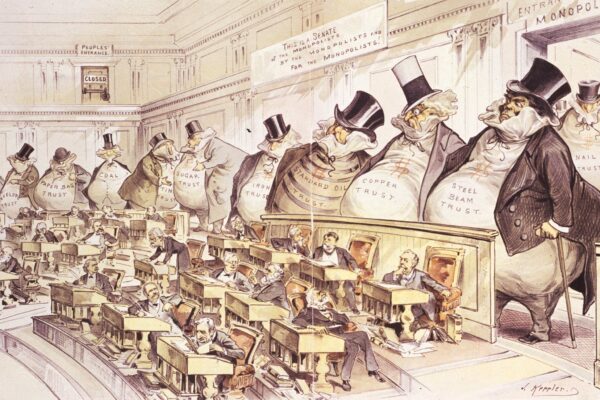
  • The MAGA Ideology and the Trump Regime

    The MAGA Ideology and the Trump Regime

    The MAGA Ideology and the Trump Regime,” Monthly Review 77, no. 11 (May 2025), pp. 1-24.

    “The Bosses of the Senate” by Joseph Keppler, originally published in Puck magazine, January 1889. Image via Library of Congress.
    “The Bosses of the Senate” by Joseph Keppler, originally published in Puck magazine, January 1889. Image via Library of Congress.


    One week after the January 20, 2025, inauguration of Donald Trump in his second stint as U.S. president, Matthew J. Vaeth, acting director of the Office of Management and Budget (OMB), issued a memorandum to federal departments and agencies ordering a temporary pause of agency, grant and loan, and financial assistance spending throughout the federal government. This was the opening shot in what the right has called the “Cold Civil War.”1 The order for a general freeze on federal civilian spending was most likely written by the incoming 2025 OMB director, Russell Vought, then awaiting confirmation by Congress. For Vought “the stark reality in America is that we are in the late stages of a complete Marxist takeover of the country” and that these enemies “already hold the weapons of the government apparatus,” which “they have aimed…at us.”2 Vought headed the OMB during the first Trump administration and was a key architect of Project 2025, the plan for the transition to a new absolutist executive, issued in 2022 by the right-wing Heritage Foundation.3 He wrote the chapter on the “Executive Office of the President of the United States” for Project 2025 and founded the Center for Renewing America, an active branch of Project 2025, which was charged with writing hundreds of executive orders in advance to be implemented immediately on the re-ascendance of Trump to the White House. Project 2025 included plans to close down whole federal departments, massively cut the federal work force, and drastically reduce federal expenditures, forcing states, local governments, universities, and the media to fall in line with the Trump regime’s dictates.4The OMB’s order to freeze federal civilian government expenditures affected spending that in fiscal year 2024 amounted to some $3 trillion, thus sending shock waves across the nation. On January 31, 2025, Chief Judge John J. McConnell Jr. of the United States District of Rhode Island issued a temporary restraining order on the OMB actions. In response, the OMB rescinded their memo. However, the Trump administration, adhering to the “impoundment theory” that claimed the executive branch had the power to zero-out funds allocated by Congress, refused to comply fully with McConnell’s court order. The subsequent decision by the U.S. Court of Appeals for the First Circuit, which supported McConnell’s decision, pointed to a looming Constitutional crisis. Major figures in the Make America Great Again (MAGA) movement have strategized in advance that the president can close down departments and impound congressionally authorized spending, while ignoring the courts, based on the sheer power of the executive office and the proposition that whatever the president does is lawful. If necessary, a state of emergency can be declared, suspending constitutional rights.5 Elon Musk’s Department of Government Efficiency (DOGE) has run roughshod over the federal government, seemingly empowered to take over and close whole agencies at will. Meanwhile, the Trump administration is claiming to have full power over the independent regulatory agencies within the federal government, such as the Federal Trade Commission, the National Labor Relations Board, the Federal Communications Commission, and even the Federal Reserve Board, under what is called the “unitary executive authority,” a controversial constitutional theory.6If the OMB order and the actions of Musk’s DOGE created a legal morass, the ideological intent of the Trump administration’s actions was nevertheless abundantly clear. According to the Vaeth/Vought memo, the purpose of the administration freeze on federal spending was to end “woke” and the weaponization of government, opposing “the use of Federal resources to advance Marxist equity, transgenderism, and green new deal social engineering policies.” The initial freeze or “pause” on spending was designed to allow the administration to identify spending devoted to “DEI [diversity, equity, and inclusion programs], woke gender ideology, and the green new deal,” together with expenditures on foreign aid, that were considered fraudulent uses of federal funding.7 In right-wing ideology, the overarching category is “Cultural Marxism,” which is seen as including the advocacy of critical race theory (CRT); environmental, social, and governance (ESG) initiatives; DEI; LGBTQ+ rights; climate change actions; open borders; universal health care; and green energy.8 This attack on so-called Cultural Marxism was in line with Agenda 47 of the Trump/J.D. Vance campaign, which was aimed at “removing all Marxist diversity, equity, and inclusion bureaucrats” and going after the “Marxist Maniacs Infecting Educational Institutions.”9

    The overall rationale behind these moves was provided by another Heritage Foundation document, also published in 2022, titled How Cultural Marxism Threatens the United States—And How Americans Can Fight It by Mike Gonzalez and Katharine C. Gorka, who went on to write NextGen Marxism: What It Is and How to Combat It (2024).10 Cultural Marxism, which is seen on the MAGA right as pervading the universities and government, as well as penetrating into corporations, is viewed as having its genesis in Antonio Gramsci’s Prison Notebooks, which broke with the economism of classical Marxism. In this distorted view, the new “Cultural Marxism” was carried forward by Frankfurt School Marxists like Max Horkheimer, Theodor Adorno, Herbert Marcuse, and Erich Fromm. It was to be given a more expansive form by postmodernists like Michel Foucault, ultimately leading to radical feminist theory and CRT. The work of Gonzalez and Gorka does not demonstrate the slightest attention to genuine scholarly research. Its purpose is not to promote intellectual inquiry, but rather a New McCarthyism. In their book, they claim that Joseph McCarthy in the anti-Communist witch hunt of the 1950s had carried out “important work,” but made the mistake of leveling charges that he “could not substantiate.” In today’s Cold Civil War, it is suggested, the McCarthyism needs to be resurrected on more solid foundations so as not to make the mistakes of the past—though in fact, the New McCarthyism is as devoid of substance as its 1950s predecessor.11

    The MAGA ideology that is now ensconced in the White House, and which has also spread to a considerable extent into the courts and Congress, has little to do with Trump himself, for whom it has served as a convenient weapon in his rise to power. Rather, its material basis is to be found in the growth of a larger neofascist movement, which, like all movements within the fascist genus, is rooted in a tenuous alliance between sections of the monopoly-capitalist ruling class at the top of society and a mobilized army of lower-middle class adherents far below. The latter see as their chief enemies, not the upper echelons of the capitalist class, but the upper-middle class professionals immediately above them and the working class below.12The primarily white lower-middle class overlaps with rural populations and adherents of religious fundamentalism or evangelicalism, forming a right-wing, revanchist historic bloc.

    The current mobilization of the lower-middle class by the right wing of monopoly capital, particularly, the tech, finance, and oil interests, is initially aimed at dismantling the present “administrative state,” replacing it with one more conducive to a neofascist project. Nevertheless, in the process, a widening political gap is already opening up between the billionaire rulers above and their MAGA army below, between different elements within the evangelical movement, and among those supporting a political dictatorship and those wishing to retain liberal-democratic constitutional forms.13

    In line with all movements in the fascist genus, the current regime will inevitably betray its mass MAGA supporters on the radical right, seeking to relegate them to a more and more subservient and regimented role and negating any policies in fundamental conflict with its capitalist-imperial ends. Nevertheless, a mass of think tanks and influencers has arisen that seek to rationalize the irrational, building on those ideological elements that appeal to a white lower-middle class, but ultimately serving the needs of the billionaire capitalist class. Understanding the basis of this new irrationalism and the forms of class rule associated with it is crucial in the counter-hegemonic struggle for a democratic, egalitarian, and sustainable—and thus socialist—future for humanity as a whole.

    MAGA’s Neofascist Ideology

    “The antonym of fascism,” Marxist economist Paul M. Sweezy wrote in 1952, “is bourgeois democracy, not feudalism or socialism. Fascism is one of the political forms that capitalism may assume in the monopoly-imperialist phase.”14 In the classical definition originating with Marxist theorists—and employed, as in the case of Franz Neumann’s Behemoth: The Structure and Practice of National Socialism, in the Nuremberg trials—those movements and regimes belonging to the fascist genus have their material foundations in a tenuous alliance between monopoly capital and a mobilized petty bourgeoisie or lower-middle class. The latter were referred to by C. Wright Mills as the “rearguarders” of the capitalist system due to their generally regressive ideology, a product of their contradictory class location.15

    Such mobilization of the lower-middle class/stratum at the instigation of sections of monopoly capital occurs when the upper echelons of society see themselves as threatened by a variety of internal and external factors that jeopardize their hegemony. This leads to attacks on the liberal democratic state and the seizure of state power by a section of the ruling class, backed by an army of adherents from below—often initially by legal means, but soon crossing constitutional boundaries. Power is concentrated in the hands of a leader, a duce or Führer, behind whom lies giant capitalist interests. Key to fascist rule, once it gains its ascendancy over the state, is the privatization of large parts of government on behalf of monopolistic capital, a concept first articulated in relation to Adolf Hitler’s Germany.16 This is accompanied by extreme repression of segments of the underlying population, often as scapegoats. Such movements inevitably seek to secure their rule ideologically by gaining control of the entire cultural apparatus of society in a process that the Nazis called Gleichschalthung, or bringing into line.

    This general understanding of fascism was dominant in the 1930s and ’40s, extending into the late twentieth century. However, fascism, as a political formation, was eventually reinterpreted in liberal discourse in idealist terms as a pure ideology, conceptually decoupled from its class and materialist foundations and reduced to its outward form as extreme racism, nationalism, revanchism, and the growth of authoritarian personalities, all of which were seen as disconnected from capitalism itself. Much of this was in fact implicit in the criticism of “totalitarianism” developed by Cold War figures like Hannah Arendt, which presented fascism as an extreme system on the right conceptually divorced from capitalism, and the antonym of communism on the left.17 Fascism thus was reinterpreted in the hegemonic ideology as a form of violent authoritarianism/totalitarianism and a departure from capitalism, which was then identified exclusively with liberal democracy. Lacking any real historical-material foundations and ignoring class realities, such reformulations were mere means of shoring up the notion of capitalism itself and have proven useless in attempts to understand the reemergence of fascist and neofascist forces in our time.

    In addressing the current neofascism, it is crucial to see it as a product of material/class/imperial relations of late capitalism, which is not to be understood simply in terms of its “populist,” hyper-racist, hyper-misogynist, or hyper-nationalist outer forms but rather in terms of a substantive class-based critique.18 Fascism is at all times an attack on liberal democracy and the substitution of an iron-heel political order under the reign of monopoly-finance capital. Its revanchist ideology does not arise primarily from monopoly capital itself, but rather is chiefly a mechanism for the mobilization of right-wing forces drawn predominantly from the lower-middle class, enlisting an army of actual or would-be stormtroopers (whether wearing black shirts, brown shirts, or MAGA hats), and providing the justification for the dismantling of the liberal-democratic state.

    Although it is the real material-class forces rather than disembodied ideology that have to be kept primarily in mind, it is nonetheless true that ideas, once they emerge, can themselves become material forces. “Ideology,” Georg Lukács wrote, is “the highest form of [class] consciousness.”19 If we want to understand the nature of the emerging MAGA regime, we therefore have to explore its governing ideology and its forms of political organization. Very little of this, it should be underscored, emanates from Trump himself, who is often described within the MAGA movement as a somewhat defective, if useful, instrument of the new order.20

    Despite its importance in publishing Project 2025, the leading think tank for the Trump movement is not the Heritage Foundation, but rather the Claremont Institute, founded in 1979 in Upland, California. The Claremont Institute was originally a base for Straussian thought (derived from the ultraconservative political theorist Leo Strauss) but has evolved into the nerve center of MAGA. Its funding comes from megadonors, including the Thomas D. Klingenstein Fund (a multibillion dollar fund managed by investment banker Thomas D. Klingenstein, chairman of the board of the Claremont Institute), the Dick and Betsy DeVos Foundation (managed by billionaire former Trump education secretary Betsy DeVos), the ultraconservative Lynde and Harry Bradley Foundation, and the Sarah Scaife Foundation.21 Its two main publications are The American Mind and the Claremont Review of Books. The Institute also has an additional branch, the Claremont Institute Center for the American Way of Life, located in Washington, DC, across from the Capitol. Academics and pundits associated with the Claremont Institute dominate Hillsdale College in Michigan. Hillsdale publishes Imprimis, essentially a Claremont Institute MAGA publication. The Institute offers a number of fellowships, including the Lincoln Fellowship. Its website tracks so-called “BLM funding” (referring to the Black Lives Matter, or BLM movement) by corporations, claiming, on extremely questionable grounds, that $82.9 billion has been directed to the CRT/Woke/Cultural Marxist cause by corporations. As in MAGA ideology in general, corporations are condemned as morally corrupt for giving way to Cultural Marxism but are seldom criticized economically. This is consistent with the entire history of petty-bourgeois ideology as reflected in the nineteenth-century writings of such celebrated figures as Thomas Carlyle and Friedrich Nietzsche, whose ideological outpourings, as Lukács noted, reflected “a contradictory twofold tendency” of a “critique of capitalist lack of culture,” while nonetheless supporting an order “located in capitalism.”22

    In 2019, Trump awarded the Claremont Institute the National Humanities Medal. On January 6, 2021, lawyer John Eastman, a member of the board of the Claremont Institute (where he remains to this day), supported by other Claremont Institute associates, played the leading role in organizing the MAGA assault on the Capitol Building in Washington, DC. He also wrote the key memos directed at pressuring Vice President Mike Pence to invalidate the 2020 election in an attempt to reverse Trump’s loss to Joe Biden. All of this earned Claremont the reputation as the January 6 attempted coup’s “brain trust.”23

    The Claremont Institute was to become the main intellectual incubus of Trump II. More than a dozen Claremont associated pundits and former Claremont fellows regularly appear on Fox News. This includes, in addition to Eastman, such luminaries as Michael Anton, Claremont senior fellow and a high-level Trump State Department appointee; Christopher Caldwell, contributing editor to the Claremont Review of Books and white supremacist commentator; Brian T. Kennedy, Claremont former president and current board member, and chairman of the Committee on the Present Danger, which advances a new McCarthyism; Charles R. Kesler, Claremont Review of Books editor and leading proponent of a “Cold Civil War”; Charlie Kirk, former Claremont Lincoln Fellow and founder/CEO of Turning Point USA (TPUSA), with its “Professor Watch List” and its evangelical branch, TPUSA Faith; John Marini, Claremont senior fellow and leading right-wing intellectual critic of the “administrative state”; and Christopher F. Rufo, former Claremont Lincoln Fellow and notorious anti-CRT pundit.

    Anton, a former managing director of investment at BlackRock and currently a senior researcher at the Claremont Institute, served as deputy assistant to the president and deputy national security advisor for strategic communication on the National Security Council in Trump’s first administration.24 He is now director of policy planning in the U.S. State Department under Marco Rubio. It was Anton more than any other single figure who connected the Claremont Institute to MAGA and the alt-right. His 2016 Claremont Review of Books article “The Flight 93 Election”—using the metaphor of the passengers who rushed the cockpit on the terrorist flight on September 11, 2001—was to go viral and played a major role in mobilizing militant support for the Trump campaign. Here Anton declared that the 2016 election was a “charge the cockpit or die election,” in which “you may die anyway” in the attempt, but if Hillary Clinton were to be elected, “death is certain.” Although the piece was disjointed, rambling, and illogical, the metaphor nonetheless caught on, catapulting Anton to right-wing celebrity status, and led to his appointment to Trump’s National Security Council with the support of the right-wing tech billionaire Peter Thiel.25

    In 2019, Anton published After the Flight 93 Election… And What We Still Have to Lose, which emphasized the need for a war on the entire left, earning the praise of Trump. This was followed in 2020 by his book, The Stakes: America at the Point of No Return, in which he proposed that immigration should ideally be stopped altogether, while birthright citizenship (citizenship by virtue of simply being born in the United States, even if not to U.S. citizens) should cease immediately. China was the primary enemy, while peace should be made with Russia. The latter, Anton explained, belonged to the same “civilizational ‘sect’” as the United States and Europe, “in ways that China would never be.” Anton’s The Stakes, however, is best known for his explicit advocacy of a “red [that is, Republican or right-wing] Caesarism,” in which the presidency would become a “form of absolute monarchy” or “one-man rule” exhibiting widespread popular support—a position that was followed immediately after in his book with the exhortation to “reelect Trump!” Only when elected would Trump declare himself Caesar.26

    In a review on “Draining the Swamp” in the Claremont Review of Books, Anton popularized Marini’s Unmasking the Administrative State. Marini’s analysis is seen as a validation of Alexandre Kojève’s conservative rendition of G. W. F. Hegel’s German idealist philosophy, which in the right-wing view is seen as forming a justification for autocratic bourgeois rule as the end of history. Applied to contemporary institutions, the bureaucratic overlords of the administrative state are to be viewed as the “ruling class.” Marini and Anton thus argue that there is a need for Trump to smash the administrative state and replace it with more centralized rule. These same views led U.S. Supreme Court Justice Clarence Thomas, who in an earlier stage of his career had employed Marini as a special assistant, to exclaim “We must read Marini!!”27

    Anton has declared that in order to win “we need bloggers, meme-makers, Twitter trolls, street artists, comedians, propagandists, theologians, playwrights, essayists, novelists, hacks, flacks, and intellectuals”—as well as Trump and right-thinking capitalists.28 His most iconoclastic act within the Claremont Institute itself was to write an article about the alt-right Nietzschean-fascist propagandist Bronze Age Pervert (known as BAP, now revealed as Romanian-American Costin Vlad Alamariu, who received a PhD from Yale), the author of Bronze Age Mindset. Anton’s role, in a 2019 Claremont Review of Books article titled “Are the Kids Al(t) Right?,” was to bring BAP/Alamariu into the MAGA mainstream in an effort to draw disenchanted white youth into the neofascist movement. Noting that BAP provided in his self-published Bronze Age Mindset a “simplified pastiche of Friedrich Nietzsche,” which had “cracked the top 150 on Amazon—not, mind you, in some category within Amazon but on the site as a whole,” Anton argued that it represented an opportunity for the MAGA right to dominate the underground youth discourse. BAP characterized the liberal elites, intellectuals, left thinkers, and the general population as “bugmen,” without heroism, similar to Nietzsche’s “Last Man.” Human beings in general were portrayed as belonging to mere “yeast” life. The solution lay in male bodybuilding through weightlifting, and the cultivation of the image of Greek Bronze Age heroes. BAP is a white supremacist, emphasizing Aryan purity and vile attacks on diverse populations everywhere. As Anton himself admitted, “the strongest and easiest objections to make to Bronze Age Mindset is that it is ‘racist,’ ‘anti-Semitic,’ ‘anti-democratic,’ ‘misogynistic,’ and ‘homophobic,’” making it more “outrageous” than Nietzsche. Yet, he pretends that BAP is “gentler” than thinkers like Karl “Marx, [V. I.] Lenin, Mao [Zedong]…[Che] Guevara, [Saul] Alinsky and Foucault, or any number of fanatics whose screeds are taught in the elite universities.” In the end, Anton underscored the importance of BAP’s attacks on “bugmen” and “bugtimes,” incorporating his views within MAGA.29

    A study of Bronze Age Mindset itself reveals venomous references to “the shantytowns of the Turd World,” and attacks, citing Nietzsche, on “pre-Aryan modes of life, the return of socialism, of the longhouse, feminism,” and “Satanic Marxist sects.” Athenian general Alcibiades, conquistadors Hernán Cortés and Francisco Pizarro, Napoleon Bonaparte, Theodore Roosevelt, Alfredo Stroessner (former dictator of Paraguay), and especially Bob Denard (a brutal twentieth-century French mercenary active in the Congo and the Comoros Islands) are BAP’s models of the return in modern times of Bronze Age Aryan humans. BAP’s favorite president, prior to Trump, is James K. Polk, who launched the Mexican-American War. The “white population” in the United States, he writes, seized Mexico “by their valor.” Feminism is seen as an abomination. “Nothing so ridiculous as the liberation of women,” BAP/Alamariu declares, “has ever been attempted in the history of mankind,” which he describes as an attempt to “return to pre-Aryan matriarchy.” He adds, “Social justice is a disgusting parasitism.” Today’s cities, subject to waves of immigrants, are “populated by hordes of dwarf-like zombies that are imported for slave labor and political agitation from the fly-swept latrines of the world.” He openly claims: “I believe in Fascism or something worse.” For all these reasons, according to BAP, Trump is to be supported in his conquest of government. “The Leviathan” of the administrative state dominated by the “bugmen,” he insists, must be smashed in order to create a new “primal order.” With the support of Anton and others, BAP was recognized as a kind of underworld Nietzschean influencer behind the MAGA movement, attractive to young, regressive white males. He was to become virtually required reading for young white staffers in the first Trump administration.30

    Anton was himself encouraged to read BAP by self-styled “Dark Enlightenment” thinker Curtis Yarvin, a neofascist close to both Anton and Vance (the MAGA heir apparent). Like Vance and Anton, Yarvin is heavily supported by Silicon Valley billionaire Thiel. Yarvin is also openly admired by Trump adviser and Silicon Valley venture capitalist Marc Andreessen for his antidemocratic views. Vance calls Yarvin, whom he has also referred to in friendly banter as a “fascist,” “my number one political influence.” In the MAGA world, Yarvin remains something of a shadowy figure, despite the fact that he has articulated the more reactionary strategies of the Trump regime. He is an ex-computer programmer and right-wing blogger, writing under the pseudonym Mencius Moldbug and advocate of a “Dark Enlightenment” or neoreactionary movement (“NRx”). Tucker Carlson devoted an entire show to interviewing Yarvin in 2021. He is best known for his anti-democracy arguments and insistence that the president can establish himself as a “national CEO” or even “dictator,” concentrating all power in the executive branch and superseding the legal system and the courts while shifting from an “oligarchical Congress” to a “monarchical president.” Americans, he insists, are “going to have to get over their dictator-phobia.”31

    Yarvin has weaponized J. R. R. Tolkien’s Lord of the Rings, seeing the leftist elite or professional-managerial class as an “elf aristocracy,” the “lower-middle class” as “hobbits,” and “dark elves” like himself as defenders of the hobbits. Like Steve Bannon, Trump’s former White House chief of staff, with whom he identifies, Yarvin sees himself as a proponent of MAGA; but, unlike Bannon, he deemphasizes the contradiction between the lower-middle class MAGA forces and the monopoly-capitalist billionaires at the top. Yarvin’s real allegiances are to the billionaires, rather than the lower-middle class. Indeed, he denies that he is a real fascist, despite the fact that he has applied the fascist label to himself, characterizing himself rather as a more straightforward supporter of dictatorship (or monarchy), since he has absolute contempt for the masses. Nevertheless, Yarvin sardonically states, “frankly, Hitler reads a lot like me”—if, he acknowledges, more talented and more evil.32

    Widely seen as a largely underground figure who has helped game the system for Trump, Yarvin has provided the general plan for an imperial presidency. He argues that real power is held “oligarchically” (distinguished from the classical notion of oligarchy as based on wealth) by people who control the media and the universities, constituting the “Cathedral.” The Cathedral can only be toppled by a monarch or dictator, acting as a CEO. Once Trump was elected, Yarvin contended, he could purge the federal bureaucracy (what Yarvin calls “RAGE,” or retire all government employees) by claiming he had an electoral mandate allowing him to transgress the law and bring both the courts and Congress to heel. All court orders requiring the president to desist should be ignored. The mainstream media corporations and the universities should be closed down. In a podcast, Anton said to Yarvin, “You’re essentially advocating for someone to—age-old move—gain power lawfully through an election, and then exercise it unlawfully.” Yarvin responded, “It wouldn’t be unlawful. You’d simply declare a state of emergency in your inaugural address.” The president could apply this to every state and take “over all law enforcement authorities.” Like Anton, Yarvin declared of the president, “you’re going to be Caesar.”33

    Anton has stated that the universities are “evil,” a position strongly supported by Rufo, a former director at the intelligent design (creationist) Discovery Institute and a Claremont Lincoln Fellow.34 Rufo is widely celebrated in MAGA circles for his grand propagandistic exploits in turning CRT and DEI into toxic conceptions in the public mind. He is currently a senior fellow at the Manhattan Institute for Policy Research and a contributing editor to its City Journal. In “Critical Race Theory: What It Is and How to Fight It” for Hillsdale’s Imprimis, Rufo argued that CRT was the product of Cultural Marxism and “identity-based Marxism.” In what has become a fundamental element of MAGA ideology, he contends that today’s Marxists are all identity-theorists and are opposed to “equality,” replacing it with “equity,” which is “little more than reformulated Marxism.” CRT, he pronounces, promotes “neo-segregation.” It violates the principle of civil rights and is discriminatory through its anti-white policies. In this way, civil rights law is to be redirected against racial minorities. Rufo associates CRT and BLM with anticapitalism and reverse racism. His assaults on CRT influenced Trump’s attacks on it in his first administration.35

    More recently, Rufo has argued for “laying siege to the institutions.” This includes attacking any corporations that instituted DEI policies, seen as the product of Cultural Marxism, CRT, and BLM—a neo-McCarthyite view shared by Florida Governor Ron DeSantis. Major targets are “radical gender theory” and what Rufo calls “the transgender empire.” He contends that “we must fight to put the transgender empire out of business forever.” Rufo and the MAGA right fulminate against the “college cartel” and argue that K–12 reeducation should start with the promotion of “Western Civilization.”36

    One of the most adamant critics of diversity on the MAGA right is Caldwell, who in his article “The Browning of America” argues that “‘Diversity’ has [always] been an attribute of subject populations.” Hence, recognizing it as a basis of social policy flies in the face of the principles of the founders of the U.S. Constitution. In an article on Robert E. Lee, Caldwell argued that left criticisms of the commander of the Confederate forces as a defender of the slaveholding South, and thus of slavery, were aimed at eliminating Lee as “the moral force of half the nation.”37

    Claremont Review of Books editor Kesler, a member of Trump’s 1776 Commission on U.S. History, intended to counter the 1619 Project on the history of U.S. slavery, has been a leading figure in promoting the MAGA notion of a Cold Civil War between the right and the so-called dominant forces on the left. The term “woke,” which arose first in the civil rights movement, has been massively turned around by the right since 2019, relying on conservative command of the media, to refer in a derogatory way to all contemporary progressive political and cultural causes. It is employed as a means of belittling social justice struggles against racism and gender inequality, while its most common usage is as a racist dog whistle.38

    The MAGA ideology’s Cold Civil War is closely attached to attacks on China. As chairman of the Committee on the Present Danger (which includes Bannon as a member), Claremont Institute board member Brian Kennedy is part of a movement to generate a new McCarthyism focused on Beijing. Claiming that Chinese Communism has infiltrated U.S. society in BLM clothing, he writes: “We are at risk of losing a war today because too few of us know that we are engaged with an enemy, the Chinese Communist Party (CCP) [sic], that means to destroy us.”39

    Christian nationalists are also being enlisted in the Cold Civil War/New McCarthyism. Kirk’s Turning Point USA became notorious in 2016 for its Professor Watch List, singling out mostly left academics across the country to be targeted by the right in a McCarthyite manner. Kirk, who also served on Trump’s 1776 Commission, has now become known as a mega “whisperer” to youth, in which he bullet points the “war on white people” and encourages white nationalism. His organization, working with the Claremont Institute, bussed MAGA supporters to the January 6, 2021, protest and assault on the Capitol. Yarvin, who has described slavery “as a natural human relationship” and promoted biological determinism and monarchy, was effusively praised by Kirk on his radio show and podcast, along with white supremacist Steve Sailer. Kirk is the author of Right Wing Revolution: How to Beat the Woke and Save the West, published in 2024. According to the publisher’s blurb, “America…is under threat from a lethal ideology that seeks to humiliate and erase anyone that does not bow at its altar…. Kirk drags wokeism out of the shadows and details the exact steps needed to stop its toxic spread,” which “has already seeped into every aspect of American society.”40

    More recently, Kirk has transformed himself into the leading promoter of evangelical Christian nationalism within the MAGA movement, establishing a division of Turning Point USA called TPUSA Faith aimed at white evangelicals. He argues that the U.S. founders created a Christian nation and advocates the Seven Mountain mandate of extreme evangelical Christian nationalism, in which believers are required to seek to dominate all of reality, including family, religion, education, media, arts, business, and government. This is tied to endism and religious apocalypticism (Second Coming) views. Kirk has sought to promote hatred of LGBTQ+ and transgender people in order to motivate the evangelical movement to take on a more direct political role.41

    OMB director Vought is undoubtedly the most powerful Christian nationalist within the Trump administration itself. Writing in 2022 for the Claremont Institute’s The American Mind, Vought claimed that the Center for Renewing America, which he founded in 2021, had demonstrated on so-called legal grounds that “illegal aliens coming across” the U.S.-Mexico border constituted “an invasion,” thus allowing state governors, who, according to Article 1, Section 10, Clause 3 of the U.S. Constitution, are not allowed to “engage in War unless actually invaded,” to act forcibly against these “invaders,” independent of the federal government.42 As a Christian Nationalist organization, the Center for Renewing America is adamantly anti-Palestinian, opposing any attempt to allow Palestinians to immigrate to the United States, arguing that “One would be hard-pressed to identify a people or culture more fundamentally at odds with the foundations of American self-government than Palestinians,” who have “a culture poisonous to the health of and integrity of American communities,” and whose ideology, despite the counter-claims of “intersectional Marxists,” has as its aim the total annihilation of Israel. Vought’s Center for Renewing America is strongly in favor of the removal of the Palestinian population from Gaza and their resettlement in the lands of the Arab League.43

    Movements in the fascist genus have often relied on opportunistic shifts from left to right. A classic example of this is the Italian leftist thinker Enrico Ferri, a reactionary pseudo-socialist who was strongly attacked by Frederick Engels, and later became a follower of Benito Mussolini.44 The main intellectual vehicle for so-called “leftist” cooperation with MAGA ideology, operating in what is presented as a common anti-liberal vein, is Compact magazine, cofounded by Iranian-American rightist and former Trotskyist Sohrab Ahmari, a close associate of Vance and now the U.S. editor of UnHerd, and by national-populist Edwin Aponte, editor of Bellows, a MAGA-style publication. Compact magazine was once described in Jacobin as a “syncretic” magazine of both left and right.45 However, rather than representing some sort of meeting point of left and right, it is strongly supportive of Trump and Vance while successfully drawing in erstwhile leftist contributors, such as Christian Parenti and Slavoj Žižek (a contributing editor) into a publication in which pro-MAGA views are hegemonic.46 Yarvin, Anton, Caldwell, and Rufo have all written multiple articles for Compact on such topics as the nihilism of the left-wing ruling class, Cultural Marxism, CRT, dismantling the administrative state, and support for Viktor Orbán’s ultra-conservative government in Hungary and the neofascist Alternative für Deutschland (AfD) in Germany.47

    Parenti, once a well-known leftist journalist, writes regularly for Compact. His columns have supported Trump’s nomination of Kash Patel as FBI director and Robert F. Kennedy Jr. as Secretary of Health. He has also written columns claiming that Trump is an anti-imperialist and that “‘Diversity’ Is a Ruling Class Ideology.” Since Trump’s reelection, Parenti has presented Trump and some of his department heads (Kennedy, Patel, and Tulsi Gabbard, Trump’s Director of National Intelligence) as potential opponents of the “deep state” or surveillance-intelligence state, and thus in line with the left in this respect. However, this is a gross misperception of the nature of the Trump/MAGA regime itself, which has nothing to do with openness or democratic control, but which is establishing the basis for its own direct rule.48

    Žižek has used Compact as a venue in which to engage in the most reactionary themes. Thus, in an article titled “Wokeness Is Here to Stay,” he presented a transphobic argument in which he declared that “the use of puberty blockers is yet another case of woke capitalism.” In this same anti-woke article, Žižek generalized from the experience of a Black professor who was strongly criticized by students from an Afro-pessimist standpoint (as detailed in a different Compact article). From there, Žižek went on to make the extraordinary racially charged statement, directed at a mainly white reactionary readership, that, “The black woke elite is fully aware that it won’t achieve its declared goal of diminishing black oppression—and it doesn’t even want that. What they really want is what they are achieving: a position of moral authority from which to terrorize all others.”49

    Compact magazine managing editor Geoff Shullenberger has specialized in bringing the ideas of BAP into the MAGA mainstream, both within Compact and elsewhere. Shullenberger also is the coeditor of COVID-19 and the Left: The Tyranny of Fear, opposing lockdowns, vaccine mandates, and masking in response to COVID-19 as due to the extremism of the left. Meanwhile, Compact columnist and MAGA “populist” supporter Batya Ungar-Sargon, author of Bad News: How Woke Media is Undermining Democracy (2021), was appointed in 2025 deputy opinion editor of Newsweek.50

    The MAGA think tanks are a product of funding by big capital interests, often promoting, in this respect, a libertarian ideology, but melding this with the need to reach the white lower-middle class with its reactionary, nationalist-populist, revanchist, racist, misogynist, and anti-socialist perspective, as a way of developing a mass constituency. The resulting MAGA ideology is disseminated through wider media such as Fox News, talk radio, social media, YouTube videos, blogs, and podcasts. The influential infotainment site Breitbart, once headed by Bannon, has published numerous articles attacking Cultural Marxism, and specializes in sensationalized shock attacks on the left. Breitbart’s senior technology editor, Allum Bokhari, a former Claremont Lincoln Fellow, has written for Hillsdale’s Imprimis on the need for the right to control big tech, along the lines subsequently implemented by Musk at X.51

    Claremont Lincoln Fellow Raheem J. Kassam, a former chief of staff to Brexit leader Nigel Farage and a Bannon ally, is the former editor-in-chief of Breitbart London. More recently Kassam had cohosted Bannon’s MAGA radio show/podcast “War Room.” In 2018, Kassam became editor-in-chief of the Trumpist news website National Pulse, and appears frequently as an “expert” commentator on Fox News, where he has discussed “How Did America Fall to Marxism?”52

    MAGA analyses are also disseminated by way of conservative book publishing. Rufo’s best-selling America’s Cultural Revolution: How the Radical Left Conquered Everything (2023) and Kirk’s The MAGA Doctrine (2020) were both published by Broadside Books, HarperCollins’s imprint for ultra-conservative nonfiction, which absorbed the Fox News book brand. The big five English-language book publishers all have distinct imprints devoted entirely to ultra-conservative books aimed at white supremacist Republicans/MAGA.53 Anton’s After the Flight 93 Election, Kesler’s Crisis of the Two Constitutions: The Rise, Decline, and Recovery of America’s Greatness(2021), Kennedy’s Communist China’s War Inside America (2020), and Ungar-Sargon’s Bad Newswere all published by Encounter Books, established by the right-wing Bradley Foundation, a funder of the Claremont Institute. Established in 1998, Encounter Books deliberately took its name from the pseudo-left-liberal journal Encounter, which was exposed in the 1970s by Ramparts as a CIA-funded publication. Kirk’s Right Wing Revolution: How to Beat the Woke and Save the West (2024) was published with Winning Team Publishing, cofounded in 2021 by Donald Trump Jr.54

    All the new right concepts and talking points end up on social media. As Fox News host Jesse Watters stated, “We are waging a 21st-century information warfare campaign against the left. It’s like grassroots guerrilla warfare. Someone says something on social media, Musk retweets it, [Joe] Rogan podcasts it, Fox broadcasts it and by the time it reaches everybody, millions of people have seen it.”55

    Division in the Ranks

    The most extreme MAGA ideologues such as Bannon, Yarvin, and Anton are distinctly aware that the nationalist-populist MAGA movement is rooted in lower-middle class whites (whom the neofascist movement in both Europe and the United States is accustomed to referring to as “hobbits”), and only secondarily in privileged elements of the working class. MAGA think tanks often present a barely disguised contempt for the “lumpen,” “pitchfork-bearing proletariat,” or “proles,” namely the working class.56 Almost no positive references to the working class or attempts to approach the underprivileged are present in the mainline MAGA literature, which is understood as rooted in a fragile national-populist alliance between the billionaire class and the lower-middle class, both of which see the working class as their most dangerous enemy (exceeding their hatred even for the upper-middle class professional-managerial stratum). Funded by the mega-rich and dedicated to the idea, as Anton says, that “race trumps class,” the MAGA pundits and influencers are unable to address directly the question of the working-class majority without undermining their claim to a broad populism. The result is that they appeal primarily to whiteness and “middle America.”57 Occasional references are made to MAGA hat-wearing truck drivers and other workers, but this only constitutes a vain attempt to elude the reality of a political bloc that consists largely of the lower-middle class and a relatively small number of privileged workers. Although Bannon, representing MAGA’s radical right, refers to workers, it is always in a context where the lower-middle class looms larger.58

    This fundamental class division will remain. Although Trump made some gains with blue-collar workers in the 2024 elections, particularly in rural areas, his political base remains the lower-middle class, which is in large part hostile towards the working class below. The Trump program is destined to hit the working class hardest economically.59 It was Anton who was to make the most serious ideological attempt to escape this trap in an article in Compact titled “Why the Great Reset Is Not ‘Socialism,’” in which he sought to examine Marxist theory and turn it on its head. Thus, he characterized Silicon Valley billionaire oligarchs in alt-right fashion as the “left,” the enemy of right-wing populism. Moreover, while the MAGA movement, he recognized, was fundamentally based in the lower-middle/middle class/the poor, its “natural” basis ultimately was to be sought in the majority that he sardonically referred to as the “proles.”60 His whole endeavor in this respect, however, was to fall flat in the face of the inescapable reality of a neofascist alliance between the billionaires and the lower-middle class—both of whom see the diverse working class as the ultimate enemy. Moreover, Anton’s contradictory attempt to create a right-wing populism that incorporated the working class and targeted billionaire oligarchs was at odds with his own role as a member of the national security establishment, dominated by the mega-capitalist class, which had him hobnobbing with some of its biggest players. He therefore quickly mended his ways. Although he persisted in criticizing “oligarchs,” they were refashioned in conformity with the hegemonic MAGA ideology as the members of the administrative state, no longer big money interests.

    Yet, if the mass MAGA movement with its racism and its small-property-based outlook is inherently anti-working class, even if it has attracted significant numbers of working-class voters, it also finds itself in conflict with the ultra-wealthy interests that have funded and mobilized it, making it a dangerous movement from the standpoint of monopoly capitalism itself. Once political power is achieved in regimes in the fascist genus, divisions quickly emerge between the top echelons of monopoly capital and its army of lower-middle class adherents. Having obtained control of the state and of the military and police powers, the ultra-wealthy ruling class has every reason to discard the more militant nationalist—often partially anticapitalist—elements of its “radical right” base. The classic historical instance of this was the Night of the Long Knives in Hitler’s Germany, from June 30 to July 2, 1934, in which the Nazi party’s paramilitary brownshirt wing, the Sturmabteilung, or “Assault Division,” known as its stormtroopers, were subjected to a bloody purge. The purge was aimed specifically at the Strasserism (named after Otto and Gregor Strasser), deeply embedded in the brownshirts within the Nazi movement, which was both antisemitic and, to a considerable extent anticapitalist, and belonged to a milieu of militant mass action or “revolutionary” nationalism. Elimination of Strasserism allowed the consolidation of fascism as a reactionary monopoly-capitalist state, repressing and regimenting its mass petty-bourgeois base.61

    In the very different conditions of the neofascist MAGA movement in the United States today, these same general contradictions appear, though minus the extreme violence. Many among the MAGA faithful were startled to see their lack of representation in the Trump cabinet following the 2024 election, a sharp contrast from the 2016 election. The Trump regime today has a cabinet of billionaires, surrounded by still further billionaires. Although there are extreme rightist operatives whose views are similar to those of the MAGA masses in the second Trump White House—such as Stephen Miller, who, despite being Jewish, appears to support white Christian nationalism, and is currently deputy chief of staff for policy—they are overshadowed by the mega-capitalists. Right from the start, it was clear that high-tech financial capital rather than the MAGA hat-wearing base was to be in charge. As Gary Stout, a Washington attorney, wrote in Pennsylvania’s Observer-Reporter, Trump “is now creating a new political elite of oligarchs that has no accountability to Congress or loyalty to his own MAGA movement.”62

    This contradiction, splitting the MAGA movement/Trump regime, was immediately apparent in the conflict over H-1B visas for foreign workers. These visas are widely used by multinational corporations to hire foreign technical workers in specialty occupations, especially high-tech, bringing in relatively low-paid skilled workers from India, China, and elsewhere. H-1B visas have been heavily criticized within the MAGA movement, since they undercut relatively high-paid U.S. jobs. Voicing the outrage of the MAGA faithful, Bannon declared prior to Trump’s inauguration that Musk, who came out strongly for the H-1B visas, was “evil” and that he would have him driven out of the White House. Bannon raged in national-populist terms against wealthy “oligarchs,” not only “the lords of easy money,” but more importantly the tech overlords of Silicon Valley, representatives of “technological feudalism,” who were now dominating the MAGA movement, and were opposing “the populist, nationalist revolution.” MAGA militant Laura Loomer presented racist arguments in which she declared: “Our country was built by white Europeans…. Not by third world invaders from India.” Openly attacking Musk on X, Loomer suddenly found herself demonetized on the platform.63 The fact that this represented a fundamental division between billionaire monopoly-finance capitalists and high-tech oligarchs at the top and the lower-middle class MAGA base was evident in an article by Kevin Porteus of Hillsdale College titled “Putting Americans First,” published in The American Mind. He advanced the argument that “America First” should mean “Americans…first.”64Breitbart likewise ran story after story against H-1B visas. The rebellion over this issue, however, was soon put down by Trump, who, himself a billionaire, sided with Musk, indicating that his own companies employed foreign workers on H-1B visas. Faced with a division between monopoly-finance capital and his own militant MAGA movement, Trump chose the former.

    The fissure between a capitalist ruling class of billionaires and the neofascist movement on the ground will only widen. The MAGA movement expects lower taxes under Trump, which will no doubt be partially forthcoming, but paid for to a significant extent by drastic cuts in social services. Expectations of lower prices, especially with new tariffs being instituted, will be dashed. Moreover, like all tax reductions under monopoly capitalism, the new Trump tax cuts will be highly regressive, benefiting the rich most of all and further widening the gap between the top and the bottom of U.S. society. The cutbacks on civilian government will hurt the vast majority of the population, including the lower-middle class. With nearly all social spending that benefits the bottom 60 percent of the population, including Medicaid, Medicare, and Social Security now in the crosshairs of Musk’s DOGE, the carnage is likely to be severe. Although the MAGA movement is characterized by extreme nationalism, monopoly-finance capital and its high-tech overlords are geared to accumulation on a world scale and global financial expropriation. They rely on the exploitation not only of the global proletariat, but also the increased exploitation and expropriation of U.S. workers. Implementation of ruling-class policies on globalization, financialization, imperialism, war, and hyperexploitation under the new regime will inevitably push much of the U.S. lower-middle class back into the working class, polarizing and destabilizing the society still further.

    Trump’s neofascist regime is a desperate act of a declining empire. It has supplanted neoliberalism only in the sense that the right wing of the ruling class itself is now in direct and open command of the state, seeking to restructure it as a vehicle of resurgent hegemony. The conflict between neofascism as a more regressive global capitalist project designed to preserve and enhance the power of the ruling capitalists with their global interests, on the one hand, and the national-populist movement of the MAGA radical right focused primarily on the conquest of the administrative state, on the other, means that the mega-capitalist interests will continually betray the MAGA “populist” base, viewed as mere cannon fodder in the Cold Civil War.

    Trump appointed billionaire Vivek Ramaswamy as the codirector of DOGE along with Musk. Ramaswamy is the founder of the giant pharmaceutical company Roivant Sciences and author of the bestselling 2023 book Woke Inc.: Inside Corporate America’s Social Justice Scam. He resigned from his DOGE position to run for governor of Ohio. With Ramaswamy departing, Musk was left as the sole power at DOGE. Ramaswamy has played a leading role in attacking corporate ESG and DEI. Recognizing that corporations had increasingly introduced limited ESG and DEI programs in response to environmental and social issues, pundits on the MAGA right, including the opportunistic plutocrat Ramaswamy, were able to make the existence of such programs a popular “anti-corporate” moral issue. The result is that many corporations now have, not unwillingly, reversed themselves in line with Trump. Some have dropped the “diversity” and “equity” from DEI while hypocritically retaining “inclusion.”65

    The sheer arrogance of the capitalist oligarchs and their managers can be seen in the rise of Thiel as a dominant figure in the Trump orbit, undoubtedly the most powerful figure connected to the regime with the exception of Musk (and the president himself). In 2022, Thiel characterized himself as leader of a “Rebel Alliance,” as in Star Wars, fighting the “imperial stormtroopers” of the U.S. establishment and engaged in a struggle aimed ultimately at China.66 In 2009, he declared “I no longer believe that freedom and democracy are compatible,” causing him openly to reject the latter.67 He is currently tied to six members of the National Security Council who are beholden to him financially and politically and are part of his industrial network: Vance (whose political campaigns were financed by Thiel), Defense Secretary Pete Hegseth (who is associated with Thiel’s military-tech network), Secretary of Energy Chris Wright (who sits on a board of the energy startup Oklo, in which Thiel is a major investor), National Security Advisor Mike Waltz (whose 2022 Florida campaign was funded by Thiel), Rubio (whose 2022 reelection bid was financed by Thiel), and White House Chief of Staff Susie Wiles (who is on the payroll of the Thiel-funded Saving Arizona PAC).68

    Thiel, like Musk, Ramaswamy, and Trump himself, stands for the interests of the “masters of the universe.”69 Despite libertarian ideology and a neofascist ethos, there is little to connect the financial plutocrats materially with the lower-middle class. Given that the so-called destruction of the administrative state is leading to more centralized monopoly-capitalist control of the state in the interests of the plutocrats, the selling out of the MAGA movement on the ground is palpably obvious.

    A further contradiction in the MAGA movement lies in its promotion of its Christian white nationalism, splitting the evangelical movement. Exit polls indicate that some 80 percent of white evangelical voters support Trump. Yet, the freezing of USAID by Trump and Musk generated strong opposition from Christian affiliated aid groups. The resulting deep division in conservative circles undoubtedly affected the U.S. Supreme Court’s decision to overturn the stoppage on foreign aid. Trump’s establishment of a White House Faith Office headed by the controversial televangelist Paula White-Cain, known for her promotion of the capitalist-oriented “prosperity gospel,” together with his creation of a task force headed by Attorney General Pam Bondi, aimed at ending “anti-Christian bias,” have upset the traditional separation of church and state. This weaponization of evangelicalism to reinforce a Christian nationalism directed at supporting the MAGA state has led to widening criticisms within the evangelical and wider Christian communities.70 Trump’s redoubled support for Israel’s extermination of Palestinians is unpopular with younger evangelicals, who are increasingly rejecting Christian Zionism.

    The most potent attack from within evangelicalism has emerged from preachers such as Jonathan Wilson-Hartgrove, assistant director for partnerships and fellowships in Yale University’s Century of Public Theology and Public Policy, in his 2018 book Reconstructing the Gospel: Finding Freedom from the Slaveholder Religion. Working closely with Protestant minister Reverend William Barber II, co-chair of the Poor People’s Campaign, Wilson-Hartgrove was motivated by his opposition to the Trump movement to address the “original sin” of the dominant white evangelicalism in the United States, which, rather than simply an evangelical movement as such, was from the first a “slaveholder’s religion.” Emerging within the evangelical community itself and receiving considerable acclaim, Wilson-Hartgrove’s critique of the slaveholder’s religion has served to bring into the open the most acute contradictions of the Christian nationalist ideology.71 As he wrote,

    The sad reality is that we [evangelicals] chose a side in the 19th century and our movement is still infected by the slaveholder religion that was funded by plantation owners. That faith did not go away after the Civil War; it doubled down and prayed for “redemption” from Reconstruction. And it rejoiced when white supremacy campaigns across the South regained power and established Jim Crow segregation. Mid-20th century, when the balance of power was again challenged by America’s civil rights movement, slaveholder religion reasserted itself, criticizing Dr. King for “politicizing” the gospel and favoring “law and order” systems that perpetuated inequality. The Southern Strategy aimed to harness slaveholder religion by creating a Moral Majority that would feel righteous for their support of the status quo.

    Donald Trump did not create the crisis we now face, but his presidency is exposing the truth about who we are as evangelicals—not a movement divided between left and right, but a people of faith who must now choose between slaveholder religion and the Christianity of Christ.72

    For “400 years,” slaveholder religion, Wilson-Hartgrove argued, has taught people to fear people of color. “Because slaveholder religion’s god ordained white supremacy, white people learned to fear equality and the black political power that challenged the social order they were taught to value.” It is not a return to the politics of “redemption” that is the answer, he argues, but completing the politics of Reconstruction.73

    Betrayal and Revolt

    The Trump regime is a regime of betrayal. It is already leading to the abandonment of the lower-middle class, which through the MAGA movement brought it into power, as well as the working-class majority.74 What it offers to its core lower-middle class constituency is a kind of nationalist culturalism, which is a mere veil for a system of far more centralized capitalist control of the state in a White House now filled with billionaires, ultimately leading to the increased economic exploitation and expropriation of the underlying population. The material betrayal of the working class will be absolute, economically and politically. For such a regime of capitalist overlords to continue, it will have to increase its repression of the body politic at every step. Its greatest fear is that the enraged masses, especially the working-class majority, would mobilize and rise up in resistance, bringing with it all of those in the society as a whole who are committed to democratic rule and to the survival of humanity in the face of growing environmental perils.

    The political and ideological successes of the MAGA movement were made possible in part by a liberal-left that abandoned the working class economically and politically under the mantle of postmodernism and identity politics, severed off from questions of exploitation, poverty, and economic and social decline. This requires a return to what Marx called the “hierarchy of…needs,” emphasizing within this real material needs, including jobs, health care, housing, free human development, community, the environment, and the right to control one’s own body—needs vital to the population as a whole, and ultimately inseparable from democratic control of the society.75 Viewed in this way, the only way to combat the current reactionary trend is based on socialist principles of substantive equality and ecological sustainability, putting the needs of the population as a whole, and those most oppressed, first. This struggle will have to emanate in the main from a resurgent, reunited working class, historically the most diverse, democratic, and revolutionary section of society, the guarantors of humanity’s future.

    Notes

    1. Matthew J. Vaeth, “Memorandum for Heads of Executive Departments and Agencies/Subject: Temporary Pause of Agency, Grant, Loan, and Other Financial Assistance Programs,” Office of Management and Budget, Executive Office of the President, January 27, 2025; Travis Gettys, “‘Reads Like a Hostage Note’: Trump Order Flagged as ‘Mass Fraud’ by Ex-Official,” Raw Story, January 28, 2025; Charles R. Kesler, “America’s Cold Civil War,” Imprimis47, no. 10 (October 2018).
    2. Vought quoted in Thomas B. Edsall, “‘Trump’s Thomas Cromwell’ Is Waiting in the Wings,” New York Times, February 4, 2025.
    3. For a leading MAGA proponent of “Caesarism” as constituting the inner telos of the Trump regime, see Michael Anton, The Stakes: America at the Point of No Return (Washington DC: Regnery Publishing, 2020), 303–18.
    4. Max Matsa, “Senate Confirms Project 2025 Co-Author as Trump Budget Chief,” BBC, February 6, 2025; Curt Devine, Casey Tolan, Audrey Ash, and Kyung Lah, “Hidden Camera Video Shows Project 2025 Co-Author Discussing His Secret Work Preparing for a Second Trump Term,” CNN, August 15, 2024; Michael Sozan and Ben Olinsky, “Project 2025 Would Destroy the U.S. System of Checks and Balances and Create an Imperial Presidency,” Center for American Progress, October 1, 2024.
    5. Vaeth, Memorandum, “Temporary Pause of Agency Grant, Loan, and Other Financial Assistance Programs”; Melissa Quinn, Richard Escobedo, and Kristin Brown, “Trump Administration Rescinds Federal Funding Freeze Memo After Chaos,” CBS News, January 29, 2025; Daniel Barnes, Chloe Atkins, and Dareh Gregorian, “Appeals Court Rejects Trump Administration Bid to Immediately Reinstate Funding Freeze,” NBC News, February 11, 2025; Bill Barrow, “How Donald Trump and Project 2025 Previewed the Federal Grant Freeze,” Associated Press, January 28, 2025.
    6. Cass R. Sunstein, “This Theory Is Behind Trump’s Power Grab,” New York Times, February 26, 2025.
    7. Vaeth, Memorandum, “Temporary Pause of Agency Grant, Loan, and Other Financial Assistance Programs.”
    8. Lance Cashion, “How to Recognize Cultural Marxism and Critical Theories,” Revolution of Man (blog), August 31, 2023; Mike Gonzalez and Katharine Cornell Gorka, NextGen Marxism: What It Is and How to Combat It (New York: Encounter Books, 2025), 15, 238, 265–69. The current right-wing attack on “Cultural Marxism” is derived from attacks on “Cultural Bolshevism” in Nazi Germany. Ari Paul, “‘Cultural Marxism’: The Mainstreaming of a Nazi Trope,” Fairness and Accuracy in Reporting, June 4, 2019, fair.org.
    9. Trump/Vance Campaign, “Agenda 47: Protecting Students from the Radical Left and Marxist Maniacs Infecting Educational Institutions,” July 17, 2023.
    10. Mike Gonzalez and Katharine C. Gorka, How Cultural Marxism Threatens the United States—and How Americans Can Fight It, Special Report No. 262, Heritage Foundation, November 14, 2022; Gonzalez and Gorka, NextGen Marxism; Tanner Mirrlees, “The Alt-Right’s Discourse of ‘Cultural Marxism’: A Political Instrument of Intersectional Hate,” Atlantis Journal 39, no. 1 (August 2018); Cashion, “How to Recognize Cultural Marxism and Critical Theories.” All of these works are poorly researched, poorly documented, unscholarly, and shallow, not conforming to academic standards in any way. As Baruch Spinoza said, “Ignorance is no argument.”
    11. Gonzalez and Gorka, NextGen Marxism, 17–18, 148–99, 242.
    12. See John Bellamy Foster, Trump in the White House (New York: Monthly Review Press, 2017), 20–22, 121.
    13. For criticism of how white evangelical Christians in the United States have embraced a “slaveholder religion,” capitulating to the religious views propounded in the Antebellum South and in the Jim Crow period, see Jonathan Wilson-Hartgrove, Reconstructing the Gospel: Finding Freedom from Slaveholder Religion (Lisle, Illinois Inter-Varsity Press, 2020); Darrell Hamilton II, “It’s Time to Break the Chains of Slaveholder Religion,” Baptist News, September 17, 2020.
    14. Paul M. Sweezy to Paul A. Baran, October 18, 1952, in Paul A. Baran and Paul M. Sweezy, The Age of Monopoly Capital, eds. Nicholas Baran and John Bellamy Foster (New York: Monthly Review Press, 2017), 86–87.
    15. Franz Neumann, Behemoth: The Structure and Practice of National Socialism (New York: Oxford University Press, 1942); Doreen Lustig, “The Nature of the Nazi State and the Question of International Criminal Responsibility of Corporate Officials at Nuremberg: Franz Neuman’s Behemoth at the Industrial Trials,” Working Paper 2011/2, History and Theory of International Law Series, Institute for International Law and Justice, 2012; C. Wright Mills, White Collar: The American Middle Classes (Oxford: Oxford University Press, 1951), 350–54. On the lower-middle class/monopoly capitalist alliance in societies belonging to the fascist genus, see also Leon Trotsky, The Struggle Against Fascism in Germany (New York: Pathfinder, 1971), 455; Ernst Bloch, Heritage of Our Times (Berkeley: University of California Press, 1990), 54; Nicos Poulantzas, Fascism and Dictatorship (London: Verso, 1974); Seymour Martin Lipset, Political Man (New York: Doubleday, 1960), 134–76; Paul A. Baran (Historicus), “Fascism in America,” Monthly Review 4, no. 6 (October 1952): 181–89.
    16. Maxine Y. Sweezy (see also Maxine Y. Woolston), The Structure of the Nazi Economy(Cambridge, Massachusetts: Harvard University Press, 1941), 27–35; Gustave Strolper, German Economy, 1870–1940 (New York: Reynal and Hitchcock, 1940), 207; Germá Bel, “The Coining of ‘Privatization’ and Germany’s National Socialist Party,” Journal of Economic Perspectives 20, no. 3 (2006): 187–94; Foster, Trump in the White House, 27–43, 65–66.
    17. Hannah Arendt, The Origins of Totalitarianism (London: Penguin, 2017); Reuven Kaminer, “On the Concept of ‘Totalitarianism’ and Its Role in Current Political Discourse,” MR Online, August 15, 2007; Slavoj Žižek, Did Somebody Say Totalitarianism? (London: Verso, 2001), 2–3.
    18. Baran, “Fascism in America,” 182.
    19. Georg Lukács, Writer and Critic (London: Merlin Press, 1978), 151.
    20. Christopher Caldwell, “Speaking Trumpian,” Claremont Review of Books 24, no. 19 (Fall 2024): 19–22.
    21. Andy Kroll, “Revealed: The Billionaires Funding the Coup’s Brain Trust,” Rolling Stone, January 12, 2022; Influence Watch, “Thomas D. Kligenstein Fund,” influencewatch.org (n.d.).
    22. Georg Lukács, The Destruction of Reason (London: Merlin Press, 1980), 730. Lukács’s reference to Carlyle here is directly relevant to the present. Leading MAGA ideologue Curtis Yarvin writes: “I will always be a Carlylean, just the way a Marxist will always be a Marxist.” Matt McManus, “Yarvin’s Case against Democracy: Curtis Yarvin Is too Elitist for Fascism,” Commonweal, January 27, 2023.
    23. Marc Fisher and Isaac Stanley-Becker, “The Claremont Institute Triumphed in the Trump Years. Then Came Jan. 6,” Washington Post, July 30, 2022; Elisabeth Zerofsky, “How the Claremont Institute Became a Nerve Center of the American Right,” New York Times, August 3, 2022; Kroll, “Revealed.”
    24. Kate Brannen and Luke Hartig, “Disrupting the White House: Peter Thiel’s Influence is Shaping the National Security Council,” Just Security, February 8, 2017.
    25. Michael Anton, “The Flight 93 Election,” Claremont Review of Books (online), September 5, 2016.
    26. Michael Anton, After the Flight 93 Election: The Vote that Saved America and What We Still Have to Lose (New York: Encounter Books, 2019); Anton, The Stakes: America at the Point of No Return (see especially section on “Caesarism” in chapter 7 and the sections on “Immigration,” “Reelect Trump!” and on “Foreign and Defense Policy” in chapter 8.
    27. Michael Anton, “Draining the Swamp,” Claremont Review of Books, 19, no. 1 (Winter 2018/19).
    28. Anton, “Draining the Swamp.”
    29. Michael Anton, “Are the Kids Al(t) Right?,” Claremont Review of Books 19, no. 3 (Summer 2019). On Nietzsche’s “last man” see Friedrich Nietzsche, Thus Spake Zarathustra (New York: Modern Library, 1917), 10–13 (prologue, section 5).
    30. Bronze Age Pervert (Costin Vlad Alamariu), Bronze Age Mindset (self-published, 2018), 12, 14, 40, 44, 52, 56, 72, 76, 80, 84, 92, 104, 110, 112–14, 118, 120–22, 126, 132–36; Ben Schreckinger, “The Alt-Right Manifesto that has Trumpworld Talking,” Politico, August 23, 2019; BAP quoted on fascism in Ali Breland, “Is the Bronze Age Pervert Going Mainstream?,” Mother Jones, October 2, 2023; Sophie Nicolson, “Bob Denard: French Mercenary Behind Several Post-Colonial Coups,” Guardian, October 15, 2007.
    31. Jason Wilson, “He’s Anti-Democracy and Pro-Trump: The Obscure ‘Dark Enlightenment’ Blogger Influencing the Next US Administration,” Guardian, December 21, 2024; Ian Ward, “Curtis Yarvin’s Ideas Were Fringe. Now They’re Coursing through Trump’s Washington,” Politico, January 30, 2025; Ian Ward, “The Seven Thinkers and Groups that Have Shaped JD Vance’s Unusual Worldview,” Politico, July 18, 2024; Jacob Siegel, “The Red-Pill Prince: How Computer Programmer Curtis Yarvin Became America’s Most Controversial Political Theorist,” The Tablet, March 30, 2022; Curtis Yarvin interviewed by David Marchese, “Curtis Yarvin Says Democracy Is Done. Powerful Conservatives Are Listening,” New York Times, January 18, 2025; “Curtis Yarvin (Mencius Moldbug) on Tucker Carlson Today,” YouTube video, 1:15:35, September 8, 2021,
    32. Jeremy Carl, “Beyond Elves and Hobbits,” The American Mind, July 22, 2022; McManus, “Yarvin’s Case against Democracy.”
    33. Wilson, “He’s Anti-Democracy and Pro-Trump”; Ward, “Curtis Yarvin’s Ideas Were Fringe”; Ward, “The Seven Thinkers and Groups that Have Shaped JD Vance’s Unusual World View”; Curtis Yarvin, “The Cathedral or the Bizarre,” The Tablet, March 30, 2022; Curtis Yarvin, “The Nihilism of the Ruling Class,” Compact, December 16, 2022. On the classical notion of oligarchy, see Jeffrey A. Winters, Oligarchy (Cambridge: Cambridge University Press, 2011).
    34. Michael Anton, “The Pessimistic Case for the Future,” Compact, July 21, 2023.
    35. Christopher F. Rufo, “Critical Race Theory: What It Is and How to Fight It,” Imprimis 50, no. 3 (March 2021).
    36. Christopher F. Rufo, “Laying Siege to the Institutions,” Imprimis 51, no. 4/5 (April/May 2022); Christopher F. Rufo, “Inside the Transgender Empire,” Imprimis 52, no. 9 (September 2023); Scott Yenor, “Repeal and Replace Today’s Education Cartel,” Law & Liberty, March 28, 2024, lawliberty.org; Frederick M. Hess, “Challenge the College Cartel,” The American Mind, July 2, 2019; Giancarlo Sopo, “Trump Must Break Up the College Cartel,” The American Mind, December 6, 2024.
    37. Christopher Caldwell, “The Browning of America,” Claremont Review of Books 15, no. 1 (Winter 2014/15); Christopher Caldwell, “There Goes Robert E. Lee,” Claremont Review of Books21, no. 2 (Spring 2021).
    38. Kesler, “America’s Cold Civil War.”
    39. Brian T. Kennedy, “Facing Up to the China Treat,” Imprimis 49, no. 9 (September 2020).
    40. Ali Breland, “Charlie Kirk Doesn’t Really Seem to Mind White Nationalism,” Mother Jones, February 13, 2024; Robert Draper, “How Charlie Kirk Became the Youth Whisperer of the American Right,” New York Times, February 10, 2025; Charlie Kirk, Right-Wing Revolution: How to Beat the Woke and Save the West (Lewes, Delaware: Winning Team Publishing, 2024); Foster, Trump in the White House, 40.
    41. Mike Hixenbaugh and Allan Smith, “Charlie Kirk Once Pushed a ‘Secular Worldview.’ Now He’s Fighting to Make America Christian Again,” NBC News, June 12, 2024.
    42. Russell Vought, “Renewing American Purpose,” The American Mind, September 29, 2022; U.S. Constitution, Art. 1, Sect. 10, Cl. 3.
    43. Center for Renewing America Staff, “Primer: Palestinian Culture is Prohibitive for Assimilation,” Center for Renewing America, December 1, 2023; Miles Bryan, “The Christian Nationalist Legal Scholar Behind Trump’s Purges: Russell Vought and His Racial Philosophy Explained,” Vox, February 20, 2025.
    44. John Bellamy Foster, The Return of Nature (New York: Monthly Review Press, 2020), 263–64.
    45. Matt McManus, “Social Democracy and Social Conservatism Aren’t Compatible,” Jacobin, August 22, 2023.
    46. On Žižek, see Gabriel Rockhill, “Capitalism’s Court Jester: Slavoj Žižek,” Counterpunch, January 2, 2023.
    47. See Michael Anton, “America Against the Deep State,” Compact, September 16, 2022; Christopher Rufo, “What Conservatives See in Hungary,” Compact, July 28, 2023; Christopher Caldwell, “Germany Considers the Alternative,” Compact, February 10, 2025. In a curious statement, Žižek wrote: “I love Compact for a simple reason: because it’s precisely not compact—it is a battlefield of ideas in conflict with each other. Only in this way can something new emerge today.” In fact, Compact is a publication where the MAGA philosophy is hegemonic, and which includes some former leftists moving right.
    48. Christian Parenti, “The Left Case for Kash Patel,” Compact, December 31, 2024; Christian Parenti, “Why RFK Must Take on the CIA,” Compact, December 11, 2024; Christian Parenti, “Diversity is a Ruling-Class Ideology,” Compact, January 19, 2023; Christian Parenti, “Trump’s Real Crime is Opposing Empire,” Compact, April 7, 2023; Christian Parenti, “The Left-Wing Origins of the ‘Deep State’ Theory,” Compact, February 28, 2025. Aside from the contradictory nature of an argument that sees Trump as the enemy of the deep state, this concept, which played so centrally in the Trump I administration, has been largely dropped in MAGA ideology as self-defeating, while Trump II has focused on slashing the administrative state.
    49. Slavoj Žižek, “Wokeness Is Here to Stay,” Compact, February 22, 2023; Vincent Lloyd, “A Black Professor Trapped in an Anti-Racist Hell,” Compact, February 10, 2023; Melanie Zelle, “Žižek Has Lost the Plot,” The Phoenix (Swarthmore College), March 2, 2023.
    50. Geoff Shullenberger, “What BAP Learned from Feminism,” Compact, September 22, 2023; Geoff Schullenberger, “The Philosophy of Bronze Age Pervert,” Mother Maiden Matriarch with Louise Perry, Episode 35, October 15, 2023; Elena Louisa Lange and Geoff Shullenberger, COVID-19 and the Left: The Tyranny of Fear (London: Routledge, 2024).
    51. Allum Bokhari, “Who Is in Control?: The Need to Rein in Big Tech,” Imprimis 50, no. 1 (January 2021).
    52. Rosie Gray, “Breitbart’s Raheem Kassam Is Out: The Editor of Site’s London Bureau Was One of the Last Steve Bannon Allies Left within the Organization,” The Atlantic, May 23, 2018; “The National Pulse’s Kassam: How Did America Fall to Marxism?,” Grabien, June 6, 2020; Batya Ungar-Sargon, Bad News: How Woke Media is Undermining Democracy (New York: Encounter Books, 2021).
    53. Amanda Crocker, “F*ck Big Book,” Canadian Dimension, February 20, 2025.
    54. Anton, After the Flight 93 Election; Charles R. Kesler, Crisis of the Two Constitutions: The Rise, Decline, and Recovery of America’s Greatness (New York: Encounter Books, 2021); Brian T. Kennedy, Communist China’s War Inside America (New York: Encounter Books, 2020); Kirk, Right Wing Revolution. Peter Collier, the founder of Encounter Books, was a former leftist and coeditor of Ramparts magazine along with David Horowitz, when they uncovered Encountermagazine’s CIA funding. He afterward moved to the far (together with Horowitz).
    55. Jesse Watters quoted in David Siroto, “How to Combat the Information War,” The Lever, February 24, 2025, levernews.com.
    56. Steve Bannon, “America’s Great Divide: Interview with Steve Bannon,” PBS Frontline, March 17, 2019; Michael Anton, “Why the Great Reset Is Not ‘Socialism,’” Compact, November 30, 2022; Foster, Trump in the White House, 32–33, 72; Steve Inskeep, “Steve Bannon Says MAGA Populism Will Win—as Trump Is Surrounded by Billionaires,” NPR, January 19, 2025; Jeremy Carl, “Beyond Elves and Hobbits,” The American Mind, July 22, 2022.
    57. Anton, “Why the Great Reset Is Not ‘Socialism.’”
    58. On the lower-middle class basis of the MAGA movement, see Foster, Trump in the White House, 19–21, 63; Les Leopold, “The Myth of MAGA’s Working Class Roots,” UnHerd, February 16, 2024; Dennis Gilbert, The American Class Structure in an Age of Growing Inequality (Los Angeles: Sage, 2011), 14, 243–47; David Doonan “Alienated, Not Apathetic: Why Workers Don’t Vote,” Green Party US, August 5, 2019, gp.org; Phil A. Neel, Hinterland: America’s New Landscape of Class and Class Conflict (London: Reaction Books, 2018), 36–37. There are of course no hard lines between the working class and the lower-middle class or petty bourgeoisie. Not income and property alone, but also urban/rural divisions and education play a role in the determination of classes in the political sense. The lower-middle class is far more significant politically than it is demographically because of its higher voter turnout when compared to the working class.
    59. Taylor Popielarz, “An Old Steel Town Highlights How West Virginia Went from Deeply Blue to Trump Country,” Spectrum News NY1, May 24, 2024.
    60. Anton, “Why the Great Reset Is Not ‘Socialism.’”
    61. Karl Dietrich Bracher, “Stages of Totalitarian ‘Integration’ (Gleichschaltung): The Consolidation of National Socialist Rule in 1933 and 1934,” in Republic to Reich, ed. Hajo Holborn (New York: Vintage, 1972), 124–28; Foster, Trump in the White House, 25–29.
    62. Gary Stout, “The Marriage of MAGA and Billionaires Is Already Rocky,” Observer-Reporter, January 25, 2025.
    63. Steve Inskeep, “Steve Bannon Says MAGA Populism Will Win—as Trump Is Surrounded by Billionaires”; Rana Foroohar, “MAGA vs. the Billionaires,” Financial Times, January 5, 2005; Nia-Malika Henderson, “Trump Inauguration: Old MAGA vs. New MAGA’s Cage Match Begins,” Bloomberg, January 20, 2025; Thomas D. Williams, “Steve Bannon: I Will Do Anything’ to Keep Elon Musk Out of the White House,” Breitbart, January 11, 2025.
    64. Kevin Porteus, “Putting Americans First,” The American Mind, January 8, 2025.
    65. Vivek Ramaswamy, Woke, Inc.: Inside Corporate America’s Social Justice Scam (New York: Center Street, 2023); Steve Rattner, “What Big-Business Leaders, Including Democrats, Say Privately About Trump,” New York Times, March 3, 2025.
    66. Peter Thiel interviewed by Peter Robinson, “Peter Thiel, Leader of the Rebel Alliance,” Uncommon Knowledge Podcast, Hoover Institution, November 9, 2022.
    67. Peter Thiel, “The Education of a Libertarian,” Cato Unbound, April 13, 2009.
    68. Max Chafkin interviewed by Belinda Luscombe, “Who’s Afraid of Peter Thiel?: A New Biography Suggests We All Should Be,” Time, September 21, 2021; Deborah Veneziale, “Trump’s Nationalist Conservative White Christian Agenda,” MR Online, February 28, 2025; Jessica Matthews, “How Peter Thiel’s Network of Right-Wing Techies Is Infiltrating Donald Trump’s White House,” Fortune, January 17, 2025; Brannen and Hartig, “Disrupting the White House.”
    69. Rob Larson, Mastering the Universe (Chicago: Haymarket, 2024), xi.
    70. Ed Kilgore, “”Trump is Dividing Evangelicals Now, Too,” New York Magazine, February 13, 2025; Sam R. Schmitt, “‘Give Cheerfully, Give Abundantly’: White American Prosperity Evangelism, Financial Obedience, and Religious Corruption in the Trump Era,” Activist History Review, May 11, 2018; James Bohland, “The Truth About MAGA: Plutocrats in Populist Clothing,” Fair Observer, October 29, 2024; Jessica Washington, “How Trump Twisted DEI to Only Benefit White Christians,” The Intercept, February 22, 2023.
    71. Wilson-Hartgrove, Reconstructing the Gospel, 33–35; Hamilton, “It’s Time to Break the Chains of Slaveholder Religion.”
    72. Jonathan Wilson-Hargrove, “In the Age of Trump, a Moment of Decision for Evangelicals,” Durham Herald Sun, April 26, 2018.
    73. Jonathan Wilson-Hartgrove, “Fear Is the Slaveholder Religion’s Tool of Control,” Sojourners, April 22, 2019.
    74. Sharon Parrott, “Well, That Was Quick: Trump’s Total Betrayal of Working People Is Now Complete,” Common Dreams, February 26, 2025.
    75. Karl Marx, Texts on Methods (Oxford: Basil Blackwell, 1975), 195.

    2025, Volume 77, Number 01 (May 2025)

  • Capitalism in the Anthropocene: Ecological Ruin or Ecological Revolution

    Capitalism in the Anthropocene: Ecological Ruin or Ecological Revolution

    Capitalism in the Anthropocene: Ecological Ruin or Ecological RevolutionCapitalism in the Anthropocene: Ecological Ruin or Ecological Revolution (New York: Monthly Review Press, forthcoming 2022), 693 pp.

    Over the last 11,700 years, during which human civilization developed, the earth has existed within what geologists refer to as the Holocene Epoch. Now science is telling us that the Holocene Epoch in the geological time scale ended, replaced by the onset of a new, more dangerous Anthropocene Epoch, which began around 1950. The Anthropocene Epoch is characterized by an “anthropogenic rift” in the biological cycles of the Earth System, marking a changed reality in which human activities are now the main geological force impacting the earth as a whole, generating at the same time an existential crisis for the world’s population.

    What caused this massive shift in the history of the earth? In this comprehensive study, John Bellamy Foster tells us that a globalized system of capital accumulation has induced humanity to foul its own nest. The result is a planetary emergency that threatens all present and future generations, throwing into question the continuation of civilization and ultimately the very survival of humanity itself. Only by addressing the social aspects of the current planetary emergency, exploring the theoretical, historical, and practical dimensions of the capitalism’s alteration of the planetary environment, is it possible to develop the ecological and social resources for a new journey of hope.

    What people are saying about Capitalism in the Anthropocene

    John Bellamy Foster has returned Socialism to a serious and sincere engagement with nature. He is as adept at navigating the latest scientific literature as he is comfortable with the immense body of Marxist theory. JBF is a key reference for the elaboration of our political struggles and for the expansion of our political imagination.

    Vijay Prashad, Director, Tricontinental: Institute for Social Research