Tag: History

  • Marx and Communal Society

    Marx and Communal Society

    Marx and Communal Society,” Monthly Review, vol. 77, no. 3 (July-August 2025), pp. 47-67.
    Marx and Communal Society

    “Ultimately communism is the only thing that is important about [Karl] Marx’s thought,” Hungarian British political theorist R. N. Berki observed in 1983.1 Although this was an exaggeration, it is undeniable that Marx’s broad conception of communal society/communism formed the basis of his entire critique of class society and his vision of a viable future for humanity. Yet, there have been few attempts to engage systematically with the development of this aspect of Marx’s thought as it emerged over the course of his life, due to the complexity of his approach to the question of communal production in history and the philosophical, anthropological, and political-economic challenges that this presented, extending to our own day. Still, Marx’s approach to communal society is of genuine significance not only in understanding his thought as a whole, but also in helping guide humanity past the iron cage of capitalist society. In addition to presenting a philosophical anthropology of communism, he delved into the history and ethnology of actual communal social formations. This led to concrete investigations into communal production and exchange. All of this played into his conception of the communism of the future as a society of associated producers.2

    In our time, communal production and exchange, and elements of a communal state, have been developed, with varying degrees of success, in a number of socialist societies following revolutions, notably in the Soviet Union, China, Cuba, Venezuela, and elsewhere around the world. Marx’s understanding of the history, philosophy, anthropology, and political economy of communal/collective society is thus an important source of insight and vision, not only with respect to the past, but also the present and future.

    The Social Ontology of Communal Production

    Marx was a product from his earliest age of the radical Enlightenment, influenced in this respect by both his father, Heinrich Marx, and his mentor and future father-in-law, Ludwig von Westphalen. To this was added his deep encounter with German idealist philosophy, as exemplified by the work of G. W. F. Hegel. Marx was an accomplished scholar of Greek antiquity, engaging in intense studies of both Aristotle, whom he viewed as the greatest of the Greek philosophers, and Epicurus, the leading materialist thinker of the Hellenistic world. He completed his doctoral thesis on Epicurus’s philosophy of nature in 1841, emerging as a materialist soon engaged with the idea of communism.3

    Marx read Pierre-Joseph Proudhon’s What Is Property? as early as 1842. However, along with other radical thinkers in Germany in the 1840s, he first took up discussions of the contemporary communistic movements emerging in France as a result of the spread of these ideas to Germany in the Prussian official Lorenz von Stein’s The Socialism and Communism in Present-Day France (1842) and Moses Hess’s Socialism and Communism (1843), which took the form of a critical commentary on von Stein. Hess was the cofounder in January 1842 of the liberal newspaper Rheinische Zeitung, which Marx became editor-in-chief of in October 1842. One of Marx’s first tasks as editor was to reply to accusations that the Rheinische Zeitung was a communist paper due to the publication of two articles on housing and communist forms of governance, and a piece on followers of Charles Fourier—all written by Hess. Marx’s reply on behalf of the Rheinische Zeitungwas very circumspect, neither supporting nor opposing communism, while making it clear that “the Rheinische Zeitung…does not admit that communist ideas in their present form possess even theoretical reality, and therefore can still less desire their practical realisation.” Marx mentions Fourier here for the first time, along with Victor Prosper Considérant and Proudhon, also referring to the idea of communism in Plato’s Republic.4

    For most thinkers at the time, the question of communism was one simply of opposition to private property and was treated purely philosophically, largely from an idealist standpoint. Hess saw society as having originated in a social compact between individuals—as distinct from both the Epicurean notion of the establishment of an original social contract between kinship groupings, which was defeated and then resurrected in more limited, class-mediated forms, following social revolt and the death of kings; and Aristotle’s sense of humanity as a political/social animal.5 The individualistic view of property of early French and German socialism reflected the influence of Proudhon, who, following Jean-Jacques Rousseau, failed to distinguish between private property and property in general, seeing property simply as “theft.”6 Proudhon thus failed to comprehend the notion of property as having its active principle in appropriation from nature. His analysis implicitly denied the universality of property in human society, and, more specifically, the existence of common property, as depicted in Hegel and Marx. Still, for Hegel, property, even if arising universally in appropriation from nature, existed as an abstract right only as private property. Abstract right thus led to the dissolution of common property.7

    In contrast to these dominant bourgeois views, which penetrated into socialist thought, Marx’s own perspective was both historical and materialist. Humans were from the start social animals. Production, based on the appropriation from nature for human purposes, was originally communal—and held in common. The complete dominance of private property as alienated appropriation/production only came into being under capitalism, preceded by “thousands of centuries” of human history.8 Marx drew from the outset on his extensive knowledge of ancient Greek and Roman philosophy and history and on traces of early Germanic history as revealed by Caesar in The Gallic Wars and by Tacitus in his Germania, which Marx translated in 1837.9 Throughout his life, Marx continued to explore whatever historical and anthropological evidence became available with respect to communal production, exchange, and property, while also considering the inner logic of communal production via philosophical and economic conceptions. As a student of classical antiquity, he would most likely have been aware of ancient accounts of the household communities in India with common tillage of the soil, recorded by Alexander the Great’s admiral Nearchus and related by Strabo.10

    Remnants of the old Germanic Mark system of common tenure and collective production on the land survived into Marx’s lifetime in the region around Trier, where he grew up. His father, a lawyer, had discussed the ramifications of these collective property rights with him in his youth.11 Signs of customary right carrying over from the commons of feudal times, were evident throughout early nineteenth-century Germany. In the same month in which he addressed the question of communism in the Rheinische Zeitung, Marx wrote his first political-economy article on “Debates on the Law on Thefts of Wood,” in which he strongly defended the customary rights of the Rhenish peasant that had persisted into the modern era related to the removal of dead wood (together with dead leaves and berries) from the forests, an act that was then criminalized. In this context, he explored how such customary rights were being systematically expropriated by landowners in league with the state. “We are only surprised,” he declared, “that the forest owner is not allowed to heat his stove with the wood thieves.”12

    Marx’s critique of private property in the 1840s and ’50s depended on an ontological conception of human beings that emphasized social and communal relations arising out of the appropriation of nature. Most of the concrete knowledge of the history of antiquity in Europe prior to the mid-nineteenth century was dependent on ancient Greek and Roman sources. As Eric Hobsbawm wrote in the introduction to Marx’s Pre-Capitalist Economic Formations (part of the latter’s Grundrisse, written in 1857–1858), “Neither a classical [European] education nor the material then available made a serious knowledge of Egypt and the ancient Middle East possible.”13 This was true also of India, Ceylon, and Java to varying degrees, though there Marx was able to rely on the questionable accounts of British and Dutch colonial administrators. The brief treatment of communal property relations under the Incas in Peru included in William Prescott’s History of the Conquest of Peru(1847) was to occupy an important place in Marx’s analysis in the Grundrisse and Capital. From the fifteenth up through the middle of the sixteenth century, the predominant tribe of the Inca social formation in present-day Peru, Ecuador, and Bolivia was “subdivided into 100 clan communes (ayllu), which gradually developed into village communes.”14

    Prior to the “revolution in ethnological time” giving rise to modern anthropological studies, beginning in 1859, the historical and anthropological knowledge of communal production in early kinship and tributary-based societies available to Marx was limited.15 Marx’s historical and anthropological knowledge of communal production in his early years was thus heavily weighted toward ancient Greek and Roman class society, where earlier communal forms of production had left their mark. Nevertheless, he relied on his deep ontological understanding of labor and production in society, allowing him to develop a penetrating analysis that, at least in its broad outlines, remains relevant today.

    Underlying Marx’s entire analysis was his materialist ontology of human labor and production first introduced in his Economic and Philosophical Manuscripts of 1844 and that became the basis of his materialist conception of history as presented in 1845–1846 in the German Ideology, written with Frederick Engels. In Marx’s social ontology, labor and production was a social process in which individuals took part as social beings. Human history could be perceived in changing “modes of appropriation.”16 All human culture was rooted in the reality of human labor and the appropriation of nature, and therefore in the formation of property relations within communities, which were originally kinship communities. The first form of property depicted in The German Ideology was tribal property, associated with hunting and gathering and the earliest forms of agriculture. These were characterized by “the original unity between a particular form of community (clan) and the corresponding property in nature.” Here the division of labor remained undeveloped. Society was patriarchal, while the first forms of the division of labor were associated with the development of the “slavery latent in the family.” In this initial description of tribal society in Marx, there is not yet any direct mention of communal production or property.17

    It is worth noting that there is no reference in The German Ideology to “primitive [original] communism,” a term that neither Marx nor Engels ever used except in reference to the “Asiatic communal system,” the Slavic form of land tenure, and, somewhat more tenuously, the precursors of the German Mark, and did not apply to hunting and gathering societies. The latter, though communal in their arrangements, were not viewed as modes of production in the full sense, but as clan-kinship societies. Use of the term “primitive communism” to describe hunting and gathering societies specifically was a later importation within the Second and Third Internationals.18

    The second historical form of property in The German Ideology is “the ancient communal and state property,” arising “from the union of several tribes into a city by agreement or by conquest, and which is still accompanied by slavery.”19 Private “property in land” in antiquity, as Marx later explained in his Ethnological Notebooks, arose “partly from the disentanglement of the individual rights of the kindred or tribesmen from the collective rights of the Family or Tribe…partly from the growth and transmutation of the Sovereignty of the Tribal Chief.” Private property in land thus was initially mediated by the communal land ownership (ager publicus), and yet gradually served to introduce class relations that weakened the collective order.20

    The notion of the “ancient commune and state” governing social relations in antiquity was associated with the polis as a communally governed society arising out of earlier tribal relations. As Patricia Springborg wrote in “Marx, Democracy, and the Ancient Polis,” the polis was “an urban commune in which private property existed alongside communal property.” The Greek polis, in Marx’s conception, Springborg explained, held “in suspension tribal and communal forms while inaugurating the state as a phenomenon.”21 The economy and conversely the state, as Hegel and Marx, and, later, Karl Polanyi, argued, were not yet disembedded from the polis. Hence, the alienation of the state from civil society in the modern sense did not yet exist, allowing for the persistence of communal forms, together with class divisions.22

    For Marx, slavery, though in many ways constituting the material foundation of the Greek polis of the golden age, was subordinate to the communal order governing property relations, arising out of previous kinship relations. The growth of mobile property and money, particularly coinage, commencing in Lydia in the seventh century BCE, had the effect of intensifying class distinctions. This development was crucial in accounting for the origins and expansion of ancient chattel slavery, while also contributing to the eventual dissolution of the ancient communal order of Greece and Rome.23

    Indeed, although heavily emphasizing the role of slavery in antiquity, Marx never characterized ancient society as an actual “slave mode of production,” as was later to become common in Marxist theory. Thus, in Perry Anderson’s Passages from Antiquity to Feudalism, we are told that the “decisive innovation” of the ancient Greco-Roman world was the “massive scale of chattel slavery” or the “slave mode of production.”24 In contrast, Marx saw slave production in antiquity as a secondary attribute of the communal and state form, associated with the growth of money and trade. At its core, the polis was rooted, from primordial times, in tribal or kinship relations, as in the Greek phratry, out of which its class divisions between the aristocracy and the demos (in the case of Athens) were to emerge with the growth of private property. Slavery was viewed by Marx as something of an add-on. Still, this did not keep him from noting in the Grundrisse, with the golden ages of Pericles’s Athens and Augustus’s Rome clearly in mind, that economically “direct forced labour is the foundation of the ancient world; the community rests on this as its foundation.”25

    The persistent critiques of unlimited acquisition of wealth that played such a prominent role in Greek philosophy from Aristotle to Epicurus were characterized by Marx (and by classical scholars up our day) as resulting from changes in the society that could be traced primarily to the first signs of a money economy, mainly in the interstices and in trading nations, opening the way to the systematic pursuit of wealth for its own sake, and destabilizing prior social relations.26 As Marx wrote: “All previous forms of society—or, what is the same, of the forces of social production—foundered on the development of wealth. Those thinkers of antiquity who were possessed of consciousness therefore directly denounced wealth as the dissolution of the community.”27

    The Political Economy of Communal Society

    “All treatises on political economy,” Marx and Engels wrote, “take private property for granted.”28 In opposition to this and in line with Hegel, Marx insisted that “all production is appropriation of nature on the part of an individual within and through a specific form of society. In this sense it is a tautology to say that property (appropriation) is a precondition of production,” while to claim that production is identical with private property is to deny the greater part of human history. Communal production and property constituted the “natural economy” of society, which had prevailed at a low level of the development of the productive forces. Private property emerged with class society and the division of labor, only becoming the dominant property form under capitalist relations of production.29

    Property,” Marx wrote in the Grundrisse, “originally means—in its Asiatic, Slavonic, ancient classical, Germanic form—the relation of the working (producing or self-reproducing) subject to the conditions of his production or reproduction as his own.” Here he meant by the “Asiatic” form primarily the village communities in India and Java; by the “Slavonic” form, the Russian mir, or peasant commune, which still persisted in the nineteenth century; by the “ancient classical” form, the communal relations still evident in the Greek polis; and by the Germanic form, the old Mark tradition, in which the commune was reflected in German tribes “coming-together” periodically on a collective basis, while not “being-together.”30 Marx also referred to communal property as evidenced in the Celts. Tacitus wrote in his Germania with respect to the Germanic tribes: “Lands proportioned to their own number are appropriated in turn for tillage by the whole body of tillers. They then divide them among themselves according to rank; the division is made easy by the wide tracts of cultivable ground available. The ploughlands are changed yearly, and still there is enough to spare.”31 It was recognized that in many communal societies, “the individual has no property as distinct from the commune, but rather is merely its possessor,” under principles of communal usufruct. A part of the surplus labor invariably goes to the “higher community” for its reproduction.32 In such situations, “membership in the commune remains the presupposition for the appropriation of land and soil, but, as a member of the commune, the individual is a private proprietor” of a “particular plot.”33

    In both the Grundrisse and Capital, Marx laid great stress on Peruvian communal relations under the Incas. Based on Prescott’s work, Marx noted that in Inca society an individual “had no power to alienate or add to his possessions” with respect to the land, which was communally held and redistributed each year. In Capital, he referred to Peru under the Incas as having a “natural economy” or non-commodity economy, and to the “artificially developed communism of the Peruvians.” What fascinated Marx with respect to Peru was that it was a “society in which the highest forms of economy, e.g. cooperation, a developed division of labor, etc.” were “found even though there [was] no kind of money” and a “community of labour.” In some other social formations, such as the Slavic communities, Marx emphasized that while monetary exchange occurred in external relations it was not “at the centre of communal society as the original constituent element.” Even in the Roman Empire at its highest development, the “money system” only dominated in the army.34

    Marx considered the “Asian communal system” represented by still-existing village communities to be one of the main exemplars of the “original unity” between workers and the natural conditions of production. He insisted that “a whole collection of diverse patterns (though sometimes only remnants survive) [of ‘primitivecommunal property’] remained in existence in India, where “communal labour” could be seen in “its spontaneously evolved form.” Indeed, “a careful study of Asiatic, particularly Indian, forms of communal property ownership would indicate that the disintegration of different forms of primitive communal ownership gives rise to diverse forms of property. For instance, prototypes of Roman and German private property can be traced back to certain forms of Indian communal property.” The Asiatic form of property in village communities represented a form (theoretically) anterior to the ancient Greek and Roman mode.35 In Marx’s analysis of precapitalist economic formations, Hobsbawm noted, “the oriental [Asiatic] (and Slavonic) forms are historically closest to man’s origins, since they conserve the functioning primitive (village) community in the midst of the more elaborate social superstructure, and have an insufficiently developed class system.”36

    It is often said that Marx and Engels laid strong emphasis on the idea of an “Asiatic mode” of production, which is usually described, relying more on Karl Wittfogel than on Marx, as a society in which the need for large irrigation projects, and thus vast collective labor, led to the growth of a centralized, despotic state, or a hypertrophy of the state. There is little basis for this in Marx, however. Although Marx employed the notion of an Asiatic mode in the preface to his 1859 Contribution to Political Economy, he almost never used the term and eventually dropped it altogether. Moreover, while Marx referred on occasion to a despotic state managing large irrigation projects, his analysis was generally directed at the village communities themselves, which he saw as self-sustaining collectives exhibiting communal ownership, production, and exchange both in agriculture and small manufacture (artisanal production).37 These Indian village communities, which he explicitly identified with “primitive communism,” exhibited a tenacity of existence that pointed to an antiquity even greater than the “ancient commune and state” of Greece and Rome. Moreover, unlike ancient Greece and Rome, slavery did not lie at the economic foundation of Asiatic society.38 Although such societies often took a despotic tributary form, this did not negate for Marx the communal nature of property/production in the village communities themselves. Nevertheless, despotism from above, together with colonization, often led to their stagnation in terms of mere simple reproduction.39

    The economic nature of communal production and exchange, Marx indicated in the Grundrisse, lay in its attention to collective human needs, and the development of the social individual. “The communal character of production would make the product into a communal, general product, from the outset” not mediated by commodity exchange. “The exchange which originally takes place in production…would not be an exchange of exchange values but of activities” and use values. Such communal production/exchange would be “determined by communal needs and communal purposes [and] would from the outset include the participation of the individual in the communal world of products.” By its very nature, communal production is not determined post festum by the market, allowing capital to mediate all production relations, but rather ex ante on communal principles through which the social character of production is presupposed from the beginning.40In this sense, production on the basis of communal property, in a modern context, he argued, would have to be carried out “in accordance with a definite social plan,” one that “maintains the correct proportion between the different functions of labour and the various needs of the associations” of workers.41

    In capitalist society, according to Marx, “Time is everything, man is nothing; he is, at most, time’s carcase. Quality no longer matters. Quantity alone determines everything.”42 In contrast, where communal production is concerned, labor time as pure quantity is crucial but does not have the final say:

    The determination of time remains, of course, essential. The less time the society requires to produce wheat, cattle, etc., the more time it wins for other production, material or mental. Just as in the case of an individual, the multiplicity of its development, its enjoyment and its activity depends on economization of time. Economy of time, to this all economy ultimately reduces itself. Society likewise has to distribute its time in a purposeful way, in order to achieve a production adequate to its overall needs…. Thus, economy of time, along with the planned distribution of labour time among the various branches of production, remains the first economic law on the basis of communal production. It becomes law, there, to an even higher degree. However, this is essentially different from a measurement of exchange values (labour or products) by labour time. The labour of individuals in the same branch of work, and the various kinds of work, are different from one another not only quantitatively but also qualitatively.43

    It is true, Marx wrote to Engels in 1868, that “no form of society can prevent the labour time at the disposal of society from regulating production in ONE WAY OR ANOTHER. But so long as this regulation is a not effected through the direct and conscious control of society over its labour time—which is only possible under common ownership—but through the movement of commodity prices,” the result is the anarchy of capitalist class society and the failure to meet the “hierarchy of…needs.” Under the generalized commodity economy of capitalism, the most pressing human and social needs—including the free development of the individual—rather than constituting the chief aims of production, become barriers to accumulation.44

    The emergent productive power of labor as cooperation through which workers become members of a “working organism” existed prior to capitalism. As Marx wrote in Capital, “simple co-operation,” which achieved “gigantic structures,” was evident in the colossal works of “the ancient Asiatics, Egyptians, Etruscans,” and, as he had noted elsewhere, in those of the Incas of Peru. Early civilizations in Asia “found themselves in possession of a surplus which they could apply to works of magnificence or utility and in the construction of these their command over the hands and arms of almost the entire non-agricultural population has produced stupendous monuments which still indicate their power.”45 Such diverse non-commodity societies were able to extract surplus as tribute from a largely agricultural population. This conformed to the model of natural economies, or what is now broadly called the tribute-paying or tributary mode of production, which encompassed numerous precapitalist civilizations from antiquity to feudalism, most of which retained communal or collectivist relations at the base of society.46 As Samir Amin remarked, “the tribute-paying mode,” emerged out of earlier “communal modes of production.” It “adds to a still existing village community a social and political apparatus for the exploitation of this community through the exaction of tribute.” Though it varied substantially in different times and places, it constituted “the most widespread form of precapitalist societies.”47

    From Medieval Commons/Communes to the Paris Commune of 1871

    Up to early modern times, peasant villages in Europe relied on customary rights in relation to the land, often accompanied by petty commodity production. Hence, the transition from feudalism to capitalism in Europe, as in England beginning in the fifteenth century, depended on the dissolution of the customary rights and enclosure of the commons, thereby generating a modern proletariat—a process that took centuries. The commons or communal property, even occurring within feudalism and other forms of tributary production, was associated with collective rights of appropriation while geared to use values and noncommodity forms of exchange. Whereas private property in a generalized commodity economy is alienable, communal property in the land is not, and is rooted in the customary rights of a particular community or locality. As historian Peter Linebaugh notes, “common rights are embedded in a particular ecology with its local husbandry.”48 In medieval society, peasant communities had customary rights to the appropriation of the land/nature that placed limits on the corresponding rights of the feudal lords to the land.

    The medieval commons of England are often thought of as simply having been based on the commons proper (woodlands, marshes, and uncultivated meadows used for grazing and for natural materials and resources), but the commons in this narrow sense could not be separated from the common fields themselves, directly surrounding the towns and villages, which were normally kept in tillage through collective ploughing, with the strips of land distributed in such a way as to ensure the equality of villagers in the access to the most fertile land.49 Marx wrote extensively in Capital and elsewhere on the enclosure of the commons as crucial to the development of capitalism, and the brutal means used in their forcible expropriation, commenting on “the stoical peace of mind with which the political economist regards the most shameless violation of the ‘sacred rights of property’ and the grossest acts of violence against persons, as soon as they are necessary in order to lay the foundations of the capitalist mode of production.”50

    The notion of communal society has always been connected to the question of the political command structure of society as well as property/production, raising the issue of communal governance. In the late medieval era, particularly in northern Italy and Flanders, there emerged urban communes or self-governing towns based on binding oaths between equal (usually wealthy) citizens in defiance of feudal notions of rank and vassalage. The medieval urban communes were built around guilds and so took the form of guild-based merchant oligarchies, forming the birthplace of the bourgeoisie. The feudal era also generated utopian conceptions of urban communes, arising from a nascent bourgeoisie.51 The government of the city of Paris following the storming of the Bastille in 1789 was known as the Paris Commune. It was from this earlier Paris Commune, emerging from a bourgeois revolution, that the revolutionary workers’ Paris Commune of 1871 was to take its name.52 A far cry from the earlier medieval communes, and even from the Commune of Paris of 1789, the short-lived Paris Commune of 1871, emerging during the Franco-Prussian War, represented, according to Marx, not the construction of a new state power but a negation of state power, and thus of the alienated dual relation of state and civil society. It constituted a genuine nineteenth-century revolutionary working-class urban communal order, which was to end after seventy-two days in a massacre of the communards by the French state.

    For Marx, the Paris Commune pointed to a new communal political command structure that, in breaking with the capitalist state as a power above society nonetheless carried out functions analogous to it, still affected by the bourgeois order from which it had emerged. Universal male suffrage was introduced. Elected officials were to be paid at rates comparable to the general workers’ wage, with the instant recall of those elected if they did not follow the mandates of their constituents. The Commune abolished the death penalty, child labor, and conscription while eliminating debts. The workers were organized into cooperative societies to run the factories, with plans to organize the cooperatives into one big union. A women’s union was created, as well as a system of universal secular education.53 As Marx wrote in The Civil War in France (1871):

    The Commune intended to abolish that class property which makes the labour of the many the wealth of the few. It aimed at the expropriation of the expropriators. It wanted to make individual property a truth by transforming the means of production, land and capital, now chiefly the means of enslaving and exploiting labour, into mere instruments of free and associated labor.—But this is Communism, “impossible” Communism!…. [Indeed,] if co-operative production is not to remain a sham and a snare; if it is to supersede the Capitalist system; if united co-operative societies are to regulate national production upon a common plan, thus taking it under their own control and putting an end to constant anarchy and periodical convulsions which are the fatality of Capitalist production—what else…would it be but Communism, “possible” Communism?… This was the first revolution in which the working class was acknowledged as the only class capable of social initiative…. The great social measure of the Commune was its own working existence. Its special measures could but betoken the tendency of a government of the people by the people…. Another measure of this [working] class [formation] was the surrender, to associations of workmen, under reserve of compensation, of all closed workshops and factories, no matter whether the respective capitalists had absconded, or preferred to strike work.54

    For Marx, the Paris Commune, with all of its weaknesses, had proven that in a working-class republic, a state power above civil society was no longer necessary along with the abolition of bourgeois civil society itself. The Paris Commune was an urban commune that prefigured a working-class republic as a whole based on collective production under a common plan and democratic social governance, thereby constituting an initial phase in the transition to a fuller communist society. “The Communal Constitution would have restored to the social body all the forces hitherto absorbed by the State parasite feeding upon and clogging the free movement of society.”55

    This overall view of the shaping of communal society, sharpened by the experience of the Paris Commune, was reflected in Marx’s Critique of the Gotha Programme, written in 1875. For Marx, the 1871 Paris Commune had represented the form at last discovered of “the revolutionary dictatorship of the proletariat,” destined, he believed, to overthrow the class dictatorship of capital, constituting a new, more democratic order in the transition to socialism/communism. In fully developed communism, as envisioned by Marx and Engels, there would be no Leviathan of state power standing above society. The state would gradually “wither away” as the political command structure was transferred to the population at large, replaced by what Engels called simply community/commune.56 Nor would there be civil society in the bourgeois sense. The economy would be run on a common plan in which decisions would be made principally ex ante by the associated producers, not post festum by the market. Creative labor, would be “the prime necessity of life” such that “the free development of each” would become the basis of “the free development of all.” The overall structure of the economy would be that of a “co-operative society based on common ownership of the means of production” and governed by the principle from each according to one’s ability, to each according to one’s need. “Within the co-operative society based on common ownership of the means of production, the producers do not exchange their products…since now, in contrast to capitalist society, individual labour no longer exists in an indirect fashion but directly as a component part of the total labour.” In such a society, “communal satisfaction of needs, such as schools, health services, etc.” would be vastly increased in proportion, as would the realm of cultural development generally. The “sources of life,” that is, the land/nature, would be made into common property for the benefit of all.57

    In delimiting the overall character of production, Marx wrote in Capital: “Freedom, in this sphere [determined by natural necessity], can only consist in this, that socialised man, the associated producers, govern the human metabolism with nature in a rational way…accomplishing it with the least expenditure of energy,” in the process of promoting sustainable human development.58 The alienated social metabolism between humanity and nature would be transcended. As Marx had indicated early on in his Economic and Philosophical Manuscripts, “communism, as fully developed naturalism, equals humanism, and as fully developed humanism equals naturalism; it is the genuine resolution of the conflict between man and nature.”59

    The Revolution in Ethnological Time

    The year 1859 saw the publication of both Charles Darwin’s On the Origin of Species, which provided a strong theory of natural evolution for the first time, and a closely related “revolution in ethnological time,” resulting from the discovery of prehistorical human remains in Brixham Cave in Southwestern England. The Brixham Cave discovery expanded the length of time in which human beings were recognized to have lived on Earth by thousands of centuries. Human remains, sometimes accompanied by primitive instruments, had been found prior to this, including the first Neanderthal remains in the Neanderthal Valley in Germany in 1856. Although less spectacular than the Neanderthal discovery, the Brixham Cave remains left no doubt about “the great antiquity of mankind.”60

    The result was a great rush to explore the evolutionary and anthropological origins of human beings, the nature of early societies, and the origins of the family, the state, and private property, in such works as Thomas Huxley’s Evidences as to Man’s Place in Nature (1863); Charles Lyell’s Geological Evidences of the Antiquity of Man (1863); John Lubbock’s Pre-historic Times (1864); Henry Sumner Maine’s Village-Communities in the East and West (1871); Lewis Henry Morgan’s Ancient Society (1877); and John Budd Phear’s The Aryan Village in India and Ceylon (1880). In Germany, Georg Ludwig von Maurer continued the research that he had commenced in 1854 with his great work on the German Mark, Introduction to the History of the Mark, Village, and Town Constitutions and Public Power.

    In 1880–1882, Marx composed a series of excerpts from the works of Morgan, Phear, Maine, and Lubbock, known as his Ethnological Notebooks. He had taken extensive notes a year earlier from the ethnological studies of the young Russian sociologist Maxim Kovalevsky, whose book manuscript, Communal Landownership: The Causes, Course and Consequences of Its Dissolution, dealt with communal relations in India, Algeria, and Latin America.61 In 1880–1881, he took down passages from William B. Money’s Java; or How to Manage a Colony (1861).

    The source of Marx’s interest in ethnological studies at the end of his life was best indicated by his response to Maurer’s work on the German Mark, in which Maurer had conclusively demonstrated that the Mark had a stronger communal basis than was previously thought. Writing to Engels in 1868, Marx indicated that these ethnological investigations of Maurer and others revealed, unknowingly on their part, that it was crucial “to look beyond the Middle Ages into the primitive age of every nation, and that [this] corresponds to the socialist trend.” Nevertheless, Maurer and other similar ethnological investigators, such as the philologist and cultural historian Jakob Grimm, Marx remarked, showed no real comprehension of this tendency: “They are then surprised to find what is newest in what is oldest.” The surviving communal forms, remnants from more egalitarian communities of the past, pointed in a dialectical way to the future developed communist society.62

    Given his previous close studies of communal property and communal governance in societies, Marx was able to incorporate these new discoveries in all their richness without fundamentally altering his basic approach, developed over his life. In his Ethnological Notebooks, the focus is often on communal relations. Twenty-seven passages from Morgan’s Ancient Society addressing communal property, housing, and land tenure are highlighted by Marx with parallel lines drawn next to them in the margins or with brief comments.63 Still, much more emphasis than in Marx’s earlier work was placed here on kinship-based and gender relations, as they shaped these communities. He was particularly impressed by Morgan’s studies of the Haudenosaunee, called the Iroquois Confederacy by the French and the League of the Five Nations by the English, representing an earlier clan-based (gens-based) society. “All members of the Iroquois gens,” Marx wrote, drawing on Morgan, were “personally free, bound to defend each other’s freedom.”64 The Haudenosaunee built large longhouses that included multiple families. The longhouses were described by Morgan in his Houses and House-Life of the American Aborigines (1881), as “large enough to accommodate, five, ten, and twenty families, and each household practiced communism in living.”65 In Morgan’s words, as excerpted and emphasized by Marx: “It (a higher plan of society) will be a revival, in a higher form, of the liberty, equality and fraternity of the ancient gentes [traditional communal society].”66

    Marx’s understanding of property as arising originally from appropriation of nature removed the myth of peoples without property used to justify the expropriation of the land by European colonists. In his interpolated extracts from Kovalevsky’s Communal Landownership with respect to Algeria, Marx (via Kovalevsky) observed that “centuries of Arabic, Turkish, finally French rule, except in the most recent period…were unable to break up the consanguineal [kinship-based] organization, and the principles of indivisibilityand inalienability of landownership.”67 Yet, only a revolt could secure lasting communal land tenure. Following two months spent in Algiers in 1882 for his health, Marx was to declare that the Algerians “will go to rack and ruin WITHOUT A REVOLUTIONARY MOVEMENT.”68 Likewise, he was to take special note via his excerpts from Kovalevsky of the British “robbery of the communal and private property of the peasants” in India.69

    Due to ill health, Marx was unable in these last years prior to his death in 1883 to develop a treatise, as he had clearly intended, based on his Ethnological Notebooks. However, Engels sought to carry Marx’s ethnological discoveries via Morgan, Maurer, and others forward in his Origins of the Family, Private Property, and the State (1884), written in the year after Marx’s death, as well as in The Mark (1882), which Marx read and commented on prior to publication. Engels’s analysis was deeply rooted in the examination of kinship and gender relations, particularly the gens (clan) as it manifested itself in different cultures. Everywhere—in the Iroquois in North America, in the Incas in Peru, in the village communities in India and Java, in the Russian obshchina, in Celtic clans in Europe, in Greek antiquity, and in the German Mark—there were indications, he argued, of large household communities, common living, common land tenure, common tillage, and cooperative labor, varying over time and location. Aspects of these archaic communal relations were evident in the ancient Greek phratry and the Roman gens.70 “The patriarchal household community,” he declared,

    was widespread, if not universal, as the intermediate stage between the mother-right communistic family and the modern isolated family…. The questions whether their economic unit was the gens or the household community or an intermediate communistic kinship group, or whether all three of these groups existed depending on land conditions will remain subject of controversy for a long time yet. But Kovalevsky maintains that the conditions described by Tacitus presuppose not the Mark or village community, but the household community; only this latter developed, much later into the village community, owing to the growth of population.71

    In Engels’s conception, in the earliest, most traditional, hunter and gatherer tribal societies, where an economic surplus did not yet exist, the social order was centered more on the reproduction of kinship relations and of the population than on production in the economic sense.72

    The contemporary issue of the Russian commune, which played an important part in Marx and Engels’s thought, first arose in 1847–1852. It was at that time that the Prussian Baron von Haxthausen-Abbenburg (a German aristocrat and official and supporter of serfdom) wrote a study of Russian agrarian relations with the support of the tsar, in which he uncovered the widespread existence of the Russian mir (obshchina). This discovery was to play a big role in the development of Russian populism. At first, Marx saw nothing particularly distinctive in the Russian mir, viewing it as simply a manifestation of a decaying archaic communal order. However, upon receiving a copy of The Situation of the Working Class in Russia by the young Russian scholar V. V. Bervi (Flerovskii) in 1869, Marx devoted himself with the utmost urgency to learning to read Russian, which he achieved in less than a year. This led him to the intensive study of Russian populism, which ended up changing his views about the contemporary significance of the mir.73

    Marx’s developed view of the Russian commune was manifested in the 1881 drafts of his letter to Vera Zasulich, and in the 1882 preface (written together with Engels) to the second Russian edition of The Communist Manifesto. In his draft letters to Zasulich, Marx argued that the Russian mir was the most developed form of communal agriculture, traces of which had been found “everywhere” in Europe, and in parts of Asia. Earlier forms, such as the German tribes at the time of Caesar, were kinship-based and characterized by communal living and collective cultivation. In contrast, the later agrarian commune of the German Mark, as described by Tacitus more than a century later, combined village communal ownership, including the periodic redistribution of the land, with individual homes and cultivation. The agrarian commune displayed a “dualism” in forms of property that was both a source of greater vitality and also a sign of impending dissolution and the gradual emergence of private property, in which the remaining communal property would become merely an appendage.74

    All of the surviving forms in the lineage of communal agriculture, to be found in Russia and in Asia in the nineteenth century (in the former, free from the distorting force of external colonization), exhibited the same fundamental characteristics and dualism of the agrarian commune. Wherever agrarian communism had survived, it was due to its existence as a “localised microcosm” that was subjected to “a more or less centralized despotism above the commune.” All of this raised the question as to whether the Russian commune or mir could be the basis for the development of a new communist society. Marx’s tentative answer was that given: (1) the non-kinship basis of the Russian commune; (2) its “contemporaneity,” which meant that it was able to incorporate some of the “positive achievements of the capitalist system without having to pass under its harsh tribute”; and (3) its survival on a national basis, it could conceivably be the nucleus of a newly developed communal society, rooted in cooperative labor. The crisis of contemporary capitalist society could itself promote “the return of modern societies to a higher form of an ‘archaic’ type of collective ownership of production.” But for this to happen, a revolution would be necessary drawing on contemporary socialist movements.75

    Marx and Engels concluded their preface to the second Russian edition of The Communist Manifesto with the words: “If the Russian Revolution becomes the signal for proletarian revolution in the West, so that the two complement each other, then Russia’s peasant communal land-ownership may serve as the point of departure for a communist development.”76

    Communal Society as Past and Future

    Marx indicated several times over the course of his life that the survival of remnants of communal landownership in the region surrounding Trier, where he grew up, had left a deep impression on him. He had discussed these archaic property relations in his youth with his father, a lawyer. His translation of Tacitus’s Germania, completed while Marx was still in his teens, no doubt reinforced these views. His early studies of the Greek polis and philosophy via Aristotle and Epicurus (both of whom addressed the nature of community); his engagement as editor of the Rheinische Zeitung with the question of the peasantry’s loss of customary rights to the forest; and his adoption of Hegel’s notion of appropriation/property as the basis of society all fed into this perspective. Property, for Marx, writing in 1842, arose from “the elemental power of nature” and human labor. This was visible in the Germany of his day in the customary/communal right to gather wood from the forest, in line with all forms of appropriation basic to human existence.77

    Marx’s approach to the question of communism from the beginning was materialist and historical, emphasizing the social origins of human beings, as opposed to the individualist, idealist, Romantic, and utopian views common among French socialists and German Young Hegelians. From his earliest writings, he stressed the natural, communal basis of human appropriation from nature and the social development of property relations as a product of human labor evident throughout human history, contrasting this to the alienated relations of capitalist private property. This involved a deeply anthropological view and a labor theory of culture.78 The resulting social ontology underpinned his entire critique of political economy. The notion that the past offered clues to the human future, and the possibility of transcending the present through the creation of a higher communal society, governed Marx’s thought almost from the beginning.

    Due to the underlying importance of communal society in Marx’s thought, he drew on all the historical and anthropological information available in his time to explore the various forms of communal property and communal governance, including both agrarian communes and urban communal structures. He dug deeply into Greek and Roman history, reports of colonial administrators, and early ethnological works. This research was carried forward by other classical Marxists, particularly Rosa Luxemburg.79 Ultimately, Marx was convinced that the past mediated between the present and the future. The natural, spontaneously communal basis of humanity would be resurrected in a higher form of society, not just in Europe, but worldwide via revolution. “No misinterpretation of Marx,” Hobsbawm wrote, “is more grotesque than the one which suggests that he expected a revolution exclusively from the advanced industrial countries of the West.”80

    In our time, the revolutions in China, with its early, vibrant People’s Communes and its current system of collective land tenure in communities, and in Venezuela, with its diverse communes and its struggle to create a “communal state,” demonstrate that the human future, if there is to be one at all, requires the creation of a communal society, a society of, by, and for the associated producers.81

    Notes

    1. R. N. Berki, Insight and Vision: The Problem of Communism in Marx’s Thought (London: J. M. Dent, 1983), 1.
    2. Paresh Chattopadhyay, Marx’s Associated Mode of Production (London: Palgrave Macmillan, 2016).
    3. On Marx and Epicurus, see John Bellamy Foster, Breaking the Bonds of Fate: Epicurus and Marx(forthcoming, Monthly Review Press).
    4. Karl Marx and Frederick Engels, Collected Works (New York: International Publishers, 1975), vol. 1, 215–23; Moses Hess, The Holy History of Mankind and Other Writings (Cambridge: Cambridge University Press, 2004); David McLellan, Karl Marx: His Life and Thought (New York: Harper and Row, 1973), 47–56.
    5. Moses Hess, “Speech on Communism, Elberfeld, 15 February 1845,” Marxists Internet Archive, marxists.org; Lucretius 5.1136; Aristotle, Politics I.1253a; Patricia Springborg, “Marx, Democracy and the Ancient Polis,” Critical Philosophy 1, no. 1 (1984): 52. In referring to man as a “political animal,” Aristotle meant a member of a polis, that is, society, particularly a town.
    6. Jean-Jacques Rousseau, The “Discourses” and Other Early Political Writings (Cambridge: Cambridge University Press, 2019), 165; Pierre-Joseph Proudhon, What Is Property? (Cambridge: Cambridge University Press, 1993), 13–16, 70.
    7. G. W. F. Hegel, The Philosophy of Right (Oxford: Oxford University Press, 1952), 41–42. On property as appropriation in classical political economy (as in John Locke), see C. B. Macpherson, The Political Theory of Possessive Individualism (Oxford: Oxford University Press, 1962), 194–262; John Locke, Two Treatises of Government (Cambridge: Cambridge University Press, 1988), 297–301.
    8. Karl Marx, Capital, vol. 1 (London: Penguin, 1976), 647.
    9. Marx, Collected Works, vol. 1, 17.
    10. Marx and Engels, Collected Works, vol. 26, 168.
    11. Karl Marx and Frederick Engels, Selected Correspondence (Moscow: Progress Publishers, 1975), 189; Karl Marx, “Marx-Zasulich Correspondence: Letters and Drafts,” in Late Marx and the Russian Road, ed. Teodor Shanin (New York: Monthly Review Press, 1983), 118; Kevin B. Anderson, The Late Marx’s Revolutionary Roads (London: Verso, 2025), 70. On the German Mark, see Frederick Engels, “The Mark,” in Engels, Socialism: Utopian and Scientific (New York: International Publishers, 1989), 77–93.
    12. Marx and Engels, Collected Works, vol. 1, 254; Daniel Bensaïd, The Dispossessed: Karl Marx’s Debates on Wood Theft and the Rights of the Poor (Minneapolis: University of Minnesota Press, 2021). On such customary rights in the English context in the eighteenth century, see E. P. Thompson, Customs in Common (New York: The New Press, 1993).
    13. Eric Hobsbawm, Introduction to Karl Marx, Pre-Capitalist Economic Formations (New York: International Publishers, 1964), 21.
    14. Editors’ note, in Marx and Engels, Collected Works, vol. 35, 773. Marx was to rely in Capital on such works as George Campbell, Modern India: A Sketch of the System of Civil Government (London: John Murray, 1852) and T. Stamford Raffles, The History of Java (London: John Murray, 1817).
    15. Thomas R. Trautmann, Lewis Henry Morgan and the Invention of Kinship (Berkeley: University of California Press, 1987), 3.
    16. Marx and Engels, Collected Works, vol. 29, 461.
    17. Karl Marx, Grundrisse (London: Penguin, 1973), 495; Marx and Engels, Collected Works, vol. 5, 32–33. The question of “mother right” or of traditional matrilineal society was only introduced later by Engels in The Origin of the Family, Private Property and the State, based primarily on Lewis Henry Morgan’s Ancient Society and Marx’s Ethnological Notebooks.
    18. Karl Marx, Theories of Surplus Value (Moscow: Progress Publishers, 1975), part 3, 422–23; Frederick Engels, “Supplement to Volume Three of Capital,” in Karl Marx, Capital, vol. 3 (London: Penguin, 1981), 1038; Marx and Engels, Collected Works, vol. 47, 103. Engels expanded the concept of “primitive communism” to the precursors of the Germanic Mark association, as well as to the village communities in India and the Russian commune or mir (obshchina) in his day. The inclusion of precursors of the German Mark in this context was probably what accounted for his own very provisional substitution of the term “primitive communism” (in his appendix to Capital and a couple of letters) for the Asiatic mode as characterizing the base mode of production in such societies. Engels refrained altogether from alluding to earlier hunting and gathering societies, as “primitive communism,” seeing these societies as determined largely by kinship relations rather than economics. Nevertheless, neither Marx nor Engels had any doubt about the communal-clan character of these earlier societies, which was reinforced in the 1870s and ’80s by their anthropological writings: Marx’s Ethnological Notebooks and Engels’s Origins of the Family, Private Property, and the State. See Stephen P. Dunn, “The Position of the Primitive-Communal Social Order in the Soviet-Marxist Theory of History,” in Toward a Marxist Anthropology, ed. Stanley Diamond (Berlin: De Gruyter, 2011), 175, 181; Moses Finley, “Ancient Society,” in A Dictionary of Marxist Thought, ed. Tom Bottomore et al. (Oxford: Blackwell, 1983), 20.
    19. Marx and Engels, Collected Works, vol. 5, 33.
    20. Karl Marx, Ethnological Notebooks, ed. Lawrence Krader (Assen, Netherlands: Van Gorcum, 1974), 292; Marx, Grundrisse, 474–75, 477, 483.
    21. Springborg, “Marx, Democracy and the Ancient Polis,” 52–53.
    22. Karl Marx, Early Writings (London: Penguin, 1974), 90; Hegel, The Philosophy of Right, 183; Marx, Capital, vol. 3, 970; Karl Polanyi, Primitive, Archaic and Modern Economies (Boston: Beacon Press, 1971), 82–83.
    23. Marx, Grundrisse, 103, 491, 495–96; Marx, Ethnological Notebooks, 213; Marx and Engels, Collected Works, vol. 5, 332; Marx, Capital, vol. 3, 970; Springborg, “Marx, Democracy and the Ancient Polis,” 59; Finley, “Ancient Society,” 20. As Samir Amin notes, slavery “is practically nowhere found to be the origin of class differentiation.” Samir Amin, Unequal Development: An Essay on the Social Formations of Peripheral Capitalism (New York: Monthly Review Press, 1976), 20. Coinage appeared in China about the same time as in Lydia (or earlier). See “Chinese Coinage,” American Numismatic Association, n.d., money.org
    24. Marx, Capital, vol. 3, 245; Perry Anderson, Passages from Antiquity to Feudalism (London: New Left Books, 1974), 18, 35. G. E. M. de Ste. Croix’s great work, The Class Struggle in the Ancient Greek World(London: Duckworth, 1981) can be seen as aligned with Anderson in this respect. In contrast, see Ellen Meiksins Wood, Peasant-Citizen and Slave (London: Verso, 1989), 42–80. Wood argued that, aside from domestic service and work in silver mines, two areas where slave labor predominated, the remaining enslaved people in ancient Athens were “scattered through the division of labour,” including areas such as agriculture and the “lower civil service,” as in the “Scythian archers who represented the nearest thing to an Athenian police force.” Wood, Peasant-Citizen and Slave, 79.
    25. Marx, Grundrisse, 245, 491, 495–96; Marx, Ethnological Notebooks, 213; Marx and Engels, Collected Works, vol. 5, 332; Springborg, “Marx, Democracy and the Ancient Polis,” 59; Finley, “Ancient Society,” 20. On the tribal formation in Attica, see George Thomson, The Prehistoric Aegean: Studies in Ancient Greek Society (London: Lawrence and Wishart, 1978), 104–9.
    26. This has now been established in great detail in contemporary classical scholarship. See Richard Seaford, Money and the Early Greek Mind: Homer, Philosophy, Tragedy (Cambridge: Cambridge University Press, 2004), 1–20, 125–36, 147–72.
    27. Marx, Grundrisse, 540.
    28. Marx and Engels, Collected Works, vol. 4, 31–32.
    29. Marx, Grundrisse, 87–88, 488–89.
    30. Marx, Grundrisse, 483, 495. In relation to Java, Marx was influenced by Thomas Stamford Raffles’s 1817 History of Java. Marx, Capital, vol. 1, 417, 916; Raffles, History of Java.
    31. Tacitus, Germania, 26; translation as found in Tacitus, The Agricola and the Germania, trans. H. Mattingly and S. A. Handford (London: Penguin, 1970), 122–23.
    32. Marx, Grundrisse, 473–75.
    33. Marx, Grundrisse, 473–75; Springborg, “Marx, Democracy, and the Ancient Polis,” 56.
    34. Marx, Grundrisse, 102–3, 473, 490; Karl Marx, Capital, vol. 2 (London: Penguin, 1978), 196, 226; Marx, Capital, vol. 3, 1017; William H. Prescott, History of the Conquest of Mexico/History of the Conquest of Peru (New York: Modern Library, n.d.; originally published separately in 1843/1847), 756–57.
    35. Marx, Theories of Surplus Value, Part 3, 422–23; Karl Marx, A Contribution to the Critique of Political Economy (Moscow: Progress Publishers, 1970), 21, 33; Marx, Grundrisse, 490–95.
    36. Hobsbawm, Introduction to Marx, Pre-Capitalist Economic Formations, 37–38.
    37. Marx’s concept of the “Asiatic mode of production,” a term which he almost never used directly (though he made frequent reference to Asiatic village communities), had the virtue of going against any unilinear theory of development, raising the issue of alternative paths. He saw it as standing for the oldest form of communal property, which, like the related Slavic form, was remarkable for its tenacity. He was eventually to conclude that the Russian commune (as well as perhaps some Asiatic village communities) could conceivably be the basis of revolutionary developments when integrated with modern communist thought, possibly skirting the capitalist path. See Marx, Theories of Surplus Value, part 3, 422–23; Lawrence Krader, The Asiatic Mode of Production: Sources, Development and Critique in the Writings of Karl Marx (Assen, Netherlands: Van Gorcum and Co., 1975), 5–7, 183; John Bellamy Foster and Hannah Holleman, “Weber and the Environment,” American Journal of Sociology 117, no. 6 (2012): 1640–41; Bryan S. Turner, “Asiatic Society,” in A Dictionary of Marxist Thought, 32–36; Karl Wittfogel, “Geopolitics, Geographical Materialism and Marxism,” Antipode 17, no. 1 (1985): 21–71.
    38. Marx, Grundrisse, 470–73; Marx, Theories of Surplus Value, Part 3, 422; Marx, Pre-Capitalist Economic Formations, 69–70, 88; Marx and Engels, Collected Works, vol. 25, 149–50.
    39. It is a mistake to argue, as Kevin Anderson does, that Marx was mainly interested in “communal social formations” as a whole, and that “communal property” was “too superficial a category for his investigations.” Rather, Marx always based his analysis in this sphere on communal property, often found in forms that were in contradiction to the larger tributary formation. Nor is it meaningful to claim that many traditional societies “lack much in the way of property,” since property itself for Marx (and Hegel) is merely derivative of forms of appropriation that lie at the basis of human material existence in all of its forms. Hence, no society can be devoid of property. Anderson, The Late Marx’s Revolutionary Roads, 8–19.
    40. Marx, Grundrisse, 171–72.
    41. Marx, Capital, vol. 1, 171–72.
    42. Marx and Engels, Collected Works, vol. 6, 127; István Mészáros, Beyond Capital (New York: Monthly Review Press, 1995), 765.
    43. Marx, Grundrisse, 172–73; Mészáros, Beyond Capital, 749. The notion of “time’s carcase” here has to do with Epicurus’s conception of time as the accident of accidents, “death the immortal,” erasing all qualitative features. Marx, Collected Works, vol. 1, 63–65; Marx, Collected Works, vol. 6, 166.
    44. Marx and Engels, Collected Works, vol. 42, 515; Karl Marx, Texts on Method, ed. Terrell Carver (Oxford: Basil Blackwell, 1975), 195.
    45. Marx, Capital, vol. 1, 451–53.
    46. On the concept of “natural economy” in Marx and Rosa Luxemburg, see Scott Cook, Understanding Commodity Economies (New York: Rowman and Littlefield, 2004), 114, 130–31, 151; Rosa Luxemburg, The Accumulation of Capital (New York: Monthly Review Press, 1951), 368–85.
    47. Amin, Unequal Development, 13–20.
    48. Peter Linebaugh, The Magna Carta Manifesto (Berkeley: University of California Press, 2008), 44–45.
    49. Jan de Vries, The Economy of Europe in an Age of Crisis, 1600–1750 (Cambridge: Cambridge University Press, 1976), 43; Christopher Dyer, “The Economy and Society,” in Oxford Illustrated History of Medieval England, ed. Nigel Saul (Oxford: Oxford University Press, 1997), 143–46; Thomas Edward Scrutton, Commons and Common Fields (Cambridge: Cambridge University Press, 1887), 1; John Bellamy Foster, Brett Clark, and Hannah Holleman, “Marx and the Commons,” Social Research 88, no. 1 (Spring 2021): 1–5.
    50. Marx, Capital, vol. 1, 889. See Ian Angus, The War Against the Commons: Dispossession and Resistance in the Making of Capitalism (New York: Monthly Review Press, 2023).
    51. See Jan Dumolyn and Jelle Haemers, Communes and Conflict: Urban Rebellion in Late Medieval Flanders, eds. Andrew Murray and Joannes van den Maagdenberg (Boston: Brill, 2023), 229–49.
    52. Mitchell Abidor, “The Paris Commune: Myth Made Material,” Tocqueville21, May 11, 2021, tocqueville21.com.
    53. Mathijs van de Sande and Gaard Kets, “From the Commune to Communalism,” Resilience, March 22, 2021, resilience.org.
    54. Karl Marx and Frederick Engels, Writings on the Paris Commune, ed. Hal Draper (New York: Monthly Review Press, 1971), 76–81.
    55. Marx and Engels, Writings on the Paris Commune, 75; Frederick Engels in Karl Marx, Critique of the Gotha Programme (New York: International Publishers, 1938), 31.
    56. Marx and Engels, Collected Works, vol. 25, 247–48, 267–68; V. I. Lenin, The State and Revolution(Moscow: Progress Publishers, 1969), 16–27. On the whole question of the “withering away of the state,” see Mészáros, Beyond Capital, 460–95.
    57. Marx, Critique of the Gotha Programme, 5–10, 31; Karl Marx and Frederick Engels, The Communist Manifesto (New York: Monthly Review Press, 1964), 41.
    58. Marx, Capital, vol. 3, 959.
    59. Marx, Early Writings, 348.
    60. Trautmann, Lewis Henry Morgan and the Invention of Kinship, 3; Lewis Henry Morgan, Ancient Society, ed. Eleanor Burke Leacock (New York: Merdian Books, 1963); Preface to John Bellamy Foster, Marx’s Ecology (New York: Monthly Review Press, 2000), 212–13.
    61. Karl Marx, “Excerpts from M. M. Kovalevsky,” in Krader, The Asiatic Mode of Production, 346–414.
    62. Karl Marx to Frederick Engels, March 25, 1868, in Marx and Engels, Selected Correspondence, 188–89.
    63. Lawrence Krader, Introduction to Marx, Ethnological Notebooks, 28.
    64. Marx, Ethnological Notebooks, 150.
    65. Lewis Henry Morgan, Houses and House Lives of the American Aborigines (Chicago: University of Chicago Press, 1965), 6.
    66. Marx, Ethnological Notebooks, 81, 139; Morgan, Ancient Society, 562.
    67. Marx, “Excerpts from M. M. Kovalevsky,” 400.
    68. Karl Marx to Laura Lafargue, April 13, 1882, Collected Works, vol. 46, 242; Peter Hudis, “Marx Among the Muslims,” Capitalism Nature Socialism 15, no. 4 (2004): 67.
    69. Marx, “Excerpts from M. M. Kovalevsky,” 387. See John Bellamy Foster, Brett Clark, and Hannah Holleman, “Marx and the Indigenous,” Monthly Review 71, no. 9 (February 2020): 9–12.
    70. Marx and Engels, Collected Works, vol. 26, 167–68, 190–203; Marx and Engels, Collected Works, vol. 6, 482; Frederick Engels, “The Mark,” in Frederick Engels, Socialism: Utopian and Scientific (New York: International Publishers, 1989), 77–93. Engels’s “The Mark” is often referred to as first having appeared as an appendix to the 1892 edition of Socialism: Utopian and Scientific, but it was initially published in the first German edition of Socialism: Utopian and Scientific in 1882. Engels sent it to Marx prior to publication requesting suggested changes. Although Marx had earlier taken notes on the Teutonic Mark in his Ethnological Notebooks based on Maurer’s discussion, it was Engels’s “The Mark” and Marx’s comments in this respect in his draft letters to Vera Zasulich that represented their most developed view, an area in which they were in close accord. Marx and Engels, Selected Correspondence, 334.
    71. Marx and Engels, Collected Works, vol. 26, 241–42. Engels’s Origin of the Family, Private Property, and the State is often dismissed for its supposed rigid notion of “primitive communism.” Thus, anthropologist David Graeber and archaeologist David Wengrow in The Dawn of Everything use this as an excuse for dismissing Engel’s analysis, despite the fact that Engels himself never used the term “primitive communism” in his book, which was imported into historical materialism in this context by Second and Third International Marxism. Nor did Engels ever apply the term “primitive communism” to hunting and gathering societies, which he saw through a much more complex kinship lens, though recognizing “communal” elements. The main outlines of Engels’s argument, focusing on kinship, community, and egalitarianism in traditional societies, conforms to what anthropology in general has long since discovered in this respect. Having foisted the notion of some kind of absolute, pure, and holistic “primitive communism” on Engels, Graeber and Wengrow proceed to declare that property relationships were more “ambiguous” than Engels thought. They emphasize the gendered division of labor, as if this invalidates Engels’s argument, ignoring his own analysis there. Nevertheless, the existence of communal property and relatively egalitarian arrangements in hunting and gathering societies and in many later societies is not to be denied. Hence, Graeber and Wengrow themselves point to a “baseline communism” supposedly in opposition to Engels’s dogmatic (though in fact nonexistent) use of “primitive communism” to describe hunting and gathering societies. David Graeber and David Wengrow, The Dawn of Everything: A New History of Humanity (New York: Farrar, Straus and Giroux, 2021), 47. For a more detailed discussion of Engels’s Origin of the Family, Private Property, and the State, emphasizing kinship-family-gender aspects of his argument, see John Bellamy Foster, The Return of Nature (New York: Monthly Review Press, 2020), 287–96. On the egalitarian character of traditional kinship societies and their collective/communal aspects, see Morton Fried, The Evolution of Political Society: An Essay on Political Anthropology (New York: Random House, 1967); Richard B. Lee, “Reflections on Primitive Communism,” in Hunters and Gatherers, eds. Tim Ingold, David Riches, and James Woodburn (New York: Berg, 1988), 252–68.
    72. Marx and Engels, Collected Works, vol. 26, 131–32; Dunn, “The Position of Primitive-Communal Order in the Soviet-Marxist Theory of History,” 180–81.
    73. Haruki Wada, “Marx and Revolutionary Russia,” in Shanin, Late Marx and the Russian Road, 43–45.
    74. Marx, “Marx-Zasulich Correspondence,” 103, 107–9, 118–20.
    75. Marx, “Marx-Zasulich Correspondence,” 110–13, 120–21.
    76. Karl Marx and Frederick Engels, “Preface to the Second Russian Edition of the Manifesto of the Communist Party” (1882), in Late Marx and the Russian Road, ed. Shanin, 139.
    77. Marx and Engels, Collected Works, vol. 1, 234.
    78. Charles Woolfson, The Labour Theory of Culture: A Re-Examination of Engels’s Theory of Human Origins (London: Routledge and Kegan Paul, 1982); Marx and Engels, Collected Works, vol. 25, 452–64.
    79. Rosa Luxemburg, Complete Works, vol. 1, ed. Peter Hudis (London: Verso, 2014), 146–234.
    80. Hobsbawm, Introduction to Marx, Pre-Capitalist Economic Formations, 49.
    81. On China, see William Hinton, Fanshen: A Documentary of Revolution in a Chinese Village (New York: Monthly Review Press, 2008) and Lu Xinyu, “‘Chinese-Style Modernization’: Revolution and the Worker-Peasant Alliance,” Monthly Review 76, no. 9 (February 2025): 22–41. On Venezuela, see John Bellamy Foster, “Chávez and the Communal State,” Monthly Review 66, no. 11 (April 2015): 1–17; and Chris Gilbert, Commune or Nothing!: Venezuela’s Communal Movement and Its Socialist Project (New York: Monthly Review Press, 2023).
  • Imperiralism and White Settler Colonialism in Marxist Theory

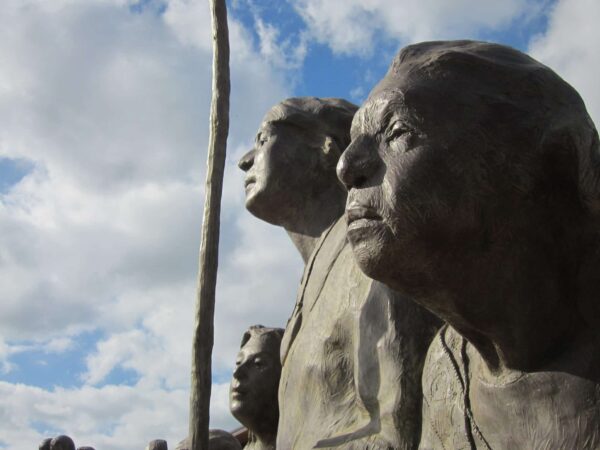
    By National Trails Office (US National Park Service) - NPGallery, Public Domain, Link.
    By National Trails Office (US National Park Service) – NPGallery, Public Domain, Link.

    The concept of settler colonialism has always been a key element in the Marxist theory of imperialism, the meaning of which has gradually evolved over a century and a half. Today the reemergence of powerful Indigenous movements in the struggles over cultural survival, the earth, sovereignty, and recognition, plus the resistance to the genocide inflicted by the Israeli state on the Palestinian people in the occupied territories, have brought the notion of settler colonialism to the fore of the global debate. In these circumstances, a recovery and reconstruction of the Marxist understanding of the relation between imperialism and settler colonialism is a crucial step in aiding Indigenous movements and the world revolt against imperialism.

    Such a recovery and reconstruction of Marxist analyses in this area is all the more important since a new paradigm of settler colonial studies, pioneered in Australia by such distinguished intellectual figures as Patrick Wolfe and Lorenzo Veracini, has emerged over the last quarter-century. This now constitutes a distinct field globally—one that, in its current dominant form in the academy, is focused on a pure “logic of elimination.” In this way, settler colonialism as an analytical category based on autonomous collectives of settlers is divorced from colonialism more generally, and from imperialism, exploitation, and class.1 Settler colonialism, in this sense, is often said to be an overriding planetary force in and of itself. In Veracini’s words, “It was a settler colonial power that became a global hegemon.… The many American occupations” around the world are “settler colonial” occupations. We are now told that not just the “pure” or ideal-typical settler colonies of the United States, Canada, Australia, New Zealand, and Israel can be seen as such, as originally conceived by Wolfe, but also the “whole of Africa,” plus much of Asia and Latin America, have been “shaped” to a considerable extent by the “logic of elimination,” as opposed to exploitation. Rather than seeing settler colonialism as an integral part of the development of the imperialist world system, it has become, in some accounts, its own complete explanation.2

    It would be wrong to deny the importance of the work of figures like Wolfe and Veracini, and the new settler colonial paradigm. As Roxanne Dunbar-Ortiz states in Not “A Nation of Immigrants”: Settler Colonialism, White Supremacy, and a History of Erasure and Exclusion, Wolfe carried out “groundbreaking research” demonstrating that “settler colonialism was a structure not an event.” He did a great service in bringing the notion of settler colonialism and the entire Indigenous struggle into the center of things. Nevertheless, in the case of the United States, she adds, in a corrective to Wolfe’s account, the founders were not simply settler colonists, they were “imperialists who visualized the conquest of the continent and gaining access to the Pacific and China.” The projection of U.S. imperialist expansion from the first had no territorial boundaries and was geared to unlimited empire. Settler colonialism reinforced, rather than defined, this global imperialist trajectory, which had roots in capitalism itself. This suggests that there is a historical-materialist approach to settler colonialism that sees it as dialectically connected to capitalism, colonialism, and imperialism, rather than as an isolated category.3

    Marx and Settler Colonialism

    It is now widely recognized in the research on settler colonialism that Karl Marx was the foundational thinker in this area in his discussion of “so-called primitive accumulation”; his references to colonialism proper, or settler colonialism; and his analysis of Edward Gibbon Wakefield and the “The Modern Theory of Colonization,” with which he ended the first volume of Capital.4 However, such recognition of Marx’s numerous references to settler colonialism seldom goes on to uncover the full depth of his analysis in this regard.

    As an authority on ancient Greek philosophy who wrote his dissertation on the ancient materialist philosopher Epicurus, Marx was very familiar with the ancient Greek cleruchy, or settler colony established as an extension of its founding city state. In many ways, the most notable Athenian cleruchy was the island/polis of Samos, the birthplace of Epicurus, whose parents were cleruchs or settler colonialists. The cleruchy in Samos was established in 365 BCE, when the Athenians forcibly removed the inhabitants of the island and replaced them with Athenian citizens drawn from the indigent population of an overcrowded Athens, turning Samos not only into a settler colony, but also a garrison state within the Athenian Empire. The dispute in the Greek world over the cleruchy in Samos was subsequently at the center of two major wars fought by Athens, resulting in the final downfall of Athens as a major power with its defeat by Macedonia in 322 BCE. This led to the dismantling of the cleruchy in Samos (in compliance with a decree issued by Alexander the Great shortly before his death), the removal of the Athenian settlers, and the return of the original population to the island.5

    For Marx and other classically educated thinkers in the nineteenth century, the Athenian cleruchy in Samos represented a pure model of colonialism. Although settler colonialism was to take new and more vicious forms under capitalism, reinforced by religion and racism, the underlying phenomenon was thus well known in antiquity and familiar to nineteenth-century scholars. In his analysis of colonialism in Capital and elsewhere, Marx referred to what is now called “settler colonialism” as “colonialism properly so-called”—a usage that was later adopted by Frederick Engels and V. I. Lenin.6 The concept of colonialism proper clearly reflected the classical viewpoint centered on Greek antiquity. Moreover, any use of “settler” to modify “colonialism” would have been regarded as redundant in the nineteenth century, as the etymological root of “colonialism,” derived from Latin and the Romance languages, was colonus/colona, signifying “farmer” or “settler.”7 Hence, the original meaning of the word colonialism was literally settlerism. But by the twentieth century, the meaning of colonialism had so broadened that it was no longer associated with its classical historical origins or its linguistic roots, making the use of the term “settler colonialism” more acceptable.

    Colonialism proper, in Marx’s conception, took two forms, both having as their precondition a logic of extermination, in the nineteenth century sense of exterminate, meaning both forcible eradication and expulsion.8 The “first type” was represented by “the United States, Australia, etc.”, associated with a form of production based on “the mass of the farming colonists” who set out “to produce their own livelihood,” and whose mode of production was thus not immediately capitalist in character. The “second type” consisted of “plantations—where commercial speculations figure from the start and production is intended for the world market.” This type was part of “the capitalist mode of production, although only in the formal sense, since the slavery of Negroes [on New World plantations] precludes free wage labor, which is the basis of capitalist production. But the business in which slaves are used is conducted by capitalists.”9

    Settler colonialism of the first type, that of farming colonists, was dominant in the northern United States, while the second type of settler colony, founded on slave plantations, dominated the U.S. South. The second type, or what Marx also referred to as a “second colonialism,” was rooted in slave labor and plantation economies that were run by capitalists who were also large landowners, with capitalist relations “grafted on” slavery. The settler colonies in the antebellum South, while based in the main on plantation slavery, also included fairly large numbers of subsistence “farming colonists,” or poor whites who existed on a marginal, subsistence basis, since slave plantation owners had seized the most fertile land.10

    In this way, Marx’s approach to settler colonialism encompassed not only the exterminist logic directed at Indigenous nations, but also the dual forms of production (free farmers and plantation slavery) that emerged within the resulting settler colonial structure. Nevertheless, the overall dialectic of settler colonialism had as its precondition the extermination (including removal) of Indigenous populations. As Marx expressed it in the first volume of Capital:

    The discovery of gold and silver in America, the extirpation, enslavement, and entombment in mines of the indigenous population of that continent, the beginnings of the conquest and plunder of India, and the conversion of Africa into a preserve for the commercial hunting of blackskins, are all things which characterize the dawn of the era of capitalist production. These idyllic proceedings are the chief moments of primitive accumulation.…

    The treatment of the indigenous population was, of course, at its most frightful in plantation-colonies set up exclusively for the export trade, such as the West Indies, and in rich and well-populated countries, such as Mexico and India, that were given over to plunder. But even in the colonies properly so called, the Christian character of primitive accumulation was not belied. In 1703 those sober exponents of Protestantism, the Puritans of New England, by decrees of their assembly set a premium of £40 on every Indian scalp and every captured redskin; in 1720, a premium of £100 was set on every scalp; in 1744, after Massachusetts Bay had proclaimed a certain tribe as rebels, the following prices were laid down: for a male scalp of 12 years and upwards, £100 in new currency, for a male prisoner £105, for women and children prisoners £50, for the scalps of women and children £50.11

    The real significance of this barbaric price structure, as Marx intimated here, was one of extermination, since male prisoners were valued only marginally more than their scalps, which were tokens of their death; while the lives of women and children simply equaled the value of their scalps.

    Marx’s primary source on colonization and the treatment of the Indigenous throughout the world, at the time he wrote Capital, was William Howitt’s Colonization and Christianity: A Popular History of the Treatment of the Natives by the Europeans in All Their Colonies (1838). Howitt’s theme with respect to the British colonies in North America was the extermination (extinction and expulsion) of the Indigenous population. Writing at the time of the Trail of Tears in the United States, he described “the exterminating campaigns of General Jackson.” In this respect, he quoted Andrew Jackson’s declaration on March 27, 1814, that he was “determined to exterminate them” all. The Native American peoples, Howitt observed, “were driven into waste [uncultivatable hinterlands], or to annihilation.”12 Writing of the conditions facing the Indigenous nations of the Southeast faced with the advance of white settlers, he explained,

    Nothing will be able to prevent the final expatriation of these southern tribes: they must pass the Mississippi till the white population is swelled sufficiently to require them to cross the Missouri; there will then remain but two barriers between them and annihilation—the rocky mountains and the Pacific Ocean. Wherever we hear now of those tribes, it is of some fresh act of aggression against them—some fresh expulsion of a portion of them—and of melancholy Indians moving off towards the western wilds.13

    For Marx, the logic of extermination introduced by English settler colonialism in the Americas was historically tied to the earlier and ongoing conquest and plundering of Ireland, the natural wealth of which was being drained continually by England. He argued that the same “plan to exterminate” that had been employed with the utmost ferocity by the English and Scots against the Irish was later applied in the British colonies in North America “against the Red Indians.”14 In Ireland, what was frequently called a policy of extermination, occurring alongside the enclosures in England, created a massive relative surplus population that could not be absorbed by the early Industrial Revolution in England, leading to a constant flow of English, Irish, and Scots Irish settler colonists to North America, where they sought to extinguish the Native Americans to make room for their own advance. A similar process occurred in New South Wales (originally a penal colony in Australia) with respect to the settler colonial treatment of Aboriginal peoples, as described by Howitt.15

    Marx and Engels were also deeply concerned with the French settler colonialism in Algeria occurring in their time, and sided with the Indigenous Algerian resistance.16 The Indigenous population of Algeria was nearly 6 million in 1830. By 1852, following the French all-out war of annihilation, including a scorched earth policy and subsequent famine, this had been reduced to 2.5 million.17 Meanwhile, “legalistic” means were also used to seize the communal lands, which were to be turned into the private property of colonists. In his excerpts in the 1870s from the work of the Russian ethnologist M. M. Kovalevsky, Marx compiled a detailed analysis of “the planting of European colonists” in Algeria and “the expropriation of the soil of the native population by European colonists and speculators.” After a brief sojourn in Algiers near the end of his life, meant as part of a rest cure ordered by his doctor, Marx argued that there was no hope for the Indigenous Algerians “WITHOUT A REVOLUTIONARY MOVEMENT.”18

    In 1882, Engels took up the subject of the English settler colonies in a letter to Karl Kautsky, writing:

    As I see it, the colonies proper, i.e., the countries occupied by European settlers, such as Canada, the Cape [South Africa], Australia, will all become independent; on the other hand, countries that are merely ruled [by colonial powers] and are inhabited by natives, such as India, Algeria and the Dutch, Portuguese and Spanish possessions, will have to be temporarily taken over by the proletariat and guided as rapidly as possible towards independence. How this process will develop is difficult to say. India may, indeed very probably will, start a revolution…. The same thing could also happen elsewhere, say in Algeria and Egypt, and would certainly suit us [that is, the socialist struggle in Europe] best.19

    Imperialism and Settler Colonialism

    Lenin quoted in 1916 from Engels’s 1882 letter to Kautsky, including the reference to “colonies proper,” and clearly agreed with Engels’s analysis.20 But the Comintern was slow to take up the question of settler colonialism. This was only to occur at the Second Congress on the National and Colonial Questions in 1928, in the “Theses on the Revolutionary Movement in the Colonies and Semi-Colonies,” which was meant to provide a critique of the entire “imperialist world system,” of which settler colonialism was considered to be a key part. A sharp distinction was drawn between settler colonies and other colonies. As the Comintern document stated:

    In regard to the colonial countries it is necessary to distinguish between those colonies of the capitalist countries which have served them as colonising regions for their surplus population, and which in this way have become a continuation of their capitalist system (Australia, Canada, etc.), and those colonies which are exploited by the imperialists primarily as markets for their commodities, as sources of raw material and as spheres for the export of capital. This distinction has not only a historic but also a great economic and political significance.

    The colonies of the first type on the basis of their general development become “Dominions,” that is, members of the given imperialist system, with equal, or nearly equal, rights. In them, capitalist development reproduces among the immigrant white population the class structure of the metropolis, at the same time that the native population, was for the most part, exterminated. There cannot be there any talk of the [externally based] colonial regime in the form that it shows itself in the colonies of the second type.

    Between these two types is to be found a transitional type (in various forms) where, alongside the numerous native population, there exists a very considerable population of white colonists (South Africa, New Zealand, Algiers, etc.). The bourgeoisie, which has come from the metropolis, in essence represents in these countries (emigrant colonies) nothing else than a colonial “prolongation” of the bourgeoisie of the metropolis.21

    The Comintern went on to conclude that,

    The metropolis is interested to a certain extent in the strengthening of its capitalist subsidiary in the colonies, in particular when this subsidiary of imperialism is successful in enslaving the original native population or even in completely destroying it. On the other hand, the competition between various imperialist systems for influence in the semi-independent countries [with large settler populations] can lead also to their breaking off from the metropolis.22

    What emerged in the analysis of the Comintern by 1928, therefore, building on the earlier work of Marx, Engels, and Lenin, was a conception of settler colonialism as an integral part of a general theory of the imperialist world system. In the view of the Comintern, race, which was now no longer seen primarily in biological terms, but was increasingly viewed through the lens of cultural resistance—as in the work of W. E. B. Du Bois—was brought into the argument more explicitly with the concept of “whiteness,” emphasizing that these were “white” settler colonies.23 The Comintern declaration on settler colonialism was concurrent with the first Palestinian treatments of the subject in the 1920s and ’30s.24

    Also in the 1920s, Peruvian Marxist José Carlos Mariátegui wrote of the Spanish “practice of exterminating the Indigenous population and the destruction of their institutions.… The Spanish colonizers,” he noted, “introduced to Peru a depopulation scheme.” This was, however, followed by the “enslavement” and then “assimilation of the Indians,” moving away from the exterminism of pure settler colonialism as the demand for labor became the dominant consideration. Here the primary objective of colonization, as Mariátegui recognized, had shifted from the expropriation of the land of Indigenous populations, and thus their erasure, to an emphasis on the exploitation of their labor power.25

    The Comintern was dissolved by the Soviet Union in 1943 at a critical moment in the Second World War as a way of demonstrating that the defeat of Nazi Germany came before all else. The notion of settler colonialism, however, was carried over into dependency theory after the Second World War by the Marxist economist Paul A. Baran, then a professor at Stanford University. Baran had been born in Tsarist Russia and received his economics training in the Soviet Union, Germany, and the United States. He linked the Comintern doctrine on settler colonialism to the question of development and underdevelopment.

    Writing in 1957, in The Political Economy of Growth, Baran distinguished “between the impact of Western Europe’s entrance into North America (and Australia and New Zealand) on one side, and the ‘opening up’ by Western capitalism of Asia, Africa, or Eastern Europe,” on the other. In the former case, Western Europeans “settled” as permanent residents, after eliminating the original inhabitants, arriving with “capitalism in their bones,” and establishing a society that was “from the outset capitalist in structure.”26

    However, the situation was different with respect to Asia and Africa:

    Where climate and the natural environment were such as possibly to invite Western European settlers, they were faced with established societies with rich and ancient cultures, still pre-capitalist or in the embryonic state of capitalist development. Where the existing social organizations were primitive and tribal, the general conditions and in particular the climate were such as to preclude any mass settlement of Western European arrivals. Consequently, in both cases the Western European visitors rapidly determined to extract the largest possible gains from the host countries and to take their loot home.27

    In this way, Baran clearly contrasted the two types of colonialism, linking each to the regime of capitalist accumulation. While European white settler colonies in North America and Australasia extirpated the original inhabitants and expropriated the land, laying the ground for internal accumulation, the wider European colonial plundering of ancient and rich societies, as in the cases of India, Java, and Egypt, fed the Industrial Revolution in England (and elsewhere in Western Europe), providing it with much of the original capital for development. In the process, preexisting civilizations and cultures were disarticulated. Their communal and collective social relations, as Rosa Luxemburg emphasized, were necessarily “annihilated” by capitalism.28

    In dependency theory from the start, white settler colonies thus stood as an exception within colonialism as a whole. Baran noted but did not analyze the role of slavery in “the primary accumulation of capital” and the development of settler colonialism. For Marx, the transatlantic slave trade was the “pedestal” on which both the accumulation of capital in the plantation South of the United States and the British cotton industry at the heart of the Industrial Revolution were to rest.29

    In the 1950s, ’60s, and ’70s, settler colonialism theory became a major focus within Marxism due to struggles then occurring in Africa and Palestine. A key figure in the analysis of settler colonialism was Frantz Fanon. Originally from the French colony of Martinique, Fanon fought with the French Free Forces in the Second World War, studied psychiatry in France, and eventually joined the National Liberation Front of the Algerian Revolution. He was the author most notably of Black Skin, White Masks (1952) and The Wretched of the Earth (1961). Influenced by both G. W. F. Hegel and Marx, Fanon applied Hegel’s master-slave dialectic to the colonizer-colonized relation in the Algerian context, accounting for the logic of violence characterizing settler colonialism and exploring the continuing search for recognition on the part of the Indigenous Algerians.30 Critical considerations of settler colonialism were also inspired by the revolt of the Land and Freedom Army in Kenya against white settlers and plantation owners between 1952 and 1960, which led to the death in combat or execution of upwards of ten thousand Africans.31

    In 1965, the Palestinian-Syrian scholar Fayez A. Sayegh wrote a pamphlet, Zionist Colonialism in Palestine, published by the Palestine Liberation Organization, arguing that “Zionist colonialism” was “essentially incompatible with the continued existence of the ‘native population’ in the coveted country,” and had as its goal the creation of a “settler community.”32 Two years later, in the midst of the Arab-Israeli War, French Marxist Maxime Rodinson, whose parents had both perished in Auschwitz, published his landmark work, Israel: A Colonial-Settler State? Rodinson commenced by stating that “The accusation that Israel is a colonialist phenomenon is advanced by an almost unanimous Arab intelligentsia, whether on the right or the left. It is one case where Marxist theorizing has come forward with the clearest response to the requirements of ‘implicit ideology’ of the Third World and has been widely adopted.” He saw settler colonialism as linked to “the worldwide system of imperialism” and opposed to “indigenous liberation movements.” For Rodinson, Zionism thus represented “colonialism in the [classical] Greek sense,” that is, in the sense of the Athenian cleruchy, which eliminated/removed the native populations and replaced them with settlers. Settler colonialism directed at the extermination and displacement of the Indigenous peoples/nations, he indicated, had also occurred in colonial Ireland and Tasmania. Given this underlying logic, “It is possible that war is the only way out of the situation created by Zionism. I leave it to others to find cause for rejoicing in this.” Israel, Rodinson added, was not simply a settler-colonial country, but participated in imperialist exploitation and expansion abroad.33

    Arghiri Emmanuel, the pioneering Greek Marxist economist and theorist of unequal exchange, had worked in commerce in the Belgian Congo in what seems to have been his family textile firm in the late 1930s and again in the late ’40s before relocating to France in 1958. In his time in Congo, he had encountered the white settler community there, part of which was Greek.34 In 1969, he published his classic work Unequal Exchange: A Study of the Imperialism of Trade. In that work, Emmanuel addressed the issue of settler colonialism or “colonialism of settlement.” Here he made a distinction between, on the one hand, England’s four main “colonies of settlement”—the United States, Canada, Australia, and New Zealand, which had introduced a policy of exterminism against the Indigenous population—and, on the other, the fifth such settlement, namely South Africa, where the native population had not been subjected to exterminism to the same extent. In South Africa, the Indigenous Africans were “relegated to the ghettos of apartheid,” allowing for the superexploitation of their labor by a substantial white minority.35

    In Emmanuel’s theory of unequal exchange, wages were treated as an independent variable, based on Marx’s notion of their historically determined character. Viewed from this standpoint, Emmanuel argued that in the first four colonies of settlement, the high wages of the white workers who constituted the majority of the population had promoted rapid capital accumulation. However, in South Africa, the fifth settler colony, the wages of the majority-Black population were abysmally low, with the result being a “semideveloped” condition. Emmanuel criticized dependency theorist Andre Gunder Frank for explaining the development of the British white settler colonies primarily in culturalist terms. Rather, it was the high wages of the white settlers that promoted development.36

    This argument was developed further in Emmanuel’s “White-Settler Colonialism and the Myth of Investment Imperialism,” published in New Left Review in 1972. Here he dealt with the frequent conflict that arose between settler colonists and the imperial powers that had given rise to them, since white settler states emerged as rivals of European colonial states, no longer subjected as easily to colonial exploitation. This dialectic led to struggles with the metropoles, most of them unsuccessful, by settlers attempting to create independent white colonial states. Here Emmanuel drew on his own experiences in the Belgian Congo. However, he put this whole dynamic in the context of the history of settler colonialism more broadly, as in Ireland and Israel/Palestine.37

    Other Marxist theorists were to enter into the analysis of settler colonialism at this time, particularly with respect to Africa, relating it to dependency theory. In 1972, shortly after the publication of Emmanuel’s “White Settler Colonialism” article, Egyptian French Marxist economist Samir Amin discussed “settler colonization” in his article on “Underdevelopment and Dependence of Black Africa—Origins and Contemporary Forms,” mainly with respect to the failed attempts at settler colonialism in sub-Saharan Africa. Amin distinguished settler colonialism from what he called “Africa of the colonial trade economy,” relying on monopolies of trade, the colonial import-export house, and the mobilization of workers through labor reserves. Later, Amin was to write about settler colonialism in Israel, which he saw as similar to the way in which the “Red Indians” in North America were “hunted and exterminated,” but which was to be viewed in Israel’s case as intrinsically related to a wider monopoly capitalist/imperialist trajectory led by the United States aimed at global domination.38

    For Marxist theory throughout this period, the concept of settler colonialism was viewed as crucial in defining the development of colonialism and imperialism as a whole. In 1974, writing for the Encyclopedia Britannica, Harry Magdoff underscored that colonialism took

    two forms, or some combination of the two: (1) the removal of the indigenous peoples by killing them off or forcing them into specially reserved areas, thus providing room for settlers from Western Europe who then developed the agriculture and industry of these lands under the social system imported from the mother countries; or (2) the conquest of the indigenous peoples and the transformation of their existing societies to suit the changing needs of the more powerful militarily and technically advanced nations.39

    A breakthrough in the Marxian analysis of settler colonialism occurred with the publication of the Australian historian Kenneth Good’s “Settler Colonialism: Economic Development and Class Formation” in The Journal of Modern African Studies in 1976. Good drew on Marx’s notion of “so-called primitive accumulation” and on dependency theory to provide a broader, more integrated perspective on settler colonialism in its various forms. Looking at Africa, he discussed “settler states” and what he termed “colon societies,” where exterminism and settlement were “particularly heavy.” Such colon societies included “Canada, Australia, New Zealand, and the Cape Colony in South Africa” Much of his focus was on the colonies of settlement in Africa that, for one reason or another, did not conform to the full logic of exterminism/elimination, but which were ruled by dominant minorities of white settlers, as in Algeria, Kenya, Rhodesia (now Zimbabwe), and South Africa. In these colonies, the object was the control of African labor as well as land, leading to apartheid-style states. Like Emmanuel, Good was primarily concerned with the complex, contradictory relation of the reactionary colons to the external colonial metropole.40

    In 1983, J. Sakai, associated with the Black Liberation Army in the United States, wrote Settlers: The Myth of the White Proletariat.41 Sakai’s work has often been dismissed as ultraleft in its interpretation, given its extreme position that there is effectively no such thing as a progressive white working class in the context of settler colonialism in the United States, thereby extending Lenin’s labor aristocracy notion to the entire “white proletariat.” Nevertheless, some of the insights provided in Sakai’s work connecting settler colonialism and racial capitalism were significant, and Settlers was referenced by such important Marxists thinkers on capitalism and race as David Roediger in his Wages of Whiteness and David Gilbert in No Surrender.42

    Settler Colonialism as an Academic Paradigm

    Dunbar-Ortiz’s landmark 1992 article on “Aboriginal People and Imperialism in the Western Hemisphere” explored the massive die-down in the early centuries following the European arrival. She described the historical connections between “colonialism and exterminism,” focusing on the U.S. context.43 However, in the 1980s and ’90s, Marxist investigations into settler colonialism were less evident, due to the general retreat from imperialism theory on the part of much of the Western Left in the period.44 There was also the problem of how to integrate settler colonialism’s effects on Indigenous populations into the understanding of imperialism in general, since the latter was directed much more at the Global North’s exploitation of the Global South than at settler colonial relations internalized in parts of the Global North.

    This changed with the introduction of a definite settler colonialism paradigm in the universities internationally, evolving out of postcolonial studies. Settler colonialism as an academic field had its genesis in 1999 with Wolfe’s Settler Colonialism and the Transformation of Anthropology. Its formal structure was derived from two premises introduced by Wolfe: (1) settler colonialism represented a “logic of elimination,” encompassing at one and the same time annihilation, removal, and assimilation; and (2) settler colonialism was a “structure rather than an event.”45The first premise recognized that settler colonialism was directed at the expropriation of the land, while Indigenous peoples who were attached to the land were seen as entirely expendable. The second premise underscored that settler colonialism was a realized structure in the present, not simply confined to the past, and had taken on a logic rooted in a permanent settler occupation.

    Methodologically, Wolfe’s treatment was Weberian rather than Marxist. Settler colonialism was presented as an ideal type that excluded all but a few cases.46 The logic of elimination was seen as only really viable when it was historically realized in an inviolable structure. In countries where the logic of settler colonialism had been introduced, but had not been fully realized, this was not characterized as settler colonialism by Wolfe. Indeed, any move toward the exploitation of the labor of the Indigenous population, rather than their elimination from the land, disqualified a country from being considered settler colonialist. According to this definition, Algeria was not a settler colonial society any more than Kenya, South Africa, or Rhodesia. As Wolfe put it, “in contradiction to the kind of colonial formation that [Amilcar] Cabral or Fanon confronted, settler colonies were not primarily established to extract surplus value from indigenous labour.”47 Likewise, Latin America, due to the sheer complexity of its “hybrid” ethnic composition, along with its employment of Indigenous labor, was seen by Wolfe as outside the logic of settler colonialism.48

    Wolfe’s reliance on a Weberian methodological individualism resulted in his tracing of settler colonialism to the type of the settler. While there was such a thing as a settler colonial state, this was secondary to the ideal type of the settler.49 Settler colonialism became its own abstract logic, entirely separated from other forms of colonialism and from imperialism. This one-sided, idealist methodology has been central to the development of settler colonialism as an academic study, removing it from the Marxist tradition (and from Indigenous traditions) from which the concept had arisen.50

    Wolfe, by the time that he introduced his settler colonial model, had already established himself as a distinguished figure on the non-Marxist/anti-Marxist left. In 1997, two years before the publication of his seminal text on settler colonialism, he published an article entitled “History and Imperialism: A Century of Theory” for the American Historical Review, which was remarkable in the sheer number of misconceptions it promoted and in the depth of its polemic against Marxism. According to Wolfe, “the definitional space of imperialism [in left discourse] becomes a vague, consensual gestalt.” Marx was a pro-colonialist/pro-imperialist and Eurocentric thinker who saw colonialism as a “Malthusian” struggle of existence; Lenin, was part of the “post-Marxian” debate on imperialism” that began with social liberal John Hobson and that led to positions diametrically opposite to those of Marx; dependency theory turned Marxism “on its head”; world-systems theory was opposed to orthodox Marxism on imperialism, as was Emmanuel’s unequal exchange theory. Finally, “a notorious color blindness” suffused Marxism as a whole, which was principally characterized by economic determinism. In writing a history of imperialism theory, Wolfe remarkably neglected to discuss Lenin’s analysis at all, beyond a few offhand negative comments. He ended his article with a reference to settler colonialism, which he failed to relate to its theoretical origins, but approached in terms of postcolonial theory, claiming that it offered “discursive distinctions which survive the de-territorialization of imperialism.” It therefore could be seen as constituting the place to “start” if imperialism were to be resisted in the present.51

    In contrast to Marx, with his two types of settler colonialism, and distinct from most subsequent Marxist theorists, Wolfe promoted a notion of settler colonialism that was so dependent on a pure “logic of elimination,” emanating from settler farmers, that he approached plantation slavery in the southern part of the antebellum United States as simply the negative proof of the existence of settler colonialism in the northern part. “Black people in the plantation South were racialized as slaves,” whose purpose in racial capitalism was to carry out plantation labor, thus distinguishing them from Native Americans due to the purely eliminatory logic imposed on the latter. The distinction, although a sharp one in some ways, relied on a notion of settler colonialism as constituting an ideal type associated with a specific form of social action carried out by settlers. As a result, the real complexity of colonialism/imperialism, of which settler colonialism is simply a part, was lost. Wolfe saw the removal of Indigenous labor from the antebellum South as a precondition for the mixing of “the Red man’s land…with Black labor.” But after that event, settler colonialism as a structure no longer applied directly to the U.S. South. Native Americans, Wolfe argued, were subject to genocide, and Black people to slavery. With respect to African-Americans, he wrote, “the genocidal tribunal is the wrong court.”52

    Wolfe’s approach also tended to leave Africa out of the picture. According to Robin D. G. Kelley, Gary B. Nash Professor of American History at the University of California, Los Angeles, whose research focuses on critical thought and movements associated with the African Diaspora, “By not incorporating more of the globe in his study, Wolfe’s particular formulation of settler colonialism delimits more than it reveals.” By excluding Africa, which did not fit into his pure eliminatory logic, Wolfe “presumes that indigenous people exist only in the Americas and Australasia…. Consequently, settler colonialism on the African continent falls out of Wolfe’s purview…. The exclusion of southern Africa and similar social formations from the definition of settler colonialism…obscures its global and transnational character.” In Africa, according to Kelley’s cogent formulation, “the European colonists wanted land and the labor, but not the people—that is to say, they sought to eliminate stable communities and their cultures of resistance.”53

    As Sai Englert, author of Settler Colonialism: An Introduction, observed in a critique of Wolfe, the “sharp distinction between settler colonialism” and other forms of colonialism “is difficult to square with reality. On the one hand, elimination and genocide are a reality across the colonial world by means of war, famine, forced or enslaved labour, and mass murder. On the other hand, many settler colonial regimes were based primarily on the exploitation of the Indigenous populations.”54

    Wolfe’s academic paradigm of settler colonialism following his death in 2016 was most influentially carried forward by Veracini, author of a wide array of works on the subject and the founding editor of the journal Settler Colonial Studies. Veracini, in a contradictory fashion, sought to adhere to Wolfe’s restrictive definition of settler colonialism, while at the same time giving it a more global and all-encompassing significance. He did this by separating “settler colonialism” entirely from “colonialism” and in effect subsuming the latter in the former. Thus, settler colonialism became the measuring stick for judging colonialism generally. As Veracini wrote in his Settler Colonialism: A Theoretical Overview, “This book is a reflection on settler colonialism as distinct from colonialism…. I propose to see…as analytically distinct, colonialism with settlers and settler colonialism.” Key to Veracini’s method was the postulate that settler colonialism was not a subtype of colonialism, but a separate entity, “antithetical” to colonialism. The notion of imperialism, as opposed to mere references to “imperial expansion,” disappeared almost altogether in his analysis. Figures like Emmanuel received dismissive treatment.55

    In a confused and contradictory series of transpositions, the concept of settler colonialism metamorphosed in the work of Veracini into an all-encompassing eliminatory logic. Wolfe had seen the classical-liberal notion of primitive accumulation—a concept that, in its bourgeois “nursery tale” form, was subjected to a harsh critique by Marx—as being “inseparable from the inception of settler colonialism,” essentially equating the two concepts.56 Prior to this, Marxist geographer David Harvey had transposed the eighteenth- and nineteenth-century historical concept of original or primitive accumulation into a suprahistorical spatial notion of “accumulation by dispossession.” Going beyond both Wolfe and Harvey, Veracini proceeded to transpose Harvey’s neologism into the cognate “accumulation without reproduction,” standing for the “eliminatory logic” of settler colonialism. Accumulation without reproduction was then seen as applying to all forms of eliminatory and predatory logic, with the result that all instances of world oppression, wherever direct economic exploitation was not concerned, including issues such as climate change, could be “most productively approached within a settler-colonial studies paradigm.”57

    In this way, not only colonialism, imperial expansion, and racial capitalism, but also the global ecological crisis, ecological debt, and the financialization of the globe, in Veracini’s expanded conception, all fell under the settler colonial paradigm, representing a dominant logic of globalized elimination. Veracini has laid great emphasis on the fact that the United States as the hegemonic power in the world today is to be seen primarily as a settler colonialist, rather than as an imperialist, power. Not surprisingly, the concept of “imperialism” was absent from his Settler Colonialism: A Theoretical Overview.58

    The theoretical distinction between a Marxist analysis of imperialism/colonialism with settler colonialism as one of its forms, and the new academic paradigm in which settler colonialism is seen as its own discrete, self-determining phenomenon rooted in the type of the settler, could not be more different. This can be perceived in the way thinkers like Wolfe and Veracini approached the Israeli state’s violent occupation of Palestine. Wolfe went so far as to criticize Rodinson’s classic interpretation of Israeli settler colonialism on the basis that, for the latter, this was a European (and North American) imperialist project, while, for Wolfe himself, settler colonialism was defined at all times by the role of autonomous settlers disconnected from the metropole. Rodinson’s argument, Wolfe claimed, did not explain why the Israeli project is specifically “a settler-colonial one.” But such a view relied once again on the abstraction of the settler as a distinct ideal type, giving rise to settler colonialism separated off from other social categories, thereby running counter to a holistic historical inquiry. In this view, the imperial metropoles, whatever role they had in the beginning—and, in Wolfe’s argument, Israel was unique in that it was constituted by “diffuse metropoles”—are, by definition, no longer directly implicated in what the autonomous settler colonies choose to do. Indeed, in some non-Marxist analyses, the metropoles are now seen as the helpless victims of the settler colonies, simply locked into a common cultural history from which there is no escape. Lost here is the reality that Israel is, for Washington, a garrison colony within the larger U.S./NATO-based strategy of global imperialist domination.59

    For Veracini, as for Wolfe, in writing on Palestine, the emphasis is on the absolute autonomy of settler colonies, which are then seen as completely self-determining. Israel’s occupation of Palestine is a case in point. This meant that the whole question of the imperialist world system’s role in the Israeli-Palestine conflict is largely denied. To be sure, Veracini has indicated that the potential remained for a reestablishment of a settler colony’s dependence on the core imperial powers (a point specifically directed at Israel) that could lead to its external “recolonization.” But this is seen as unlikely.60

    Within what has become in the mainstream settler colonial paradigm, therefore, the approach to Israel’s occupation of Palestine is worlds away from that of historical materialism. Rather than relying on a very restrictive logic, Marxist analysis seeks to place the reality of Israeli settler colonialism in a wider and more dynamic historical perspective that grasps the complex and changing dialectical relations of capitalism, class, and imperialism/militarism.

    Here it is important to note Israel/Palestine is demographically unique in the history of settler colonialism, since rather than either a definite majority or a powerful minority of colonizers emerging, there is a rough equality in numbers overall. Over seven million Israelis live in present-day Israel and the West Bank in 2022, and some seven million Palestinians live in the West Bank, the Gaza Strip, Israel, and East Jerusalem. Given the significantly higher birth rates of Palestinians, this is viewed by Israel as a demographic threat to its logic as a Zionist settler colonial state. Tel Aviv therefore has enhanced its efforts to seize complete control of the entire region of Israel/Palestine (referred to by the Israeli right as “Greater Israel”), adopting an ever more aggressive strategy of exterminism and imperialism.61 This strategy is fully supported, even urged on, by Washington, in its goal of absolute imperial domination of the Middle East, Central Asia, and parts of South Asia—the region of the United States Central Command.

    Israel’s average annual military spending as a share of GDP from 1960 to 2022 is 12 percent. After shrinking officially to around 4–5 percent in recent years, it is now again on the rise. It has the second-highest military spending per capita in the world (after Qatar) and possesses not only military superiority in the Middle East region but also an arsenal of weapons of mass destruction (nuclear, chemical, and biological).62 Its war machine is supported by massive aid from the United States, which provides it with the most advanced weapons in existence. NATO has given Israel the designation of a “major non-NATO ally,” recognizing its position as a key part of the U.S.-European imperialist bloc.63 In the United Nations, it is a member of the Western European and Other Group (WEOG) within the official regional groupings. The “Other” stands for the main settler colonial nations: the United States, Canada, Australia, New Zealand, Israel, and formerly apartheid South Africa.64

    For Max Ajl, a senior researcher at the Brooklyn Institute for Social Research, Israel, while a “settler society” and tied into a logic of exterminism, has to be seen in a larger context of the imperialism/militarism of the Global North. “The question of Palestine,” he writes, “is not merely a question of national [or settler] oppression, but poses Israel’s uniqueness: a condensation of Western colonial and imperial power, a world-wide symbol of Western perfidy, a state which physically cleaves Africa and Asia, a merchant and mercenary of global counter-insurgence, all melded in a manticore of death and destruction.”65 If Israel can be viewed as a pure settler-exterminist state, it is also a global garrison state, tied to the entire system of world domination rooted in monopoly capitalism/imperialism in which the United States is the hegemonic power.

    Wasi’chu

    The rise of the American Indian Movement in the United States in the 1960s and ’70s led to strong critiques of the reality of settler colonialism. An extraordinary work in this context was Wasi’chu: The Continuing Indian Wars by Bruce Johansen and Roberto Maestas. Wasi’chu is a Lakota word that refers not to white man or settler but to a logic, a state of mind, and a system. Literally, it means “takes the fat” or “greedy person,” appropriating not just what is needed for life, but also what properly belongs to the whole community. “Within the modern Indian movement,” it “has come to mean those corporations and their individuals, with their government accomplices, which continue to covet Indian lives, land, and resources for public profit.” The term was famously used by Black Elk in Black Elk Speaks, based on interviews in the early 1930s, in which he emphasized the Wasi’chu’s unrelenting desire for gold. As Johansen and Maestas explained, Wasi’chu is “a human condition based on inhumanity, racism, and exploitation. It is a sickness, a seemingly incurable and contagious disease which begot the ever-advancing society of the West.” This observation became, in the work of these authors, the basis of a searing account of settler colonialism in North America, not simply geared to the past but to the present.66

    “Wasichu,” Pulitzer-Prize-winning novelist Alice Walker elaborates in her Living by the Word,

    was a term used by the Oglala Sioux to designate the white man, but it had no reference to the color of skin. It means: He who takes the fat. It is possible to be white and not a Wasichu and a Wasichu and not white…. The Wasichu speaks, in all his U.S. history books, of “opening up virgin lands.” Yet there were people living here on “Turtle Island,” as the Indians called it, for thousands of years….

    We must absolutely reject the way of the Wasichu that we are so disastrously traveling, the way that respects most (above nature, obviously above life itself, above even the spirit of the universe) the “metal that makes men crazy”.… Many of us are afraid to abandon the way of the Wasichu because we have become addicted to his way of death. The Wasichu has promised us so many good things, and has actually delivered several. But “progress,” once claimed by the present chief of the Wasichus to be their “most important product,” has meant hunger, misery, enslavement, unemployment, and worse to millions of people on the globe.67

    Wasi’chu, as the Indigenous understood it, was the personification of what we know as capitalism, colonialism, and imperialism, a system of greed, exploitation, and expropriation of human beings and the land.68 The Lakota people clearly understood this system of greed as one that had no limits and that was the enemy of communal existence and reverence for the earth. It is this more profound critique of capitalism/imperialism as a system dominated by the Wasi’chu that seizes “the fat,” (the surplus that is the inheritance of humanity as a whole) that we most need today. As The Red Nation’s The Red Deal states, the choice today is “decolonization or extinction,” that is, “ending the occupation” and destruction of the earth by imperialist “accumulation-based societies,” so as to “build what sustains us.”69

    Notes

    1. Key foundational works in this paradigm include Patrick Wolfe, Settler Colonialism and the Transformation of Anthropology (London: Cassell, 1999); Patrick Wolfe, Traces of History: Elementary Structures of Race (London: Verso, 2016); Patrick Wolfe, “Settler Colonialism and the Elimination of the Native,” Journal of Genocide Research 8, no. 4 (December 2006): 387–409; Patrick Wolfe, “Land, Labor and Difference: Elementary Structures of Race,” American Historical Review 106, no. 3 (June 2001): 866–905; David Lloyd and Patrick Wolfe, “Settler Colonial Logics and the Neoliberal Regime,” Settler Colonial Studies 6, no. 2 (May 2015): 109–18; Lorenzo Veracini, The Settler Colonial Present (London: Palgrave Macmillan, 2015); Lorenzo Veracini, Settler Colonialism: A Theoretical Overview (London: Palgrave Macmillan, 2024); Lorenzo Veracini, “Containment, Elimination, Endogeneity: Settler Colonialism in the Global Present,” Rethinking Marxism 31, no. 1 (April 2019): 118–40. Marxian-oriented critical perspectives can be found in Jack Davies, “The World Turned Outside In: Settler Colonial Studies and Political Economy,” Historical Materialism 31, no. 2 (June 2023): 197–235; and Sai Englert, Settler Colonialism: An Introduction (London: Pluto, 2022).
    2. Wolfe, “Settler Colonialism and the Elimination of the Native,” 387–88; Wolfe, Settler Colonialism and the Transformation of Anthropology, 2; Veracini, The Settler Colonial Present, 51, 54–56; Veracini, Settler Colonialism: A Theoretical Overview, 4–11; Veracini, “Containment, Elimination, Endogeneity,” 121; Davies, “The World Turned Outside In,” 207.
    3. Roxanne Dunbar-Ortiz, Not “A Nation of Immigrants”: Settler Colonialism, White Supremacy, and a History of Erasure and Exclusion (Boston: Beacon, 2021), 18; R. W. Van Alstyne, The Rising American Empire (New York: W. W. Norton, 1960).
    4. Veracini, The Settler Colonial Present, 39–40; Lorenzo Veracini, “Introduction: Settler Colonialism as a Distinct Mode of Domination” in The Routledge Handbook of the History of Settler Colonialism, Edward Cavanaugh and Lorenzo Veracini, eds. (London: Routledge, 2017), 3; Englert, Settler Colonialism: An Introduction, 29–30; John Bellamy Foster, Brett Clark, and Hannah Holleman, “Marx and the Indigenous,” Monthly Review 71, no. 9 (February 2020): 3.
    5. John Bellamy Foster, Breaking the Bonds of Fate: Epicurus and Marx (New York: Monthly Review Press, forthcoming 2025).
    6. Karl Marx, Capital, vol. 1 (London: Penguin, 1976), 917; Karl Marx and Frederick Engels, Collected Works (New York: International Publishers, 1975), vol. 46, 322; V. I. Lenin, “The Discussion on Social-Determination Summed Up,” July 1916, section 8, Marxists Internet Archive, marxists.org.
    7. “Colony (n.),” Online Etymology Dictionary, etymonline.com. As G. E. M. de Ste. Croix states, “The Latin word coloni…had originally been used in the sense of ‘farmer’ or ‘settler.’” G. E. M. de Ste. Croix, The Class Struggle in the Ancient Greek World (London: Duckworth, 1981), 159.
    8. According to the Oxford English Dictionary, the word “exterminate” comes from the Latin for “to drive beyond boundaries.” From the sixteenth century onward, it meant “to drive forth (a person or thing), from, of, out of, the boundaries or limits of a (place, community, region, state, etc.); to drive away, banish, put to flight.” However, by the seventeenth century it had also taken on the additional meaning of “to destroy utterly, put an end to (persons or animals); not only to root out, extirpate (species, races, populations).” Oxford English Dictionary, compact edition (Oxford: Oxford University Press, 1971), 938.
    9. Karl Marx, Theories of Surplus Value: Part II (Moscow: Progress Publishers, 1968), 301–3; Marx, Capital, vol. 1, 917.
    10. Marx, Theories of Surplus Value: Part II, 301–3; John Bellamy Foster, Hannah Holleman, and Brett Clark, “Marx and Slavery,” Monthly Review 72, no. 3 (July–August 2020): 98.
    11. Marx, Capital, vol. 1, 915–17, emphasis added; William Howitt, Colonization and Christianity: A Popular History of the Treatment of the Natives by the Europeans in All Their Colonies (London: Longman, Orme, Brown, Green, and Longmans, 1838), 348.
    12. Howitt, Colonization and Christianity, 346–49, 378–79, 403–5.
    13. Howitt, Colonization and Christianity, 414.
    14. Karl Marx and Frederick Engels, Ireland and the Irish Question (New York: International Publishers, 1971), 266.
    15. Marx and Engels, Ireland and the Irish Question, 66, 193, 216, 283, 303, 366, 372; John Bellamy Foster and Brett Clark, The Robbery of Nature (New York: Monthly Review Press, 2020), 72–75; Dunbar-Ortiz, Not A Nation of Immigrants,” 36–46, 126.
    16. Marx and Engels, Collected Works, vol. 18, 60–70, 212–13.
    17. Kenneth Good, “Settler Colonialism: Economic Development and Class Formation,” Journal of Modern African Studies 14, no. 4 (December 1976): 599.
    18. Karl Marx, “Excerpts from M. M. Kovalevsky,” appendix to Lawrence Krader, ed., The Asiatic Mode of Production (Assen, Netherlands: Van Gorcum and Co., 1974), 400, 406–7, 411–12; Foster, Clark, and Holleman, “Marx and the Indigenous,” 11–12.
    19. Marx and Engels, Collected Works, vol. 46, 322. Translation altered slightly to change “actual colonies” to “colonies proper,” in accordance with the translation of Engels’s letter in V. I. Lenin, Collected Works (Moscow: Progress Publishers, n.d.), vol. 22, 352.
    20. Lenin, Collected Works, vol. 22, 352.
    21. Communist International (Comintern), Theses on the Revolutionary Movement in the Colonies and Semi-Colonies (1928), in Theses and Resolutions of the VI. World Congress of the Communist Internationalvol. 8, no. 88, International Press Correspondence, no. 84, sections 10, 12 (extra paragraph indent created beginning with “Between”); Oleksa Drachewych, “Settler Colonialism and the Communist International,” in The Palgrave Encyclopedia of Imperialism and Anti-Imperialism, Immanuel Ness and Zak Cope, eds. (London: Palgrave Macmillan, 2021): 2418–28. Lenin’s recognition of Engels’s position on “colonialism proper” and the Comintern’s detailed treatment of settler colonialism demonstrate that Veracini’s uninformed claim that “Lenin and twentieth century Marxism…conflated colonialism and settler colonial forms” was simply false. It is further falsified, as we shall see, by numerous explicit twentieth-century Marxist treatments of settler colonialism. Veracini, The Settler Colonial Present, 39.
    22. Comintern, Theses on the Revolutionary Movement in the Colonies and Semi-Colonies, 12–13.
    23. W. E. B. Du Bois, Darkwater: Voices from Within the Veil (New York: Harcourt Brace and Howe, 1920), 29–42.
    24. Jennifer Schuessler, “What Is Settler Colonialism?,” New York Times, January 22, 2024.
    25. José Carlos Mariátegui, José Carlos Mariátegui: An Anthology, Harry E. Vanden and Marc Becker, eds. (New York: Monthly Review Press, 2011), 74–76.
    26. Paul Baran, The Political Economy of Growth (New York: Monthly Review Press, 1957), 141.
    27. Baran, The Political Economy of Growth, 142.
    28. Rosa Luxemburg, The Accumulation of Capital (New York: Monthly Review Press, 1951), 370.
    29. Baran, The Political Economy of Growth, 139–42, 153; Marx, Capital, vol. 1, 925.
    30. Frantz Fanon, The Wretched of the Earth (New York: Grove Press, 1963), 93; Simin Fadee, Global Marxism: Decolonization and Revolutionary Politics (Manchester: Manchester University Press, 2024), 132–52. In the work of Glen Sean Coulthard, Fanon’s emphasis on the colonial dialectic of recognition is combined with Marx’s critique of “so-called primitive accumulation” to generate one of the most powerful theoretical analyses of settler colonialism and Indigenous resistance up to the present. See Glen Sean Coulthard, Red Skin, White Masks: Rejecting the Colonial Politics of Recognition (Minneapolis: University of Minnesota Press, 2014).
    31. Donald L. Barnett and Karari Njama, Mau Mau from Within (New York: Monthly Review Press, 1966).
    32. Fayez A. Sayegh, Zionist Colonialism in Palestine (Beirut: Palestine Liberation Organization, 1965), 1–5.
    33. Maxime Rodinson, Israel: A Colonial Settler State (New York: Monad Press, 1973), 27–33, 89–96. Rodinson’s monograph was first published during the 1967 Israeli-Arab War in Jean-Paul Sartre’s journal, Le Temps Modernes.
    34. Jairus Banaji, “Arghiri Emmanuel (1911–2001),” Historical Materialism (blog), n.d.
    35. Arghiri Emmanuel, Unequal Exchange: A Study of the Imperialism of Trade (New York: Monthly Review Press, 1972), 37–71, 124–25, 370–71.
    36. Emmanuel, Unequal Exchange, 363–64.
    37. Arghiri Emmanuel, “White-Settler Colonialism and the Myth of Investment Imperialism,” New Left Review 1/73 (May–June 1972), 39–40, 43–44, 47; Emmanuel, Unequal Exchange 124–25, 337, 363, 370–71.
    38. Samir Amin, “Underdevelopment and Dependence in Black Africa—Origins and Contemporary Forms,” Journal of Modern African Studies 10, no. 4 (December 1972): 519–22; Samir Amin, The Reawakening of the Arab World (New York: Monthly Review Press, 2016), 182–89.
    39. Harry Magdoff, Imperialism: From the Colonial Age to the Present (New York: Monthly Review Press, 1978), 19–20.
    40. Good, “Settler Colonialism: Economic Development and Class Formation.”
    41. J. Sakai, Settlers: The Mythology of the White Proletariat (Chicago: Morningstar Press, 1989).
    42. David Gilbert, No Surrender: Writings from an Anti-Imperialist Political Prisoner (Montreal: Abraham Gullen Press, 2004), 5–59; David Roediger, The Wages of Whiteness: Race and the Making of the American Working Class (London: Verso, 1991), 184.
    43. Roxanne Dunbar-Ortiz, “Aboriginal People and Imperialism in the Western Hemisphere,” Monthly Review 44, no. 4 (September 1992): 9.
    44. On the retreat from imperialism theory on much of the left, see John Bellamy Foster, “The New Denial of Imperialism on the Left,” Monthly Review 76, no. 6 (November 2024): 15–19.
    45. Wolfe, Settler Colonialism and the Transformation of Anthropology, 2, 27, 40–43; Wolfe, “Settler Colonialism and the Elimination of the Native,” 387, 402.
    46. Wolfe, “Land, Labor and Difference,” 868; Englert, Settler Colonialism: An Introduction, 16.
    47. Wolfe, Settler Colonialism and the Transformation of Anthropology, 1, 167.
    48. Veracini, The Settler Colonial Present, 54. On the relation of Latin America to settler colonialism, see Richard Gott, “Latin America as a White Settler Society,” Bulletin of Latin American Research 26, no. 2 (April 2007): 269–89.
    49. Wolfe, Traces of History, 28.
    50. David Harvey, The New Imperialism (Oxford: Oxford University Press, 2003), 137–82. The concept of accumulation by dispossession is contradictory in Marx’s terms, since accumulation by definition is not dispossession or expropriation, but rather is rooted in exploitation. Marx was strongly critical of the notion of “primitive accumulation” or “original accumulation,” as presented by classical-liberal economists like Adam Smith, and preferred the term “original expropriation,” or simply expropriation. See Ian Angus, The War Against the Commons (New York: Monthly Review Press, 2023), 204–9.
    51. Wolfe, “History and Imperialism,” 389–93, 397, 403–7, 418–20.
    52. Wolfe, “Settler Colonialism and the Elimination of the Native,” 388, 392, 403–4; Wolfe, “Land, Labor and Difference,” 868.
    53. Robin D. G. Kelley, “The Rest of Us: Rethinking Settler and Native,” American Quarterly 69, no. 2 (June 2017): 268–69.
    54. Englert, Settler Colonialism: An Introduction, 15. For an indication of this complexity see Gerald Horne, The Dawning of the Apocalypse: The Roots of Slavery, White Supremacy, Settler Colonialism, and Capitalism in the Long Sixteenth Century (New York: Monthly Review Press, 2020).
    55. Veracini, Settler Colonialism: A Theoretical Overview, 4–12; Lorenzo Veracini, “Israel-Palestine through a Settler-Colonial Studies Lens,” Interventions: International Journal of Postcolonial Studies 21, no. 4 (2019): 572.
    56. Lloyd and Wolfe, “Settler Colonial Logics and the Neoliberal Regime,” 8; Marx, Capital, vol. 1, 874; Davies, “The World Turned Outside In,” 217. On the history of the classical-liberal conception of original, or primitive, accumulation prior to Marx, see Michael Perelman, The Invention of Capitalism: Classical Political Economy and the Secret History of Primitive Accumulation (Durham: Duke University Press, 2000).
    57. Veracini, “Containment, Elimination, Endogeneity,” 119, 122–28; Veracini, “Israel-Palestine Through a Settler-Colonial Studies Lens,” 579–80; Nicholas A. Brown, “The Logic of Settler Accumulation in a Landscape of Perpetual Vanishing,” Settler Colonial Studies 4, no. 1 (2014): 3–5; Davies, “The World Turned Outside In,” 214; Harvey, The New Imperialism, 137–82.
    58. Veracini, “Containment, Elimination, Endogeneity,” 122–8; Davies, “The World Turned Outside In,” 214.
    59. Wolfe, Traces of History, 234–37; Veracini, “Israel-Palestine through a Settler-Colonial Studies Lens,” 570; Joseph Massad, “Israel and the West: ‘Shared Values’ of Racism and Settler Colonialism,” Middle East Eye, June 13, 2019; Jordan Humphreys, “Palestine and the Classless Politics of Settler Colonial Theory,” Marxist Left Review, June 13, 2024.
    60. Lorenzo Veracini, Israel and Settler Society (London: Pluto, 2006), 97. It is notable that Veracini, like Wolfe, fails to recognize the significance of Rodinson’s Israel: A Colonial Settler State, stating that it was published in “the 1970s” (the time when the English edition came out), even though it appeared in French in the midst of the 1967 Arab-Israeli War, and had an enormous influence at the time, instilling throughout the world increased awareness of Israeli settler colonialism.
    61. Claudia de Martino and Ruth Hanau Santini, “Israel: A Demographic Ticking Bomb in Today’s One-State Reality,” Aspenia Online, July 10, 2023.
    62. Varun Jain, “Interactive: Comparing Military Spend around the World,” Visual Capitalist, June 4, 2023; “Israel: Military Spending, Percent of GDP,” Global Economy, theglobaleconomy.com; U.S. Congressional Research Service, Nuclear, Biological, and Chemical Weapons and Missiles: Status and Trends (Washington, DC: Congressional Research Service, February 20, 2008), 16.
    63. Thomas Trask and Jacob Olidort, “The Case for Upgrading Israel’s ‘Major Non-NATO Ally’ Status,” Jewish Institute for National Security of America, November 6, 2023.
    64. Craig Mokhiber, “WEOG: The UN’s Settler-Colonial Bloc,” Foreign Policy in Focus, September 4, 2024, fpif.org.
    65. Max Ajl, “Palestine’s Great Flood, Part I,” Agrarian South: Journal of Political Economy 13, no. 1 (March 2024): 62–88; Esther Farmer, Rosalind Pollack Petchesky, and Sarah Sills, A Land with a People: Palestinians and Jews Confront Zionism (New York: Monthly Review Press, 2021).
    66. Bruce Johansen and Roberto Maestas, Wasi’chu: The Continuing Indian Wars (New York: Monthly Review Press, 1979), 5, 11, 16, 18; Black Elk and John G. Neihard, Black Elk Speaks: Being the Life Story of a Holy Man of the Oglala Sioux (New York: William Morrow, 1932), 7–9.
    67. Alice Walker, Living by the Word: Selected Writings 1973–1987 (New York: Harcourt Brace Jovanovich, 1981), 144–49.
    68. Wasi’chu, as understood here, is essentially a materialist perspective, where a generalized human nature characteristic of certain groups of social actors is seen as a reflection of an underlying logic or system. In Marx’s terms, the capitalist is presented as a personification of capital. This is in contrast to a Weberian style ideal type, rooted in methodological individualism, where social structures are interpreted in terms of a type of social action with subjective meaning traceable to a type of methodological individual. Thus, from that perspective, it is the methodological individual of the settler who is at the root of settler type meanings/actions and is the basis of colonialism/settlerism. The ideal type of the settler constitutes, rather than is constituted, and is not itself the product of an ensemble of social relations. Marx, Capital, vol. 1 ,92.
    69. The Red Nation, The Red Deal (New York: Common Notions, 2021), 7, 13, 135–37; Veracini, “Israel-Palestine Through a Settler-Colonial Studies Lens,” 570–71.

    2025, Volume 76, Number 09 (February 2025)

  • Preface to the German Edition of Marx’s Ecology

    Preface to the German Edition of Marx’s Ecology

    Preface to the German Edition of Marx’s Ecology,” Monthly Review, vol. 76, no. 7 (December 2024), pp. 41-43.

    Marx' Ökologie: Materialismus und Natur
    Marx’ Ökologie: Materialismus und Natur

    The research leading to the writing of Marx’s Ecologybegan in the mid-1990s in response to a request for an article on “Erde” (Earth) for volume 3 (Ebene-Extremisis) of the Historisch-Kritisches Wörterbuch des Marxismus, edited by Wolfgang Fritz Haug at the Free University of Berlin.1 I was asked at that time to provide an account of how the classical political economists up through Karl Marx had approached the question of the earth or soil. My original background was in political economy. But in the late 1980s and ’90s I had turned to the study of the global ecological crisis, leading to the publication of my book The Vulnerable Planet in 1994, along with a number of articles on Marx and ecology.2 Yet, while I was familiar at the time with the classical rent theory in the work of Adam Smith, Thomas Robert Malthus, David Ricardo, and Marx, and knew of Justus von Liebig’s influence on Marx with respect to the analysis of the nineteenth-century soil crisis, I had never systematically examined the underlying ecological assumptions of classical political economy with respect to the earth/soil. Nor to my knowledge had anyone else. I therefore set out to explore the question in depth. The result of this investigation was the recovery of Marx’s far-reaching ecological argument. Thus, it was in the Historisch-Kritisches Wörterbuch des Marxismus that I was to offer the first systematic elaboration of Marx’s conception of the rift in the metabolism between humanity and the soil. From there, I went on to write my article “Marx’s Theory of Metabolic Rift” in the American Journal of Sociology in 1999, which laid out the wider implications of Marx’s theory of ecological crisis, followed by the publication of Marx’s Ecology in 2000.3

    The recovery of Marx’s metabolic rift theory raised entirely new questions. How was it that Marx had developed such an incisive ecological crisis theory based in the natural science of his day, surpassing that of all others in the understanding of what he termed the “social metabolism” connecting humanity and the earth as a whole? The obvious answer was that this could be traced to his overall materialist outlook. But what exactly did that materialism entail? In Western Marxism it was commonly contended that materialism in Marx’s thought had primarily to do with the means of production and could be understood exclusively in terms of economic relations, divorced from both natural-scientific conceptions and philosophical materialism. Yet, Marx’s ecological analysis was clearly materialist in the much broader sense of adhering to a materialist conception of nature, underpinning his materialist conception of history. Hence, the only way to understand the development of Marx’s ecological thought, I concluded, was to examine the origins and development of his materialism, starting with his doctoral thesis on Epicurus’s philosophy of nature. Moreover, such an inquiry could not be carried out by simply exploring his work in isolation, but also had to be seen in terms of the historical evolution of materialism in general as it had developed up through the nineteenth century. It was this argument, then, that formed the basis of Marx’s Ecology as a whole.

    However, it was not the overall analysis of Marx’s Ecology with respect to materialism and nature, but rather Chapter 5 on the metabolic rift theory, that first caught people’s imaginations and dominated in the initial reception of the book, leading almost immediately to new, far-reaching theoretical developments. The real breakthrough here occurred in 2005 with the publication by Brett Clark and Richard York of “Carbon Metabolism: Global Capitalism, Climate Change, and the Biospheric Rift” in Theory and Society.4 They demonstrated that Marx’s theory of the metabolic rift provided the basis for understanding capitalism’s disruption of the Earth System’s carbon metabolism, generating the climate-change emergency. In 2010, a decade after the publication of Marx’s Ecology, I wrote The Ecological Rift, together with Clark and York, linking metabolic rift theory to the emergence of the Anthropocene and the Earth System crisis. A decade still further on, in 2020, I completed, along with Clark, The Robbery of Nature, connecting the metabolic rift to capitalism’s expropriation of humanity and the earth.5

    Although metabolic rift theory was to occupy a central place in the contemporary ecosocialist critique, the broader questions with respect to materialism and nature raised in Marx’s Ecologywere to engender still further investigations into the ecological bases of historical materialism, expanding the overall range of analysis. A common criticism leveled at Marx’s Ecology was that Marx’s environmental critique had no discernible influence on subsequent socialist and ecological thinkers, making it of little historical significance. In the epilogue to Marx’s Ecology, it was explained why any such criticism would be incorrect, based on what was already then known of the work of later socialist ecological thinkers. But it took twenty years of research before I was able in 2020 to address this question fully in The Return of Nature. There I demonstrated the ways in which socialist ecological analyses focusing on the metabolism of humanity and nature and the dialectics of nature, and rooted in the work of Marx and Frederick Engels, had been central to the development of both ecological science and the modern ecological critique. The wider implications of this for environmental theory and practice are brought out in my 2024 book The Dialectics of Ecology.6

    Although many critical issues remain to be explored, and crucial debates naturally persist within ecosocialism, there is no longer any question about the depth of Marx’s metabolic critique, its influence on the development of ecology, or its centrality in terms of the philosophy of praxis in our day.

    —John Bellamy Foster
    Eugene, Oregon
    September 25, 2023

    Notes

    1. John Bellamy Foster, “Erde,” in Historisch-Kritisches Wörterbuch des Marxismus, Band 3 (Ebene-Extremismus) (Berlin: Argument-Verlag, 1997), 669–710. English translation in Historical Materialism 15, no. 3 (January 2007): 255–62.
    2. John Bellamy Foster, The Vulnerable Planet (New York: Monthly Review Press, 1994).
    3. John Bellamy Foster, “Marx’s Theory of Metabolic Rift,” American Journal of Sociology 105, no. 2 (September 1999): 366–405.
    4. Brett Clark and Richard York, “Carbon Metabolism: Global Capitalism, Climate Change, and the Biospheric Rift,” Theory and Society 34, no. 4 (2005): 391–428.
    5. John Bellamy Foster, Brett Clark, and Richard York, The Ecological Rift (New York: Monthly Review Press, 2010); John Bellamy Foster and Brett Clark, The Robbery of Nature (New York: Monthly Review Press, 2020).
    6. John Bellamy Foster, The Return of Nature (New York: Monthly Review Press, 2020); The Dialectics of Ecology (New York: Monthly Review Press, 2024).

    2024, Volume 76, Number 07 (December 2024)